Procedures don't dive. People do.
Two days with Gareth Lock in Toronto, alongside CUCE 2027. 7-8 April 2027.
An open, face-to-face Diving Crew Resource Management course for commercial, occupational and public safety dive teams. Your management systems describe how work should happen. These two days work on how it actually does.
- Dates
- 7-8 April 2027
- Time
- 08:30-17:30 each day
- Location
- Toronto, Canada, linked with CUCE 2027
- Trainer
- Gareth Lock
- Group size
- Maximum of six
- Price
- CA$950CA$750 course + CA$200 trainer travel
One team, several vantage points.
This open course is a chance for individuals from different organisations to experience DCRM before taking it back to their own teams. Each person holds part of the picture. The skills are about passing it on early.
The diving supervisor.
You make go/no-go calls under time, client and operational pressure, often with only part of the picture. You will practise ways to read the diver in the water, invite challenge before you need it, and make decisions you can explain afterwards.
Divers, tenders and standby divers.
You hold information nobody else can see. The course gives you a shared language for passing it on early, from a simple question through to calling a stop, without it feeling like a breach of the chain of command.
Police, fire and search and recovery dive teams.
Your team works with time pressure, poor visibility and high public scrutiny. You will see how the same non-technical skills support safer call-outs, clearer communication on scene and better learning afterwards.
Does this sound like your operation?
- Your audits come back clean, yet the job on deck or on scene does not always look like the procedure.
- Near-miss reports are rare, and you are not sure whether that is good news.
- Your last investigation finished with a person's name rather than an understanding of the conditions.
- Information between the diver, the tender and dive control passes through more people than it should.
- Stop-work authority exists on paper, but you are not sure anyone would use it under pressure.
These two days are where you start closing the gap between the procedure as written and the operation as it actually unfolds.
Technical competence is necessary. It is not sufficient.
Occupational and public safety diving have mature frameworks for technical competence, and incidents still happen. About 80% of serious incidents in commercial diving involve human and organisational factors rather than technical failure. The technical investigation is necessary. It is rarely enough on its own.
In Canada, CSA Z275.2 now includes an annex on Human Factors in Diving. The standard names the competence. This course puts it to work. You practise the skills as a team in realistic scenarios, then debrief what happened and why, so the learning is something you have done rather than something you have read.
Tools you can use on the next shift.
Two days of facilitated practice, scenario work and structured debriefs. You leave with frameworks you have already used together, in language that fits commercial, occupational and public safety diving.
Briefs and debriefs that build a shared picture
Briefs that set abort criteria and invite challenge. Debriefs that repair awareness rather than tick a box.
Escalating concern with PACE
Probe, Alert, Challenge, Emergency. A shared structure that makes stop-work authority real rather than theoretical.
Supervisor decisions under load
How go/no-go calls are actually made, the biases that bend them, and the team checks that catch them early.
Conditions before judgements
The WITH framework as a pre-task check, so the factors that shape performance are seen before the dive, not after the incident.
Learning from what happens
LEODSI and PETTEOT to look past the person closest to the event and find the conditions that would produce the next one.
Scenario-based practice
Realistic failures drawn from commercial, occupational and public safety work, handled as a team and debriefed without scapegoats.
How the two days run.
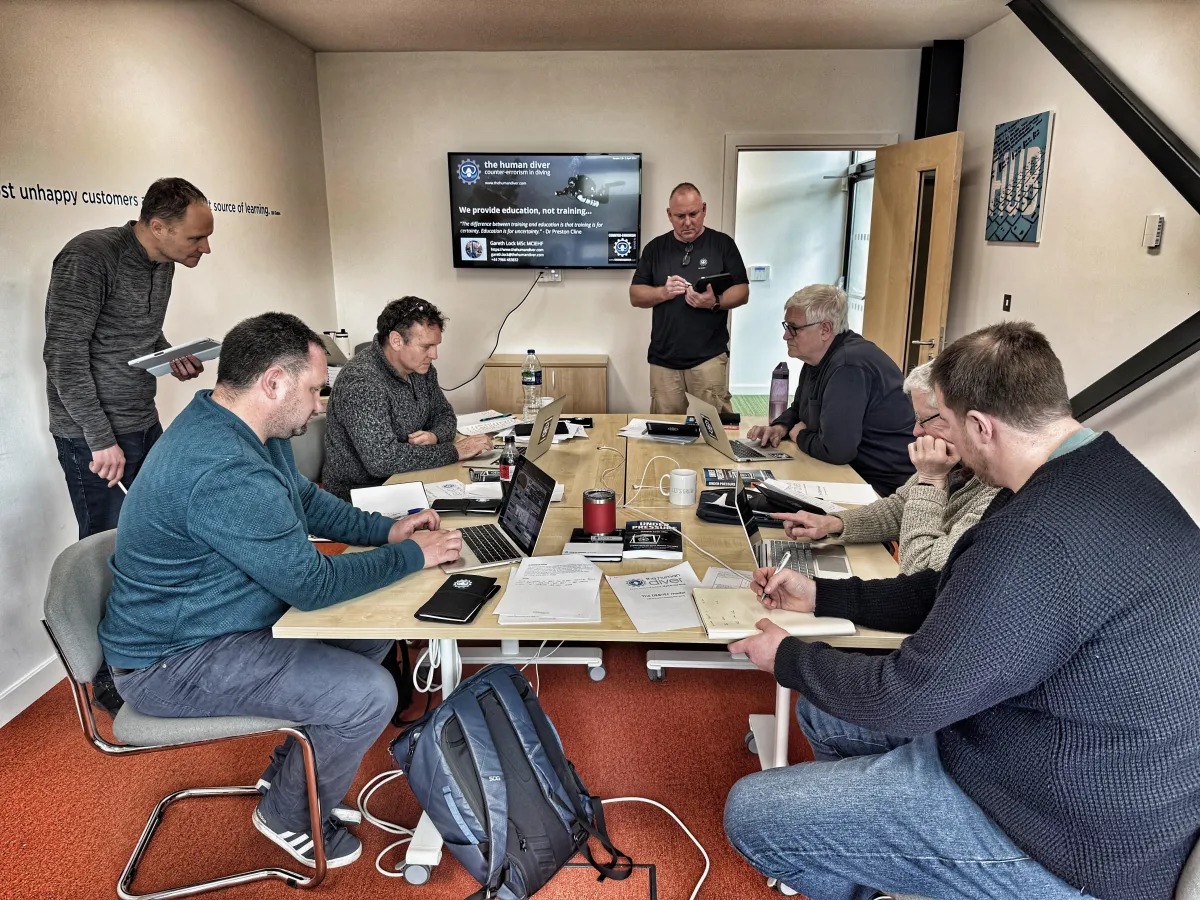
Each day mixes short theory sessions with team scenarios and structured debriefs. The group is kept small, with a maximum of six, so everyone takes an active part.
The team and the shared picture
- Human factors and non-technical skills in diving operations
- Briefing and debriefing to build a shared picture
- Teamwork, leadership and followership, including PACE
- Team scenarios with structured debriefs
Decisions, awareness and learning
- Situation awareness and supervisor decisions under load
- The WITH pre-task check
- Learning from events with LEODSI and PETTEOT
- Applying the tools to your own operation
The exact balance of topics follows the group in the room, so the scenarios and examples reflect the work you and the other participants do.
From the people who do the work.
“The course made me aware of different forms of communication and highlighted the need to work as a team. It highlighted that human error is part of who we are but there is ways in which we can reduce it. It taught me how to risk manage, but introduced a fun and exciting way to do it. Others should do this course as it will highlight different techniques to learn about human factors and how they can be used within our company from the top of the tree level down to the base level, and that it can create a common goal for all people involved within the company.”
ABDiving Supervisor. Commercial diving“As a governance specialist for commercial diving activities, the course reinforced my beliefs in the value of a human performance orientated approach to safety, where greater emphasis on the person is key to making further gains. Fundamental in all of this is the need to understand how to get the best from yourself and others. The Human Diver gives you the tools to better understand the why and how behind the human factors that directly impact on outcomes; it is a hugely valuable training package applicable to anyone who is engaged in risk to life activities.”
OADiving Supervisor and governance specialist. Commercial diving“The technical foundations of diving operations are well established. The next step is strengthening the human systems that operate within those frameworks. I am fully supportive of this work and commend it to everyone with responsibility for the performance and safety of diving teams.”
Esteban MarrufoDirector, Commercial and Defence Auditing Solutions (CDAS)Everything you need, before, during and after.
- Two full days of immersive, facilitated training, led by Gareth Lock
- An online mini-course as pre-learning, included free
- The Human Diver Wetnotes, with briefing and debriefing frameworks built in
- A personal copy of Under Pressure: Diving Deeper with Human Factors
- Checklist, briefing and debriefing guides you can use straight away
- Pre- and post-class coaching emails to help the learning stick
CA$750 course fee plus CA$200 towards trainer travel. Your own travel and accommodation are not included. Booking several people from one team? Talk to us.
Book your place →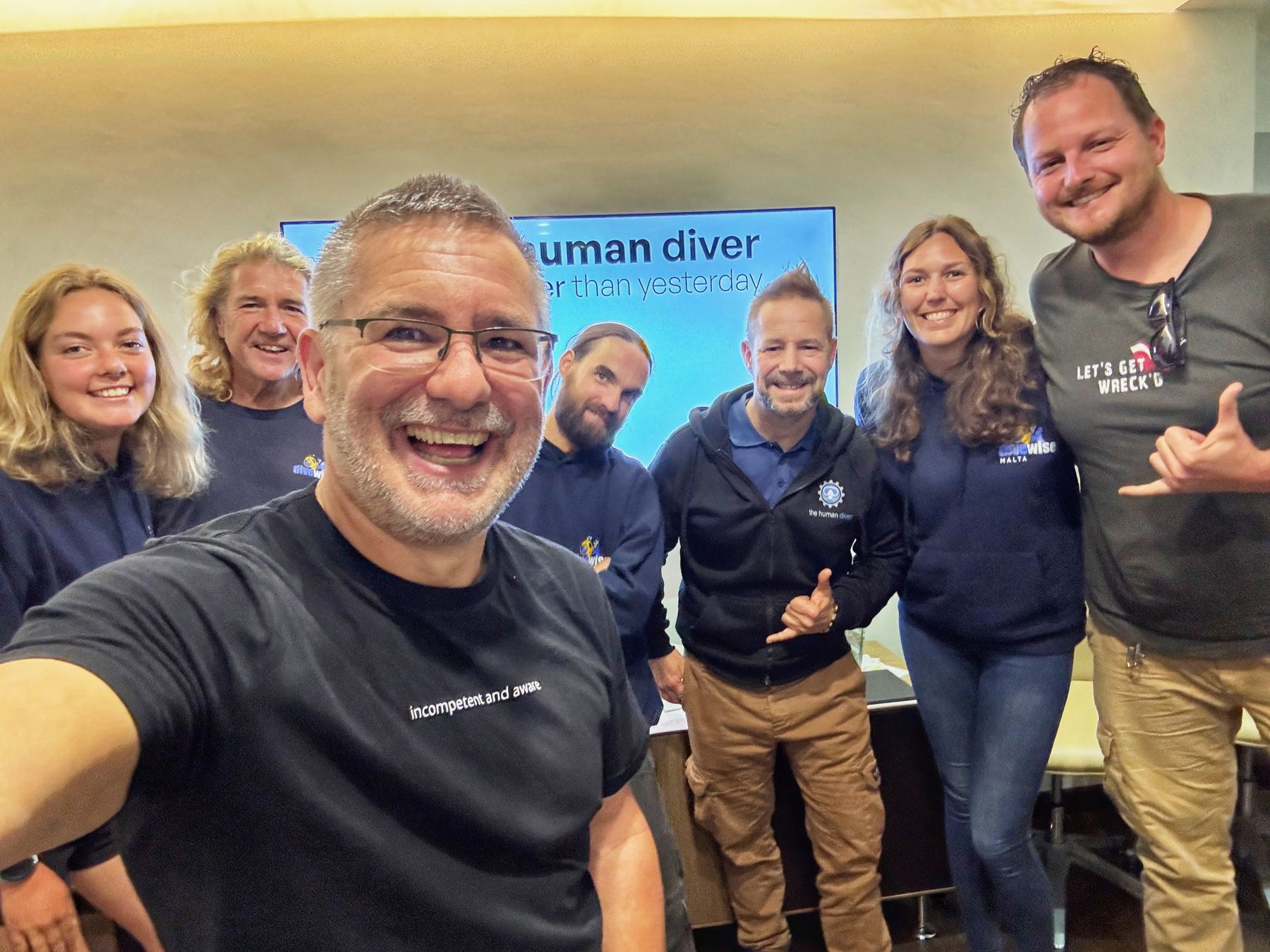
Gareth Lock
I spent 25 years in the Royal Air Force as a C-130 navigator and tactical flight instructor. Crew Resource Management was part of everyday flying, and it showed me that teams perform well when the conditions around them support it. DCRM is built on that aviation approach, adapted for diving rather than the other way round.
I have supported fatal accident investigations for the UK MOD and the New Zealand Defence Force, and delivered DCRM training to the Canadian Armed Forces and the Belgian Navy. I also taught Well Operations Crew Resource Management in the oil and gas sector. That work gives me a clear view of how rank, pressure and procedure shape what happens on the job.
My MSc in Human Factors and System Safety from Lund University provides the research base. Around 800 dives, many of them in technical teams on rebreathers, mean I understand the work from the water as well as from the classroom.
Questions, answered honestly.
Who should attend?
Diving supervisors, divers, tenders and standby divers, along with operations, HSE and project managers who own the conditions their teams work in. Leaders and members of police, fire and search and recovery dive teams are equally welcome.
We are a public safety team, not a commercial contractor. Is this relevant?
Yes. Communication, situation awareness, decision-making under pressure and speaking up matter in the same way whether you are on a barge or at a call-out. The scenarios focus on how teams work together, and the discussion draws on the work each person brings.
Does this replace our technical or procedural training?
No. It works alongside it. Your procedures describe what should happen. This course develops the skills that help people carry them out well when the day does not go to plan.
How does this relate to CSA Z275.2?
The standard now includes an annex on Human Factors in Diving. This course gives your people practical tools they can use on the job to meet that intent.
What does the price include?
Two full days of training, the online mini-course, Wetnotes, Under Pressure, guides and coaching emails. The CA$950 is made up of a CA$750 course fee and CA$200 towards trainer travel. Your own travel and accommodation are not included.
Can we bring this course to our own base?
Yes. Most DCRM: Applied Skills courses are private deliveries at your base, vessel or training facility. See DCRM: Applied Skills or get in touch to discuss your requirements.
Be better than yesterday.
Nobody comes to work to get it wrong. The question is whether the conditions you build make it more or less likely that good intentions turn into the outcome everyone wants. These two days in Toronto, alongside CUCE 2027, are a practical place to start.
DCRM: Applied Skills.
Toronto, alongside CUCE 2027.
7-8 April 2027.
- 08:30-17:30 on both days, led by Gareth Lock
- Maximum of six participants
- For commercial, occupational and public safety dive teams
- Wetnotes and Under Pressure included
- CA$950 (CA$750 course + CA$200 trainer travel)
Please tick the subscribe box. It lets us send your joining details and the pre- and post-class coaching emails. If you leave it unticked, you will not receive them.
Questions before you book? Get in touch.
DCRM: Applied Skills: Toronto, CA. 7-8 April 2027. (Linked with CUCE 2027)
Note, if you do not accept the marketing and privacy statements, you will not get notifications or specific emails regarding your course or other courses you might be signed up to. This includes pre- and post-class coaching emails.
Non-Technical Skills are essential to improve performance and diving safety.
Crew Resource Management has been shown to reduce accidents and incidents in aviation.
Online mini-course included for free
Checklist and briefing/debriefing guides provided.
Wetnotes included.
Personal copy of Under Pressure included.