
About — Gareth Lock & The Human Diver
It started with an accident that could have killed someone.
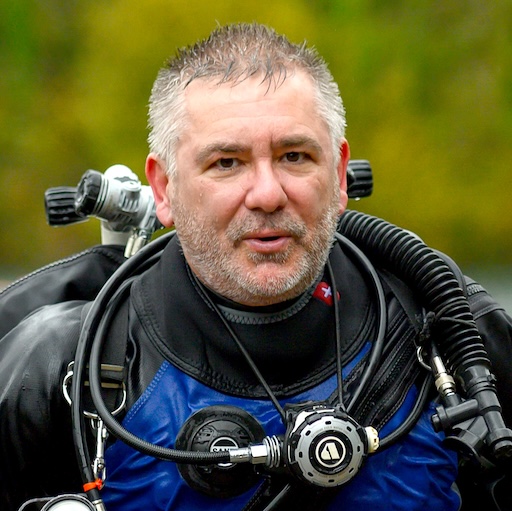
The Human Diver was founded by Gareth Lock — ex-RAF, human factors specialist, technical diver — after a diving accident of his own that did not need to happen, and that the diving industry's standard explanations did not adequately account for.
The accident was not extraordinary. That was the point. It happened the way most diving accidents happen — through a sequence of small drift, normal-looking decisions, but then there wasn't an easy way to define a lack of performance or how to allow others to learn from this event. The industry was not prepared in a mature way to learn and develop. And this initial work happened between 2005 and 2011.
The investigation that followed used the same vocabulary the industry always uses. Diver error. Failure to follow procedures. The bad apple. The conclusions stopped short of the things that would have actually changed something.
The Human Diver was built to do that other work — the work the safety-critical industries (aviation, healthcare, oil and gas) have been doing for forty years and that the diving industry has, for the most part, not. Human Factors. Non-technical skills. Psychological safety. Just culture. Learning from Emergent Outcomes.
The mission of the Human Diver is to shift the global diving community from compliance and blame toward genuine capability and systemic learning — equipping divers, instructors, and leaders with the human factors knowledge and non-technical skills to perform better, recover from error, and keep learning.
Systemic curiosity over individual blame. When something goes wrong, we ask how the system made it make sense at the time — not who failed. Blame closes learning. Curiosity opens it.
Honesty before comfort. We don't soften findings to protect egos, organisations, or reputations. The diving community deserves accurate analysis, even when it's uncomfortable.
Depth over breadth. We’d rather see one diver genuinely change how they think than a thousand simply receive a certificate. Real understanding matters more than numbers. The 1%.
Practice over performance . Human factors isn’t about box ticking or badge collecting. It’s about changing how we think, communicate, and act before, during, and after a dive.
Community without hierarchy. We build a space where divers, instructors, and researchers learn alongside each other — because ego and hierarchy regularly cause incidents, not prevent them.
Since 2011, that work has developed. It has its library of resources and training opportunities, its own community, and its own language. This site is the front door.
Who it's for
Three readers, one course.
If you teach diving
The working instructor.
An investment in your craft as an instructor. The 1% of instructors who do this work change the diving culture of every student they teach — the multiplication effect over a teaching career is substantial, and it is the reason this segment matters more than any other to us.
If you dive in serious teams
The technical diver.
You already know that the team is the system, and that the system fails before the individual does. Applied Skills gives you working tools for briefing, role allocation, in-water communication, and the recovery from the bad five minutes.
If you lead diving
The dive leader, club officer, training manager.
You carry responsibility for outcomes you don't fully control. Applied Skills gives you a vocabulary and a set of practices for building the kind of team that handles the bad five minutes well.
What you take away
A different way of being a diver.
By the end of ten weeks, this work isn't language you reach for — it is how you read a situation, how you brief a team, how you debrief a problem.
The FIRST book
Under Pressure: Diving Deeper with Human Factors.
The book that started the wider conversation. Endorsed by leaders in diving safety and read across recreational, technical, scientific and commercial diving.
Two new books are in the final stages of editing: The Thinking Diver, and The Thinking Instructor.
“Before this programme I thought I understood why diving incidents happened. Afterwards I realised I had been looking at the wrong thing entirely. The shift in how I now brief, debrief, and respond when something goes differently to the plan is not subtle — it is fundamental.”
[Name]
Technical Diving Instructor, [Country]
Sector: Technical Diving

“We have had safety consultants before. Gareth is not a safety consultant. He changed how our entire leadership team thinks about what an incident actually tells us. Our near-miss reporting increased by over forty per cent in the six months after the programme.”
[Name]
Head of HSE, [Organisation], [Sector]
Sector: Corporate and Industry

“The best keynote I have seen in fifteen years of conference attendance. He did not tell us what to think. He gave us a framework we couldn't unsee.”
[Name]
Conference Chair, [Event Name]
Sector: Speaking and Keynotes
The DOCUMENTARY
If Only...
This is the first documentary that tells the story of a tragic diving event, where a diver lost their life, his wife lost a husband, and three children, lost their father.
The story moves the diving community from the traditional, simple narrative, to one that explains how it made sense for Brian to do what he did at that time, and why others on the boat did what they did. They weren't stupid. They were humans in a complex system.
Schedule
Public dates.
Held at partner facilities across the UK, North America and Europe.
Cirencester, UK
14–15 June 2026
Toronto, ON
12–13 July 2026
Edmonton, AB
23–24 August 2026
Plymouth, UK
20–21 September 2026
Stockholm, SE
11–12 October 2026
On request — clubs, agencies, dive operators
Private dates
Pricing
HFiD Applied Skills
HFiD Applied Skills
£450
Two days · in-person
Two full days of facilitated training
All materials and structured scenarios
Certification and bridge access into the practitioner community
Regional pricing on request
Travel and accommodation not included.
Our promise
100% money-back guarantee.
Work through the course. Do the exercises. If you have given it a fair effort and it has not changed how you think about diving — we will refund you in full. No forms, no friction. The guarantee is meaningful because the work is meaningful.
Frequently asked
Questions, answered honestly.
When do courses run?
Public dates run several times a year across the UK, North America and Europe. Private dates can be arranged for clubs, agencies and dive operators.
Is Essentials a prerequisite?
Strongly recommended but not strictly required. If you have come in through reading, the podcast, or significant teaching experience, you will be fine — talk to us if you're unsure.
What does the £450 include?
Two full days of facilitated training, all materials, certification, and bridge access into the practitioner community. Travel and accommodation are not included.
Is there a money-back guarantee?
Yes — if you give the course a fair effort and it has not changed how you think about diving, we refund in full.
Be better than yesterday.
Be better than yesterday. Not perfect. Better. That is the only honest measurement, and it is the measurement that compounds.
The humaN DIVER
Be better than yesterday.
Human factors, non-technical skills and learning from emergent outcomes for the divers who refuse the bad-apple story.
programmes
The humaN DIVER
© 2026 The Human Diver. All rights reserved.
Built for the 1%
"The course made me aware of different forms of communication and highlighted the need to work as a team. It highlighted that human error is part of who we are but there is ways in which we can reduce it. It taught me how to risk manage, but introduced a fun and exciting way to do it. Others should do this course as it will highlight different techniques to learn about human factors and how they can be used within our company from the top of the tree level down to the base level, and that it can create a common goal for all people involved within the company." - AB, Diving Supervisor
The procedures are necessary. They're also not sufficient
The majority of serious incidents in commercial and occupational diving do not result from procedural absence. They result from normalisation of deviance/risk; the gradual drift away from standards that happens in every operational environment, at every level of seniority, when nothing has gone wrong. Yet.
They result from supervisors who feel pressure to proceed. From divers who see something wrong and don't say it. From teams that have lost the habit of genuine pre-dive briefing. From incident investigations that stop at the individual and never reach the system.
None of those are addressed by adding another layer of procedure. They require a different understanding of how human performance works, and a culture in which that understanding is applied, not just documented.
~80%
of serious incidents in commercial diving involve human and organisational factors, not technical failure. The technical investigation is necessary. It is rarely sufficient.
Work-as-Done
The gap between how procedures say work should be done and how it is actually performed is present in every operation. The question is whether it is visible, understood, and managed, or remains invisible until it becomes an incident.
THE GAPS
What conventional safety training doesn't cover.
Industry-standard commercial diving safety training covers procedures, hazard identification, emergency response, and equipment. It does not typically address the following; which is where most incidents originate.
Normalisation of deviance/risk
How operational drift accumulates over time, why it is invisible to those inside it, and what structural practices interrupt it before it becomes an incident.
Stop-work authority
Why divers and supervisors often don't use it when they should, and what organisational and team conditions make it genuinely available rather than theoretically available.
Supervisor decision-making
How commercial diving supervisors make go/no-go calls under time, commercial, and organisational pressure, and what cognitive and team factors compromise those decisions.
Incident investigation quality
Most investigations in commercial diving identify the proximate human error and stop there. The systemic conditions that produced the error, and that will produce the next one, remain unaddressed.
Power distance
The hierarchical structures of commercial diving operations create pressure gradients that suppress concern-raising. This is predictable, measurable, and manageable, if it is recognised.
Learning culture
The conditions required for near-miss reporting, honest post-job debriefs, and genuine learning from experience, rather than documentation-focused DEBrIEFs and after-action reviews.
WHAT WE DO
Our approach for commercial and occupational operators.
DCRM training for commercial diving contexts is adapted from the core HFiD curriculum with case studies, language, and scenarios drawn from commercial and occupational operations. The conceptual framework is the same. The application is specific.
01
Work-as-Done vs Work-as-Imagined
We surface the gap between your documented procedures and the way work actually gets done, without blame, and with a view to making the gap smaller. This is the foundation of all the other work.
02
Supervisor and team non-technical skills
Situation awareness, communication under pressure, decision-making in ambiguous conditions, workload management, and team leadership, applied directly to commercial diving contexts.
03
Just Culture implementation
What a Just Culture actually requires, not the policy statement, but the organisational conditions: leadership behaviours, and investigation practices that make it real rather than aspirational.
04
Incident analysis and learning
How to investigate your own incidents and near-misses in a way that produces systemic understanding, using LFEO/LEODSI and similar tools, rather than a narrative that stops at the individual who was closest to the event.
05
Leadership and safety culture
How senior leaders and supervisors shape the conditions in which their teams operate, the culture that determines whether concerns are raised, whether near-misses are reported, and whether learning actually occurs.
"As a governance specialist for commercial diving activities, the course reinforced my beliefs in the value of a human performance orientated approach to safety, where greater emphasis on the person is key to making further gains. Fundamental in all of this is the need to understand how to get the best from yourself and others. The Human Diver gives you the tools to better understand the why and how behind the human factors that directly impact on outcomes; it is a hugely valuable training package applicable to anyone who is engaged in risk to life activities. "
OA. DIVING SUPERVISOR
HOW WE DELIVER
Flexible delivery for operational teams.
We work with commercial diving contractors, vessel operators, and project managers to deliver training that fits the operational reality, not the other way around.
DCRM: Essentials (Online)
Self-paced online pre-learning covering the conceptual foundations; human error, situation awareness, communication, decision-making, Just Culture. Suitable for all team members prior to face-to-face sessions. Goes live 1 May 2026.
DCRM: Applied Skills (On-site)
Two-day face-to-face immersive programme. Can be delivered on-site at your operational base, vessel, or training facility. Includes scenario work, debrief practice, and application to your specific operational context. Available now. Get in touch.
Bespoke programmes
For operators with specific incident histories, regulatory requirements, or operational cultures, we develop tailored programmes that address your context directly. Contact us to discuss scope, format, and delivery.
Supervisor & management sessions
Focused sessions for diving supervisors and operations managers on decision-making under pressure, safety culture leadership, the organisational conditions that either support or undermine stop-work authority, plus learning from emergent outcomes when things don't necessarily go to plan.
Join the Waitlist
Essentials will be live on 1 May 2026.
NEXT STEP
The gap between your
procedures and your practice is where incidents live.
If you want to understand it, measure it, and close it, start a conversation
with us. We work with commercial diving contractors, vessel operators, and
diving medical and safety professionals across the industry.