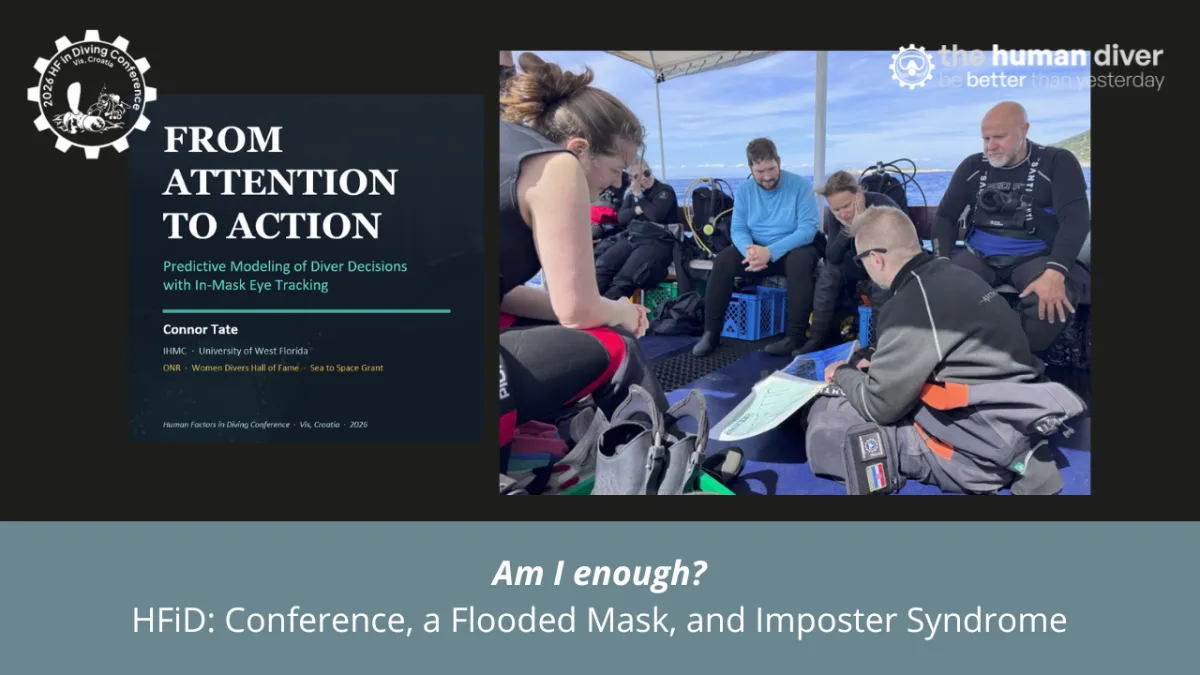
4. Am I Enough?
Am I good enough? Experienced enough? Do I really know what I'm talking about? Have I lived in the lab too long? Do my beliefs actually map onto reality? Shouldn't I know that by now? If I don't, does that mean I'm not? Will they see it? Should I be more confident? Will that come across as arrogant? Will they think I'm an imposter?
Am I an imposter?
If there were a soundtrack to my life, these would be the back-up vocals… or maybe the chorus, on some days it's quiet and others it’s deafening, but it is never fully off.
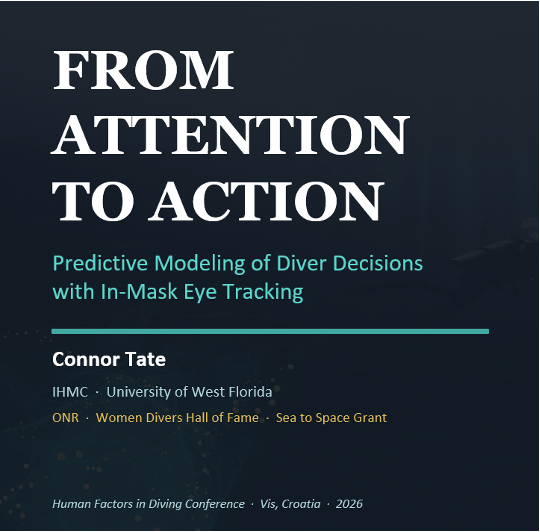
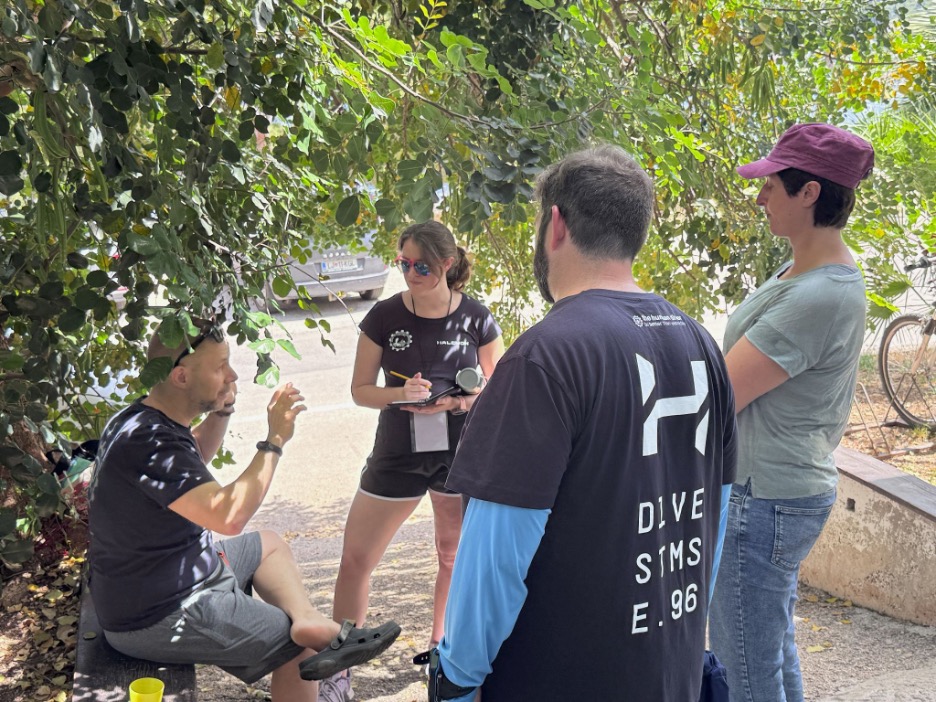
It was playing loudly the morning I stood up in front of a room full of dive masters, instructors, and deep technical divers to present my research on diver decision-making and stress detection.
With only my Open water certification to 18 meters and five dives logged while everyone else in that room had 100 or more… some even thousands, I was about to stand up in a room full of experts and tell them why my research in diver decision making, attention and stress detection matters.
The Gap Between Knowing and Doing
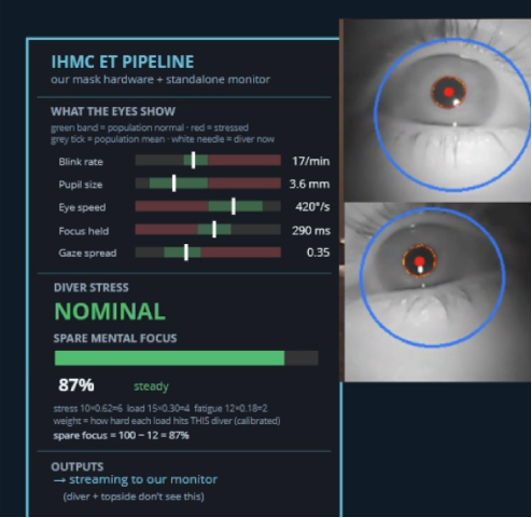
I know the theory. I understand, in granular physiological and psychological detail, what can go wrong in a diver's body and mind under operational stress: hypoxia, hypercapnia, narcosis, the slow creep into panic. I've built a depth-certified, in-mask eye-tracking system designed to catch the early signs of those states before the diver even consciously registers them: the rapid, scattering eye movements, the changing pupil diameter, the patterns that distinguish a calm expert scan from a novice one starting to unravel.
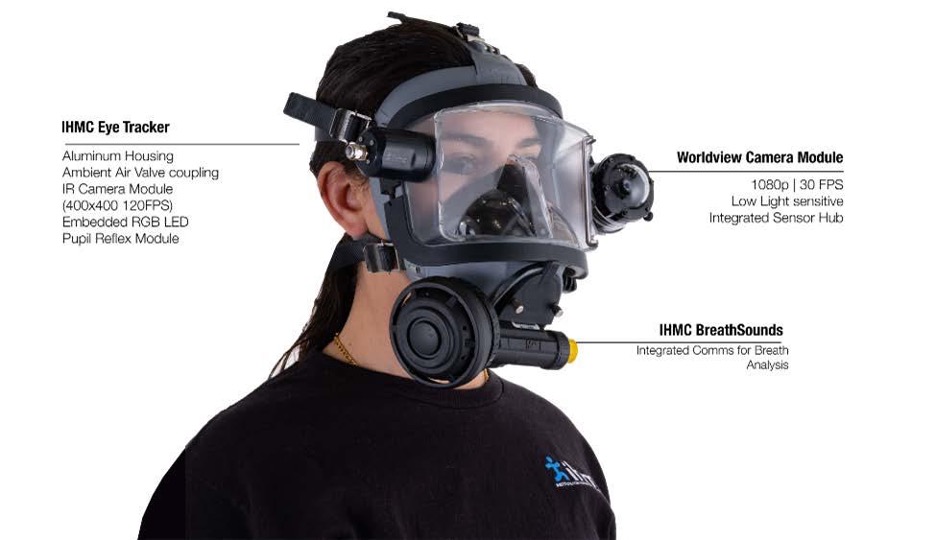
I don't build this technology to replace a diver's judgment, or an expert's instinct. I build it to do what a good debrief does: help us see what we missed, name the assumptions we didn't know we were making, understand what we are paying attention to in moments of stress and get a little better than we were yesterday.
I know how to detect panic in someone else's eyes.
I did not yet know what it felt like to almost lose my own composure underwater.
The talk went fine… not my best, not my worst. A few people seemed genuinely curious about the early-stress detection work, and about where I want to take it next: buddy-to-buddy heads-up displays that flag a dive partner's rising stress before they even notice it themselves. But underneath all of it ran the same question, quieter now but not gone: what am I actually doing here?
Dive Day Two
After the first day of diving we'd had a real debrief the night before, not the performative kind where someone says "there are no bad questions" while their tone says otherwise. This was structured and honest, even the divemasters with thousands of dives talked openly about what they'd want to improve. We followed step-by-step Gareth Lock's DEBrIEF method, and it was the first time I'd seen psychological safety actually function instead of just get name-dropped.
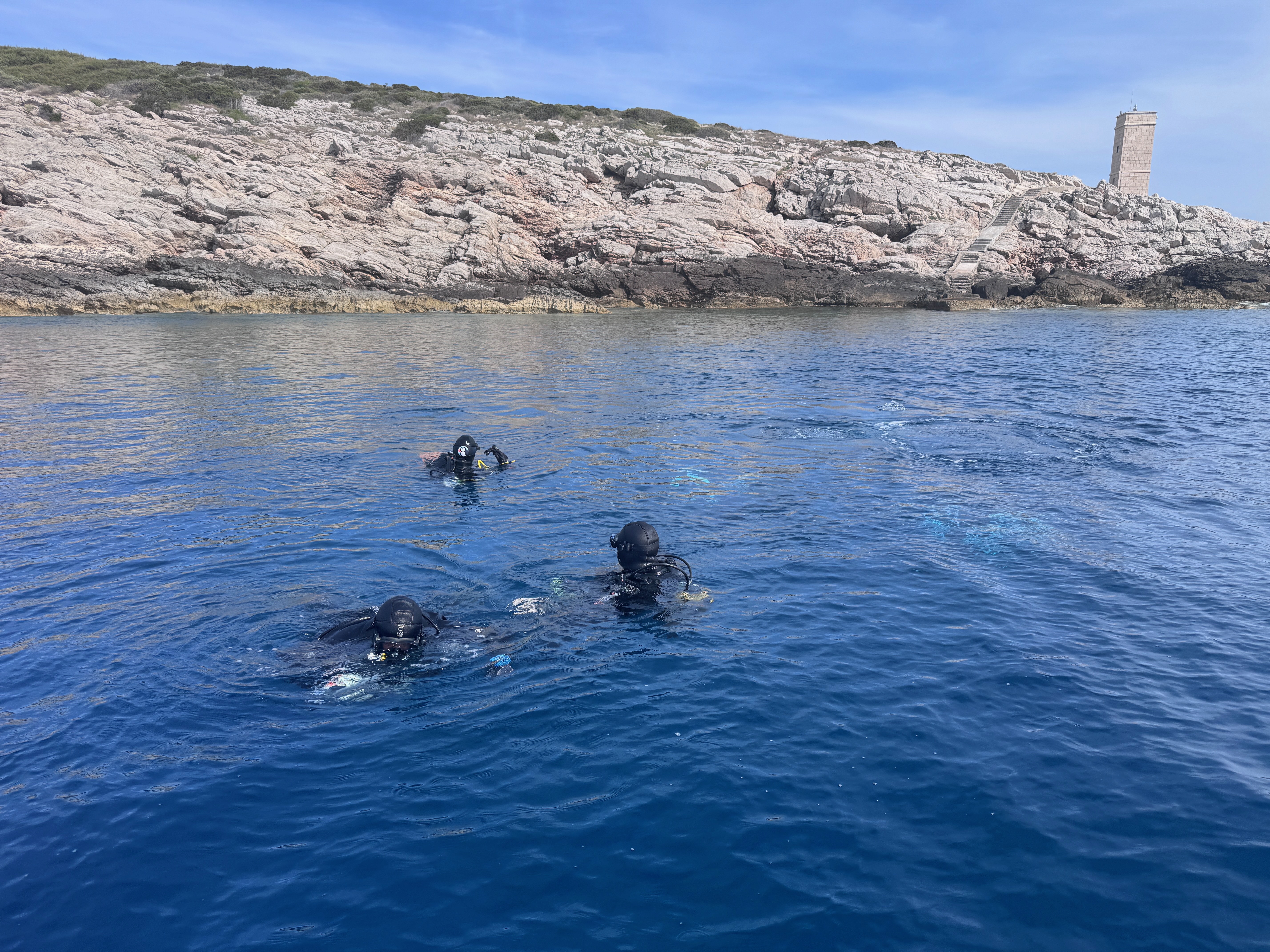
I went into my third dive of the trip determined to be better than the day before. Slower descent, better communication. And I was! ….. Right up until I had to clear my mask at depth, wearing a hood and gloves in the 62 degree, low vis water.
You see, I'd learned to clear a mask snorkeling off the Florida coast as a kid. Warm water, no hood, no gloves. My method was a habit, one of the few things I thought I could rely on without thinking… turned out to be exactly wrong for this setup. It was at my max depth that I went to clear my mask and the hood kept sliding under my seal. Every attempt to clear it made it worse. And you see, I am the kind of blind where, without my contacts, I can't read the giant E at the eye doctor. If my contacts had come out in a fully flooded mask, I wouldn't just be losing visibility of my dive computer, I'd be losing sight of my own bubbles and my orientation to the surface, with no safe way to ascend on my own and no DSMB or training on how to use it to ensure I wouldn’t get hit by a passing boat.
I tried to clear and reset my mask 4 times. Each attempt making the problem rapidly worse and it was in this moment I noticed I was starting to panic. I started evaluating if I could catch up to my buddy fast, scanning, searching trying to come up with a quick contingency and then Laura, a divemaster and instructor diving near me, was just there, calmly helping me reset the mask under the hood.
I could have cried and not just because of the sting of the salt water in my eyes… But I didn't, we recentered and completed the rest of the dive with no issue.
The Moment It Stopped Being Theoretical
Later that night we debriefed the moment and upon reflection, here's what hit me; hovering at depth with a fixed mask and a racing heart: the eye movements I'd been exhibiting: the darting, the search pattern, the look for my buddy, the glance at the surface; these are exactly what my own technology is built to catch. I wasn't reading about panic onset in a paper or inducing it in a controlled laboratory setting. I was experiencing it in the real, uncontrolled environment of the world experiencing the theory.
And if you've read Steve's blog post then you'll recognize the phrase, "was I lucky or was I good," and here is the thing… I was lucky because my dive team was good. An experienced, attentive buddy nearby and excellent visibility so she could see what was going on with me. What if I hadn't been? What if it had just been me and one less experienced or less observant buddy further ahead, in low viz? Would I have had to make an unsafe solo ascent from depth, alone, half-blind?
My research has been real to me for years, built from data, from labs, from genuine belief that it matters. But in that moment, something else clicked: I wasn't just the person who studies this. I was also exactly the diver who needs it.
Laura saw what was happening because she was paying attention, close enough and experienced enough to read it. That's exactly what I want this technology to do for every team: not replace that kind of attentiveness, but extend it to the dives where there isn't a Laura right there watching or an instructor is juggling multiple students in low visibility.
What the Conference Actually Gave Me
The rest of the conference and diving continued to improve, each nightly debrief reinforcing the lessons learned in the Applied Skills class and then experienced on our dives.
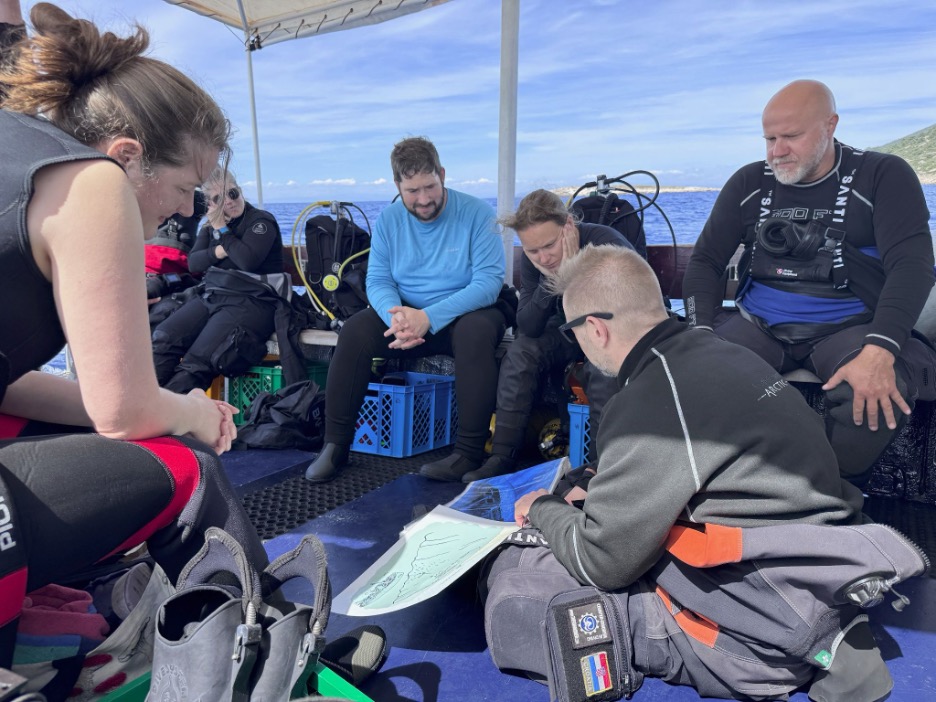
When I finally returned home to work and daily life I almost immediately had to deliver hard, structured feedback to a team I lead. So I readied myself to use the skills we practiced at the conference, using the same UNITE and DEBrIEF framing we practiced day after day. Define the problem. Clarify roles and scope. Name the risks. Check understanding. It worked, the team left that meeting with group accountability and an actionable plan to overcome our challenges. It worked because the structure forced honesty without blame, exactly the framing Gareth set in his opening talk: human factors isn't about pinning the problem on the last person who touched it. It's about understanding the factors affecting people, and the systems we put them in.
I was terrified of walking into that conference as an imposter, five dives, big theories, no real dive experience. I left with double the dive experience, a flooded mask story I'll never forget, and a little bit of confidence added to my own personal soundtrack: proof that my perspective had value because of my experience, not in spite of it.
Be better than yesterday was the theme of the week. Turns out it applies to more than diving technique. It applies to the soundtrack in your head, too.
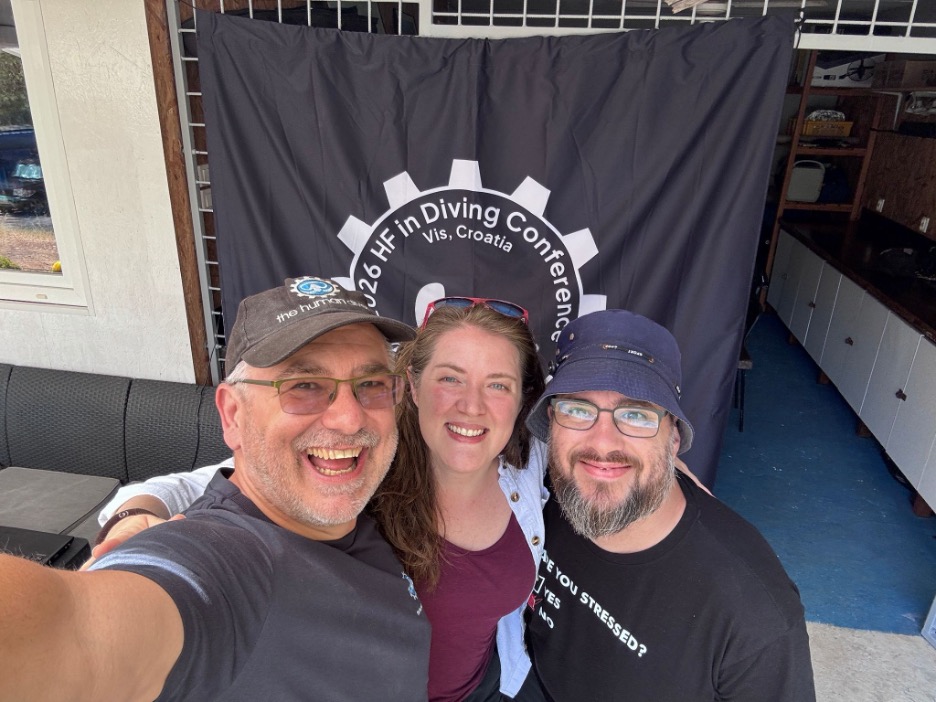
So If You're Asking Yourself the Same Questions
If you're wondering whether you're a good enough diver, employee, leader…. whatever your version of the question is …. I'd say: come challenge yourself at next year's Human Factors in Diving Conference and learn the skills you need to know you can be.
It's a room full of people who will not let you be an imposter for long. Not because they'll tell you that you're not one. Because they'll show you, in how they debrief, how they listen, how they jump in when your mask floods, that what you bring matters more than how long you've been doing it.
I hope to see you there next year :)