

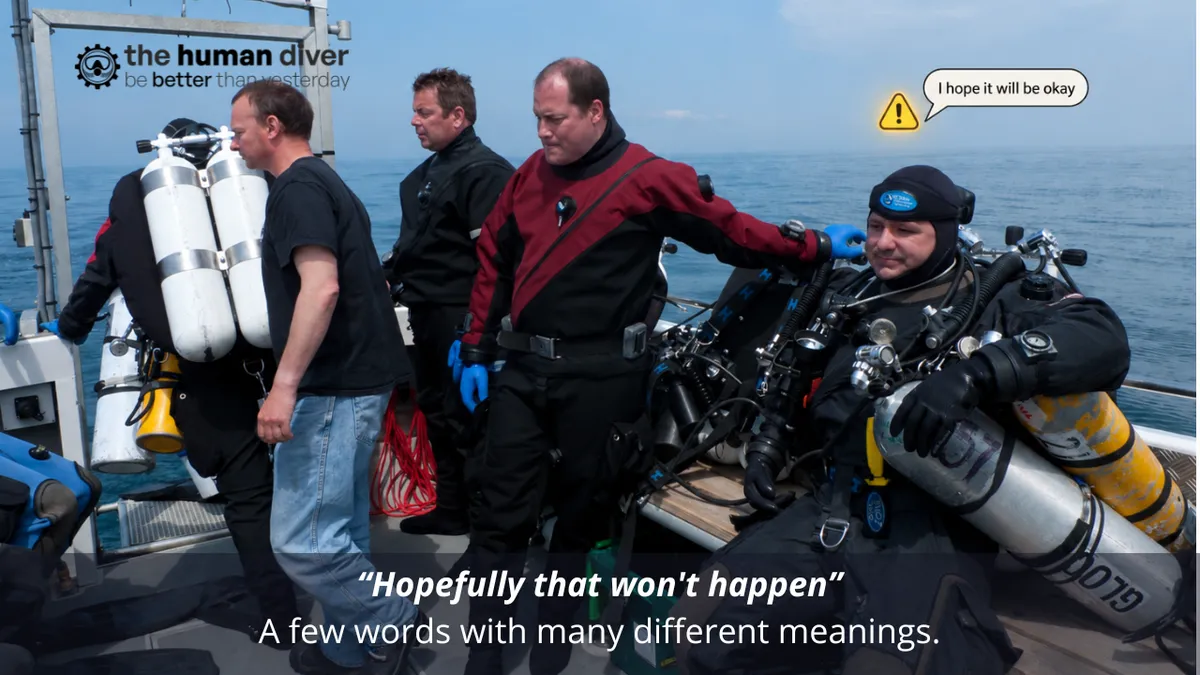
Hopefully that won't happen: A few words with many different meanings.
A few days ago, I posted an image on Facebook with a line I use a lot in my teaching. "Whatever a person believed to be true at the time was, for them, reality. You can only understand their choice from inside the world they thought they were in."
An experienced diver came back with a fair challenge. He argued that when someone's reality at the time was "hopefully that won't happen", understanding it serves little purpose, because the choice was still a poor one whatever the outcome. He could ask a curious question, such as "Why would you bet your safety on hope?", but he doubted the answer would tell him anything useful.
I appreciated the challenge and respected that perspective, and I think many divers probably share it. When someone says "hopefully it'll be fine" about a known problem, it sounds as though they haven't thought it through, and it is tempting to stop there. Instead, I went looking at what the research says about the phrase "I hope it will be okay" in high-risk activities because I know this isn't the first time such things have been said, and I also know that there would likely be more behind it. That literature review forms the basis of this blog.
Hoping is not the same as expecting
The first thing the research makes clear is that hope and expectation are different. Expectation is what you think will probably happen, while hope is what you want to happen - unfortunately, those two can be miles apart. A diver can believe that something is quite likely to go wrong and still say "hopefully it won't".
A diver who says this tells us something worth digging into. If someone says "hopefully that won't happen", they have already seen the hazard. What they haven't done, or haven't been able to do, is turn that awareness into a plan that is likely to survive contact with the 'enemy'.
Psychologists also separate active hope, which influences us be proactive, thereby preparing and finding ways around the likely problems, from passive hope, which swaps doing for wishing. Rick Snyder's well-known model describes hope as the will to reach a goal combined with the ways to get there. When the ways are missing, hope becomes a wish.
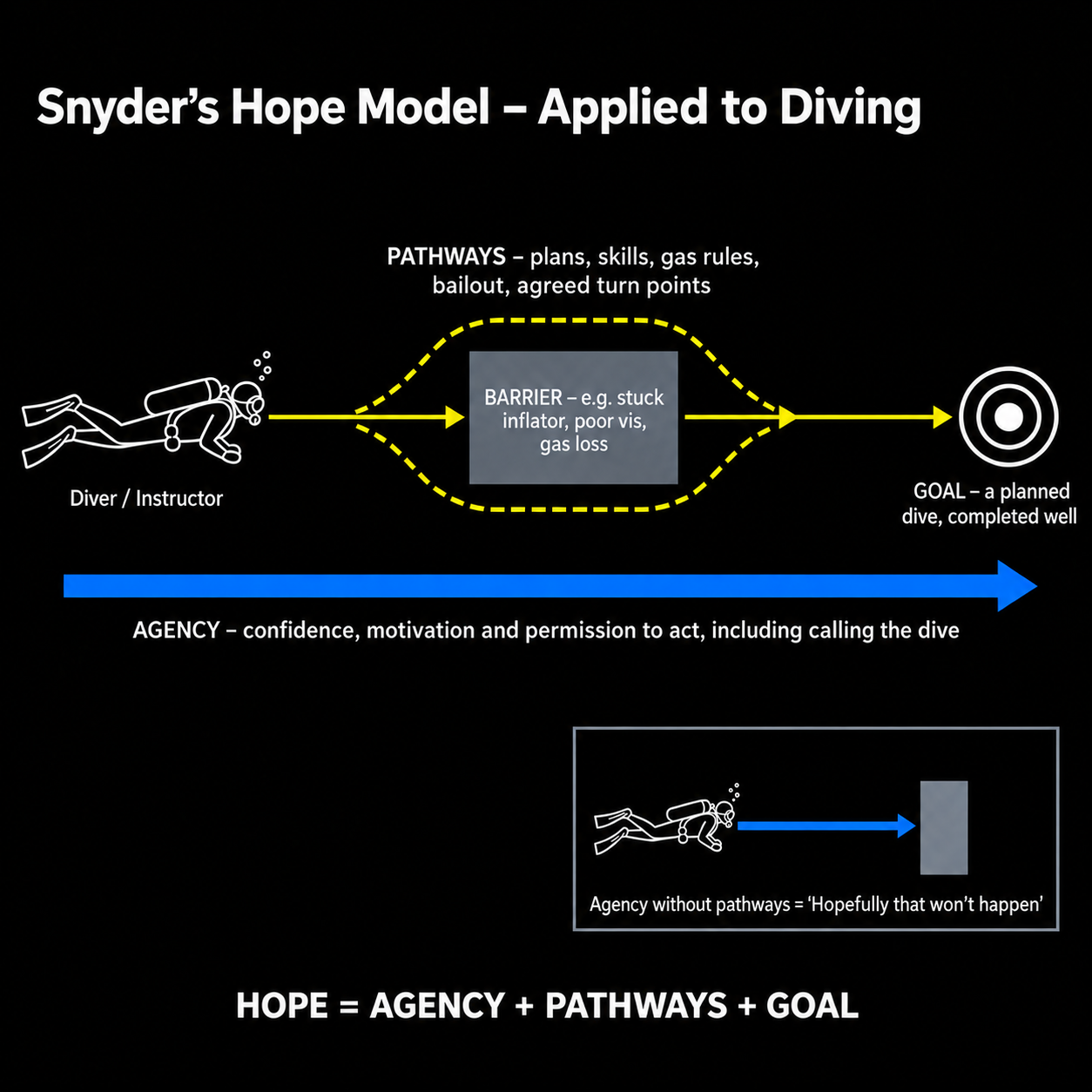
Consider a simple example. A diver's wing inflator sticks on the last dive of the day. They rinse it, it seems fine on the boat, and they say "hopefully it won't do that again tomorrow". Their hope tells you they noticed the problem and that it bothered them. It also tells you there is a gap, because there has been no service, there is no planned check at shallow depth, and there is no plan for what they will do if it sticks again. That gap is where a conversation can start.
Why do people bet on hope?
So why is the gap there? The research points to several conditions, and very few of them are about people being "dumb".
The first is the feeling of control. Studies, many of them from driving, show that when people believe they can control a hazard, they tend to see less risk and take more of it. In diving, "I've dealt with free flows before" can quietly turn into "I don't need a plan for a free flow".
The second is experience. Each time a shortcut works out, it feels a little more normal, and the margin we think we have grows while the real margin stays the same or shrinks. This is often called the normalisation of risk, and it appears across many high-risk industries. Nobody wakes up and decides to accept more risk; it creeps in, one good outcome at a time.
The third is pressure. A review of 181 studies found that pressure to keep things moving is one of the most common contributors to accidents, because it nudges local decisions away from safety. In diving, that might be the cost of the trip, the boat that leaves at 08:00, or the client who has flown halfway round the world. In an earlier blog, I wrote about a team who spotted a problem with their guide's bailout cylinder but didn't call the dive, because it was a very expensive day out and they didn't want to lose the chance.
The fourth is commitment. Research on pilots flying into worsening weather found that the further they had already flown, the more likely they were to keep going. "Hopefully it'll clear" is often the sound of a plan that needs an exit but doesn't have one. Plan continuation bias and sunk cost fallacy are the terms you might have heard to describe this.
Put together, hope starts to look less like a personal flaw and more like what fills the gaps when the system hasn't given someone the time, tools, skills or permission to do something different.
Hope as a quiet warning
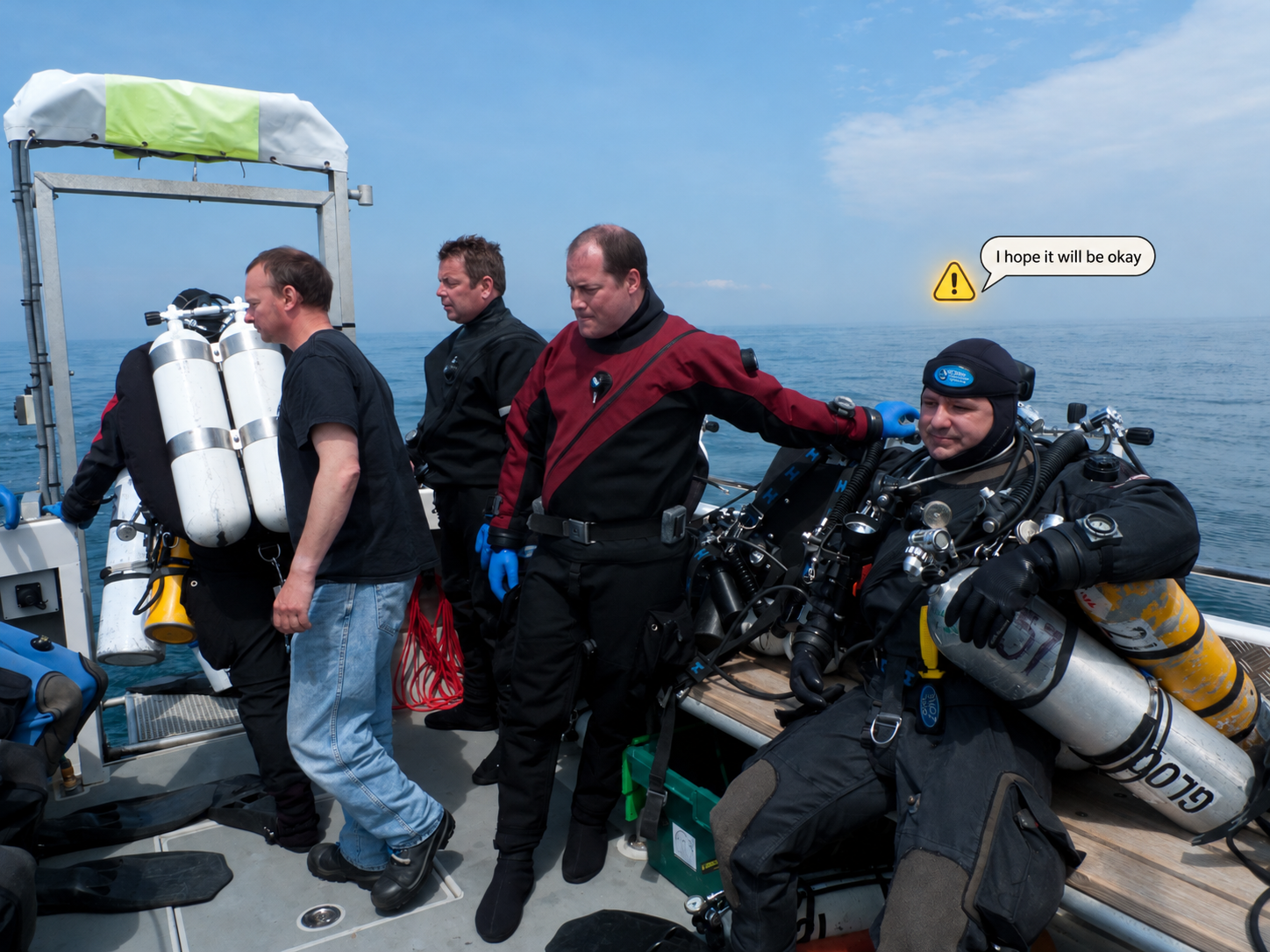
For teams, I think the most useful part of the research is this. When someone says "I hope it'll be okay", they may be raising a concern in the only way that feels safe to them.
Research on safety voice describes a large middle ground between speaking up and staying silent, where concerns are hinted at, softened, or wrapped in vague words. A rising "okay?", a "hmm", or a "hopefully that's fine" can all carry a warning without saying it out loud.
Studies of cockpit voice recordings found that in nearly all of the accidents studied, someone in the crew did speak up. Their concerns were often not heard, were brushed aside, or were weakened by the difference in rank between the people involved. Speaking up on its own did not prevent the accident, because how the message was received was just as important.
Something to consider: if our response to "hopefully that won't happen" is to decide the choice was 'dumb', we may get the judgement of the decision right but lose the person. That person learns that saying this out loud brings criticism, so next time the hope will still be there but we won't hear it. Silence is rarely a character trait - it is usually a response to the context which someone finds themselves in. Another example of why building psychological safety is so important.
So is understanding their reality useful?
I think it is, although understanding is not the same as agreeing. I can see why a choice made sense to someone and still think it was poor. Understanding their local rationality shows me where to help. If I don't know the person was relying on hope, I will probably try to fix the wrong thing.
I agree that "Why would you bet your safety on hope?" is unlikely to get a useful answer. That isn't because the person has nothing to say; the question sounds like a verdict. Most people hear it as an attack on them rather than a question about their decision, defensiveness kicks in, and learning stops.
Better questions move from the past to the future.
"What would you do if it did happen?"
"What would tell you early that it was starting?"
"What would it take for you to call the dive?"
These questions don't argue with the hope. They ask the person to build the pathways that are missing.
The research supports this. Studies on how to stop people pressing on with failing plans found that simple warnings did very little, while clear decision rules helped much more. In diving terms, that means turn pressures, gas rules, bailout plans and agreed triggers for ending a dive. They turn "hopefully" into "if this happens, then I will do that".
This is also why I keep going on about context-rich stories. A dry fact, such as "inflators can stick", rarely changes anything, whereas a story told with detail and feeling often does. "I've seen this before, here is where it went wrong, and I can see something similar here. What have you put in place so that you can fail safely?" That kind of story gives the person a picture of the future they can plan against. The PACE model (Probe, Alert, Challenge, Emergency) adds a structure for raising a concern step by step, so that the message gets stronger if the first attempt doesn't land. The same goes the speak up when you can't talk model described in the HFiD FB group. Keep the language about the decision and the situation, and leave the person's character out of it.

What the research can't tell us yet
Most of the research doesn't study the words "I hope it'll be okay" directly. It draws on nearby ideas, such as hope theory, softened speech, psychological safety and normalisation of deviance. Very few have recorded real people using hopeful language in the field before something went wrong, and research on listening is much thinner than research on speaking up.
Divers can help close that gap within their own teams. Listen for "hopefully" in your briefs and in your debriefs. When you hear it, treat it as information about the situation. A structured debrief, using something like the DEBrIEF model, gives you a regular place to ask whether you were good or lucky. Hopeful language is often a sign that luck played a bigger part than the plan.
Bringing it together
The diver who challenged me was right that hope is not a safety strategy. Where we differ is on what to do when we hear it, because the phrase tells us the person has seen the hazard and hasn't yet built a way to deal with it. It may also be the only warning they feel able to give. Judgement tends to shut the warning and the associated conversation down. Curious questions and good stories give us a chance to turn a wish into a plan before the day it is needed.
Next time you hear "hopefully that won't happen", from a buddy, a student or from yourself, what question will you ask?
Literature References
Snyder, C. R. (2002). Hope theory: Rainbows in the mind. Psychological Inquiry, 13(4), 249–275. https://doi.org/10.1207/S15327965PLI1304_01
Noort, M. C., Reader, T. W., & Gillespie, A. (2021). Safety voice and safety listening during aviation accidents: Cockpit voice recordings reveal that speaking-up to power is not enough. Safety Science, 139, 105260. https://doi.org/10.1016/j.ssci.2021.105260
Hashemian, S. M., & Triantis, K. (2023). Production pressure and its relationship to safety: A systematic review and future directions. Safety Science, 159, 106045. https://doi.org/10.1016/j.ssci.2022.106045
O'Hare, D. (2024). Effects of distance flown on pilot decision making in continued flight into deteriorating weather conditions. Journal of Safety Research, 88, 336–343. https://doi.org/10.1016/j.jsr.2023.11.020
Ohlert, C. R., & Weißenberger, B. E. (2020). Debiasing escalation of commitment: The effectiveness of decision aids to enhance de-escalation. Journal of Management Control, 30, 405–438. https://doi.org/10.1007/s00187-019-00290-z


