5. Human Factors as an Operating System
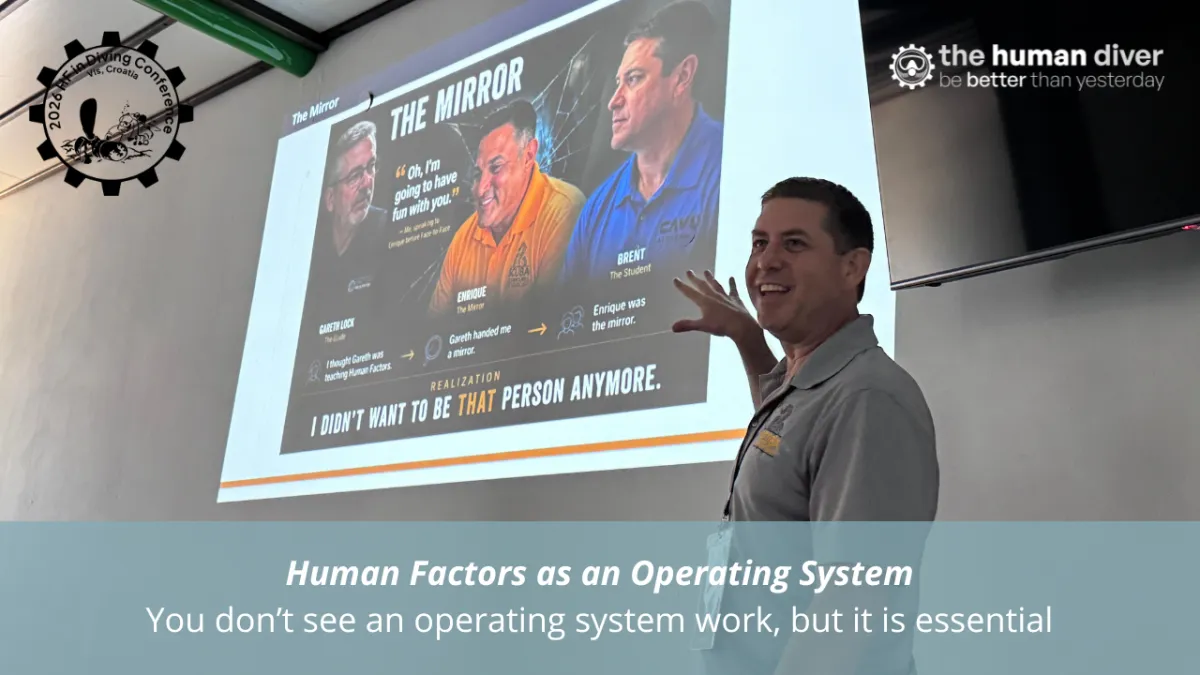
At the beginning of June 2026 I flew to Vis, Croatia to deliver a presentation on how to run a profitable dive shop and integrate Human Factors as part of the HF in Diving Conference being run by The Human Diver. I will be honest, I did not start my presentation until I was already in route to Croatia, preferring to finish a show on Amazon Prime rather than spend that sequestered flight time on being productive on getting the presentation done.
Why did I not do it before getting on the flight?
I mean, I knew the date was comingupand yet I put it off. One of the reasons that may be the case is because I was actually operating my business using Human Factors, giving attention to maintain psychological safety and just culture in the business by reflecting on interactions between customers, staff and myself so that we as a scuba business could learn how to operate better in the future.
During drafting the presentation,I came to the realization, albeit not a huge leap, that while we try to sell the Human Factors in Diving products; HFiD: Essentials, HFiD: Applied Skills and now the Learning from Emergent Outcomes (LFEO): Essentials and Applied Skills courses, the real value comes from the idea that we are actually using Human Factors as a foundation for how we operate.
Human Factors is something we teach. A class. A workshop. A collection of concepts. Psychological Safety. Just Culture. Systems Thinking. Debriefing. Learning Teams. Humble Inquiry.
All valuable ideas. All useful tools.
But as I was building the presentation, I found myself reflecting on how we operate at Scuba Adventures, Plano.
We discuss and reflect on interactions with each other, with other staff and with customers.
What if Human Factors is the operating system of our organization?
Through my aviation business I became aware of Entrepreneurial Operating System (EOS). EOS is not the business itself. Customers do not buy EOS. Employees do not come to work because of EOS. Instead, EOS provides the framework underneath the business. It shapes how decisions are made, how accountability works, how priorities are established, and how problems are solved.
The operating system is rarely visible, but it influences everything people experience.
Human Factors can function the same way.
The applications people see are the obvious things: training, customer service, equipment sales, equipment service, travel programs, leadership, and daily operations. Those are the visible outputs.
What they don’t see is the deliberate reflection we take as dive professionals and how they carry over to our everyday life. One of my favourite sayings I took out of The Human Dive and Human Factors in Diving, is
“We can’t reflect in the moment, until we have reflected on it.”
One thing Human Factors has changed for me personally is how often I reflect on interactions. Not because I am second-guessing decisions or looking for mistakes, but because I am looking for opportunities to improve. Could I have asked a better question? Could I have listened longer before responding? Could I have been more curious? Those small reflections compound over time and eventually become culture.
The more I thought about it, the more I realized that Human Factors had become the thing underneath everything else.
Customers don't come to Scuba Adventures because of Psychological Safety.
They don't sign up because of a Just Culture.
They don't buy equipment because of Systems Thinking.
They come to learn to dive, travel, buy gear, and spend time with friends.
Those are the applications.
Human Factors is the operating system running underneath them.
So where did this all start?
In September of 2022, after being introduced to Gareth Lock by a mutual friend in the dive industry I arranged for Gareth to run two classes back-to-back. I had pushed my way through the Essentials class and was familiar with “If Only...” so I thought this would be a walk in the park. I even had a colleague who was one of my newer staff in the class and I said to him, “Oh, I’m going to have fun with you in the class.”
That was until the metaphorical mirror was held up to me. I defaulted to my normal self in high stress scenarios, and in those moments, I barreled over everyone around me.
What does success look like if you 'win' but leave every man behind?
That was the catalyst which would change Scuba Adventures from being a dive shop to being a personal growth organization that facilitates it through scuba.
Fast forward to today, a couple of weeks after the conference in Croatia and I am still having trouble completing this very blog, not because we don’t do the reflecting, and not because we aren’t operating with Human Factors as our operating system but because we are. Debriefing is no longer something we reserve for dives. We debrief customer interactions, staffing challenges, difficult conversations, and operational decisions with the same curiosity we bring to a dive incident.
As an example, I was at the lake this past weekend, The Scuba Ranch to be exact, and while we had a student that got separated from us, and we had a text book reunification at the surface after following the lost buddy procedures to a tee. It was a success, but the divemaster and myself debriefed our interaction and we debriefed with the group as a whole. Here is where I go back to my favorite quote, we reflected on the incident, even though it was a success, so that we can reflect in the moment in the future, in a situation that may not be the same and may not be as successful as we found this one to be, or we may find holes and gaps, that were near-misses and we can closes those holes and gaps for the future.
I realized that the reason that this presentation became a challenge and likewise this blog became a challenge was because it has become an operating norm. The operating system that I am using to operate not only my scuba business, but also my aviation business as well.
An operating system still needs something to execute it. In technology that role belongs to the CPU. In organizations, it belongs to leadership.
Every interaction becomes an opportunity to either reinforce or undermine the operating system.
When a staff member makes a mistake, leadership determines whether psychological safety is real or simply a slogan.
When a customer complains, leadership determines whether curiosity or defensiveness comes first.
When two people disagree, leadership determineswhether the organization learns or whether it simply decides who wins.
People don't experience the operating system we write down. They experience the operating system we execute.
When I watched my instructors this weekend communicate with their studentsthey pushed the ideas of psychological safety and just culture, not from a script but from a culture that has engrained it into our every corner of our organization. And when those same instructors asked the students at the tables who experienced personal growth over this weekend, all the hands were raised.