
When Skill Alone Isn't Enough: The Resilient Performance Model
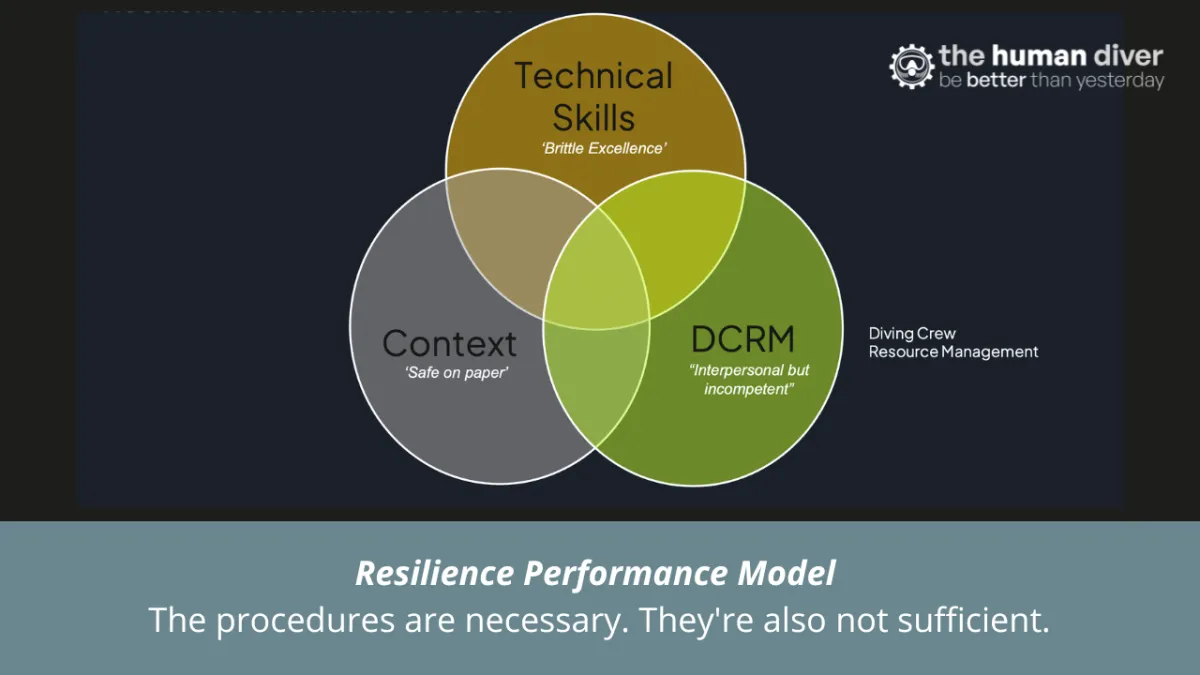
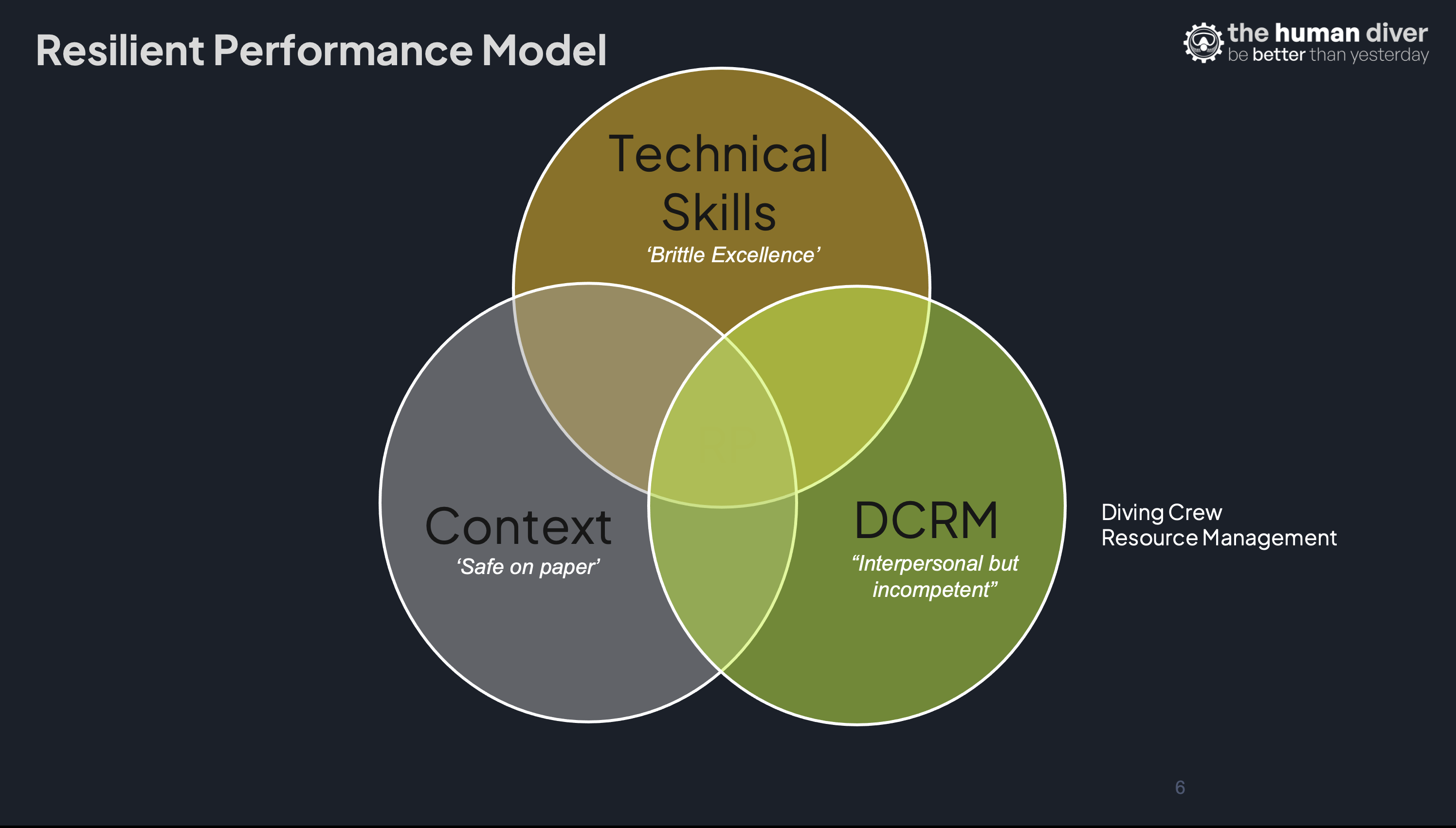
Most diving operations don't fail because people are incompetent. They fail because competence, however real, is operating without the support structures it needs when things stop going to plan. The Resilient Performance Model developed by The Human Diver is built around exactly that observation. Performance is not an individual property. It emerges from the interaction of three domains: Technical Skills, Non-Technical Skills including Diving Crew Resource Management, and Context. Understanding how those three interact, and what happens when one or two are absent, is one of the most practically useful frameworks available to anyone working in high-risk diving environments, from occupational saturation operations to military clearance diving.
The Three Domains
Technical Skills are what most people mean when they talk about competence: buoyancy, trim, gas management, equipment use, decompression knowledge, rescue capability. In commercial and military diving, that extends to crane lift protocols, confined-space entry, mine countermeasure procedures, and emergency intervention skills. These are built through instruction, deliberate practice, and operational experience. Historically, they absorb the majority of investment in training and assessment, and that is understandable — but it is not sufficient.
Diving Crew Resource Management (DCRM), also known as Non-Technical Skills (NTS) or Crew Resource Management (CRM) in other domains, are the cognitive and social behaviours that determine how technical skills actually get applied under real conditions. Situation awareness, decision-making, communication, teamwork, leadership, followership, and the ability to recognise when your own performance is being degraded by performance influencing factors, such as fatigue, stress, or time pressure. These are not optional extras; they are the mechanisms through which technical capability either reaches its potential or falls well short of it. During the analysis of a military organisation's incident reporting system, it became apparent that approximately thirty percent of reported events were categorised simply as "failure to follow procedure." When a learning team process was used to examine some of those cases more closely, systemic issues surfaced that the incident category had completely obscured. A LEODSI programme was also recently conducted on a ‘lost diver’ during a training serial, and this surfaced many factors that related to DCRM, not just the ‘didn’t follow the procedure’. These factors were known about, but the system didn't make it easy to speak up, or be heard and listened to.
Context is the third domain, and often the least visible. It encompasses the organisational and cultural environment in which work takes place: staffing levels, equipment availability, time pressure, the quality of SOPs, the openness of the safety culture, and the norms (stated or unstated) that govern what people feel permitted to do. Context shapes behaviour without anyone necessarily choosing it. During that same military programme, participants discussed their own organisation's reporting culture and reflected on how the number of hazardous occurrence reports had doubled in recent years. This wasn’t because diving had become more dangerous, but because something in the culture had shifted enough to make reporting feel less risky. Reporting numbers going up, in that framing, is not a sign of failure. It is a sign that the context is beginning to support honesty.
What Happens In The Gaps
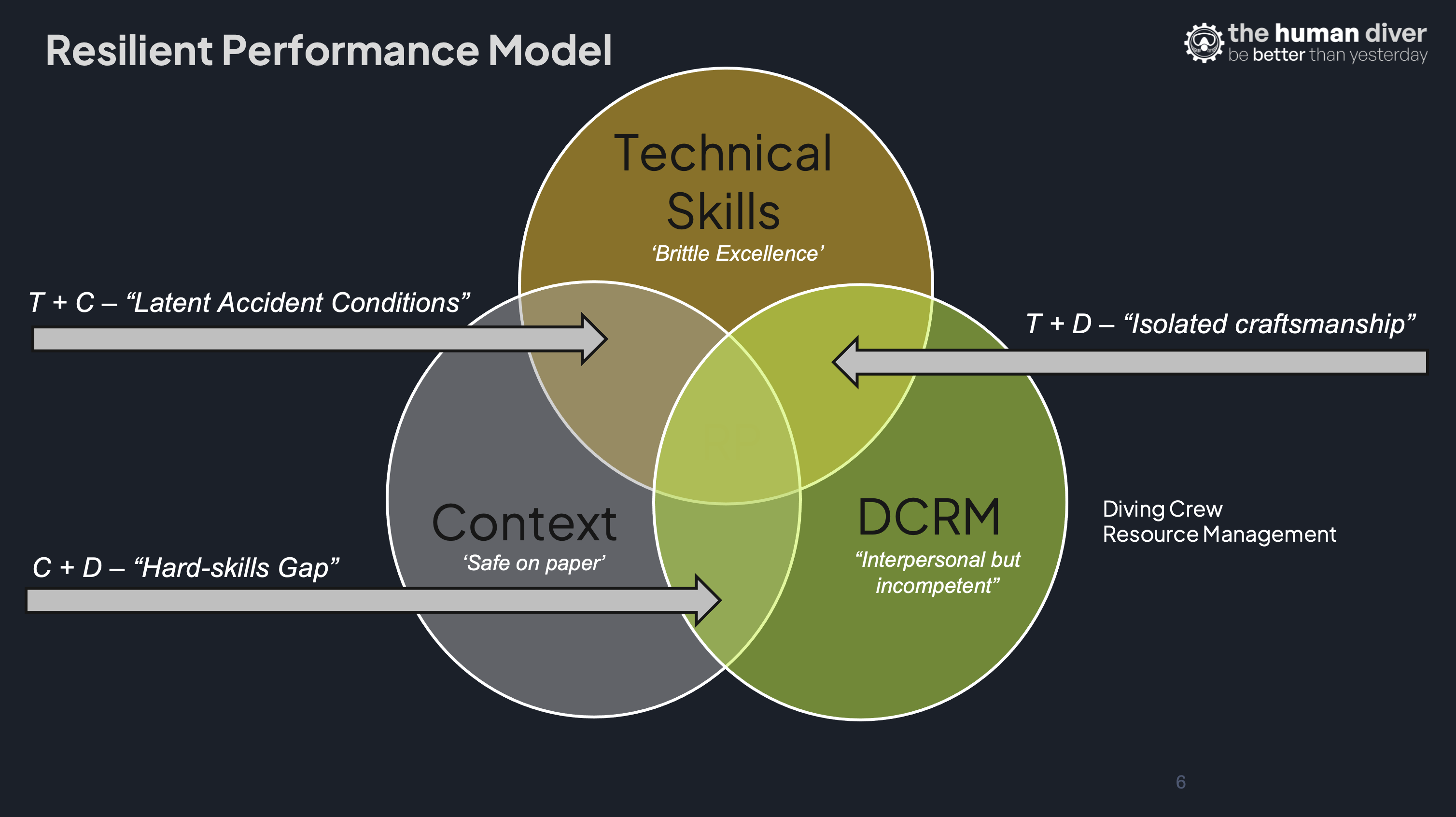
The model becomes most instructive when you look at the overlapping zones — the pairings where one domain is weak or absent.
Strong technical skills without non-technical support is what the model calls ‘brittle excellence’. A skilled diver with poor buddy communication and no agreed contingency plan is performing on the assumption that nothing will deviate. In one vignette from the commercial diving sector, a junior technician monitoring panel gauges during a high-value dive day noticed an unusual pressure fluctuation, a pattern he had seen before indicating a failing valve seat. He almost spoke up. But the supervisor was already on comms and projecting total certainty, and the technician stayed silent rather than risk looking stupid or stopping a £500,000 operation over "a feeling." The fault developed. The event escalated. When the investigation concluded, it found not the valve but the conditions that had made silence feel safer than speaking. The technical proficiency in that room was not the problem. Everything else was.
Strong context and non-technical skills without matching technical depth produces the inverse: coordination without capability – a ‘hard’ skills gap. Teams communicate well, culture is supportive, risk is discussed openly, but the specific technical skills needed for a higher-consequence situation are not there when it matters. This is the profile of a well-led operation that manages day-to-day work comfortably but has quietly allowed recency of practice to erode in areas that only matter during emergencies. It surfaces not in the calm days but in the ones that weren't supposed to go wrong.
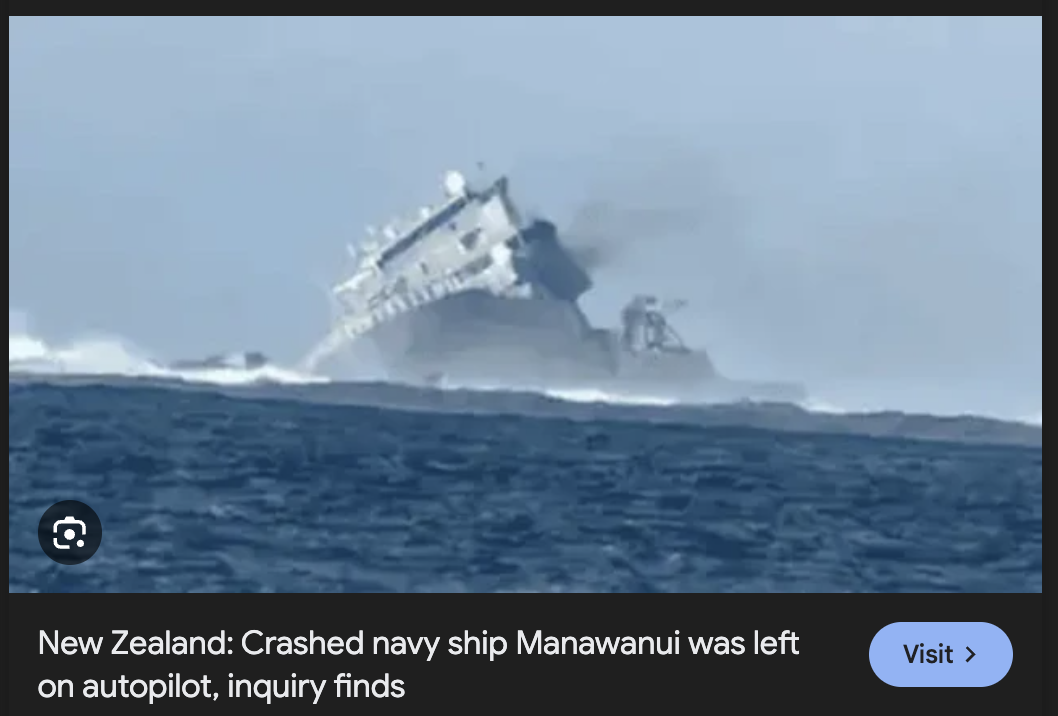
The pairing of strong technical skills and strong context, without explicit non-technical skills, is perhaps the most deceptive configuration of all. The model calls it "latent accident conditions," and it deserves the name. Everything looks robust from the outside. Trained people, quality equipment, reputable operator, written SOPs. But briefings are rushed, cross-checks are skipped, challenge is implicitly discouraged. During the military programme, participants examined the grounding of HMNZS Manawanui as a case study in this exact dynamic. The formal systems, on paper, were working. The context in which individual decisions were made, political pressure to demonstrate capability with a newly acquired vessel, crew composition decided at short notice, inadequate time for any meaningful workup, was not. To be blunt, the vessel had sailed in similar circumstances on multiple prior occasions without incident. The normalisation of that risk did not become visible until the system finally ran out of margins. Unfortunately, in immature organisations or situations, this often means pointing the finger at the last person to touch it.
What Resilient Performance Actually Looks Like
Resilient performance sits at the centre of all three domains, where technical skills, non-technical skills, and context are strong and aligned simultaneously. It doesn't mean preventing all failures. In complex systems, variability is unavoidable. Equipment fails without warning. Environmental conditions change faster than forecasts. Personnel who were expected to be present are not. What resilient performance means is that the system can absorb disturbance, adapt effectively, and still produce acceptable outcomes. And critically, it can learn from what happened rather than simply resetting the same conditions that allowed it to happen.
In practice this looks like competent divers operating with appropriate equipment, supported by realistic planning assumptions and briefings that genuinely invite challenge, within an organisation that treats unwanted outcomes as learning opportunities rather than threats to its reputation. During one of the wrap-up discussions in a recent programme, a senior participant observed that the cultural piece was probably the most tractable lever available to frontline leaders: it was relatively easy to update procedures, but very difficult to shift what happens in someone's head in the first seconds after they hear about an incident. One of the hardest parts is shifting their first questions from "Who was involved? Why did they do THAT?" to "How did it make sense for them to do what they did? What conditions made this possible?" That instinctive framing, repeated across hundreds of conversations and responses over years, is exactly how a safety culture either calcifies or evolves.
Building that kind of performance requires balanced investment across all three domains, not just the most visible one. This is not a comfortable message for organisations that have spent years refining their procedures and technical standards. It asks something harder: to look at whether the culture, the communication environment, and the quality of non-technical skills training are genuinely aligned with the technical standards already in place, or whether there is a gap that competent, well-intentioned people are quietly compensating for every time they go to work.
One story from a commercial diving operation captures the cost of that gap with unusual clarity. A North Sea operator won three major contracts in the same quarter and assumed existing personnel could absorb the expanded workload. Nobody modelled what the schedule adjustments would actually mean for the people executing the work. Budget was set at a crew size viable for the original scope and unworkable for the expanded one. Three incidents followed in short succession: a dropped object during a rushed lift where a supervisor was simultaneously managing a second operation due to under-resourcing, a confined-space event linked to fatigue and compromised communication, and a near-miss involving equipment past its service date. Three senior supervisors resigned within a month, exhausted from signing permits in conditions they would not have signed twelve months earlier. The company lost two of its three contracts the following year. The technical standards had not changed. The context in which those standards had to be executed had shifted to the point where they no longer provided meaningful protection.
The Lesson Across Sectors
The Resilient Performance Model is not sector-specific. The dynamics it describes, brittle excellence, latent accident conditions, isolated craftsmanship, and the zone where all three domains align, appear across recreational, technical, commercial, military, and public safety diving (and non-diving environments too). The language and the immediate pressures differ. The underlying structure does not. What changes an organisation's position within that model is not one training course or one updated procedure. It is the cumulative effect of how leaders respond when things go wrong, how openly frontline operators can share what they actually know, and whether the system is designed to support good decisions or merely to document that someone was responsible when a good decision wasn't made.
Resilient performance is not about perfect dives. It is about systems that help people succeed when things do not go to plan. And then reflecting and learning to be better than yesterday.


