

‘Safety First’ Slogans do not create safety, capacity or competencies do
I have seen two things recently that have been written by individuals and organisations who want divers to come home safe, i.e., not physically, physiologically, emotionally, or psychologically harmed during a dive. This should be the primary goal of EVERY dive – not whether you laid the line to the end, captured the photos/video, or survey the reef and got that important data. Those are secondary goals.
The first was a post from one of the training agencies. It said that safety is not a marketing message or a cliché but a responsibility, set out the agency's commitment to diver safety, and announced new instructor-to-student ratios. The second was a graphic headed Scuba Diver Creed, built around the line "I'm in charge of my own safety and pleasure", and carrying four instructions. Safety first. Dive within our training. Pick operators on safety, not the cheapest sticker. Slow. Slower. Slowest.
Both are intended as really positive messaging for safer diving, in fact, one of the replies said, “I think we all knew what [the OP] meant”. The ratio change in the first one is a tangible structural change which modifies the conditions in which the teaching happens, and changing conditions works better than asking people to try harder or be more careful.
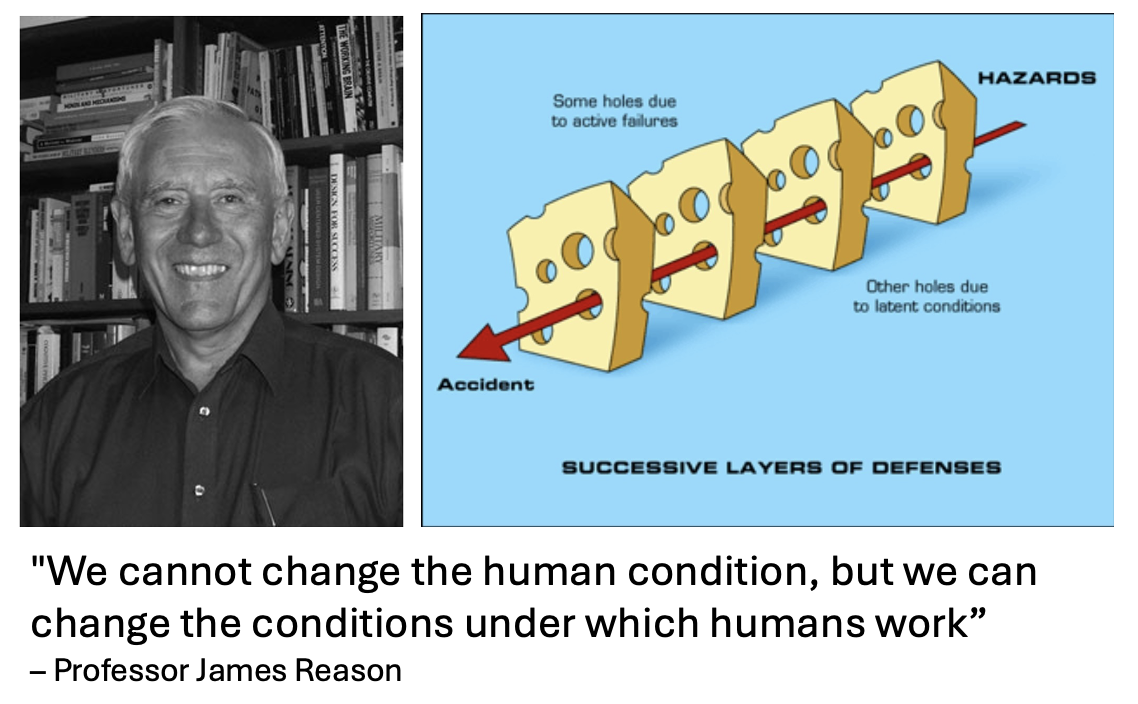
Each of these considers safety as something a person or an organisation can have by deciding to have it. Unfortunately, neither gives anyone a capability they did not already possess.
‘Safety first’ is not a common thing in an adventure sport
Take the first line of the creed at face value and diving stops. If safety genuinely came first, we would all have the best available equipment, unlimited time to plan, perfect fitness, and no reason ever to get in when conditions were less than ideal.
Diving is an adventure sport, and that means there is always an irreducible risk that someone will get harmed or killed during the activity. As such, nobody can say, ‘safety first’, including the people who write the slogans, because the slogan describes a priority that no practical diving operation can hold.
The only organisations who can genuinely apply this are those with bottomless pockets, nuclear energy. What we actually do is make compromises and educated guesses because every dive or diving operation sits inside a set of tensions:
Does the business stay viable?
How much does my full-time job supplement my hobby business?
Can I afford to get my equipment serviced on schedule because it works at the moment?
Does the customer feel they got what they paid for?
What do the organisation's own constraints allow?
I’d like to have two students for quality, but I can’t make that pay given the market pricing.
How much uncertainty are we willing to accept because compliance only gets you so far in a dynamic, complex world.
I intentionally chose that last word because we have to recognise that we are dealing with uncertainty rather than risk: risk implies numbers we can put on things, and in recreational and technical diving we do not have those numbers in any form that we can use. Gerd Gigerenzer has spent a career on the difference between calculable risk and genuine uncertainty, and diving lives almost entirely in the second category.
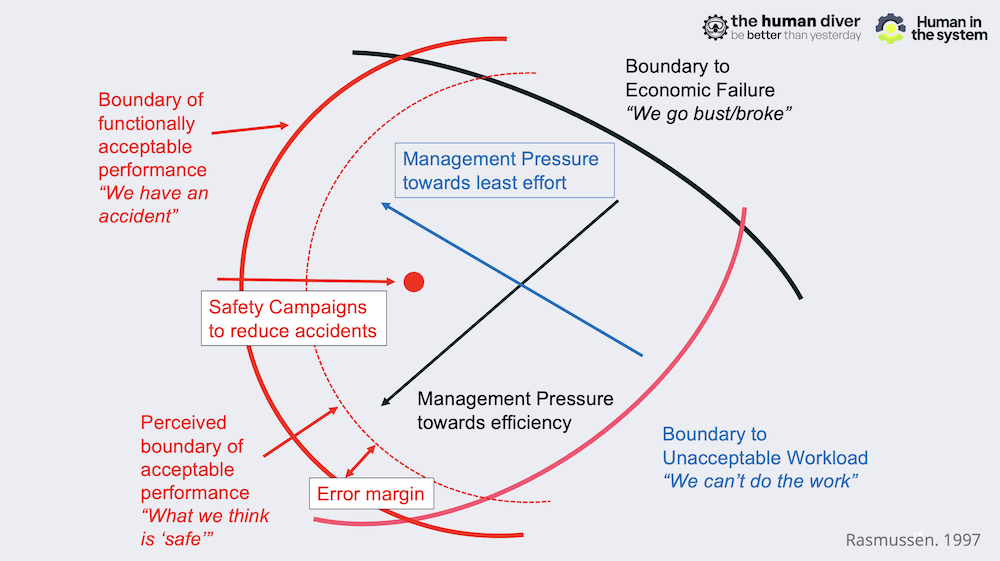
At the operational level, this was described in 1997, so it is not new. If you been to some of my presentations, you will have seen the image above. Jens Rasmussen drew the space any operation works inside as a triangle with three edges. One edge is the point where the business runs out of money, one is the point where the people run out of capacity, and the third is the edge of acceptable safety performance, which is the only one of the three you cannot see until you have crossed it.
‘Work’ (diving) does not remain stationary inside that triangle. It moves along two gradients, and both look credible and logical from inside, the operational perspective. Cost pressure pushes the operation away from the money edge (the blue arrowed line), because a centre that runs out of cash stops existing. Effort finds the easier (cheaper) path away from the workload edge (the black line), because nobody can hold full thoroughness across a season.
Both point the same way, towards the safety edge, and these tensions never really feel like a safety decision at the time. Over a season the brief shortens by five minutes, the skill circuit loses ten, the extra session becomes "they will be fine in open water", and the operation settles wherever the envelope allows. Importantly, there are few organisations who reward operators, instructors, or skippers for spending more money and taking more time in a competitive environment because the average consumer is looking for fast and cheap. Finally, your biggest bang for buck is when your toes are on the safety line, but you don’t know where that is until you step over it!

We call the everyday version of this the efficiency-thoroughness trade-off (ETTO), and the key point is that you cannot escape it. Nobody can be fully thorough and fully efficient at the same time, so we all pick a spot between the two, usually without noticing, and usually towards efficiency during the long stretches when things go well.
That is not a flaw in the personal character of those involved, it is what makes the diving operations possible at all. "Safety first" asks people to pretend the trade-off is not happening, which means we can’t have a conversation about what tensions really exist, and then try and fix the secrets that we know about but can’t talk about.
Dive within our training
The second line sounds unarguable, but how does anyone get better?
Take another course is the obvious reply, and it is not a wrong answer, but it treats diver training as the ability to give everyone all the information for all the scenarios in the training courses, and the instructors have this knowledge and competency – and we know that isn’t true. A more useful description of how competence develops is that people find the edges of what they can do and discover where those edges are by getting close to them under conditions such that WHEN they make a mistake, it isn’t catastrophic – they can fail safely. That is what a good instructor creates: a place to fail safely, then talk about it. It is also what a rushed course, a compressed skills circuit and a full boat make nearly impossible to achieve.
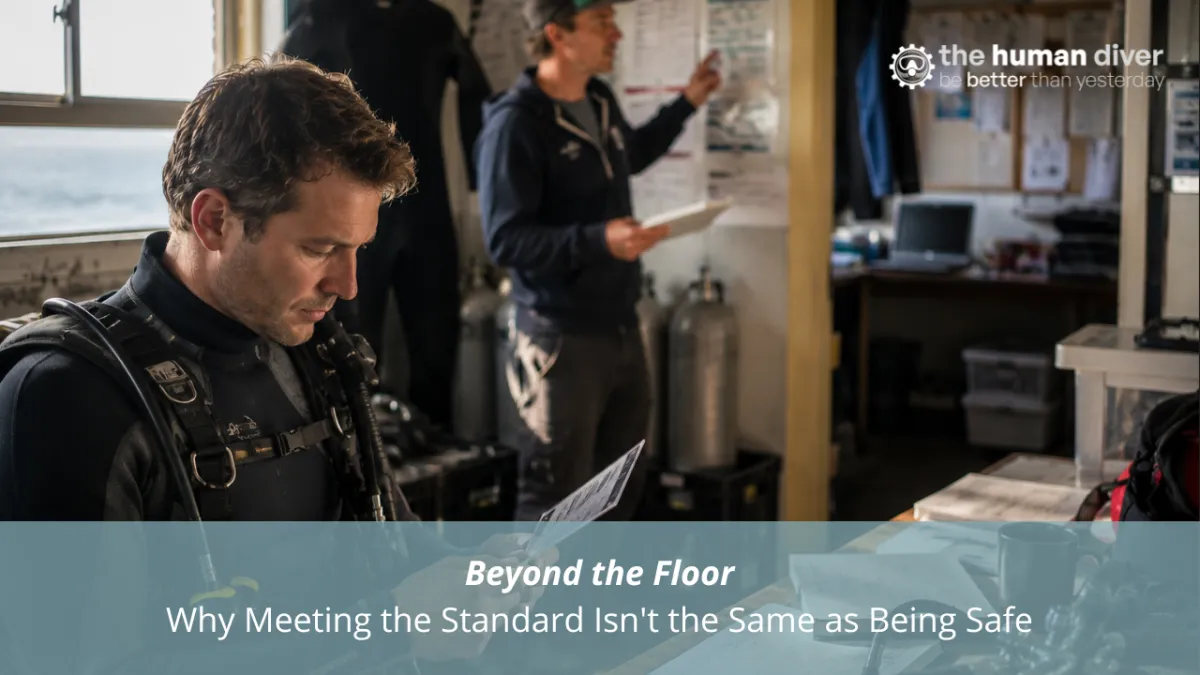
Standards describe a minimum, written by people who could not know that site, that team, those conditions or that day. To make useful decisions in the water, a diver has to think past the rote material they were given. Somebody has to have taught them how to think, and not only what to do. Education theory around Kirkpatrick’s Levels covers this and will be subject of another blog.
While "dive within our training" is credible advice to limit your risk exposure to those based on your training limits, it doesn’t say how we develop capable divers. We need to understand:
Where is the boundary?
How do you find out where it is?
Who is going to be there when you find it?
Pick operators on safety, not the cheapest sticker
While I do agree with this, it is also the line that is hardest to take action on. It asks divers to do something the industry has not equipped them to do. Who decides what safe looks like? What is the metric?
Andrew Rae and David Provan looked at this problem and explained the difficulty.
Safety work is what an organisation does in the name of safety.
The safety of work is whether the ‘work’ has become less likely to hurt anyone.
The two are linked because safety work is visible and easy to show, while the safety of work is hard to measure and largely invisible even to those doing it. Ask a dive instructor or dive centre manager how they know they are practically and operationally safe, without reference to compliance paperwork…
A diver choosing an operator can see the safety work. They can see the certificates on the wall, the briefing that gets delivered, the oxygen kit in the corner and the statement on the website. They have almost no access to the safety of work, which lives in how the operation behaves on a bad day at the end of the season or off season, when the boat is late and the staff are tired, and there are external pressures that are driving certain behaviours.
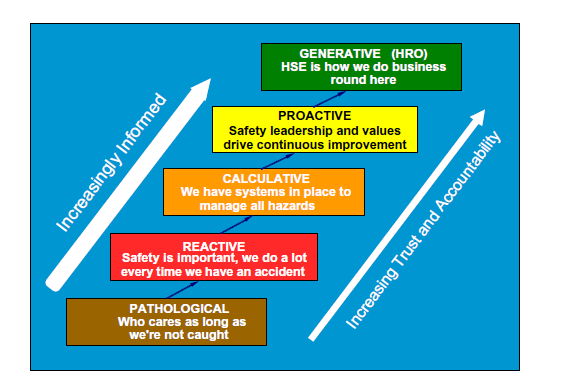
Unfortunately, the evidence on self-assessment makes this worse. Leonie Boskeljon-Horst and colleagues studied the ladder-style culture assessments that place a unit somewhere between pathological and generative, and found the scores ran inversely to real safety outcomes. Paradoxically, the units rating themselves highest were not the ones doing best. The likeliest conclusion is that a confident score identifies a military aviation unit that has stopped being critical on how it looks at itself, while a low score marks one that knows exactly where its problems are. Applied to choosing a dive operation, the centre most willing to tell you what it is still working on may well be the better (safer) bet. Unfortunately, this is not how anyone shops for their dive centres!
When diving operations or instructors hide their events for fear of being judged, then how does the consumer know what is safe or not? This was another output from the MSc…
Slow. Slower. Slowest.
This is a time metric standing in for a quality one. Managing the speed of your ascent from depth is definitely important. Speed as a general proxy for competence is a different claim, and the evidence isn’t there. For example, I can be the slowest instructor on the island and still deliver a poor brief, skip the contingency discussion, and certify somebody who is not ready. Slow is easy to observe, which is why it gets measured, and it says very little about whether the diving or the diving instruction was any good. Effective quality management with performance metrics, credible audits, and robust feedback is how you show this…
Safety is not a state you hold
What underpins this is a view of safety as a property. Something you can have, declare, and put on a graphic. A piece of equipment is safe. A training course is safe. A dive location is safe.
Karl Weick described safety as a dynamic non-event, meaning that when it is present nothing happens, and the nothing that happens has to be actively produced over and over by people doing things well. It is not stored or held anywhere. It does not carry over from last season. Hortense Blazsin and Frank Guldenmund went further. They showed that what counts as safe is socially constructed, and gets negotiated differently by different groups inside the same organisation. The word does not mean the same one thing to a diver, an instructor, a centre owner and an agency. For example, ask an open water diver is cave diving is safe…

If safety is transient and socially constructed, then telling somebody to be safe gives them nothing. It names a state without supplying any of the tools, skills or capacity that would let them produce it. That is the mechanism behind what Sidney Dekker calls safety theatre: activity that has the appearance of safety, is cheap to perform, satisfies the audience, and doesn’t address the activity that needs to be done. A creed graphic is theatre in that sense, however sincerely it was made. So is a commitment statement.
None of this means the people posting don’t care. It means we have a shared habit of producing artefacts that describe safety instead of interventions that create the conditions for it.
The caring version of the same problem
The agency post is the sentiment form of the same move. Its argument is that safety is a responsibility, that the agency takes it seriously, and that its commitment is genuine. The familiar shorter version turns up after almost every incident. If only they had cared more.
In my experience of working with instructors, centre owners and technical teams, a shortage of caring is very rarely what happened. David Weber and colleagues found the same thing in a setting where the right to act was written down. They studied workers who held a formal right to stop unsafe work, and took their title from one of them, who said "we can stop work, but then nothing gets done." The right was real and so was the concern. What decided whether people used it was the local cost of doing so, and above all how their supervisor treated the decision. How does a diving instructor get treated when they push back on a time-compressed course with a hard deadline for the clients?
A claim about caring also does something to the conversation. It puts the organisation in the role of moral subject and asks the reader to judge intent rather than effect. That makes disagreement awkward, because anyone questioning the claim can be read as saying the people involved do not care about divers.
The useful reply to a commitment statement is not about whether the comment is meant - of course it is. Rather, we should ask whether pressures have changed - a ratio change answers that, but a statement on its own does not. Actions are what makes the difference.
Where this goes next
Criticism like the above is pretty easy, and I have been criticised in the past for saying what’s wrong with the system without giving practical ideas/solutions that people can apply easily. What falls out of this are two questions that haven’t been considered.
The first is what we owe people when something does go wrong, because both the creed and the commitment statement have something to say about that and neither make that explicit. The second is what I would actually put on a graphic instead, given that "give people capability" is easy to write and much harder to specify.
I have put both into a second blog that will be published tomorrow: What Good Can Look Like.
In the meantime, the question I would ask of any agency, centre or professional publishing a message like these - what has changed for the instructor standing on the boat or dockside tomorrow morning ready to kick off their class?
References
Gigerenzer, G. (2008). Rationality for Mortals: How People Cope with Uncertainty. Oxford University Press.
Rasmussen, J. (1997). Risk management in a dynamic society: a modelling problem. Safety Science, 27(2-3), 183-213. doi:10.1016/S0925-7535(97)00052-0
Hollnagel, E. (2009). The ETTO Principle: Efficiency-Thoroughness Trade-Off. CRC Press.
Rae, A. & Provan, D. (2019). Safety work versus the safety of work. Safety Science, 111, 119-127. doi:10.1016/j.ssci.2018.07.001
Boskeljon-Horst, L., Sillem, S. & Dekker, S.W.A. (2022). 'Ladder'-based safety culture assessments inversely predict safety outcomes. Journal of Contingencies and Crisis Management. doi:10.1111/1468-5973.12445
Dekker, S.W.A. (2009). Just culture: who gets to draw the line? Cognition, Technology & Work, 11(3), 177-185. doi:10.1007/s10111-008-0110-7
Weick, K.E. (1987). Organizational culture as a source of high reliability. California Management Review, 29(2), 112-127. doi:10.2307/41165243
Blazsin, H. & Guldenmund, F. (2015). The social construction of safety: comparing three realities. Safety Science, 71, 16-27. doi:10.1016/j.ssci.2014.06.001
Dekker, S. Safety Theater: Where Your Accidents Hide in the Green. See also Rae, A.J., Provan, D.J., Weber, D.E. & Dekker, S.W.A. (2018). Safety clutter: the accumulation and persistence of 'safety' work that does not contribute to operational safety. Policy and Practice in Health and Safety, 16(2), 194-211.
Weber, D.E., MacGregor, S.C., Provan, D.J. & Rae, A. (2018). "We can stop work, but then nothing gets done." Factors that support and hinder a workforce to discontinue work for safety. Safety Science, 108, 149-160. doi:10.1016/j.ssci.2018.04.032
Antonsen, S. (2009). Safety culture and the issue of power. Safety Science, 47(2), 183-191. doi:10.1016/j.ssci.2008.02.004


