3. Don’t Wait - Learn From Everyday Work Using HOP Principles
"My goal is to learn enough to realize that given the (1) conditions people faced (2) information they had (3) tools and equipment they used and (4) pressures they were under … I would have probably made similar decisions." -
Baker and Edwards
HOP - Human and Organizational Performance - is an approach to safety management that aligns nicely with The Human Diver’s Human Factors approach. HOP is a philosophy for improving safety and overall performance by acknowledging human fallibility and designing systems that are more error-tolerant. HOP is based on five principles, as shown in the graphic below.
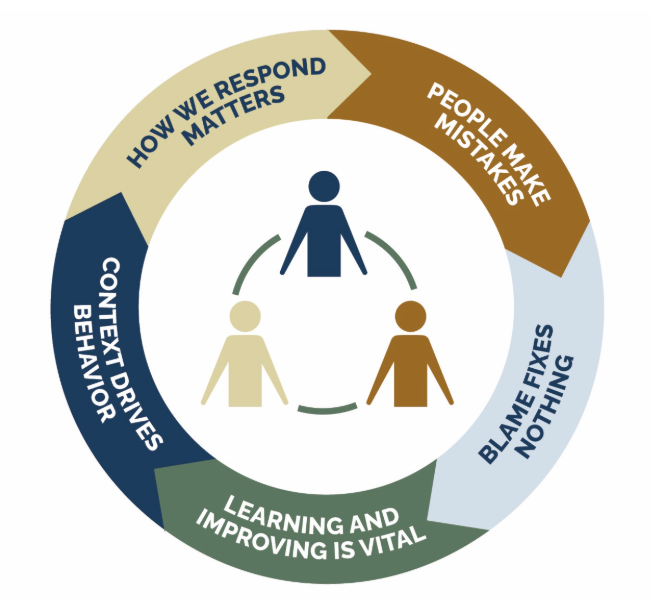
PEOPLE MAKE MISTAKES - Errors are a natural aspect of human behavior
BLAME FIXES NOTHING - Instead of blaming, HOP focuses on learning the underlying causes of errors
LEARNING & IMPROVING IS VITAL - Organizations should actively learn from incidents to improve safety and performance
CONTEXT DRIVES BEHAVIOR - The work environment significantly influences how people behave and make decisions
HOW WE RESPOND MATTERS - Leaders should seek to learn rather than to blame, and to be humbly curious about safety events.
How we applied HOP principles at the Human Factors in Diving Conference
In Vis, Croatia, Steve Smith delivered a workshop based on applying the HOP principles to everyday work, to foster a proactive, context-rich way of understanding workplace challenges, successes, and risks. The central premise is that rather than waiting for incidents to occur to learn, we can learn from everyday work. We don't need to wait for mistakes to happen, and then go looking for people to blame - we can, instead, focus on understanding the ways in which our daily routines may drift towards (or cover up) risks that are outside of our ability to manage, or to accept. Rather than waiting for errors to occur, and blaming people, we can ask the front line workers themselves where errors are likely, or where risk may be hiding in our daily successes. We can seek to understand the challenges and complexities of daily work before incidents occur, to help us either prevent incidents, or be better equipped to recognize and absorb their impact.
Participants in the workshop had an opportunity to use actual, recent events from their own experience, working in small groups to experience the difference between a traditional mode of incident "investigation" and the HOP approach of "humble inquiry." While the traditional approach yielded routine information about the who, what, when, where, and why, the HOP approach invited them to go back in time before the incident occurred to place it in a larger context. Using the HOP approach, participants asked questions that go back in time well before the event occurred, such as:
Tell me about a normal day at work?
What common challenges do you have to deal with?
Where are mistakes or injuries more likely to occur?
Where do you have to make trade-offs or workarounds to get the job done?
Are there policies that are harder to follow than others?
Next, participants were invited to ask questions moving forward in time towards the incident itself:
Was there anything different or difficult about this day?
How did your decisions make sense to you at the time?
Help me understand what you were seeing and experiencing.
Who was hurt?
What do they need?
Whose job is it to provide that?
What would you need in the future to be able to better avoid this kind of outcome?
A Hypothetical Example
A commercial diving vessel accidentally leaves two divers behind at a reef, realizes it hours later, and goes back to find them unharmed but upset.
A traditional "incident investigation" would look at this event to understand the who, what, when, where, usually starting with the incident and working backwards in time to identify a "cause," or possible contributing factors. Due to powerful influences such as hindsight bias and knowledge of the outcome of the event, there may be a natural tendency to look for someone to blame, or to identify a "fix" for whatever didn't work in this case. There may be organizational pressure to quickly identify what happened, what went wrong, and how to fix it for the future. In short, the investigation's chief purpose may be to understand what happened, identify a cause, and address the cause -- often, this takes the form of a simple story that blames an individual. Human error is always present in some fashion, and it's easy to say that the dive boat captain was clearly at fault, should have cared more and tried harder, and should have followed their checklist more closely. Why didn't they just follow the rules, and the training they had been provided?
The HOP approach would go back in time well before the moment the divers were left behind to try to put this event in a bigger context. Was this event a surprise to the front-line staff, or was it seen as inevitable, based on the what a normal day was like for them? What pressures were they under based on the dive program design, schedule, itinerary for the day? How did the makeup of the dive group itself -- physical abilities, group size, interpersonal dynamics, etc. -- contribute to the events of the day? What pressures did the captain feel to get back to the harbor before darkness fell? How tired were the dive instructors and crew? What ideas did they have to help them be in a better situation in the future? The HOP approach would seek to understand the organizational factors that made the event more likely to occur -- and seek to fix the workplace, not just fix the worker.
Participants reported that using the HOP approach gave them a much better way to understand incidents from the perspective of those involved at the time. It was very encouraging to see how easily participants were able to adopt and adapt the HOP questions to their situation.
A graceful way to enter into these kinds of conversations, rather than waiting for an incident to occur, is to engage in regular, ongoing debriefs when things go well -- to explore, what made them go well?
Were we lucky, or were we good?
Concepts and images courtesy of Steve Smith’s 2026 book, Safety Science for Outdoor & Experiential Education Programs.