

The Price of Speaking Up: Giving you the tools to make it cheap and easy
When a dive goes wrong, someone nearly always asks the same question. "Why didn't you say something?" You hear it on the boat, in the debrief and in online comments. Often the person asking it most is the diver who stayed quiet.
The question makes it sound as if speaking up is all about courage. I don't think it is. Whether a diver speaks up depends a lot on the people around them, and most of all on the person leading the dive.
Strangers in the cockpit
In the 1980s, a researcher called Robert Ginnett studied airline pilots as they got ready to fly. Most of the crews had never met before. Even so, they were working well together within a few minutes.
Ginnett said this worked because each pilot arrived with an invisible rulebook. He called it a "shell". It came from their training, their airline and the rules all pilots follow. Everyone already knew who did which job, who was in charge and how things usually ran. They didn't have to work it all out on the day, so they had more brain space for flying.
The rulebook wasn't fixed, though. Ginnett found that the captain could change it in the first few minutes, usually during the briefing. One pilot told him you could tell what kind of captain you had almost straight away.
Four kinds of dive leader
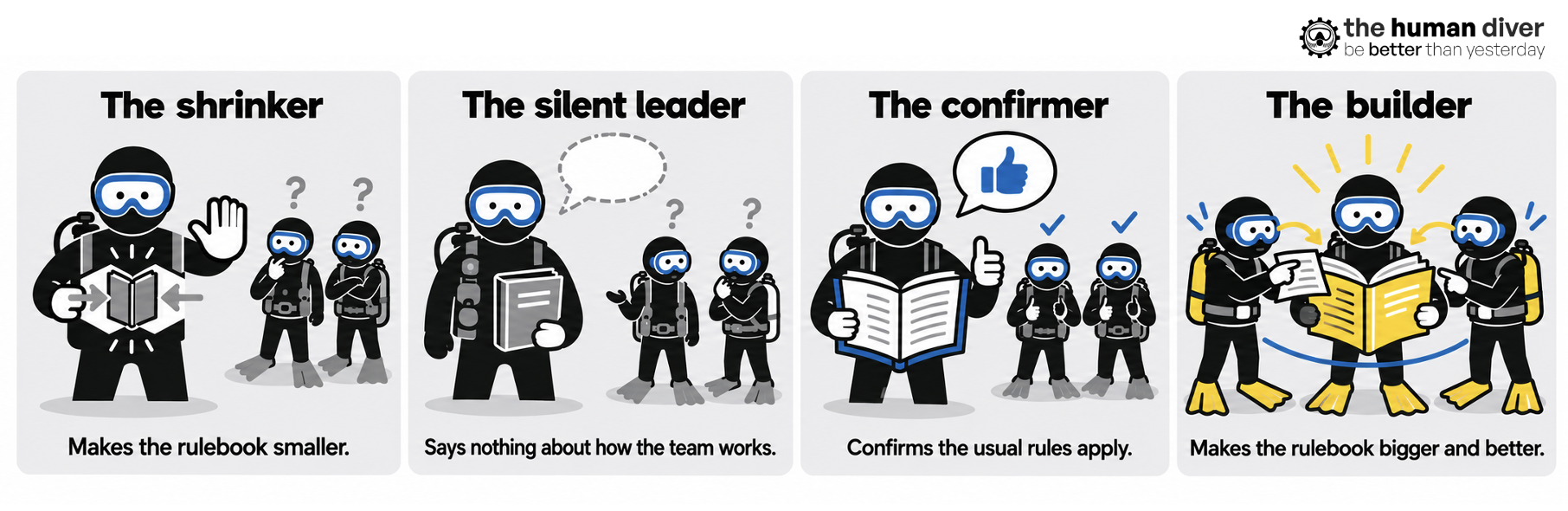
Ginnett saw four ways a leader could treat the rulebook. They fit dive leaders and instructors just as well as captains.
The shrinker makes the rulebook smaller. Picture a dive guide who says, "Nobody does anything without checking with me first." Now the divers aren't sure if they can end their own dive, or even check their own gas, without asking. One rule has made them unsure about everything else.
The silent leader says nothing about how the team should work. The briefing covers the site and the dive plan, and that's all. The divers are left to guess whether the usual rules still apply today.
The confirmer says, "Normal rules apply. Anyone can end the dive at any time." That helps divers feel sure of what to do. If the usual rules are good ones, this works well.
The builder makes the rulebook bigger and better. They might say, "I've dived this site lots of times, which is exactly why I might miss something new. If you spot anything, I want to know." Then they make sure everyone agrees how they will show it underwater.
From quiet to loud
Now think about the divers who aren't leading. When they notice a problem, there are five things they might do. Each one is a bit louder, and feels a bit riskier, than the one before.
The first is staying quiet. The diver thinks, "The instructor must already know." On one technical course, a student had a sticking drysuit inflator at fifty metres. He sorted it out quietly because his instructor was busy. Afterwards, all the students said the same thing: "I thought you knew."
The second is hinting. The diver does something small that is easy to miss. They tap their gauge and shrug, or they say on the boat, "Bit chilly down there, wasn't it?" A hint can be ignored, and often is.
The third is asking. Underwater that might mean signalling "Show me your gas." The fourth is saying it clearly, like signalling "I'm cold" and then "I want to end the dive." The fifth is stopping. That's the thumb. Any diver can call any dive, at any time, and the reason can wait until the surface.
The same diver might stay quiet with one leader and speak clearly with another. So what makes the difference?
Leaders set the price
Speaking up has a price. It might be looking silly in front of people who are more experienced, or being teased on the boat afterwards. Before a diver says anything, they quickly work out how high that price might be. Two researchers, Megan Reitz and John Higgins, found that whether people speak up depends mostly on whether they expect to be listened to.
This is where the leader comes in. A builder makes the price low. Divers know their concerns are wanted, so asking, saying it clearly and calling the dive all feel normal.
A silent leader leaves the price unclear. Divers tend to hint, because a hint is easy to take back if it goes badly.
A shrinker makes the price high. Divers stay quiet, or hint so softly that nobody notices. They also take that habit with them to their next dive, with a different leader.
So when a diver only hinted, or said nothing, a better question is what made speaking up feel so expensive.
Why diving's rulebook is thinner
Pilots share a big, detailed rulebook. Their training is very similar wherever they learn, and they can talk to each other on the intercom. Divers have much less to go on. Training varies between agencies and instructors. Buddies are often paired up on the day, and few teams agree who is leading or how to raise a worry. Then, once we're underwater, we can't talk at all.
This is why a confirmer helps less in diving than in a cockpit. There just isn't as much in the rulebook to confirm.
When the rulebook is thin, divers use other clues to decide whose view counts. They notice who has an instructor card, or who has logged the most dives, or some other form to show 'power'. A newer diver might think, "I'm only on my tenth dive, so I'm probably wrong." They talk themselves out of their concern before anyone else has a chance to hear it.
On your next dive
If you're leading, use the briefing to build the rulebook. Tell the team, in your own words, that you might miss things and want to hear about them. Agree the gas and time limits that will end the dive, so a diver can point to a number instead of challenging you. Then ask everyone to show you the signal for "I'm not happy". You may be surprised how many different versions you see.
During the dive, treat a hint as if it were said out loud. If a diver looks unsure or gives a slow OK, go and check.
After the dive, thank anyone who called it, and don't ask them to justify it. Then ask the group, "Did anyone notice something they didn't mention?" The answers show you where speaking up still feels too expensive.
If you're not leading, you can still help. Asking a question in the briefing makes it easier for the next person to ask one too.
Who made it easy, or hard, to speak up on your last dive?


