
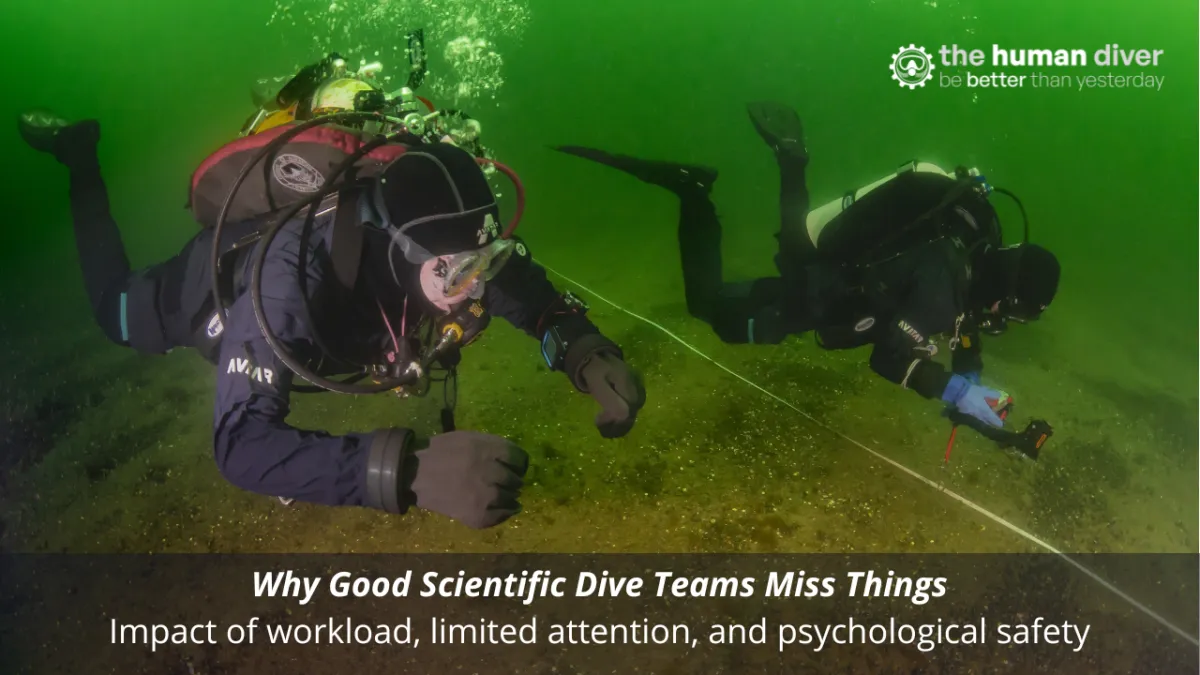
Why Good Scientific Dive Teams Miss Things: Impact of workload, limited attention, and psychological safety
Why Good Scientific Dive Teams Miss Things: Impact of workload, limited attention, and psychological safety
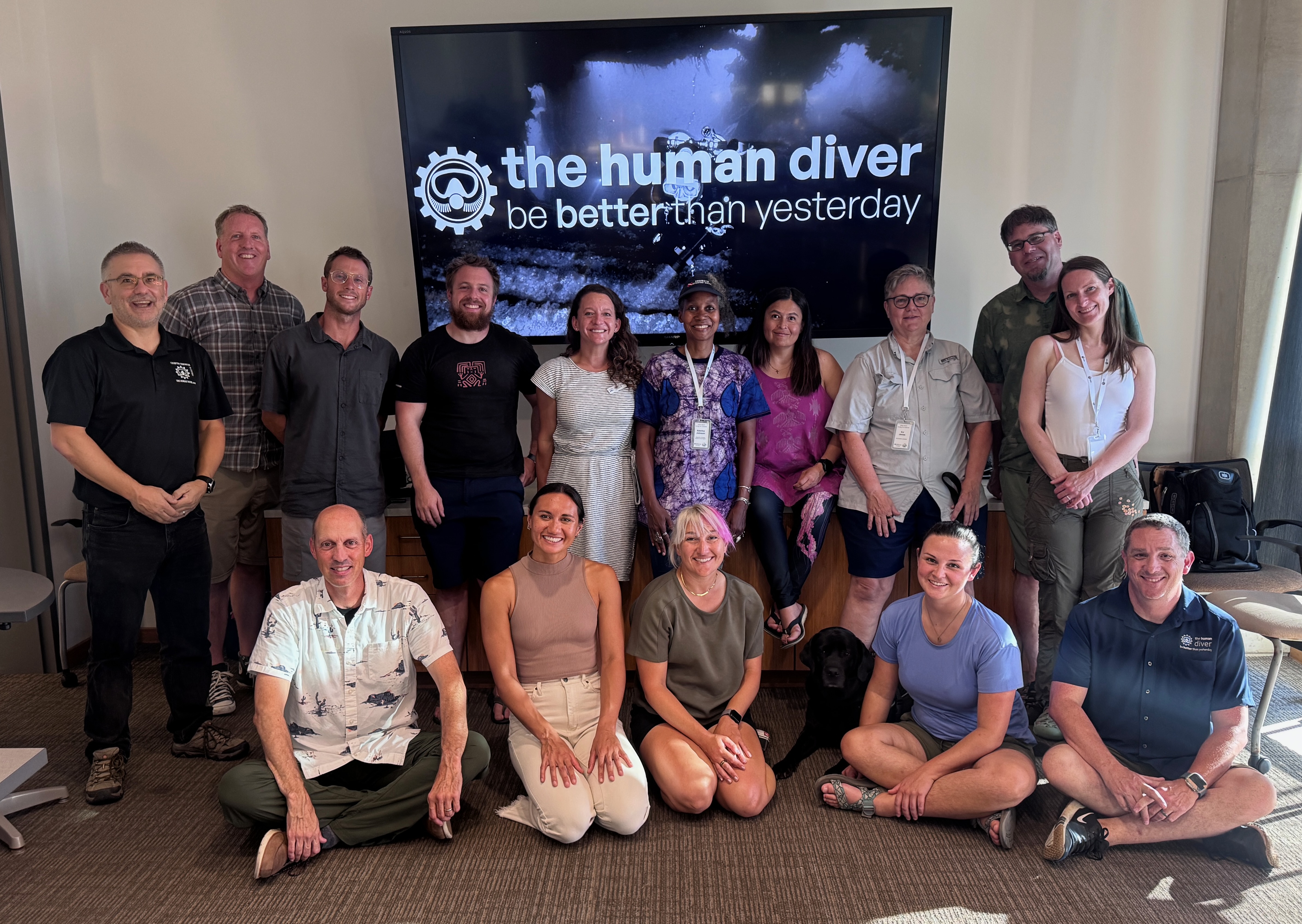
This week (5-10 Oct 2026) the American Academy of Underwater Sciences (AAUS) held its annual symposium, and this year it falls on the organisation's 75th anniversary. On Monday and Tuesday I was in San Diego, supervising an HFiD: Applied Skills class for 12 people. They came from seven different institutions across the United States looking to learn to apply the concepts and tools to their own diving operations - this includes a principal investigator who wanted to know how to support their dive teams and lead them well.
That made this feel like the right week to share the summary of a paper I have been writing with eight colleagues from scientific diving programmes in Finland, Saudi Arabia, the United States and Australia. It looks at human factors in scientific diving and is being prepared for submission, so it has not yet been through peer review. Although it was written for scientific divers, the ideas apply to anyone who dives as part of a team, from a buddy pair on a Saturday reef dive to a rebreather team surveying a wreck at 60 m.
Why scientific diving?
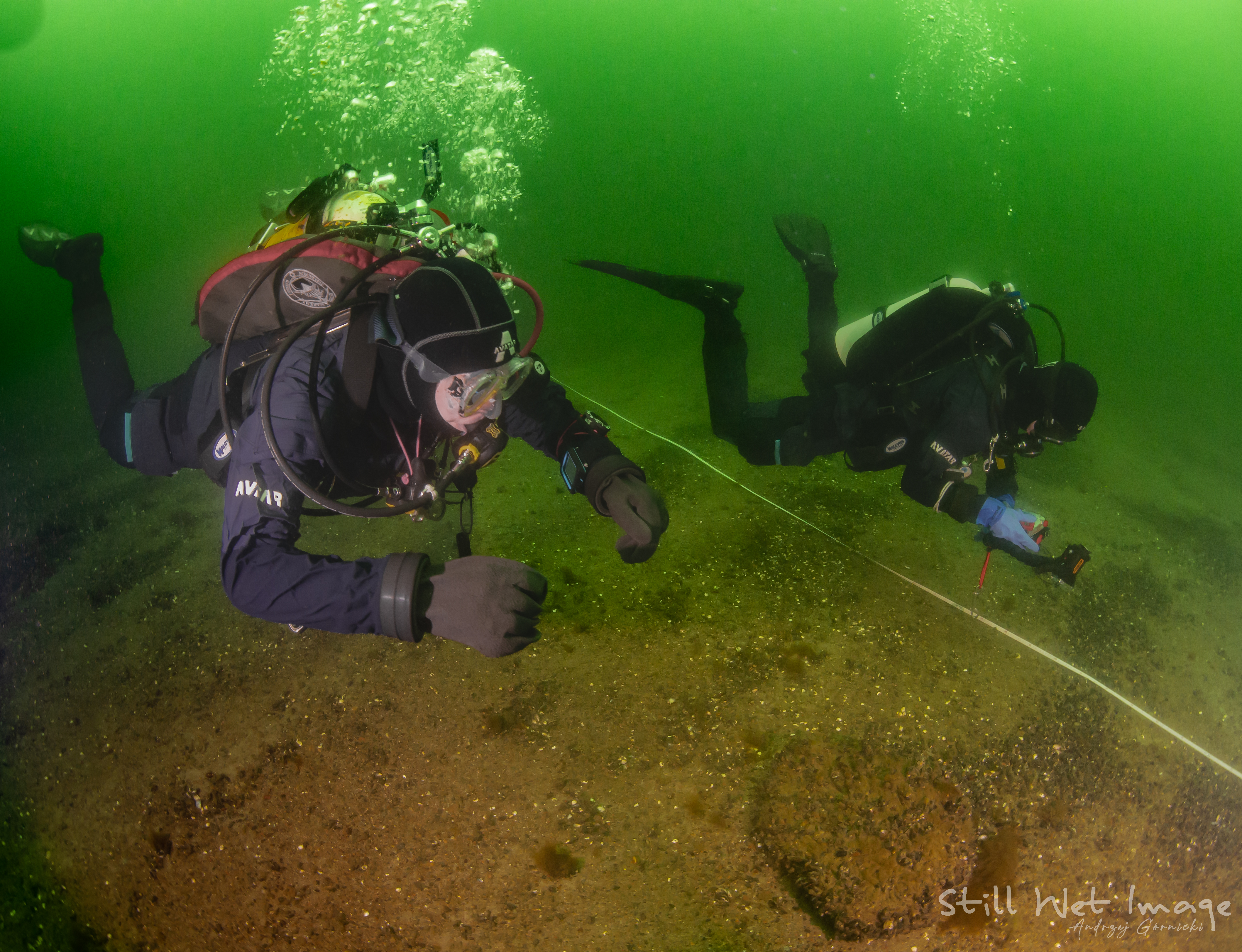
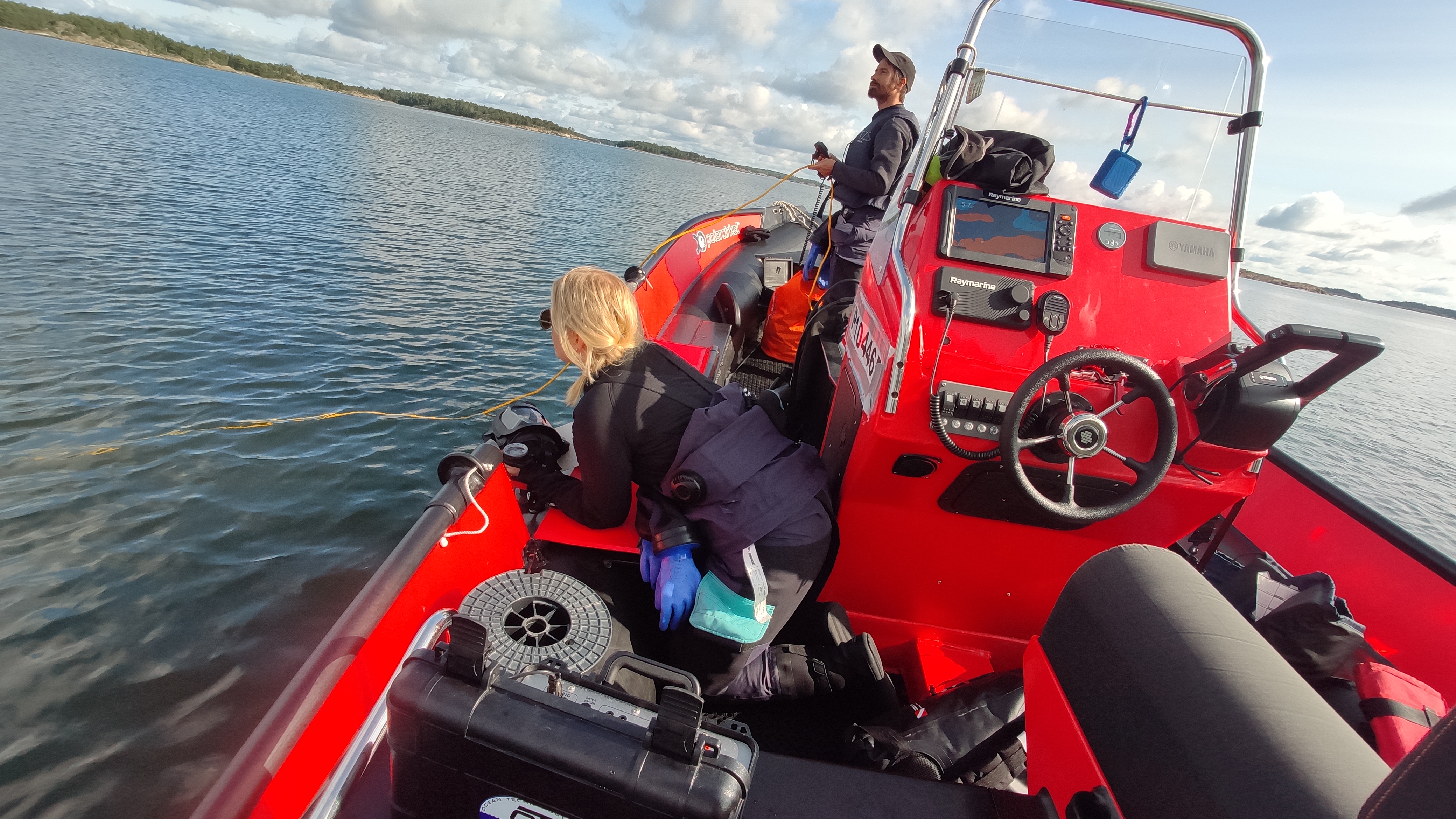
Scientific divers do far more than dive. They manage their life support while running cameras, sensors and survey rigs, often to tight windows set by gas, tides and boat schedules. The team may include a surface supervisor, an ROV pilot and a skipper, none of whom can see what the divers see.
In aviation, surgery and offshore energy, the skills that help teams cope with this kind of work are well known. They are called non-technical skills: situation awareness, decision-making, communication, teamwork, and leadership and followership. They are trained, observed and assessed. In diving they have had very little formal attention. There is no tested framework of non-technical skills for scientific diving, and no published study of whether human factors training works in this setting.
The easy argument is that this training works in aviation, so it will work in diving. That argument is not that strong, because anyone can list the ways diving is different from flying. So the paper asks a different question. Under what conditions do teams tend to miss, misread or fail to pass on information? And are those conditions present in scientific diving?
Three conditions
We pulled together three bodies of research that grew up largely independently of each other, but have a common theme: under what conditions are teams more likely to get into trouble?
The first is running out of attention. Our brains can only process so much at once, and tasks clash most when they use the same channel, such as reading a display while navigating by sight. Think about a scientific diver on a closed-circuit rebreather (CCR) running a survey. They are tracking oxygen, scrubber duration, buoyancy, navigation, time and deco, and on top of all that, the job they came to do. When attention is stretched like this, it tends to lock onto one thing and lose the rest. A diver absorbed in a survey instrument is less able to monitor the unit that is keeping them alive. Some studies show poorer decisions at 30 m than at 5 m on air, while others with CCR divers on trimix found no real change. This is the least tested part of our argument. Nobody has yet measured the workload of a scientific diver underwater.
The second is losing the shared picture. Each person in a team builds their picture of what is going on from the information they have in front of them. A surface supervisor watching a camera feed sees fine detail but nothing outside the frame, which researchers call the keyhole effect. A diver at depth, a supervisor on deck, and an ROV pilot will each build a different picture, and those pictures drift apart unless the team works to keep them aligned. Good briefings, closed-loop communication and simply saying out loud what you are seeing all help. This is also contextual: a two-person shore dive encounters much less of this than a large, spread-out operation.
The third is concerns that never get voiced. Scientific diving teams usually sit inside a university or institute. The lead scientist or primary investigator holds the funding and sets the goals. The Diving Safety Officer may be junior to them in the wider organisation. The working divers are often students or early-career researchers whose futures depend on that lead scientist and their published research. Research in healthcare shows again and again that rank and fear stop people from raising safety concerns. In a survey of US Navy divers, junior divers said they wanted to ask questions, while senior divers said they did not want to be questioned. This is a feature of how the organisation is built - it is not a flaw in the people within it.
These three conditions feed each other. High workload leaves less attention for keeping the team picture up to date and for noticing that something needs to be said. A team where people do not feel able to speak up loses the very information that would correct a drifting picture.
What tempers the argument
Scientific diving already has a good safety record. A review of more than one million American scientific dives between 1998 and 2007 found a decompression illness rate well below that of recreational, commercial and military diving. Most of those dives were shallow no-decompression dives, and the authors suggested there may be less pressure to dive in poor conditions. So the three conditions are not constant. They are likely to be strongest in deep CCR work and large expeditions with tight deadlines, and that kind of work is growing.
The evidence for team training is also mixed. People like it and learn from it, but changes in what they do are less consistent, and no review has shown a clear drop in accidents. Generic courses copied from aviation did poorly in shipping, and gains tend to fade within a year without refreshers. Some critics argue that ideas like "loss of situation awareness" can become just another way to blame the person at the sharp end. We take that seriously. Training is one layer in a much larger system, and it can be misused to shift blame onto divers for conditions they did not create.
What five organisations have done
The paper includes short reports from five organisations that have brought human factors into their diving: the Finnish Scientific Diving Academy, King Abdullah University of Science and Technology (KAUST), Georgia Aquarium, the California Academy of Sciences and the University of Tasmania.
KAUST worked to remove the stigma around incident reporting. Within about a year, staff described problems being raised openly rather than hidden. Georgia Aquarium runs seven or eight emergency scenarios a month, each closed with a debrief built on two sets of paired questions. What did you do well and why? What do you need to improve and how will you do it? The California Academy of Sciences brought in face-to-face kit checks, which have caught wrongly routed hoses, wrongly set computers and closed valves before anyone got wet. The University of Tasmania rewrote its dive manual to move away from the language of compliance and towards learning.
These are self-reported accounts with no control groups. I also have a financial interest, because The Human Diver developed and delivers the training most of these organisations used. So the paper treats them as observations that fit the framework, and makes no claim that they prove it. One pattern did stand out. The organisations describing the deepest change were those whose leaders changed their own behaviour and the way reporting worked. Training on its own was not enough, which fits what healthcare research has found about speaking up, and the biopharma work when Human and Organisation Performance (HOP) principles were applied, tracking the impact of present and departing committed leadership.
Where next
The paper sets out five studies to turn this from a strong idea into solid evidence. Two would measure what is happening now: diver workload as tasks are added one at a time, and how safe people feel to speak up in different kinds of dive team. A third would interview experienced scientific divers to build a set of non-technical skills that fits their world. A fourth would test training with independent observers during real operations. The last would look back at incidents using system-based methods such as AcciMap, to see whether these conditions show up in real events.
The bodies that set scientific diving standards, AAUS in the United States and its counterparts in Europe and Australia, all have ways to revise their rules. The paper does not ask them to make human factors training compulsory. It asks whether there is enough evidence to start that conversation while the research goes on.
What this means for the rest of us
You do not need to be a scientist for any of this to apply. If you have ever added a camera to a dive, you have stacked tasks. If you have ever surfaced to find your buddy thought the plan was something different, you have lived with a drifting picture. If you have ever stayed quiet because the other person was more experienced, or was your instructor, or was paying, you have felt the third condition. These are normal features of teams working under pressure, and they can be designed for. Brief in a way that builds a shared picture and checks it. If you are the senior person, invite challenge out loud before the dive. Debrief every dive, including the ones that went well.
Georgia Aquarium uses a simple objective for every dive: every diver returns safely while achieving the mission goals. Which of these three conditions is most likely to get in the way of that on your next dive, and what will your team do about it?


