
The Tower Was Already Full of Holes
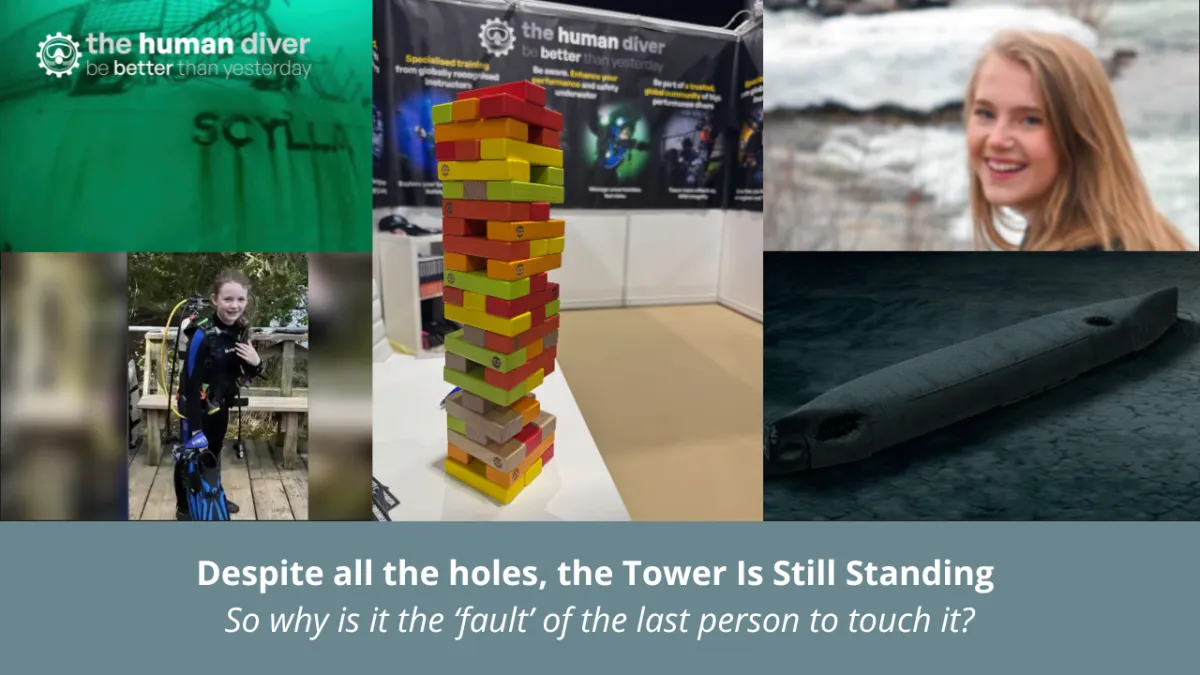
Imagine a Jenga tower. Not a pristine one fresh out of the box, but one that's already had dozens of bricks pulled from it. Gaps everywhere. And then someone reaches in, pulls out one more piece, and the whole thing comes crashing down. Whose fault is it?
Most people don't even hesitate. "Yours. You pulled the brick." And on one level, that's true. You were the last to touch it. But look at how many holes were already in that system before you got anywhere near it. The environment. The equipment. The training. The social pressure. The commercial reality. All of those missing bricks were already there, and the tower was still standing. Until it wasn't.
This is how we tend to deal with diving incidents. We find the last person to touch the tower and we pin it on them. Social media lights up, the judgements roll in, and the community reassures itself that as long as they're not as careless or as reckless as that diver, they'll be fine. It's comforting. It's also almost entirely wrong.
Why We Blame the Individual
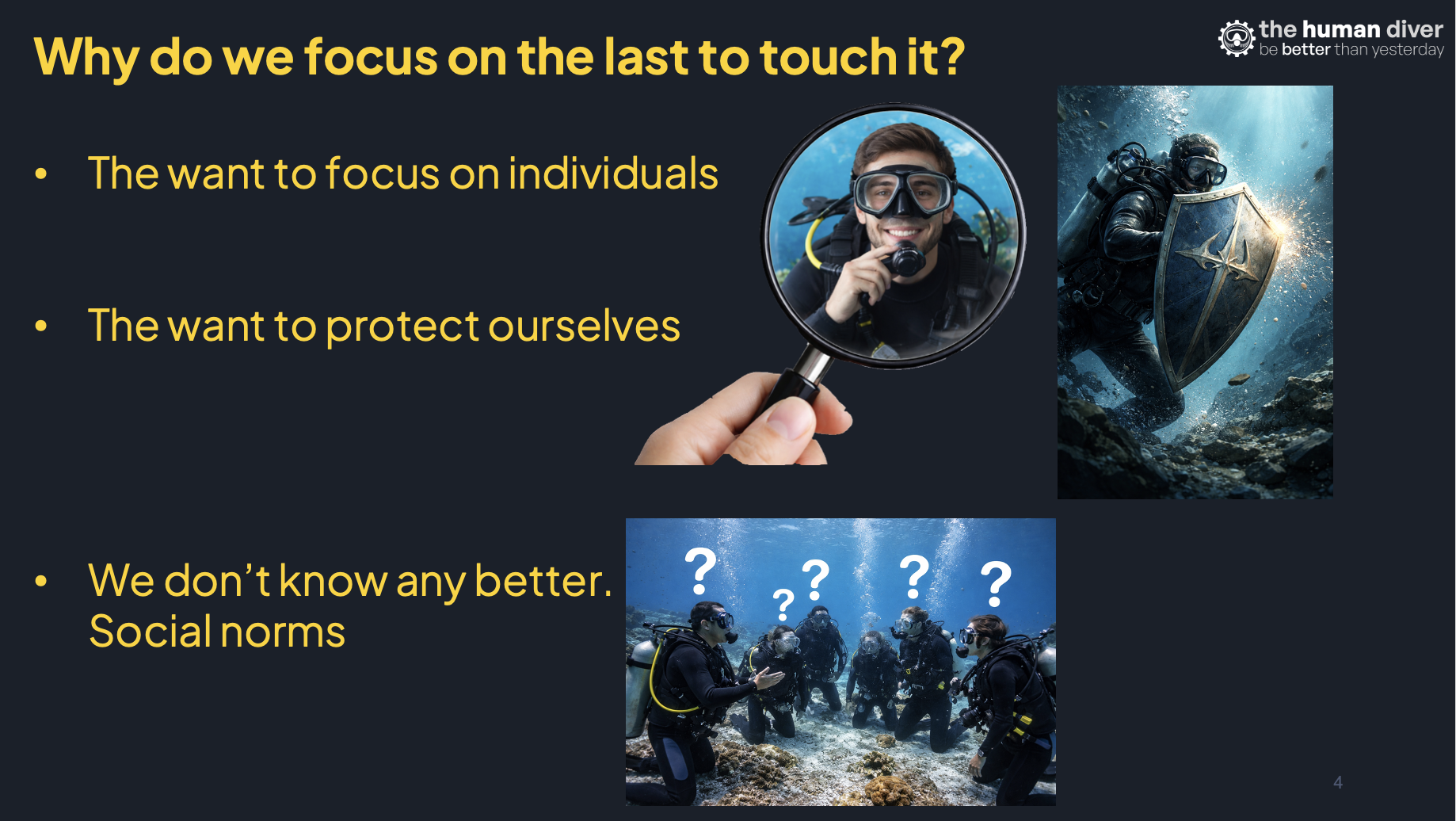
There are three reasons we default to blaming the person closest to the event. The first is that it's easy. Finding the individual who "made the mistake" requires almost no effort. Understanding the system that shaped their decisions requires a lot of it. The second is self-protection. If I can convince myself that the accident happened because that diver was incompetent, then I can reassure myself that I'm safe — because I'm not like them. The third reason is simply that nobody has taught us to think any differently. Blaming individuals is the social norm. It's what we see modelled in media, in coroners' reports, in training agency responses. We behave as social creatures, and when the bandwagon heads toward blame, most people pile on without ever questioning whether the destination makes any sense.
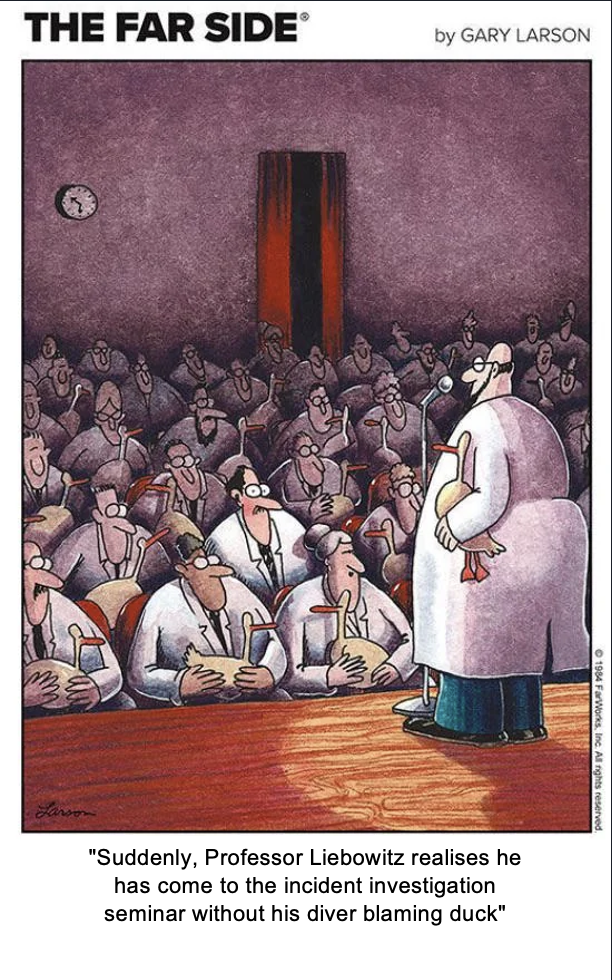
There's a Far Side cartoon I use in presentations: "Suddenly, Professor Liebowitz realises he's come to the incident investigation seminar without his diver-blaming duck." And every time I stand in front of an audience and suggest that maybe we should look beyond the individual, I can see some people thinking, "Here we go, Gareth. Why can't we just pin it on the person?" Because it feels good. As Sidney Dekker puts it, blaming the bad apple is like wetting your pants — it feels warm and satisfying when it happens, but shortly afterwards things get cold and uncomfortable. That's what happens when the deeper context starts to emerge and the simple story falls apart.
The Stories That Don't Get Told
Consider a few events I regularly walk through in presentations. Four experienced rebreather divers enter a wreck on what was supposed to be a two-hour dive. They didn't run a line. The wreck had collapsed since the last time their guide had transited it — and he'd done that transit sixty to seventy times before. Why would you line in if you've done it dozens of times without incident? But this time, the exit was blocked. Four divers, pitch black, silted out, no way forward, no way back. It turned into a five-and-a-half-hour ordeal. The simple narrative? "They should have lined in." The deeper story? The wreck environment had changed. The task shifted from photography to survival in seconds. Their rebreathers — not open circuit — kept them alive. A cave-trained diver on the surface team had just fifteen minutes to kit up and go back in to find them. If any one of those factors had been different, we'd be reading a fatality report, not a learning story.
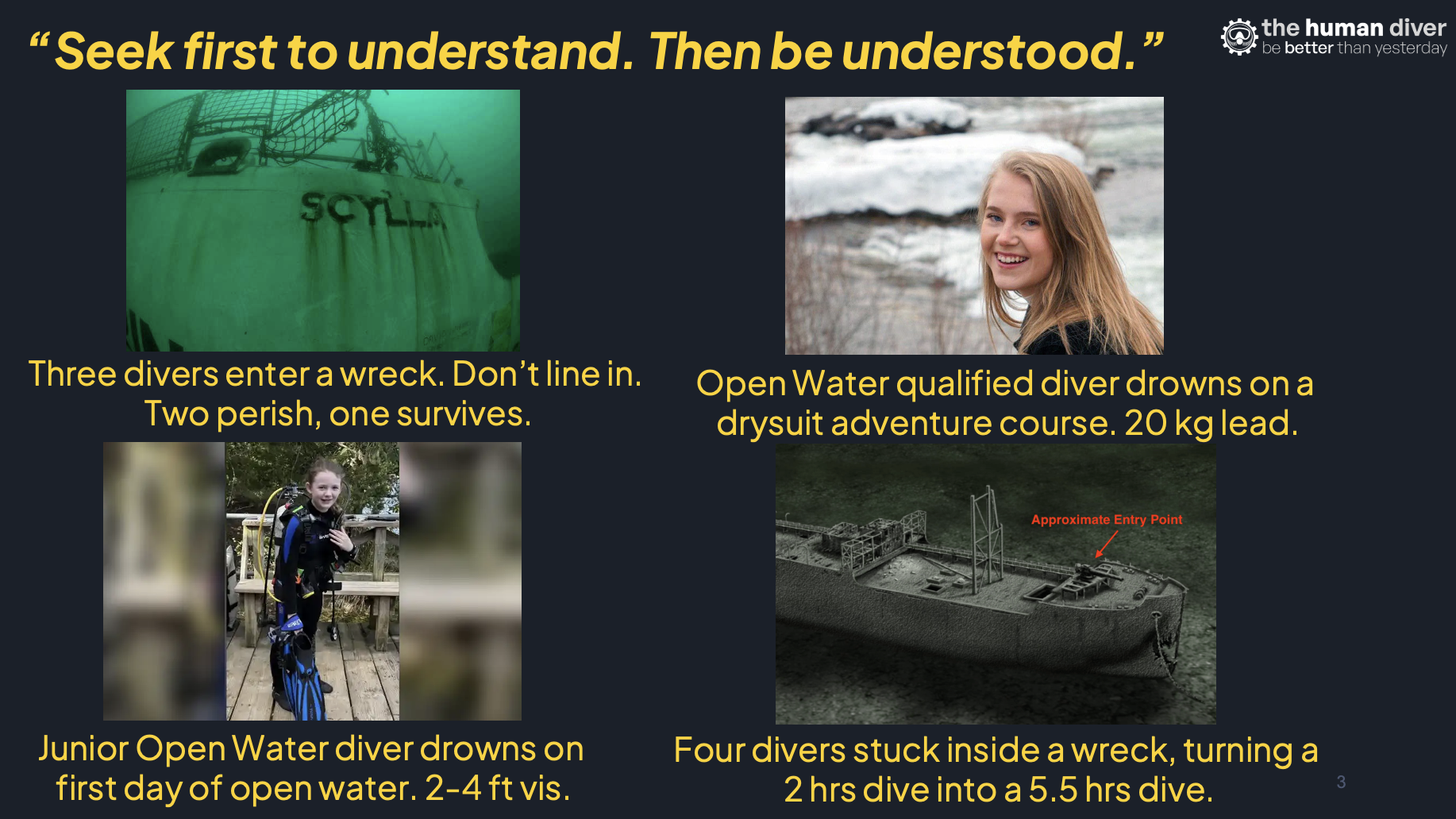
Or consider the Scylla. Three experienced divers enter a familiar wreck — two instructors and a divemaster, all from the same dive centre. They know each other, they trust each other, and they've dived this wreck many times before. Decks one and two are clean. Deck three and below? Very different. Silt brought in by dredging operations miles away. Percolation from their own exhaled bubbles bringing down rusticles. What started as a social dive with no real plan became a fight for survival in chocolate-brown water where you couldn't see your own hand. One diver got out through a gap so tight he shredded his wetsuit. He said afterwards that if he'd been wearing a drysuit with a thermal liner, he wouldn't have fitted. He surfaced with twelve draws left on his regulator. The other two didn't make it out. The simple story says they should have lined in. The deeper story asks why experienced divers, in a familiar environment, with a track record of safe outcomes, would feel they needed to.
And then there's Linnea Mills. Eighteen years old. Forty-five pounds of lead zipped into pockets she couldn't ditch. A drysuit she'd never used. An instructor who wasn't qualified to teach the class. The easy reaction is to blame the instructor. But when I spoke to another instructor who'd been at one of the original TekCamp workshops in Vobster, UK, he described pulling twenty kilos of lead off a student across two dives — and that was considered normal for that club. Because that's what they'd been taught. The system produced those conditions. The instructor was operating inside a framework that had normalised exactly this kind of practice.
Finally, look at the systemic factors that led to a 12-year old dying during a Junior Open Water class in Dallas, TX in 2025. Many of those factors had been normalised as individual factors, but when they interact, a tragic outcome emerges.
What We're Actually Looking For
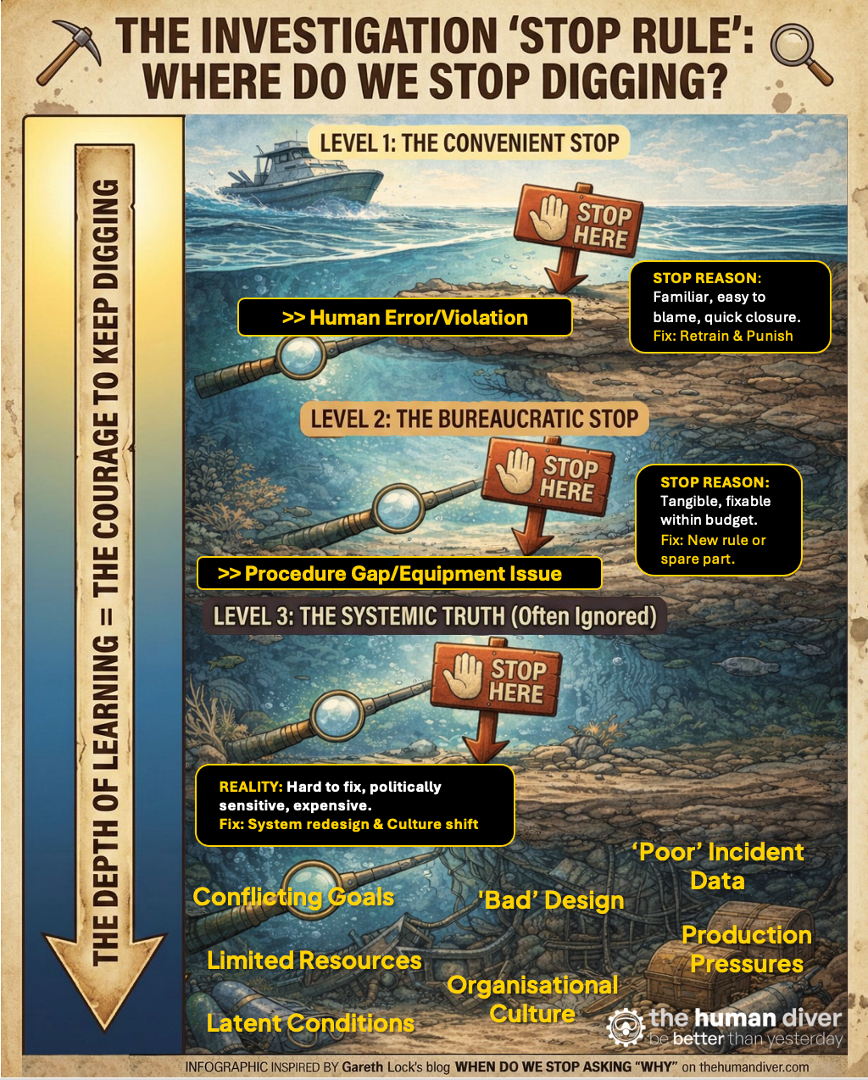
When a coroner delivers a verdict, they tell us the cause of death. Drowning. Misadventure. Medical event. What they almost never tell us is the cause of the cause of death — the conditions, the pressures, the trade-offs, the drift that made the outcome not just possible but, in hindsight, almost predictable. That's where the learning lives. Not in the verdict, but in the context.
Every time you hear the words "should have," "could have," "would have," or "failed to," you're hearing a counterfactual. A story that didn't exist being told after the fact by people who weren't there and who already know how it ended. The question that actually matters is different: how did it make sense for that person to do what they did, at the time, with the information they had?
That question changes everything. It moves us from judgment to curiosity. From blame to learning. From pinning it on the individual to understanding the system that shaped their choices.
The Tower Is Still Standing
Here's the uncomfortable truth: the conditions present during a serious accident are nearly always present during normal operations. The same gaps in the tower exist on every dive. The difference between a good day and a catastrophe is often a matter of margins — one more factor, one less resource, one moment of bad timing. Your dive operations are not perfect. They never will be. You, as a human, are filling those gaps with experience, judgment, and adaptability every single time you get in the water.
So what can you do? Be curious. Resist the pull of the first story. Ask how it made sense. Understand that the people involved in these events were not trying to hurt themselves or anyone else — they were doing the best they could with the resources available in the time they had. Develop your skills, both technical and non-technical, so that when the margins get thin, you've got something in reserve. And share your stories — not the polished versions, but the real ones — so that the rest of us can learn without having to learn the hard way.
The tower is always full of holes. The question is whether we're paying attention to the ones that matter.
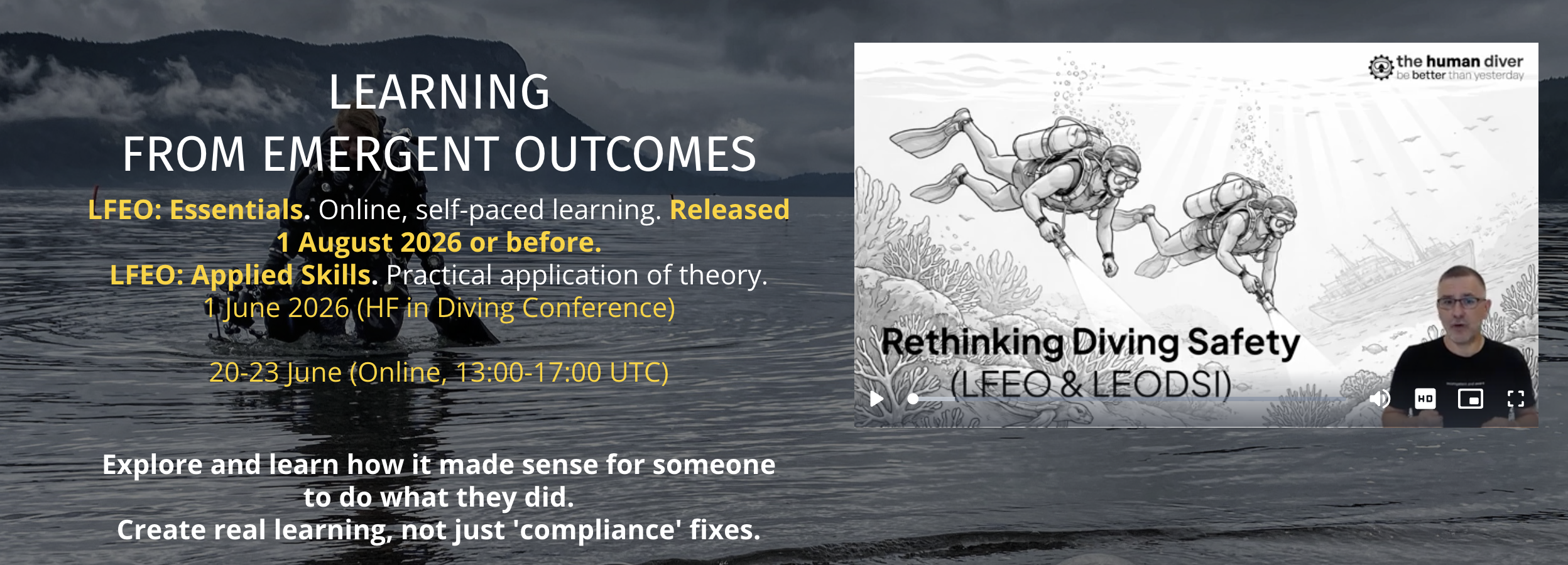
If you want to make a tangible difference to your competence, knowledge and skills, sign up to be on the waiting list for the Learning from Emergent Outcomes (LFEO) course that is being released at the 2026 HF in Diving Conference, on the island of Vis, Croatia (F2F) or the first online programme running 20-23 June (14:00-18:00 UTC).
There will be a presentation on 19 March, starting at 19:00 UTC, covering this topic in more details. Visit this group to register your interest and you'll get sent details.


