

The death of a child in diver training. There are no ‘silver bullet’ solutions
Note, this analysis has been undertaken using the court filings available here. Those filings have been prepared with a view to litigation and so the data presented will be framed for that purpose (see this blog for the purposes of an investigation). There will be many other factors and facts not yet known to the community, to parties, and to me. If the case goes to court, they may be discovered. If the case doesn’t go to court, this is about as good as it gets for information release. This analysis is primarily focused on a systems-perspective, and so information and opinion are presented with that frame of reference; hypotheses (not absolutes) are based on human factors and system safety knowledge and research. Critically, there will be people out there who know more about what is presented, but that is not publicly available. What I've written on is based on what I've got.
This analysis is not intended to assign personal blame, nor to invite online harassment or speculation beyond the available evidence. The goal is learning and prevention.
Introduction
On August 16, 2025, 12-year-old D.H. drowned during her first day of open water certification at The Scuba Ranch in Texas. Her parents had paid premium rates for "private instruction" from a NAUI-certified operation, trusting that professional oversight would keep their daughter safe.
This Learning from Emergent Outcomes in Diving Systems and Interactions (LEODSI) analysis examines not "who failed" but "how the diving system shaped conditions that produced this outcome" and what can be changed.
The PETTEOT System: Seven Elements That Interact and Lead to Success and Failure
LEODSI uses a framework called PETTEOT to understand the diving system: People, Environment, Tools & Technology, Tasks, External influences, Organisation and Time. In this incident, failures cascaded across all seven elements.
People: skills, experience, expectations, stress, fatigue, and communication
Environments: water conditions, depth, visibility, temperature, noise, and access
Technology & Tools: equipment design, reliability, configuration, automation, and feedback
Tasks: sequencing, complexity, time pressure, and competing goals
External influences: regulations, weather, logistics, commercial or social pressures
Organisation: training systems, standards, culture, incentives, and norms
Time: Time aspect considers Work as Imagined (WAI), Work as Normal (WAN) and ‘Work as Done on the Day’ (WADD), along with available time compared to the time needed to evaluate the situation, select an option, and then perform it.
People:
D.H. weighed 77.6 pounds and stood under 4'10" tall. She received 3 hours of pool training (along with 3 hours knowledge review); this is 30% of the required 10 hours. During her first dive, she visibly struggled with buoyancy control, clinging to platforms and lines to avoid floating upward. She had no training on what to do if separated from her instructor, and due to having no dive computer, no equipment to monitor her depth independently.
W.A, the instructor, arrived after working 24+ hours straight; a full day shift as an Assistant Chief Deputy Sheriff, then overnight security work, then a one-hour drive to the dive site. Fatigue severely impairs judgment, reaction time, and vigilance. There is no requirement for a fitness-for-duty assessment, leaving this to personal judgement. He and J.R. supervised 8 students in 2-4-foot visibility. This mean that it would be practically impossible to manage risk ‘as low as reasonably practicable’.
J.R, the divemaster, told D.H.'s parents: "I will not take my eyes off your daughter." In 2-4 foot-visibility, with students spread throughout the water column, that statement would be physically impossible to keep unless a 1:1 ratio was applied, but this would increase the ratio in the rest of the class. It could be argued this statement reassured parents enough to overcome their protests about group placement.
J.J., Scubatoys owner, had been recorded in 2017 saying to staff about how many students they'd killed and how their insurance broker said they could "kill two a year and be fine." This reveals organisational values where student deaths/insurance premiums were potentially part of the ‘acceptable cost-of-business’ calculations. Business risk vs safety risk.
It is known that psychological safety is poor in the industry. While there is a phrase that 'anyone can end a dive at any time for any reason', the reality is different. This phrase is akin to a 'Stop Work Authority' in high-risk activities. The research (here and here) shows that workers often only 'stop work' when they've run out of resources to achieve the goal, considering their perception of the risk if they continue and working out if can they recover their actions, and what happened to the last person who stopped work. If the goals are important, and adaptations possible, they will go ahead. Social conditioning makes it hard to speak up against authority, even if the procedure or process says they should do so.
Environment: Unsuitable Conditions Normalised
The Scuba Ranch's spring-fed lake had 2-4-foot visibility the day D.H. died; far below NAUI's 10-foot threshold for "limited visibility" and nowhere near PADI's requirement for "pool-like conditions." Multiple witnesses confirmed these conditions. Visibility routinely degraded throughout the day as training classes churned bottom sediment.
A thermocline at approximately 25 feet created a sudden transition to colder water. D.H. was found at 45 feet, nearly three times deeper than the 16-foot training platform depth. Without a depth gauge, she had no way to know she'd descended into increasingly hazardous conditions.
This poor visibility wasn't unusual, it was chronic at this facility, and yet operations continued. In this condition of extremely poor visibility, the site was fundamentally unsuitable for entry-level training, especially for children, but it could be argued that economic incentives overrode safety judgment. Not just for this training course and Scubatoys, but also for the many other dive operators using this site. The trade-off that occurs is that if you don’t dive at Scuba Ranch, you have to travel long distances to get better conditions.
Tools & Technology: Missing Critical Safety Equipment
D.H. was not provided with a dive computer, depth gauge, or timing device. Scubatoys' policy was "we don't provide those to students." This also aligns with NAUI agency guidance. This created complete dependence on instructor supervision to provide depth reference. This provides a dependency that is fragile, because we know that humans are not perfect and neither are the conditions in which we operate.
Without these instruments, when D.H. became separated she had no means to:
Know her current depth (found at 45 feet vs 16-foot training depth)
Execute a safe controlled ascent
Monitor ascent rate
There are differences between ascending in a swimming pool and in deeper water, hence the need for acceptable conditions to learn controlled ascents in confined water.
Her equipment had other problems: a fin came off immediately upon water entry, and she carried 8+ pounds of lead weight. An approximate amount of lead for a person of her weight and configuration is estimated to be 3-4 pounds.
The air consumption data shows that D.H.'s tank contained approximately 2,500 psi before her final descent and 1,650 psi when recovered. She consumed 850 psi over several minutes before she drowned.
Tasks: Complexity Mismatched to Preparation
Open water certification demands simultaneous management of:
buoyancy control,
spatial orientation,
equipment monitoring,
communication in limited visibility,
depth and time awareness,
and emergency response capability.
For a 12-year-old in a completely novel environment (first time in open water, experiencing thermoclines, low visibility, deep water), this represents an enormous cognitive load.
D.H. had only 3 hours of pool training to prepare for this complexity. She demonstrated she hadn't achieved competency, struggling with buoyancy during the first dive, yet the second dive proceeded. The task demands catastrophically exceeded her preparation level.
The task demands also exceeded those of the instructor and dive master which meant the critical controls, to make up for the lack of capacity of the student, were not able to be executed either.
External Influences: Economic Pressures and Regulatory Vacuum
Recreational diving operates in a regulatory vacuum – the Recreational SCUBA Training Council (RSTC) provides overall guidance and (minimum) standards. ISO also provides standards to comply with. In both cases, agencies are required to undertake their own quality management activities. No government oversight exists in the US (and most other locations too). Near-misses or DCS events aren't required to be reported to external authorities in most locations. The Kaufman County Sheriff's Office took brief statements and closed the investigation in less than 90 minutes after D.H. was declared dead. Only public outcry weeks and months later prompted the Texas Rangers to reopen investigation.
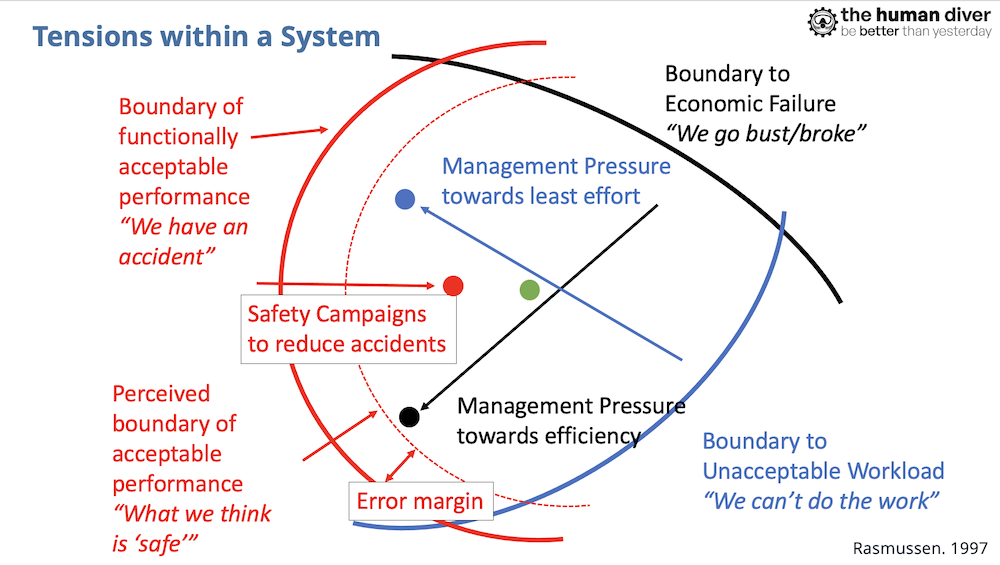
Training agencies compete for dive shop affiliations. Stricter standards drive shops to more permissive competitors, creating a "race to the bottom" on safety. High-volume operations like Scubatoys (800+ certifications annually) are most profitable. In the trade-off between performance (safety), cost, and resources (video), it is often cost that wins the game because of the perceived absence of harm (not much reporting of near-misses and adverse events).
We don’t make logical decisions in the absence of data; we use biases and heuristics (mental shortcuts) to make the leaps between judgements. Most of the time we are right, sometimes we are tragically wrong.
Insurance structures may function more as financial risk management tools than as active safety improvement mechanisms. Johnson's statement about "killing two a year and being fine" reveals insurance as cost-of-business calculation rather than safety incentive. Rates have risen consistently over recent years with a number of underwriters pulling out of the business.
Organisation: System Designed for This Outcome
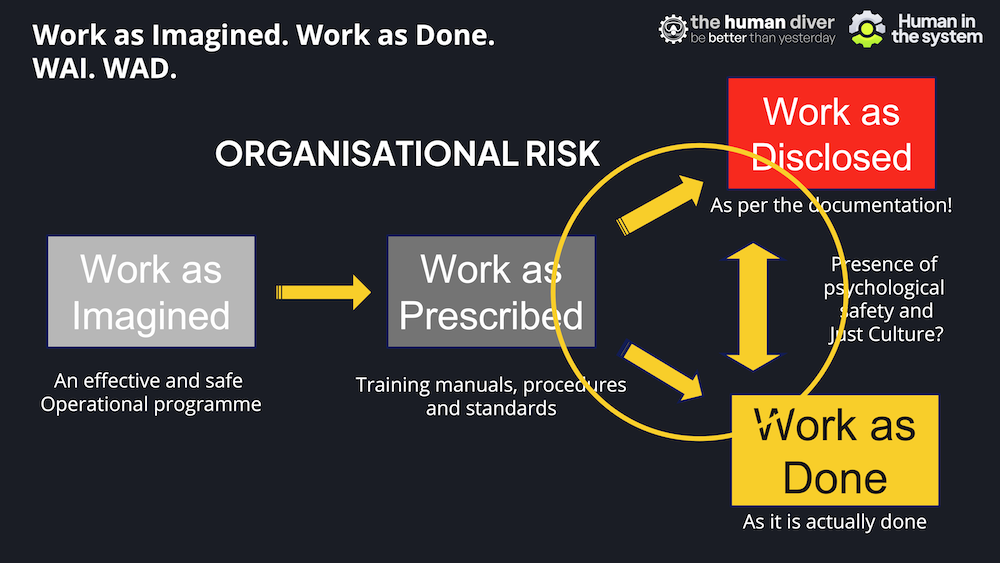
NAUI received video evidence in 2017 of J.J.'s statements. The CEO specifically declined to take any action. Regional representative R.G., visible in the video, showed no objection. NAUI had direct evidence of concerns within a high-volume facility and appears to have prioritised commercial stability over intervention. This is not a unique example of corporate or organisational culture and behaviours: Boeing, Wells Fargo, and Volkswagen are much larger examples of this. Knowledge about the gaps between ‘Work as Imagined’ and ‘Work as Done’ can be considerable, especially in large organisations where feedback is prevented because of the absence of psychological safety, a just culture and organisational structures to facilitate critical conversations.
Workarounds are normal, even in regulated environments like military aviation. The absence of adverse events along with the statement that rules are being followed, makes it easy to make the cognitive link: diving instructors say they are following rules, we have no accidents, therefore, following rules = no accidents. Whereas it is the human 'at the sharp end' who is closing the gap, and they have a finite capacity to do this.
PADI will have conducted facility inspections at The Scuba Ranch examining ‘surface level’ factors e.g., visibility of PADI products, equipment offered for rental, washroom facilities etc, as part of the oversight of being a PADI RRA member, while apparently ignoring chronic visibility problems that made the site unsuitable for some levels of training. This could be likened to the Deep-Water Horizon disaster where ‘personal and visible safety’ (slips, trips, and falls etc) were prioritised over process safety (blowout protection and commercial pressures to extract oil and gas).
Scubatoys, like many dive centres in a competitive environment, operate under a production-pressure culture where:
Training was routinely compressed (3-6 hours vs 10 required)
Equipment costs were minimised
Standards were violated as normal practice
The description of “private instruction” may not reflect the operational reality on.
Training organisation’s quality management systems and the resources available to those departments are tiny compared to the marketing department’s resources. While this is not surprising, without clear organisational and cultural structures around learning and the dissemination of information, it does limit the ability of the training organisation to identify issues and address them. Research shows that many barriers to learning from adverse events have their genesis at the organisational level and the 'protectionist' structure of the training and 'fun diving' systems.
Diving instruction is a hobby or part-time activity for many involved in the industry. This can mean diving is an income top-up for some, it also means that other personal or professional tasks can take priority over time and rest, leading to last minute changes in the scheduling for a dive operation. Ad hoc teams (classes) are formed without the knowledge of how to generate psychological safety quickly, which can make it hard to raise concerns when things have moved too far from an acceptable standard. When the financial constraints are tight, there is little slack in the system if instructors/staff drop out, and others may be required to undertake more work than is ‘safe’. More on this in the 'time' section. In the absence of serious adverse events, these ‘safe’ outcomes could be ascribed more to luck than judgement.
“The purpose of a system is what it does.” – Stafford Beer.
The system wasn’t malfunctioning; it was producing the results its current incentives and constraints make likely. Economic incentives and rewards lead to adaptations and workarounds, while enforcement is absent because of limited financial resources at the organisational level. The normalisation of deviance isn’t about rule-breaking per se, it is the social acceptance of the drift from standards thereby increasing risk, or making new standards with lower thresholds around ‘safe’ operations to maximise financial compensation.
Work as Imagined vs Work as Done: The Dangerous Gap
The following provides a way of looking at the differences between Work as Imagined (the standards), Work as Normal (routine for this and other shops, but not necessarily all shops), and Work on the Day of the Dive (as per the court filing). The 2021 HF in Diving Conference covered this topic at this timestamp in my presentation.
Work as Imagined (the standards):
10 hours minimum pool training
Training in pool-like conditions with good visibility
Students equipped with depth gauges, and maybe dive computers
Maximum 8:1 ratios, reduced for conditions and student age
Rested instructors maintaining visual contact
Immediate recognition of missing students
Work as Normal (routine practice):
3-6 hours pool training typical
2-6 foot visibility accepted as "normal for this site"
No dive computers provided (shop and agency policy)
8:1 ratios maintained regardless of conditions
Fatigued instructors working multiple jobs
Reactive response to problems
Work as Done on the Day (the fatal dive):
Only 3 hours pool training
2-4 foot-visibility
No dive computer, depth gauge, or timing device
Instructor with 24+ hours without sleep
Group "spread out feet-first" descent (loss of visual contact)
Multiple minutes before recognising D.H. missing
30 minutes from last seen to recovery
Each level of deviation and adaption seemed reasonable locally but combined catastrophically.
How It Made Sense at the Time
This is where LEODSI differs from traditional incident analysis. Rather than judge decisions in hindsight and on severity, we ask: "How did this make sense to those involved?" Note, all there is to go on is the case filings, and therefore the following statements are hypothesised not factual.
The Instructor may have thought "I've taught tired before. The ratio is standard-compliant. Visibility is normal here. Students passed pool training so they're ready."
The Divemaster may have thought: "I'm certified to do this. I've supervised students in these conditions successfully before. The instructor is in charge. It's hard to challenge the status quo."
The Course Director may have thought: "The student demonstrated basic skills. Three hours in the pool seemed adequate. We do hundreds of certifications this way annually. If NAUI thought this was wrong, they'd have acted on that 2017 video."
The parents may have thought: "We paid for professional instruction. NAUI and PADI are legitimate organisations. The divemaster promised constant supervision. They wouldn't let our daughter dive if it wasn't safe."
The NAUI leadership may have thought: "We provide standards. We can't monitor every dive. Enforcement would drive shops to competitors. This is the shop's responsibility, not ours."
Each perspective seemed locally rational while contributing to systemic failure.
System Interactions: How Factors Combined
No single failure caused this tragedy. Serious injuries and fatalities happen when the capacity to fail safely has been exceeded. When we increase the number of interactions where margins are small, the likelihood of failure increases. Examples of multiple factors interacting are described below:
Inadequate in-water training (3 hours) × Poor visibility (2-4 feet) = Inability to self-rescue when separated
Severe fatigue × 8-student supervision = Degraded monitoring capability
Missing depth gauge × Thermocline at 25 feet = No awareness of descending into hazard
Production pressure × Weak enforcement = Normalised dangerous practices
8:1 ratio × Low visibility = Mathematical impossibility of visual contact
Excessive weighting × Small body mass = Inability to achieve positive buoyancy
Delayed recognition (minutes) × Disorganised search (30 minutes) = Loss of viable rescue window
The outcome emerged from combinations, not isolated causes. None of these on their own were necessary for failure, but the combination of 'normal' factors leads to a condition where no margin or capacity for 'safe' diving remains. A question to consider - if D.H. hadn't died, would these same latent conditions still be present for someone else to encounter?
Time is often missing from investigations. Not real-world time. But the time needed to execute an activity, and how much slack there is in the system.
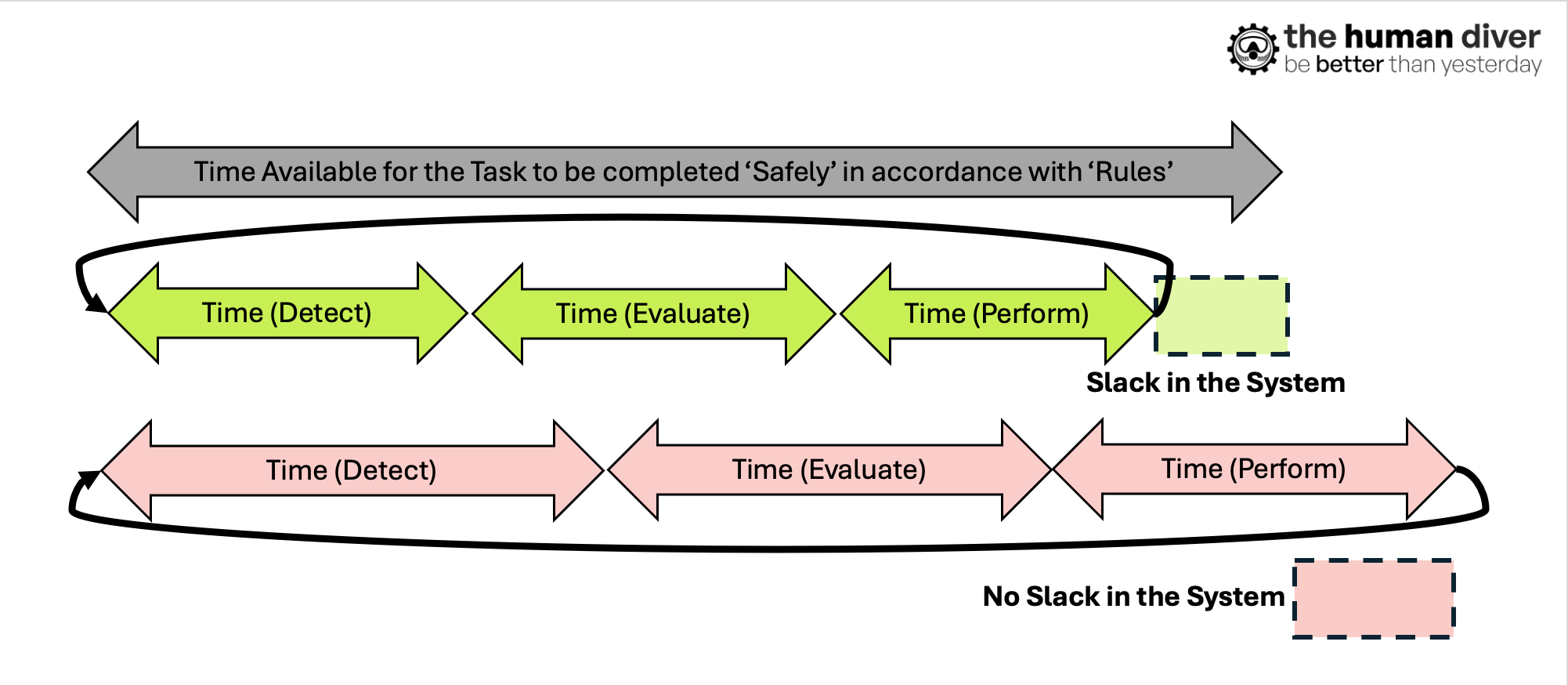
To execute an activity, there is the time needed to detect that something needs to be done, then options need to be developed and evaluated, the action needs to be performed, the response happens, and we then see if that made a difference. If the time available is less than the sum of these parts, margins are eroded or workarounds are often applied to achieve goals. Performance Influencing Factors (PIFs) like high workload, limited visibility, and lower levels of competence, all impact the timelines needed to successfully execute an activity. When slack or capacity are removed (because they have a cost and can be seen as inefficient), the system becomes brittle and failure can happen more quickly that the system can detect and correct. This coupling and fragility is what contributed to the shoot-down of two US Army UH-60 helicopters in Northern Iraq by two USAF F-15 pilots.
Learning Responses: What Can Change
The following are examples of what can be done to shift the needle. Some are simple, some are more complex and require substantial organisational, financial and educational commitment by stakeholders within the industry. At Rebreather Forum 4.0, I made the statement that "change comes from a politically-relevant event, and fundamentally, there are not enough dead divers to make a difference to the status quo." There isn’t enough emotional or political pressure to create change that counters the commercial drivers in the industry. While the task might feel huge, small changes can lead to massive change over time. As my friend Guy Shockey said when describing the work of The Human Diver, every blizzard starts with a single snowflake…
Immediate Actions
Mandatory dive computers for all students from first pool session
Ratio reduction: Maximum 4:1 for students under 16; 2:1 or 1:1 in visibility below 10 feet
Fitness to practice: Instructors must verify adequate rest before teaching (although this could be ‘gamed’ like medicals)
Environmental restrictions: Suspend entry-level training when visibility falls below 10 feet
Equipment verification: Mandatory pre-dive buoyancy and weighting checks
Hobby mentality: Moving from a ‘hobby’ mindset to a 'professional' activity operating within an inherently hazardous environment
System-Level Changes
Training redesign:
Enforce 10-hour minimum confined water training – although how this could be done is hard to say if this is already the standard
Require demonstrated buoyancy mastery (objective test) - same agencies already have this
Add mandatory separation response training
Match training duration to student age and development – difficult given the ‘one size fits all’ across all environments and competencies
Instructor development to focus on competency development for ‘real-world’ diving and not just passing an entry-level class
Include materials focused on leadership, cognitive biases, and ‘difficult’ conversations
Develop competencies within professionals around operational risk management (diving) and not risk management that primarily focuses on liability management
Organisational accountability:
Independent oversight (not agency self-regulation) – STANEVAL model from aviation could work.
Mandatory incident reporting to external database using learning-focused language not ‘non-compliance’ – these need to be funded and resourced correctly. 'Legal Discovery' might be an issue.
Consequences for repeated violations - not sure what this looks like
Transparent safety records (facility and instructor level)
Develop a learning culture focused on forward-looking accountability for continuous improvement
Cultural transformation:
Shift from "certification as goal" to "competency as goal"
Reward quality over quantity
Break silence around industry incidents, including teaching about psychological safety, just culture, and how to write incident reports/outputs based on learning opportunities rather than focusing on non-compliance
Consumer education on recognising quality training
Economic restructuring:
Insurance premiums tied to safety performance and performance development (without it being target orientated).
Incentives rewarding safety over throughput
How much will actually change?
How much of this is actually embodied within the industry will ultimately depend on existing inertia and the quality of leadership willing to confront it. Some recommendations are relatively low‑cost and easy to implement. Others carry profound cultural, operational, and financial consequences that require real commitment and sustained effort.
At this point, we are back to the central risk‑management question: the ongoing tension between business risk and safety risk. Every organisation navigates this tension daily, whether consciously or not.
As Steve Shorrock has observed, safety culture can be defined by how an organisation manages the constant tensions and trade‑offs between the competing goals of acceptable performance, available resources, and workload. In practice, this means balancing what is economically viable, operationally feasible, and ethically responsible, often under pressure.
In an inherently hazardous environment, “safe” does not exist as an absolute. What exists is “safe enough.” And what constitutes “enough” is rarely objective. It is shaped by experience, emotion, incentives, expectations, and context. Different people, at different times, will answer that question differently.
There are no silver bullets. There is only the daily work of sense-making, noticing threats, making informed decisions, learning from failure, supporting one another, and having the discipline to act when caution is inconvenient. Irrespective of where you are in the organisation.
Real progress will not come from slogans or checklists alone. It will come from leaders and professionals who are willing to balance care with competence, efficiency with responsibility, and ambition with humility, again and again, even (and especially) when no one is watching.
That is the work of safety and operational excellence.
Conclusion
D.H.'s death was not a random accident; it emerged from a system whose structures, incentives, and adaptations made these conditions possible. There are social, moral, technical, and cultural needs that need to be met following a serious injury or fatality and these haven been demonstrated online recently. Often these needs are in conflict with each other.
Her parents trusted professional certifications, brand names, and explicit promises of supervision. Multiple layers of trust did not hold under operational pressure; not by individual malice, but by systemic design that prioritised economic efficiency over potential loss of human life, something demonstrated in many other domains.
When ‘learning systems’ or quality management systems do not show the ground truth, it is impossible to see how many margins are being eroded until the system fails catastrophically. We only have to look at the Challenger and Columbia shuttles, and more recently and relevantly, the grounding and loss of HMNZ Manawanui, the death of military divers LCpl Partridge and ADR Yarwood, to understand what happens when you erode margins and human capacity fills the gaps. Until it can’t. Steve Smith’s recently published book ‘Safety Science for Outdoor and Experiential Education: Were we lucky or were we good’ provides a research-based perspective to high-risk outdoor education and is highly recommended for anyone who wants to dig deeper into this topic.
The diving community has a choice: continue the current system where standards exist on paper, but workarounds and adaptations are routine, where enforcement is absent, where economic pressures drive dangerous shortcuts, or fundamentally redesign how we train, supervise, and protect student divers and prepare them for the ‘real world’. Change happens because of a politically-relevant event, many thought that the loss of Linnea Mills’ life would be that change, but it wasn’t.
LEODSI doesn't ask "who failed?" It asks: "How did the system shape the conditions that produced this outcome, and how can we redesign the system to prevent recurrence?" We don't need fatalities to trigger change.
D.H. deserved better. Every student diver deserves better. The system must change.
Relevant blogs to consider to expand your knowledge about investigations, their purpose, why we blame, and the use of language in reporting.
When the Story Hurts Too Much to Change.
What Is the Purpose of an Investigation in Diving? Four reasons, some in conflict with others.
What story gets told? What words are used? Who gets to the tell the multiple stories? How we frame the stories makes a huge difference as to the learning potential from an event. Who tells the story shapes the learning too.
When Do We Stop Asking “Why?” This isn't about 'Five Whys', it is about how and why we stop digging in an investigation. We can't keep going back in time/space, here's why we potential stop sooner than we should.


