

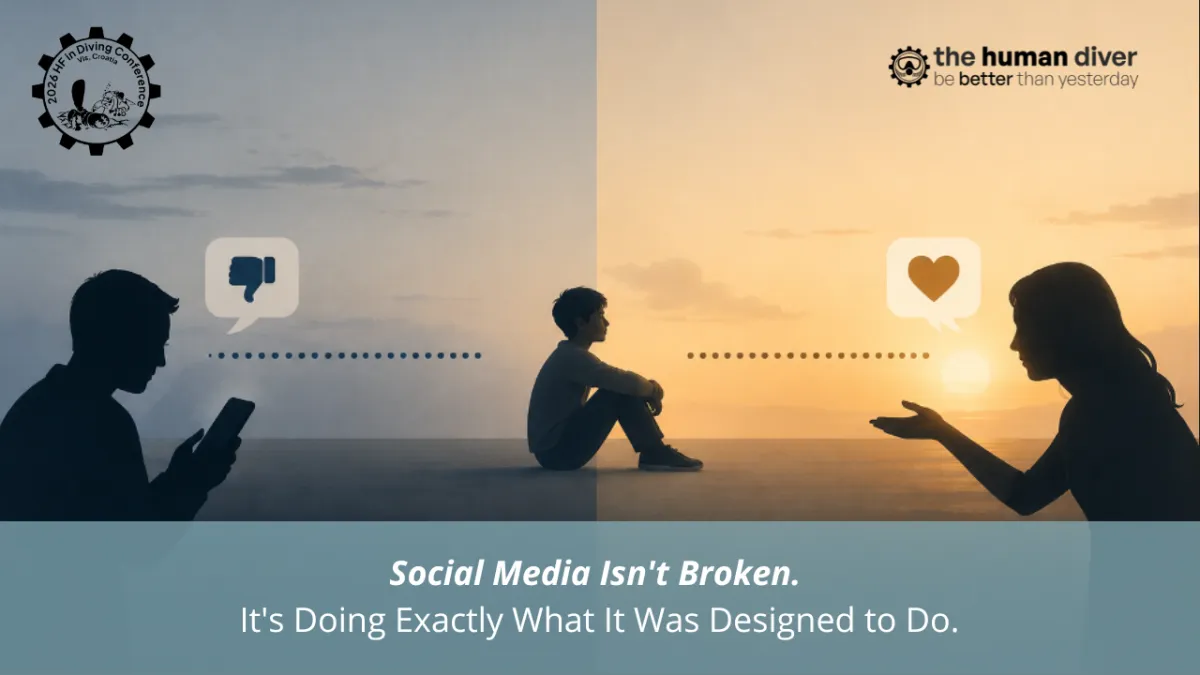
6. Social Media Isn't Broken. It's Doing Exactly What It Was Designed to Do.
Every time a serious diving incident appears online, the same pattern unfolds. Someone shares a news article or a brief description of what has happened and, within minutes, the comments begin to accumulate. The first few responses are often expressions of sympathy, but they rarely remain that way for long. Before investigators have reached the scene, before witnesses have been interviewed and before anyone has established what actually happened, the discussion has often shifted from concern to certainty. Someone identifies the mistake, someone identifies the rule that must have been broken, and someone inevitably explains why they would never have found themselves in the same situation.
The recent tragedy in the Maldives, where five Italian divers lost their lives, followed precisely this pattern. Within hours, social media had already produced countless explanations and assigned responsibility with remarkable confidence, despite almost no verified information being available. It would be easy to dismiss this as the behaviour of a few loud voices on the internet, but I think that misses the real issue. The problem is not simply that some people enjoy criticising others. The problem is that the environment we have created actively rewards certainty, emotion and judgement while making curiosity, nuance and uncertainty much harder to sustain.
The Business Model Behind the Conversation
Social media has become the most influential learning environment the diving community has ever known. Thousands of divers now rely on Facebook groups, forums and other platforms to share experiences, seek advice and discuss incidents that, only a decade ago, would probably have remained within individual clubs or training organisations. This phenomenon has enormous potential. We have access to more experiences, more perspectives and more opportunities to learn than at any point in the history of sports diving.
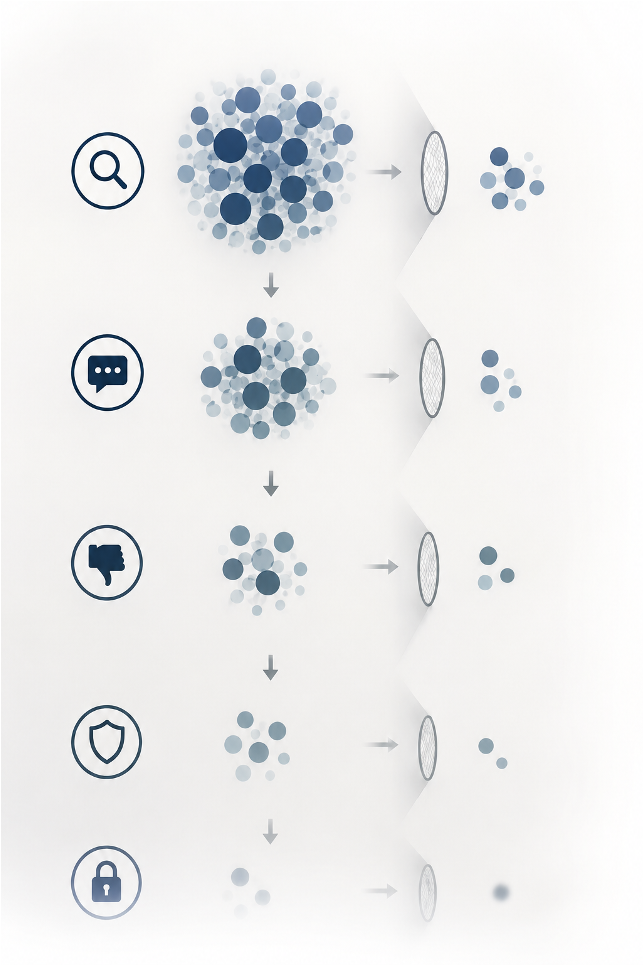
The difficulty is that these platforms were never designed to optimise learning. Their purpose is to maximise engagement. Every click, comment, reaction and share becomes evidence that a post is capturing attention, encouraging the algorithms to distribute it more widely. Emotionally charged and morally loaded content spreads further than balanced, reflective discussion, not because it is necessarily more accurate but because it provokes stronger reactions. Outrage attracts replies, certainty attracts agreement, disagreement fuels debate and the resulting engagement tells the platform that more people should see exactly the same type of content. Before long, the posts that dominate our newsfeeds are rarely those that promote understanding; they are those that provoke the strongest emotional response.

People Become Characters
Something else changes once an incident enters this environment. The people involved gradually stop being people.
The instructor becomes “reckless and negligent." The experienced diver becomes “a cowboy with an ego." The student becomes "the novice who should never have been there." Real lives, relationships and circumstances disappear behind labels that make the story easier to consume and much easier to judge. Complex events involving dozens of interacting factors become simple narratives with obvious heroes, villains and lessons.
Many of the people writing these comments genuinely believe they are contributing to safety. A statement such as, "They should never have entered the cave," is often intended as advice for others rather than an attack on those involved. Yet these comments frequently serve another purpose that is much less obvious. They also communicate something about the person writing them. Publicly identifying what someone else did wrong becomes a way of demonstrating competence, signalling experience and reassuring ourselves that we belong on the safe side of the line. The victims become the backdrop against which we present our own identity as careful, knowledgeable and responsible divers.
The Stories We Never Hear
Perhaps the greatest cost of this culture is not what gets written beneath incident posts but what never gets written at all. Most divers who read these discussions never contribute to them. They simply observe how the community responds when someone admits to making a mistake or becomes involved in an accident.
Imagine experiencing a frightening incident yourself. Perhaps you became separated from your buddy, mismanaged your gas, missed an important cue or found yourself overwhelmed by a situation that, with hindsight, seems straightforward. You think about sharing the experience because there are valuable lessons within it, but then you remember the last fatality that appeared online and the hundreds of comments ridiculing the people involved. The calculation becomes simple. Remaining silent feels much safer than becoming the next cautionary tale.

Over time this changes the stories our community tells. Rich, detailed accounts become shorter. Context disappears. Ambiguity is edited out. Some incidents are never shared at all. Ironically, the experiences that contain the greatest learning value are often the very ones least likely to survive in an environment where vulnerability is routinely met with criticism.
Choosing a Different Conversation
None of this suggests that standards no longer matter or that accountability should disappear. Diving, like every high-risk activity, depends upon good judgement, sound decision making and a willingness to hold ourselves and others to high standards. The issue is not whether accountability has a place; it is when it enters the conversation.
If our first response to every incident is deciding who was wrong, we often stop searching for the conditions that made those decisions appear reasonable at the time. We lose interest in understanding because we have already satisfied our need for an explanation. Curiosity gives way to certainty, and certainty is a surprisingly poor teacher.
Social media is not going away, nor should it. It has connected divers across continents and created opportunities for shared learning that previous generations could scarcely have imagined. The challenge is recognising that these platforms are not neutral. They amplify what captures attention rather than what develops understanding. They reward confidence over humility, certainty over curiosity and performance over vulnerability.
The next time a diving incident appears in your newsfeed, resist the temptation to become another investigator armed only with hindsight and a comment box. Instead, ask yourself a much simpler question.
Is my contribution helping the community understand what happened, or am I simply helping the algorithm decide what everyone else sees next?
Please note - all the ideas contained within this blog are my own. It is written by me and then tweaked by AI to make it easier to read.


