
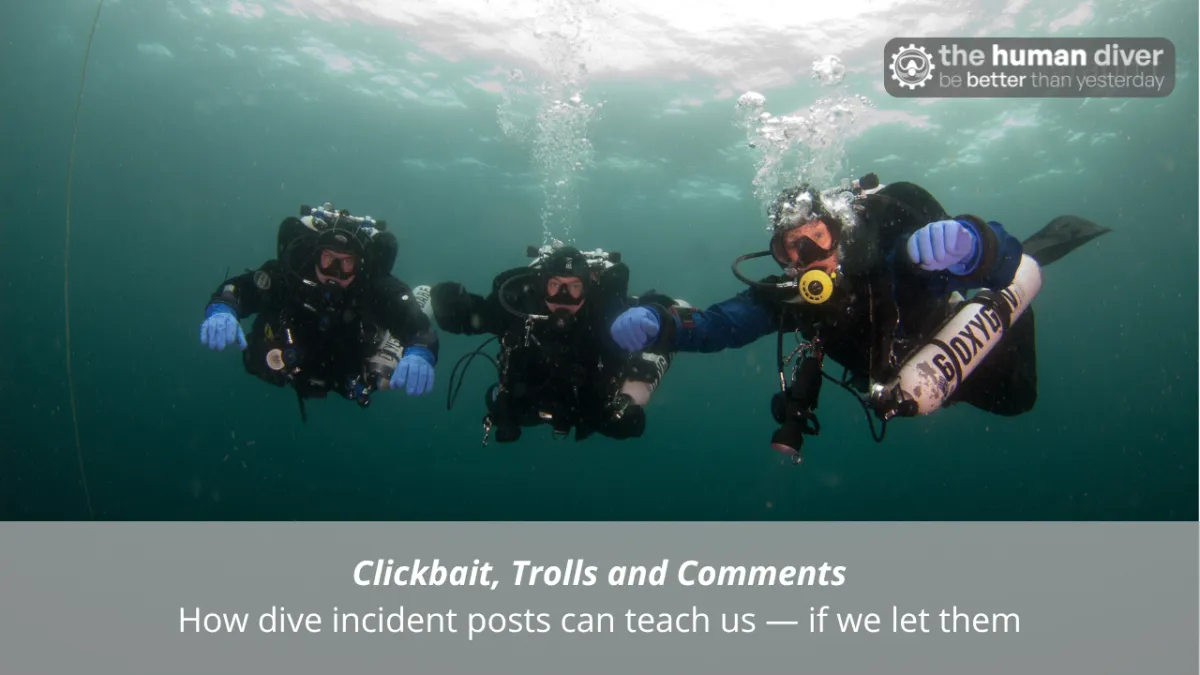
Clickbait, trolls and comments. How dive incident posts can teach us — if we let them
As you spend more time browsing any diving Facebook group, a familiar pattern begins to emerge. This pattern is, by definition, more than an occasional anomaly. It is a recurring feature of how incidents are discussed, interpreted, and ultimately understood within the community.
So how does this pattern form? In general, the first thing is a short post appears, often written quickly and with limited detail, outlining a sequence of events that has already concluded, sometimes with serious consequences.
A diver is named or implied.
A chain of actions or a timeline is described.
Importantly, the outcome is known from the outset.
Comments arrive quickly, often within minutes, and they tend to converge on a similar tone and direction. The language becomes more certain, the judgements sharpen, and the discussion accelerates toward a collective conclusion that feels decisive, confident, and, on the surface at least, constructive.
“He should have checked his gas.”
“There is no excuse for that.”
“This is basic training.”
Within a short space of time, the complexity of the incident is compressed into something far simpler: a story about an individual who made a mistake, and a group of observers who believe they would not have made the same one.
It has the appearance of learning, yet what is actually taking place is something quite different.
The issue lies less with individuals and more with the structure of the story
The instinct to analyse, critique, and suggest alternatives is neither surprising nor inherently problematic, particularly in a domain where consequences can be severe and experience is often hard-won. However, the nature of the response is heavily shaped by the way the incident is presented in the first place.
When an event is described as a short, linear sequence, i.e., this happened, then that happened, and then the outcome followed… the narrative (largely subconsciously) invites a very specific cognitive response from those reading it. The gaps in the narrative do not remain neutral or unresolved; instead, they are filled in (either implicitly or explicitly) quite rapidly by the reader, who draws on their own experience, assumptions, and, critically, their own knowledge of how the story ends.
A substantial body of research across safety science, psychology, and media framing demonstrates that simple, linear narratives consistently drive readers toward individual-level blame attribution, with attention naturally drawn to the actions of the person at the centre of the story and away from the broader system in which those actions took place. Humans are inherently lazy (or efficient if you’re a ‘glass half-full’ person) and a linear narrative fits our nature. It is simple. We like ‘simple’.
Note that while it is indeed simple, this response is most definitely not a reflection of poor intent or lack of professionalism; it is the predictable outcome of how human cognition processes information when outcome knowledge is already available. Decisions that were made in a dynamic, uncertain environment are reinterpreted through the lens of certainty, and actions that made sense at the time are judged against a standard that did not exist in the moment.
From a distance, and with the benefit of hindsight, the dive appears straightforward. From within the dive, as it unfolded, it was anything but.
The first story is compelling; the second story is instructive
Most incident posts on social media remain firmly anchored in what might be described as the first story, which focuses on what happened in a chronological and often simplified sequence.
A diver descended.
A problem emerged.
A critical action was missed or delayed.
The outcome followed.
This form of storytelling is efficient, accessible, and well-suited to the constraints of social media platforms, where brevity and clarity often determine whether a post is read, shared, or ignored. It also travels quickly, precisely because it is easy to process. And we’ve already said that we like this sort of thing.
However, its usefulness as a learning tool is limited.
The second story requires a different approach, one that seeks to understand why the actions taken made sense to the individual at the time, given the conditions they were operating within.
This involves expanding the frame of the narrative to include factors that are often omitted:
What were the environmental conditions and how were they evolving?
What information was available to the diver, and how reliable was it?
What expectations or mental models were guiding their interpretation of the situation?
What pressures – time, task, social, or cultural – were shaping their decisions?
As soon as these factors are introduced and the answers considered, the narrative shifts from a simple account of failure to a more complex exploration of human performance within a system. The diver is no longer reduced to a single action or omission, but is understood as part of a broader set of interacting factors.
It is within this second story that meaningful learning begins to take shape.

Why the comments follow such a predictable path
The structure of the original post does more than frame the incident; it strongly influences the nature of the responses that follow. In fact, the structure is critical.
Simple narratives not only encourage hindsight-driven analysis but also make it difficult for readers to develop any meaningful sense of the diver’s perspective. Without access to the conditions, constraints, and uncertainties present at the time, there is little opportunity to build empathy or to understand how the situation evolved from the inside.
In the absence of that perspective, readers often default to comparison and separation.
Statements emerge that subtly, or sometimes explicitly, position the commenter as different from the individual in the story:
“You wouldn’t catch me doing that.”
“I always check mine.”
“This is why standards are slipping.”
This form of distancing serves a psychological function, reinforcing the belief that the incident could not happen to the person making the judgement. It creates a divide between “us,” who operate correctly, and “them,” who do not.
Once this divide is established, the tone of the discussion tends to harden, and the space for more reflective or exploratory contributions begins to narrow.
At the same time, the dynamics of the platform itself play a significant role. Social media algorithms are designed to amplify content that generates engagement, particularly when that engagement is emotionally charged or morally framed. Expressions of blame, outrage, or condemnation tend to attract more interaction, which in turn increases their visibility and reinforces similar responses from others.
Over time, this creates a self-reinforcing cycle in which certain types of responses become more prominent, not necessarily because they are more accurate or useful, but because they are more engaging. This is clickbait in action.
What this does to learning over time
As this pattern repeats across multiple incidents and discussions, its impact extends beyond individual threads and begins to shape the broader learning environment within the community.
Blame-focused commentary tends to reduce complex events to a small number of simplified lessons:
Check your gas.
Maintain awareness.
Follow procedures.
While these points are valid, they do little to explain how situations develop in the first place or how similar conditions might arise again in slightly different forms. They focus on the final link in the chain rather than the chain itself.
Perhaps more importantly, the expectation of judgement influences what people choose to share. If the anticipated response to an incident is criticism or ridicule, then it is entirely rational for individuals to protect themselves by limiting the amount of context they provide, or by avoiding sharing altogether. Stories become shorter, less detailed, and more defensive in tone.
The result is that the very information required to support deeper learning is filtered out before the discussion even begins.
This dynamic is central to ongoing research into diving social media narratives, which proposes that simpler posts attract more blame-focused commentary, and that this form of commentary represents a poorer learning outcome than the more systemic, context-driven discussions associated with richer accounts. I personally feel that this sort of research may produce conclusive findings that go further than merely ‘poorer learning outcomes’ and will possibly suggest that the path we’re on is actively making diving less safe.
A system producing predictable outcomes
It is important to recognise that this pattern does not depend on the presence of trolls, nor does it require individuals to be acting in bad faith.
Experienced divers, instructors, and well-intentioned community members contribute to this dynamic regularly, often without recognising the broader effect of their contributions. The combination of narrative structure, human cognitive processes, and platform design leads to outcomes that are remarkably consistent across different groups and contexts.
When these elements align, the result is a discussion environment that tends to favour ‘certainty’ over curiosity, simplicity over complexity, and judgement over understanding.
What can be changed
The constraints of social media platforms are unlikely to change, and the underlying features of human cognition are not something that can be easily altered. However, the way incidents are described and the way they are interpreted remain within the control of the community.
A shift in narrative structure does not require extensive detail or academic language, but it does require a deliberate effort to include the factors that shaped the decisions being examined.
Instead of focusing solely on what happened, there is value in exploring what made those actions appear reasonable at the time:
What was the diver attending to, and what were they missing?
What cues were present, were they noticed, and if so, how were they interpreted?
What constraints, perceived or real, limited the available options?
What expectations influenced the decisions that were made?
Beyond how they’re written, there is a great deal of value in how these posts are read and interpreted.
Before moving quickly to counterfactual statements about what should have been done differently, it is worth pausing to consider what information is absent, how the situation may have appeared from within, and how hindsight may be shaping the interpretation.
These are not abstract considerations; they are crucial steps that influence the quality of learning that emerges from each discussion.
Allowing the post to do its job
Social media remains one of the most accessible and widely used platforms for sharing experiences within the diving community, offering a reach and immediacy that formal reporting systems cannot replicate.
It has the potential to support meaningful learning at scale, connecting divers across locations, experience levels, and disciplines. At the same time, it is structurally biased to favour certain types of narratives and responses over others.
Whether a particular post becomes a source of insight or simply another example of collective judgement depends less on the platform itself and more on how the story is constructed and how it is engaged with.
Clickbait will continue to exist, comments will continue to follow, and strong reactions will always be part of the landscape.
So what can we do about it?
The next time an incident post appears in your feed, there will be a moment – often brief – before the familiar pattern begins to take hold. It is the point at which the story could remain a simple account of failure, or begin to open into something more useful to learn from.
Instead of reaching immediately for what should have been done differently, consider what might be missing from the account, what the situation may have looked like from within, and what made the actions taken appear reasonable at the time.
If you choose to comment, shape it in a way that invites understanding rather than closes it down. If you choose not to comment, reflect on why – because that decision in itself might say quite a lot about the environment the community is creating for itself. Caveat: I do accept that you simply might not have time to comment!
Every post, and every response to it, contributes to what others come to expect when they consider sharing their own experiences. Over time, those expectations determine whether the stories that matter most are told in full, or reduced to something safer, shorter, simpler and far less useful.
And that, more than any individual comment, is what ultimately shapes how much our community is able to learn.


