
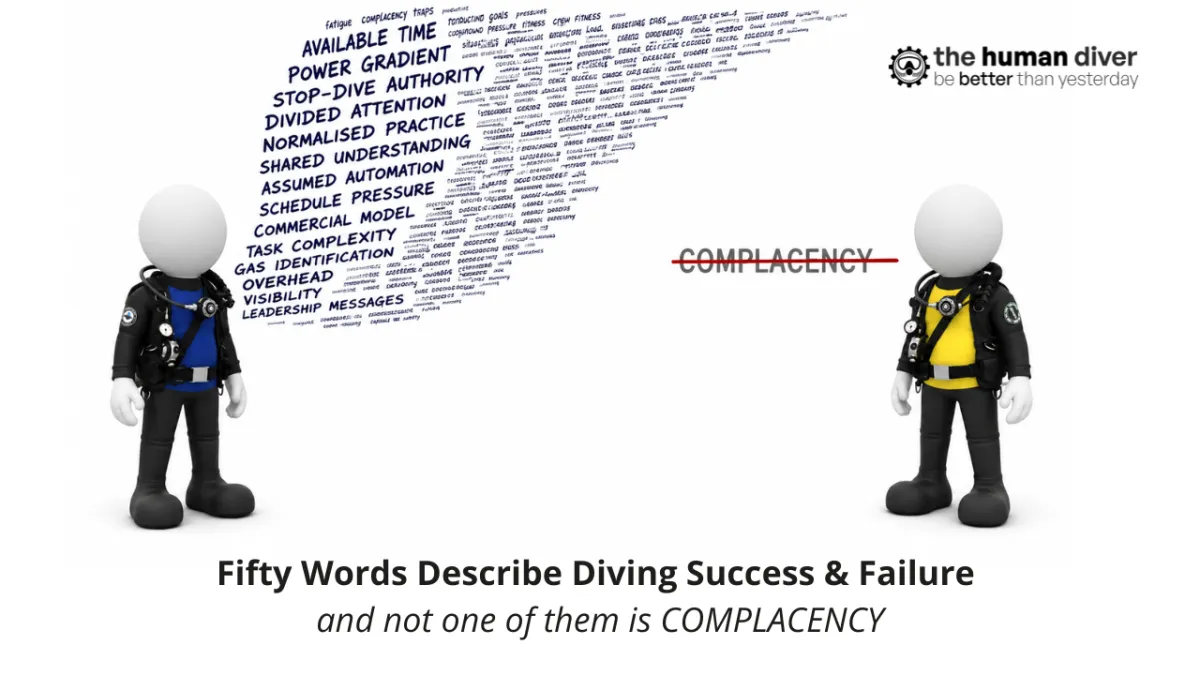
Fifty Words Describe Diving Success & Failure and not one of them is complacency
Along with root causes, we talk about contributory factors in diving incident discussions all the time. But we rarely define them! The same is true of performance influencing factors (PIFs) and error producing conditions (EPCs). While we talk about them in the HFiD: Essentials, HFiD: Applied Skills, and the HFiD: Masterclass, it isn't in much detail. The terms end up in incident talks and at conferences, often as a kind of "here, address these", but nothing really happens because they aren't specific. Time for that to change.
The Energy Institute (EI) has just published a document that helps us. EI 3646 sets out thirty-eight performance influencing factors, or PIFs. They are grouped into seven categories, with definitions and around 150 worked examples. It was written for the energy sector and can be downloaded for free from here https://www.energyinst.org/technical/publications/topics/human-and-organisational-factors/research-report-a-proposed-human-factors-performance-influencing-factors-pif-taxonomy. The EI accepts the document is a work-in-progress and are looking for feedback. Importantly, hasn’t been tested/validated but it is a great starting point to codify what we point at when we say that “conditions or context shaped behaviour”.
What a PIF actually is. And what it is not.
PIFs came out of human reliability analysis. That is the branch of engineering that puts numbers on how likely a person is to make an error during a task. Different methods use different terms. Performance shaping factors, error producing conditions, error traps - they all describe the same thing but from slightly different angles.
The EI uses a simple working definition. A PIF is a condition in the context that affects how well a person performs, recognising that the effect can be positive or negative, because conditions can improve performance as well as reduce it. PIFs are outcome agnostic.
In most domains, including diving, we look at PIFs as being negative, focusing on them when something has gone wrong. We use them to explain a bad outcome, but rarely do we use them to explain the three hundred ‘good’ dives, in the same water, with the same team, using the same kit.
The report is also specific about what a PIF is not. Errors, mistakes and deliberate breaches of a procedure are not PIFs. Nor are the deeper decisions that created the conditions in which workers (divers & diving instructors) have to operate. The report uses an example of a bowtie model and puts PIFs in the middle. The PIFs are the preconditions that sat under the final action or inaction of the individuals involved. Below those sit the contributing causes or latent conditions, which are usually about policy, money, leadership and strategy. The areas we look up and out to.
The link between a PIF and the action is one of likelihood. A PIF is not a cause; it made the action more likely. The distinction might be semantic, but it is also the reason the approach does not fall back onto blame.
The report's worked example is a spanner falling from height onto someone's head.
The barrier was a sealed tool bag.
The immediate cause was that the spanner went into a back pocket instead.
The preconditions were the time available and the messages from leaders about finishing on time.
The underlying causes were cost pressure and a change of leadership team.
Move that into diving and we can see the parallels. A rebreather diver enters the water in surface mode with the oxygen cylinder turned off. The barrier was the pre-dive check. The immediate cause was that the check was run from memory while on the boat. The preconditions were the time left before the boat had to move, the fact that the diver had done this dive dozens of times, other things (personal and professional) taking up cognitive space, and a group where nobody was watching anyone else's pre-dive checks being done. The underlying causes sit further back, in how the day was planned and who was responsible for what. If you look at the documentary “If Only…” you will see how this plays out for real, unfortunately leading to a fatality.
Words make a difference: the wording problem
This is where Steve Shorrock's work comes in. In 2023 he wrote a piece called Set Taxonomies to Neutral. It is a public critique of his own PhD work. He built TRACEr, a scheme for analysing thinking errors in air traffic control, and it was taken up across Europe and beyond. His argument twenty years on is that the method was built to describe what went wrong, so all of its language was negative, and that language then shaped what its users could see.
His central point is that most safety schemes give you a hundred terms for the tiny slice of work that goes badly, and no terms at all for the huge slice that goes well. If all your words describe deficits, you cannot answer two useful questions.
Why is this operation working when it works?
Which of the things we do now would we want to defend when someone tells us to be more efficient?
His fix is simple. Set the scheme to neutral. Strip out the adjectives and the prefixes: poor, inadequate, incorrect, mis-, failure to.
Inadequate supervision becomes supervision,
Poor teamwork becomes teamwork,
Incorrect decision becomes decision.
What is left is a term for something that was present, and we believe we should focus on, and importantly, no verdict attached before we start talking about things. A bit like understanding what has happened before you run through a Just Culture algorithm.
If we turn to diving to see how our own bodies define what should be reported. NAUI's material describes diving incidents as usually the result of poor decisions or bad judgment and adds that many happen because divers are beyond their training and experience. IANTD's rescue material sorts every cause of injury into two boxes: unsafe conditions and unsafe acts. Both of these are verdicts dressed up as categories, telling the person filling in the form what kind of answer is wanted before they have described anything.
Then there is 'complacency', which is the word we so often hear as a ‘cause’. It is not a condition - it is a judgement about a person, arrived at once we know the outcome, and it explains nothing about the situation they were in. Divers are rarely ‘complacent’ in their own account of their dive - they were confident, or busy, or working from a picture of the situation that turned out to be wrong, and because those conditions are defined, we can ask about them.
The EI report makes the same criticism of its own industries, and it was one reason members asked for a new scheme. Factors worded in the negative describe things that were absent, and absences cannot influence anything. A condition that was not there did not shape a decision; something that was there did. The report's own requirement is that factors should describe what was present.
Seven categories from high-risk domains translated to diving
The EI groups its thirty-eight factors under seven headings, which came from asking what an investigator would want to know. Every one of them has a direct diving equivalent.
Organisational influences covers competing goals, safety culture, leadership messages, policies, and training and competence. In diving this is the agency standard and the dive centre's margin, the instructor whose income depends on courses completing, the power gradient between a course director and a new instructor, and what happens to the person who calls a dive off.
Documentation, procedures and information covers procedures, risk assessments, signs and labels, handovers, displays, alarms, and changes that nobody passed on. In diving this is the standards manual, the unit manual, the checklist and the dive plan. It is also the analysis sticker on a cylinder, the head-up display, and the brief that assumed everyone heard the same thing.
Social, supervisory and team influences covers team dynamics, communication, supervision, staffing, roles, shift patterns and cultural norms. In diving this is who is watching whom, who feels able to call a dive, the assumed shared understanding in a buddy pair, and the group of five with no clear leader.
Task influences covers task difficulty, time available, split attention, familiarity and planning. Diving has all of these, and it also has a problem of its own. A routine task done at depth, under a N2 or CO2 narcotic load, is not the task it was in the classroom or the quayside.
Work environment covers physical conditions, weather, layout, terrain and hazardous energies. This is the one area where diving is already fluent. Viz, current, temperature, surge, boat traffic, overhead.
Equipment and tools covers what kit was there, whether it suited the task, its condition, how easy it was to use, the interface, and automation. This is where rebreather diving lives. Two of the factors are worth explicitly pointing out: assumed automation is the belief that a system will handle something it will not; and overreliance on automation, the skill decay that follows from letting it.
Person factors covers competence and experience, physical capability, fitness for duty, workload and personal motivations. Fitness for duty takes in fatigue, mental state, medication, illness and distractions from home life. That last one hardly ever shows up in a diving incident report, and it is present on a great many dive days, including “If Only…”
Anyone who has worked through PETTEOT will recognise most of this. The mapping is close and you can download a diving PDF version of this from here which uses PETTEOT as the framework. Person, environment, tools, tasks, external influences, organisation and time cover the same ground at a broader level. What the EI adds is detail and definitions. PETTEOT tells you where to look, and a scheme like this one tells you what to write down when you get there, with the term carrying the same meaning for the next person who reads it.
What neither of them tells you is how to get the information out of a person who was there. A factor only exists in the incident data if somebody said the thing that puts it there, and people do not volunteer conditions because many don’t recognise their importance in shaping outcomes. This means those running an inquiry need to explicitly ask about them. Carefully. By someone who is trusted and who is known not to be looking for a culprit.
This is what the Learning from Emergent Outcomes (LFEO) programme is built to do. LFEO is the process that holds PETTEOT together and turns it into something a dive centre or a club can actually run and then use for learning. It works through Learning Teams rather than a single investigator, and it has discovery and analysis phases where we seek to understand the event and surrounding system description before anyone looks for conclusions and solutions. During these phases, these factors the EI has described become visible to divers. In diving, we don’t have anything like this to help us learn from adverse or positive events. Investigations that do happen in diving are often directly linked with legal cases, and there is no incentive to be open there.
So I have built such a taxonomy. Like the EI one, it isn't tested against data, but it is starting point. It is structured on PETTEOT rather than on the EI's seven categories, and it runs to fifty factors.
Person,
Environment split into physical and social,
Tools and technology,
Tasks,
External influences,
Organisation, and
Time.
Every factor is worded neutrally and describes something that was present. Six of the fifty have no equivalent in the EI list, and they are the places where diving is not the energy sector: the physiological change that happens to a person during the task rather than before it, the distance to a chamber, and the four elements of the time model.
None of the fifty is complacency.
Further growing the capability of the diving industry through the LFEO course, I have also published a set of prompts to support students in the course ask better questions during the discovery and analysis phases of the programme. Better Questions for the System Description - also built around PETTEOT and the time model, and it works from two habits.
Ask about the conditions that were present rather than the ones that were absent, because a 'lack of' explains nothing and tends to close the conversation down.
Keep returning to local rationality, which means asking how it made sense to do what was done, given what was known at the time.
The guide also lists the questions that close people down.
Why didn't you just..?
Didn't you think to check..?
What should you have done..?
Whose responsibility was that..?
These are the spoken version of a deficit-worded scheme. They carry the verdict inside the question, and once someone is defending themselves you get the account they think you want rather than the one that happened. The taxonomy problem and the interview problem are the same problem but in two places.
Why this is difficult for diving
Rebreather Forum 4 agreed a consensus statement on this. Analysis of accident and incident data should look at wider context and error producing conditions, and not just the immediate factors. The community has already signed up to the idea, and the gap is that agreeing to look at something is not the same as having the words to write it down.
As always, it isn’t that simple in diving! The EI report exists to help organisations pool findings across many events so that patterns show up. Diving cannot do that. Yet. We do not know how many divers there are, how many dives are made, or how many events happen that nobody hears about. Coding a handful of published fatalities against thirty-eight factors would give us a table with no denominator and no meaning. However, that doesn’t mean we shouldn’t look to be consistent from now. Every dataset started with a single entry!
Shorrock's own cautions apply to diving.
Setting a bad scheme to neutral does not make it a good one; it makes it slightly better.
A good scheme is also worth little if the reporting is thin, or if the people doing the analysis have not been trained to look past the nearest person.
As explained in so many places, the value isn't numerical and quantitive, but in the narrative and the talking. These schemes make certain terms normal, and the terms shape the conversations people can have. Words make worlds.
Think of an instructor debriefing a student who messed up on a skill. That conversation goes one way if the available words are task difficulty, split attention and time available, and quite another way if the only word on offer is concentration. This is the valuable point we consistently make about teaching human factors to the diving community – give people a vocabulary and they can now describe what the issues are in a way we can address them.
What this looks like on your next dive or course
Take the terms and use them in a debrief where nothing went wrong. Which conditions today made this easier, and which made it harder? Ask that after the good dives as well as the bad ones, because it is the only way to find out what you are relying on before the day it is not there. This aligns with the DEBrIEF format for I and E. What did we do well? Why? What needs to be improved? How? The question set linked above works just as well on a dive that went to plan as on one that did not, and if you want the wider process around it, that is what LFEO: Essentials and LFEO: Applied Skills cover.
When something does go wrong, write down the conditions that were there rather than the ones you wish had been there – avoid counterfactuals.
Instead of a lack of supervision, describe the supervision that was in place and what it was doing.
Instead of poor communication, describe the communication that happened and what was in it.
Then ask why those conditions existed, because that question moves you past the dive and into the organisation, and the organisation is where lasting change happens.
This doesn’t make analysis quicker, rather it makes it more transparent and valuable. Transparent and clear is what we need it to be if leaders and organisations are going to act on it.
Question time!
If you are an instructor or dive leader, and you had to describe what made your last good dive a good one, using words that carry no verdict or judgement, could you do it? If you went to describe a dive that didn’t go to plan, and had an adverse outcome, how hard would it be not to use judgemental words?
Sources:
Energy Institute (2026) EI 3646 Research report: A proposed human factors performance influencing factors (PIFs) taxonomy;
Shorrock, S. (2023) 'Set Taxonomies to Neutral'


