
LEODSI and PETTEOT: A Systems Approach for Understanding How Diving Really Works
When something goes wrong in diving, the question most people ask first is: "Who made the mistake?" It's an understandable impulse. We want a clear answer, something actionable, someone to hold accountable. But that question, as natural as it feels, almost always leads us away from understanding rather than toward it. It gives us a story that feels complete but leaves the system unchanged. And that means the next diver, in similar conditions, with similar pressures, faces the same risks, because we never looked at what actually shaped the outcome.
LEODSI, Learning from Emergent Outcomes in Diving Systems and Interactions, exists to ask better questions. It's a framework developed specifically for the diving community that treats any diving outcome, whether it's an incident, a near-miss, or a dive that succeeded against the odds, as something worth understanding in full systemic context. The name itself is the philosophy: outcomes emerge from systems, not from individuals acting in isolation. LEODSI is not a course, that is what the Learning from Emergent Outcomes (LFEO) courses are about. LEODSI is pronounced 'lee-odd-see'.
Why Diving Has to Be Understood as a System
Diving is complex. No two dives are the same, even when the site, the plan, and the equipment appear identical. Visibility shifts. Fatigue accumulates differently. Team dynamics change. A diver who has completed a hundred wreck penetrations on familiar ground still encounters a system that is slightly different every time. Conditions are variable, information is incomplete, and the plan is always, to some degree, a fiction that reality will modify.
That means we cannot explain diving outcomes by looking only at what one person did in the final moments before something went wrong. Outcomes are emergent. They are produced by the interaction of multiple elements across time, and that's precisely what LEODSI is designed to capture.
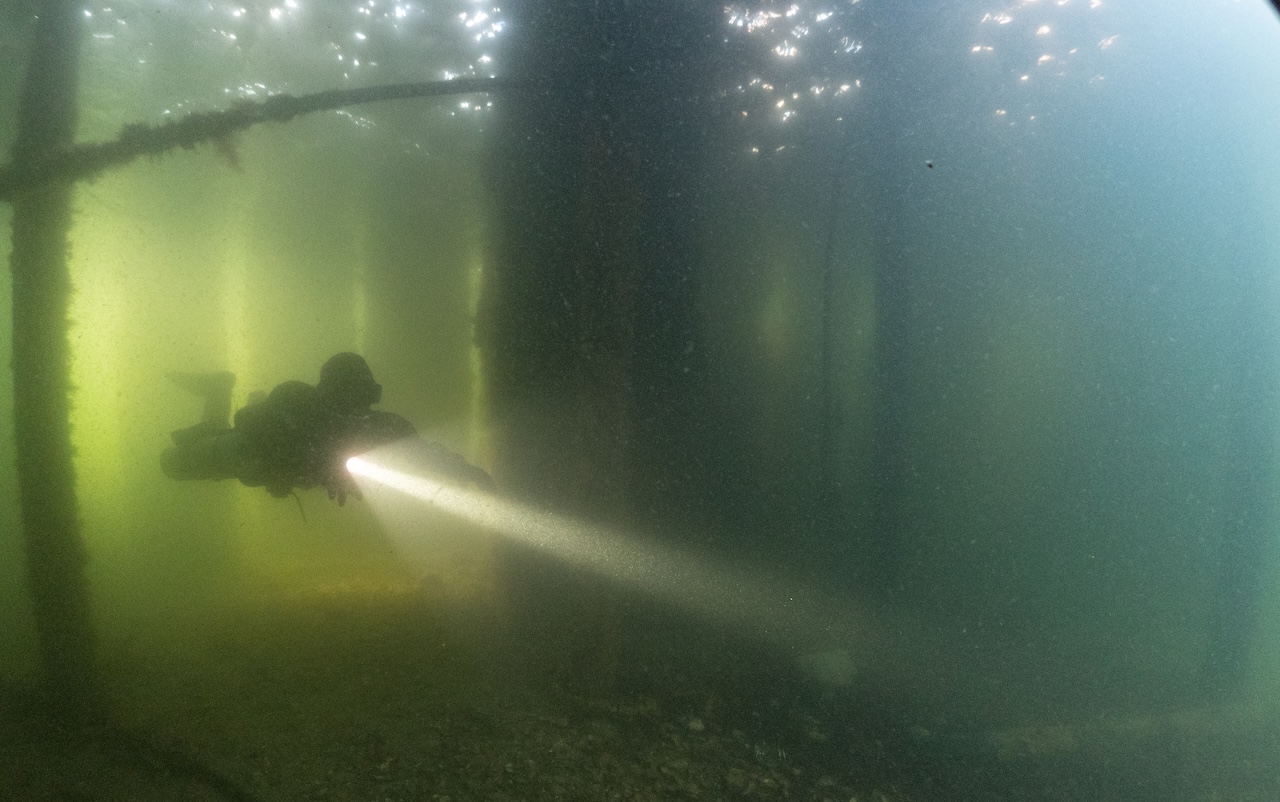
Image courtesy of SANTI
PETTEOT: The Seven Elements of the Diving System
LEODSI analyses diving through a structured model of the work system called PETTEOT. The acronym stands for Person(s), Environment, Tasks, Tools and Technology, External Influences, Organisation, and Time, pronounced 'pett-ee-ott'. These are the seven elements whose interactions shape every dive, whether it ends safely, badly, or somewhere in between:
Persons are critical to the model, because they contribute to both success and failure. Not them as individuals, but their skills, experience(s), physical and cognitive states, expectations, fatigue, confidence, and the ability to speak up when something doesn't feel right: all of these are in play on every dive. LEODSI deliberately uses "person(s)" to reflect that much of diving is team-based, or at least involves multiple people taking part in the activity. The interaction between divers, instructor and student, buddy pair, expedition team, is itself a system element.
Environment covers what divers actually experience in the water: current, visibility, temperature, depth, noise, and access. These are not neutral backdrops. A 3°C thermocline at 30 metres changes cognitive capacity. A surge that wasn't forecast changes workload. The environment interacts with everything else in the system.
Tasks describes the sequencing, complexity, and competing demands of what divers are trying to do. Photography and navigation are both legitimate goals, but they compete for attention. Deco management and buoyancy control are both critical tasks, but under stress, one may dominate the other. LEODSI asks how tasks were structured, what was competing, and whether the task design set people up to succeed or to struggle.
Tools and Technology covers the equipment divers depend on: how it's designed, configured, and how well it communicates with the diver. A dive computer alarm that is subtle and easy to miss in high workload conditions is not a neutral object. It's a system element that shapes whether a diver gets useful feedback at the moment they need it.
External Influences acknowledges that a dive doesn't happen in a vacuum. Weather, boat schedules, regulations, commercial or social pressures, and logistics all shape what decisions are available and how much slack the system has. When the boat leaves at noon regardless, the surface interval gets compressed. When limited site access creates pressure to complete a dive, divers and teams stretch their margins.
Organisation addresses the training systems, standards, cultural norms, incentives, and informal rules that shape behaviour before anyone enters the water. This is often where the conditions for an incident are created, long before the dive day. The instructor who has learned that debriefs are routinely cut short, the dive centre that normalises running behind schedule, the training programme that has never examined the gap between the standards it publishes and the way training actually gets delivered: these are all organisational realities that LEODSI takes seriously.
Time is the seventh and most recently formalised element, and it's one that traditional incident analysis consistently makes invisible. Time is not simply when things happened. It is an active system element that shapes performance, decision-making, and safety margins throughout a dive. LEODSI analyses time through three lenses: Work as Imagined (WAI), the planned timeline and what the standards and briefings assumed would happen; Work as Normal (WAN), what actually happens when things go "normally," including the routine workarounds and adjustments that experienced practitioners make; and Work as Actually Done (WADD), what happened on this specific dive, on this specific day.
The gap between these three perspectives is where much of the real learning lives. Consider an open water course scheduled to take place at an inland dive site. WAI assumes adequate visibility for a four-to-one instructor ratio, with enough bottom time per student to attempt each skill, receive feedback, and repeat it where needed. WAN knows that conditions at this site are variable, and experienced instructors quietly build in a buffer. On this day, visibility drops to no more than two metres. The ratio reduces to two students per instructor to maintain any meaningful supervision at all, which immediately halves the available water time per student across the group. The session runs to its scheduled end because the site closes at 5pm. Every skill gets completed. Ticks appear in every box. But the temporal compression created by the visibility change meant that feedback loops were shortened, repetition was reduced, and the debrief that should have addressed what students found difficult was squeezed into ten minutes on a cold quarryside picnic bench. WADD tells a different story to WAI: the course was delivered, but the conditions under which mastery is actually built were not present for much of it.
What LEODSI Does That Other Approaches Don't
Most incident analysis in diving stops at the point where human error becomes legible. A diver ran low on gas: poor gas planning. A student panicked during skill practice: inadequate preparation. A diver didn't turn the dive: poor decision-making. These explanations feel satisfying, but they're actually the beginning of the analysis, not the end of it. They tell us what happened. They tell us nothing useful about why it made sense to the people involved at the time, or what in the system made it likely.
LEODSI starts from a principle of local rationality: the idea that decisions made sense to the people involved, given what they knew, what they were trying to achieve, and the conditions they were operating in. This doesn't mean decisions were correct. It means we have to understand them before we can learn from them. Hindsight makes competent divers look careless, and careless solutions look obvious. LEODSI deliberately works against that distortion.
Rather than asking "what caused this?", LEODSI asks "what interactions across the system shaped this outcome?" That shift matters enormously. In a near-miss where a diver surfaced with minimal gas remaining, a linear analysis says poor gas planning. A LEODSI analysis reveals that tasks competed for attention, the dive computer alarm was subtle, the current increased workload beyond what the dive plan anticipated, an informal team norm stretched dive duration, and limited site access created pressure not to abort. The outcome emerged from the combination, not from a single error. Fixing only one element, reminding the diver about gas checks, leaves every other contributing condition untouched.
LEODSI Is Not Just for Incidents
One of the most important aspects of LEODSI is that it's designed for everyday use, not just post-incident review. DEBrIEFs structured around PETTEOT can follow any dive. The question isn't only "what went wrong?" It's "what were we trying to achieve, what actually happened, why was there a difference, and what can we learn?" Applied to a successful technical dive where the team managed an equipment problem and exited safely, that same framework generates equally valuable insight. We learn what the system did well, where the margins were thinner than planned, and what conditions made safe adaptation possible.
This is the Safety-II perspective embedded in LEODSI: that learning from what goes right is at least as important as learning from what goes wrong, and that the two processes use the same analytical lens. The goal is continuous improvement, not incident-triggered reaction.
Using LEODSI in Practice
The framework is deliberately modular and scalable. A recreational buddy pair can use the core questions after a dive in ten minutes. An expedition team can apply the full PETTEOT template across a week of diving to identify system patterns. An instructor can use LEODSI to review a training programme and identify where the gap between Work as Imagined and Work as Done has created unacknowledged risk. No part of the toolkit is mandatory. Its value comes from use, not completion.
What it does require is a willingness to look honestly at the system rather than quickly at the individual. It requires the psychological safety to say "this is what actually happened" rather than "this is what the debrief sheet says should have happened." It requires leaders who treat adverse events as information about the system, not evidence of personal failing.
The diving community has enormous untapped capacity to learn. Every dive generates data. Every near-miss contains insight that could prevent a fatality. Every successful adaptation under pressure contains knowledge about what makes systems resilient. LEODSI is the structure that lets us capture that learning, share it honestly, and use it to be better than yesterday.
That's the whole point.
At the HF in Diving Conference running between 31 May and 5 June, the first live LFEO course will run, taking numerous case studies and applying the LEODSI tool to them. This will lead to outputs similar to the blogs here and here.


