

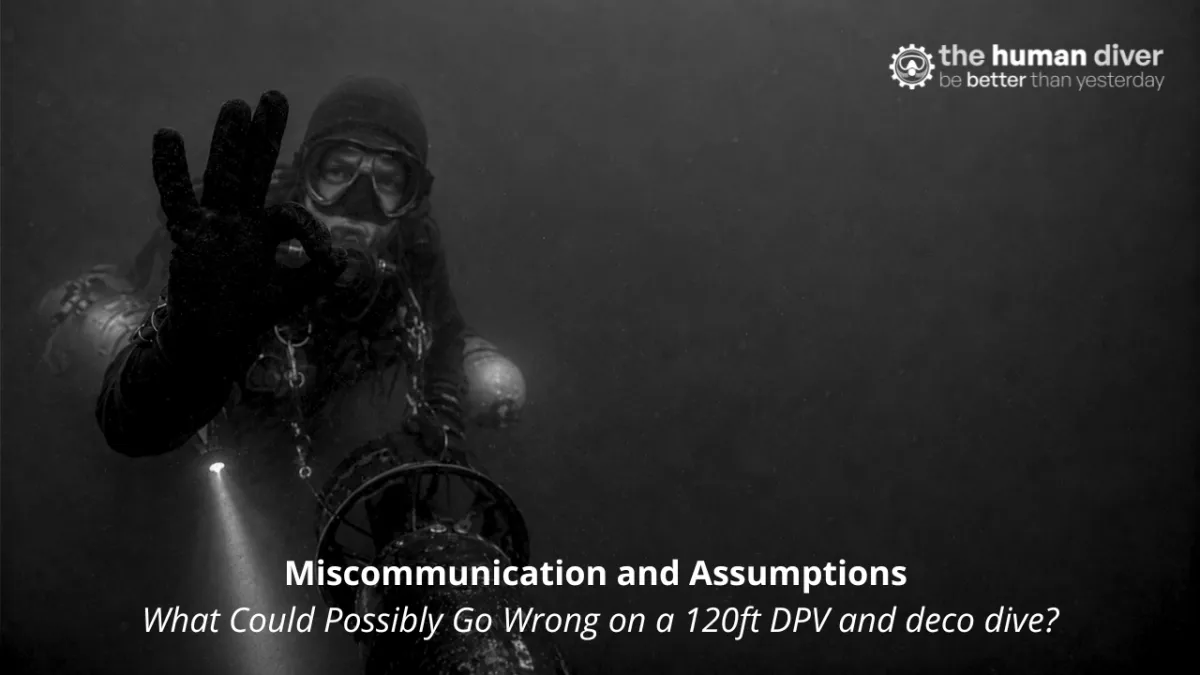
Miscommunication and Assumptions - What Could Possibly Go Wrong? A HF Perspective.
This blog was submitted as an anonymous account to help with community learning. All names, sites, and identifying details have been removed or generalised. While you read this, don't think how different this is to your own diving experiences and how you wouldn't do this, look for the similarities in both performance and context. It is a long account, but the account and analysis are spot on.
Background and Pre-Dive Decisions
I had recently completed technical diving training (advanced nitrox and decompression procedures) and was approaching my 500th dive. I wanted the milestone to be memorable, and an experienced technical diver I had taken classes with — my teammate for this dive, and from here on just "my teammate" — wanted to be part of the celebration. This was not a class dive. I chose a wreck sitting at roughly 120 ft in fresh water. She knew the site and explained that it involved a long surface swim and was better suited to DPVs. When she asked whether I had DPV experience, I told her plainly: I knew only the theory and had never used one.
Two teammates owned scooters. One agreed to lend me his, confirming it was weighted for fresh water. The other declined to lend his, but gave two pieces of advice: do several DPV training dives first, because a DPV disrupts buoyancy — "it's simple, until it is not" — and take reels, plural, because the last time he dove this wreck the permanent lines were cut in more than one place.
I asked her directly for her external perspective on whether I was ready to add a first-ever DPV to a decompression dive at a new site. I told her I did not want to be carried away by the excitement of the dive. She reassured me that buoyancy is only tricky when changing depth, and that the plan — scoot on the surface, drop on the buoy, scoot along the bottom line — would be fine. She borrowed a second DPV and we built the plan: about 25 minutes of bottom time with roughly 10 minutes of accelerated decompression on 50%. I did not do the recommended DPV training dives and I did not take a reel. I had convinced myself the DPV risk was handled and that she knew the site well enough to find the wreck.
The Dive
On the day, everything checked out: dive plan, gases, DPVs, emergency O2 kit. From the first minutes the DPV fought me — I struggled with the trigger and fell behind on the surface swim. We descended and visibility dropped to about 5 ft. The plan of clipping the DPVs collapsed immediately: we found a marker, but no line. We dragged the scooters while searching. I was too close to the bottom, silting the area, breathing faster than I had on any dive, with tingling starting in my arms and legs.
At one point I stopped inside my own silt-out, computer pressed against my mask, flashing my light until my teammate found me by feel. She asked if I was OK. I was not — but I gave the automatic OK. I wanted to push through. I did not want to disappoint. It was my 500th dive.
She found the line at minute 20, and only then did we start riding the DPVs along it. Mine nose-dived into the silt and tangled in weed; I held it choked against my body, working harder still. At minute 25 we had not found the wreck and turned the dive. My pressure read 800 psi in each sidemount tank at 117ft; my rock bottom was 600 psi per cylinder. To me, that reading meant it was time to go up, and I signalled it twice. I later learned my teammate read the same number as "above rock bottom, we're fine."
We ascended, and I switched to my 50% deco bottle at 70 ft — but by then I was in survival mode: a death grip on my teammate's harness, reflexively finning upward while she fought to deploy her DSMB. I never switched the gas in my dive computer, and my teammate could not switch her gas at all because of my grip; she made the judgment call to omit her own decompression rather than leave me. We did as much decompression as I allowed — about 9 of the 10 planned minutes of accelerated deco for me. When we surfaced, our computers read 23 minutes of omitted deco.
Those numbers deserve care, because "we omitted 23 minutes of deco" is not what actually happened. I had been on 50% for 8–9 minutes and was, practically speaking, nearly clear — but because I never switched the gas in my computer, it kept calculating on back gas, and I had no confirmation that my saturation was coming down. The genuine omission was my teammate's: she never got to switch at all. Even so, with our computers set conservatively against the gradient factors we had planned, she surfaced under 100% surface GF. The physical risk turned out to be far smaller than the number on the screen; the psychological load of that number, in the moment, was not.
On the surface we stopped all exertion, breathed both deco bottles empty, left our gear in the water, walked slowly to the car, and breathed emergency 100% O2 for about half an hour while watching for symptoms. Post-dive analysis of the profile showed that for 14 minutes — the deepest, most work-intensive part of the dive — my gas density exceeded 6 g/l, peaking at 6.2 g/l. My heavy breathing and panicked sensations were very likely narcosis, CO2 retention, or both.
Triggers and Stressors
DPV not starting and lagging behind the team from the start
Low-visibility descent (~5 ft) at depth
Not finding the line; the expectation of clipping off the DPV at the line was not possible
DPV sinking, dragging, and the feeling of losing it
Breathing hard; suspected CO2 build-up and/or narcosis
Seeing 800 psi in each tank at 117 ft — used to diving with ample gas and never having to lean on a gas plan
Uncertainty about rock bottom vs. "peace of mind" pressure — not knowing how much gas was enough
Adding gas to the suit; possibly overweighted, or should have added gas to the harness instead
Tingling sensation in arms and legs
Not finding the wreck
Feeling of not getting enough gas from the right tank
Worry about the deco obligation on back gas
Mask flooding
A moment of "this is it"
What Helped: Actions That Worked
Stopped, waited out the silt, and waved my light rather than moving blind
Checked tank pressure and switched regulators correctly
Cleared a flooded mask under stress
Calmed myself down at three points: when my teammate found me in the silt-out, when we found the line, and when I switched to deco gas
Managed the gas switch to the 50% deco bottle correctly (though I did not switch my computer to the deco gas)
Controlled floaty legs on the second try; dumped gas from the suit, legs up
Signalled my pressure twice and insisted on ascending
On the surface: stopped, no exertion, breathed the deco bottles empty, left tanks in the water, walked slowly out, and breathed 100% O2 while monitoring for DCS symptoms
Post-Dive: Denial and Delayed Symptoms
The five days after the dive were marked by denial. I had a DCS hit six years earlier — treated on a Table 6 in a recompression chamber — and even then it took me two days to call the diver emergency hotline. This time, muscle pain appeared in my left arm two days after the dive. I told myself it was the death grip on my teammate's harness plus a recent return to the gym. I called my teammate; she thought I would be fine and that it was not DCS — and I heard exactly what I wanted to hear. I did not call the diver emergency hotline, and I am still asking myself why not. The honest answer: I was too embarrassed to admit I had screwed up, and afraid it would cost me the diving I live for. The symptoms evolved and resolved by the fifth day.
Conclusion: A Human Factors Analysis
I have rewritten this conclusion using the human factors approach taught in the diving human factors community: the goal is not to identify who failed, but to understand why the decisions we made seemed reasonable to us at the time — local rationality — and what conditions shaped those decisions, so that other divers can recognize the same conditions before their own incident, not after.
Local rationality: why it made sense at the time
No one on this dive intended to take a foolish risk. I raised the DPV question myself, asked for an external check, and got reassurance from the most experienced person available to me. She genuinely believed the risk was handled: surface scooting, drop on the buoy, clip off the DPV. If the line had been intact, we would probably have had an uneventful dive — and that is exactly the trap. A good outcome would have validated a flawed plan. The plan was built for the best case and had no contingency for the very failure a teammate had explicitly warned us about.
Drift and discounted warnings
Two clear warnings were available before the dive: a teammate's advice to do DPV training dives first because "it's simple, until it is not," and his report that the lines on this wreck were cut in more than one
place. Neither warning made it into the plan. I rationalized the first ("we'll only scoot on the surface and clip at the line — how difficult can it be?"), and the second simply never became a contingency.
Goal fixation and plan continuation
The dive was loaded with meaning before we ever hit the water: dive number 500, a cool wreck, a diver I admired there to celebrate it. That created summit fever. Underwater, every cue that should have prompted a pause or a thumb — the silt-out, the breathing rate, the tingling limbs, the failed DPV handling — was absorbed in favor of continuing. I was ready to end the dive for many minutes and kept hoping my teammate would thumb it for me, rather than doing it myself. Plan continuation bias kept us pushing toward the wreck until minute 25 of a 25-minute bottom time.
Communication and the automatic "OK"
When my teammate asked if I was OK, I said OK while not being OK. That single moment is where the dive was recoverable and was not recovered. It was not a lie so much as a script: pride, embarrassment, perceived peer pressure, and the wish not to disappoint produced the automatic answer. We also lacked a shared mental model on gas: 800 psi at 117 ft meant "we go up now" to me and "we're above rock bottom, we're fine" to her. Rock bottom had been calculated but not briefed as a shared, actionable trigger with an agreed response.
The authority gradient: one conversation, heard two ways
The responsibility for this dive is mine. I made the decision to get in the water, and I gave the OK that was not true. What I want to examine here is not what my teammate did wrong, but how two people acting in good faith can leave the same conversation with opposite understandings of what was decided — because I believe that gap, more than any single decision, is what set this dive up.
Before the dive, I asked her directly whether I was ready to use a DPV for the first time on a decompression dive. I heard her answer as her OK for the dive. Looking back, she may have been doing something quite different: turning the question around and inviting me to assess myself. When we debriefed afterwards, she told me, "I did not want to push my will upon you." That is consistent with a mentor deliberately leaving the decision where it ultimately belonged — with me. The problem is that neither of us checked which conversation we were actually in. Across an authority gradient — and one existed here even though this was not a class dive — a less experienced diver who asks "am I ready?" will hear almost anything short of a clear no as endorsement. Her respect for my autonomy and my need for her judgment passed straight through each other, and nobody noticed.
The same unspoken mismatch followed us through the dive. In my head, this was a training scenario in which she would bail me out — a "trust-me dive" — so I gripped her harness and let her carry the ascent. In her head, I suspect, I was the equal teammate we had agreed I should be. Neither frame was wrong; they were never reconciled out loud. And after the dive, when I reported arm pain, we both leaned toward the explanation we wanted to be true — her reassurance and my denial fed each other, and the call to the diver emergency hotline never happened.
If there is a lesson here for instructors and mentors, it is not "override the less experienced diver." It is: make the decision-making explicit. Say out loud whose call the dive is, what you would want in place before you would do it yourself, and what would make you thumb it. Less experienced divers will fill any ambiguity with permission — not because they are reckless, but because they trust you. And the mirror
lesson for divers like me: when I catch myself asking "am I ready?", the honest version of that question is usually a statement — "I don't think I'm ready" — and I should say that instead.
Physiology: the invisible contributing factor
For 14 minutes at the deepest and most work-intensive phase, my gas density exceeded 6 g/l (peaking at 6.2 g/l), well above the recommended maximum. Dense gas, heavy exertion, and a choked, dragging DPV are a recipe for CO2 retention, and CO2 is both narcotic and the strongest known trigger of panic. Much of what I experienced — the breathing I could not slow, the tingling, the "this is it" moment, the tunnel vision on my own struggle — was probably not weakness of character but predictable physiology. Planning gas density, not just decompression, is now part of how I plan dives.
Post-incident: embarrassment as a safety hazard
The most dangerous part of this incident may have happened on dry land: five days of denial, symptoms rationalised away, and a hotline not called because of embarrassment — even though I had been through DCS treatment before and knew better. Fear of judgment does not just suppress incident reports; it suppresses treatment. A just culture matters not only for organizations but inside a single diver's head. I am submitting this report as my own corrective action against that instinct.
What I will do differently
Treat unsolicited warnings from experienced peers as data, not noise — and when a plan depends on a single assumption (an intact line), plan the contingency or do not go.
New equipment, new site, or new team: change one variable at a time, and never introduce new life-support-relevant equipment on a decompression dive.
Brief rock bottom out loud, agree what number triggers what action, and repeat it back to my teammate.
Switch the gas in my dive computer the moment I switch the gas in my mouth — the confirmation on the screen matters almost as much as the physiology, and its absence became its own stressor.
Replace the automatic "OK" with an honest status check: How is my breathing? Buoyancy and trim? Position? Team? Depth, gas, and time? If the answer is not OK, say so.
Agree before every dive that any diver can thumb the dive at any time for any reason, and that the thumb will be honored without debate — then actually use it.
Plan gas density as a hard limit alongside decompression.
Any post-dive symptom after a compromised ascent or decompression means calling the diver emergency hotline first, not a friend, an instructor, or my own wishful thinking.
Use a structured debrief after significant dives: define the scope, lead by example in owning mistakes, review the dive chronologically, name one individual and one team strength and improvement each, and follow up.
Before committing to future goals (rebreather, cave), honestly inventory what I have and what I still need to build, define the level of risk I am truly willing to accept, identify the divers and resources that will get me there, and have an honest conversation with my family about those risks.
A first consequence of this shift: I have since declined a proposed dive under a local bridge that I now recognize as an overhead environment I am not yet trained for. I have done it in the past without truly registering the risk. I will do it when I have the training and experience it deserves — and that decision, made calmly on the surface, is the real measure of what this incident taught me.
Endnote
Two points from me, Gareth.
This account shows how multiple factors contribute and converge to create something only just unmanageable. Each of the factors, in-of-themselves, is likely manageable, but when things come together, their effect is magnified. Next week's blog (19 August) will look at exactly this point and show why we aren't very good at looking at synergistic or compound risks.
The language used in this account is very much about learning, moving beyond blaming the individuals involved, and exploring the context. What you don't see from this blog is that this was the fifth iteration of the account as those involved had conversations to explore what happened, and how it made sense from the different perspectives, and amend accordingly. Conversations trigger memories in others, which why a conversation is worth way more than a first-hand written account when it comes to better understanding an event.


