

If there are no silver bullets, build capacity to fail safely
A recent discussion asked an uncomfortable but necessary question: what might meaningful safety improvement look like in diving?
Not aviation.
Not nuclear.
Not healthcare.
Diving.
Sports diving is commercially driven, lightly regulated, federated across multiple agencies, instructor-centric, and culturally marketed as accessible for all. This context is a critical point to make; if we start by pretending diving is tightly regulated and centrally controlled, we will reach the wrong conclusions. We cannot copy aviation oversight wholesale, but what we can do is learn from how structured industries manage tension, not how they eliminate potential harm.
And tension is the right word.
We can’t eliminate potential harm as that is linked directly with the rewards we get from being underwater; an inherently hazardous environment, some areas with smaller margins (cave, wreck penetration, decompression overheads...) than others (open water recreational diving).
There is also another confounding factor.
Sports (recreational and technical) diving is split between the ‘training system’ and the ‘fun diving’ system, and there is some overlap, with dive centres often sitting in the centre of this overlap. Notwithstanding this duality, the majority of this article is focused on the training system. Not because the ‘training’ system can control the ‘fun’ system, but because the training system sets the tone and culture for the 'fun diving’ system.
Accept the Premise
Diving operates in a space where:
Commercial survival matters.
Students (and staff) have time and budget constraints.
Agencies compete for market share regarding dive centres and instructors.
Instructors sit at the sharp end of every trade-off.
Clients often don’t know what they don’t know – following marketing messaging as the ground truth.
Power dynamics go up, down, and across the system.
Accepting this premise is not a moral failing. It is structural reality.
Research on procedural deviation is clear: when workers face competing goals under constraints, they adapt. It shows that adaptation is usually rational, is rarely malicious, nor is it the norm to be negligent.
In diving, instructors (and dive centres) constantly balance the tensions between:
Student development
Staff/peer development
Environmental variability
Standards compliance
Commercial viability
Reputation
If we do not design the system to manage that tension, we leave it to individual professionalism alone. Individual behaviour in a competitive environment with limited to no oversight, is just asking for a fragile and brittle system to fail. When you've removed all the middle bricks to 'win the game of the tallest tower' you can't do anything else but create a failure-prone situation.
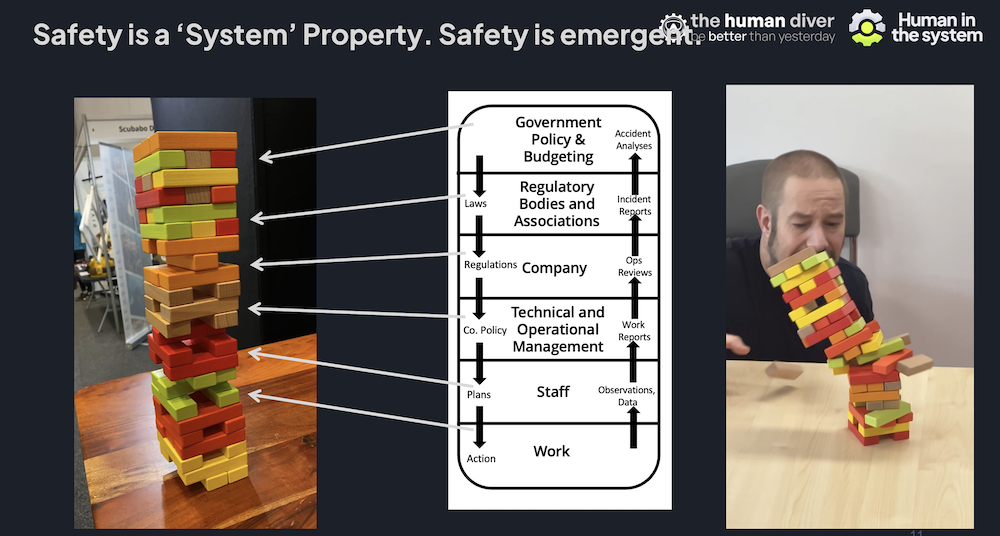
“Safety is not the absence of accidents or incidents, it is the presence of barriers and defences, and the capacity of the system to fail safety.”
Todd Conklin
Build Margin (Capacity) Into the System — Not Just Rules
In structured industries, safety does not rely solely on procedures. It relies on buffers, capacity and slack:
Technical redundancy. Things fail, we’ve got a spare (person, technology)
Competency development and practical reinforcement. Skills need to be acquired, and they fade without practice and feedback, so need constant reinforcement.
Time slack. We know things never work to plan, and often they go ‘long’.
Human workload management. Understanding cognitive performance, and Performance Influencing Factors and designing systems accordingly.
Organisational learning systems. We are never going to make all the mistakes ourselves, so let’s create systems that allow us to learn from others. Learning from inside and outside of diving.
In diving, because of commercial pressures, there is a tend to focus on maximum ratios and because of the compliance culture, the use of, and adherence to, written standards is the measure of safety. Those are surface artefacts. Margin goes deeper and covers many different aspects of diving operations and risk/hazard management.
Structural Margins
Condition-based ratio rules rather than fixed maximums.
Hard visibility floors for entry-level.
Explicit protections for minors.
Mandatory instrumentation for students.
These are not bureaucratic controls. They are buffers that recognise environmental variability. Environmental variability is just one of the many variables that have to be managed in a dynamic system like diving.
When procedures do not reflect real conditions, people adapt, workaround and use their local ingenuity to solve problems to meet the implied and explicit goals and rewards of diver training systems. Better alignment reduces the need for silent (and hidden) adaptations.
Time-based Margins
There is a minimum training time that cannot be compressed. While 20 mins is the minimum duration for many entry-level training dives, how much knowledge and skill uptake happens during this time? Especially in classes with maximum ratios.
No same-weekend rush certifications.
Protected rest for instructors.
Protected time for reflections and reinforcement. Learning happens in the reflection of the doing, not in the doing itself.
Time pressure is one of the strongest drivers of deviation across industries; time is money and non-productive time costs. Diving is no exception. If schedules leave no slack, shortcuts become normalised. And in the absence of an adverse event, the shortened timelines are normalised. Once one deviation has occurred, it is harder to push back.
Cognitive (Thinking and Interaction) Margins
This is the missing layer. Instructor training focuses on skills delivery and checklist completion. It does not deeply address bias recognition, workload management, decision-making under uncertainty, communication under pressure, or how commercial tension distorts judgement.
Yet the research shows that individual cognition interacts with system pressures to shape deviations, adaptations and workarounds The industry does not acknowledge, let alone teach, trade-off literacy and the impact it has on safety and performance. Diving isn’t unique in this lack of educational delivery.
Shift From Compliance to Capacity
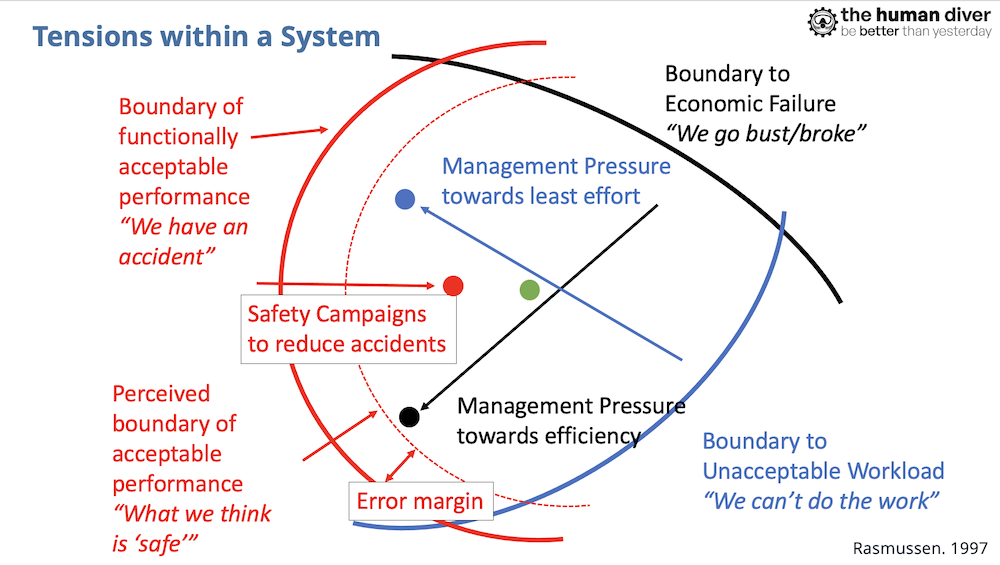
Mature and progressing organisations and industries don't not just ask, “Did you follow the rule?” They ask, “Do you have the capacity to operate safely today?”
That is an important shift in how we see the world.
Compliance looks backwards. Capacity looks forwards. In diving, a capacity-focused approach would include:
Formal pre-dive operational risk assessments considering conditions, student capability, and instructor fatigue. Note, this sort of risk assessment is not about liability risk management leading to defensive or defendable teaching.
Protected cancellation authority, and this means managing the clients’ expectations too.
Normalising “not today.”
At present, cancellation often feels like failure. That is cultural. If we only measure adherence to written standards, we miss the more important question: were the conditions right in the first place?
Developing capacity isn’t about throwing the rules out of the window and accepting anarchy; but ensuring that competent operators are able to understand the tensions between workload, financial constraints, and operational safety and have the social space to call it when it doesn't appear right. You can’t manage the risk of a hazard materialising if you don’t know what the hazard is or what it looks like. Step one of the risk management processes, identify the hazards.
Address the Commercial Tension Directly
Those who say commercial pressures shouldn’t get in the way of safety might not consider it as a credible factor because they have resources (capacity) to say stop. Critically, the reality of financial pressures cannot be ignored. At the same time, instead of saying “shops should not pressure instructors,” we should design mechanisms that reduce the impact of that pressure.
For example:
Agencies and dive centres explicitly backing instructors who fail students for competence reasons.
Confidential near-miss reporting without punitive consequences – this needs to be resourced correctly and staffed by informed professionals in this space.
Insurance incentives for conservative operations.
Marketing language aligned with the reality that competence takes time.
When incident reports are released, explicitly call out the tensions and systemic interactions.
When marketing says “easy, fun, accessible,” but training requires disciplined skill development, we create cognitive dissonance. That dissonance becomes systemic pressure. The research shows that punitive or compliance-heavy cultures drive surface compliance, not deep safety improvement. If we invite openness but punish disclosure, we create concealment.
At this point, we come across the critical problem of ‘first to move’ and the prisoners’ dilemma. I have been told by the CEO of one organisation that if they adopted a HF approach in a mandatory way, it would have commercial implications because instructors would go to another agency that didn’t have such programmes because it is easier to get an instructor ticket there. I've also been told by the CEO of another organisation that they wouldn't endorse HFiD because it isn't something that their organisation had developed, and as such, didn't see the need to develop/market it.
Fix the “Air Gap”
There is a structural air gap between agencies and instructors. In many cases, responsibility for risk management (and accountability when it goes wrong) effectively transfers downward. Structured industries tend to scale responsibility and learning upward because they recognise you can’t fix a secret.
In diving, that could mean:
Mandatory, confidential learning summaries after events (and this requires education to produce good learning-focused products).
Cross-agency safety forums where judgement is suspended, looking at conditions, not people/agencies.
Recurrent instructor training that includes performance demonstration, decision-making and non-technical skills development, not just paperwork renewal.
Without systemic feedback loops, drift between ‘Work as Imagined’, ‘Work as Done’ and ‘Work as Disclosed’ is invisible, and this poses an organisational risk.
Move the Anchor
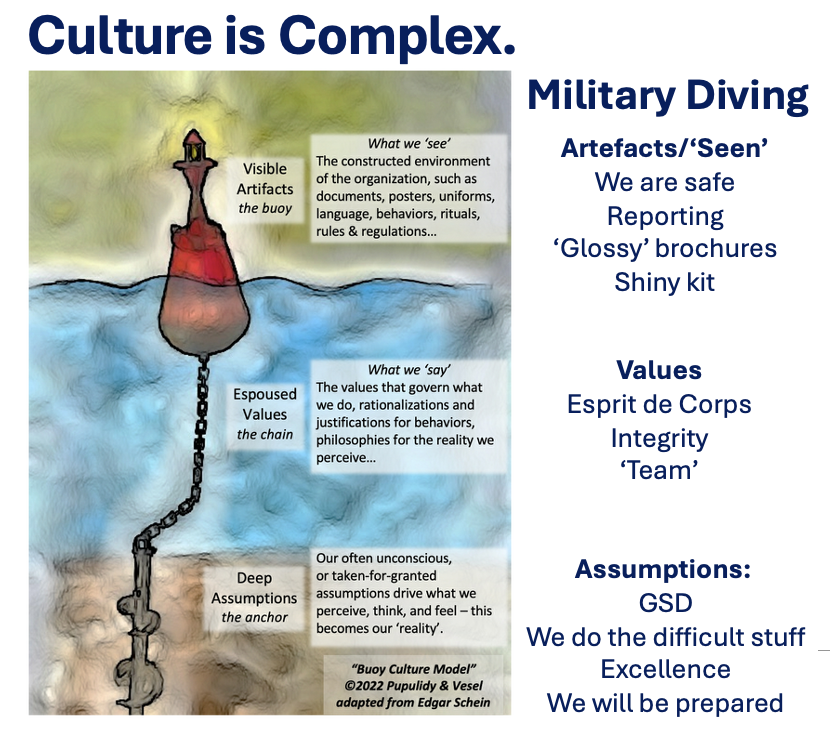
Using Schein’s model, the output described artefacts, espoused values, and deep assumptions.
Artefacts: teaching ratios, computers, checklists, marketing, # of certs issued.
Espoused values: “safety first.” “you are our highest priority”
Deep assumptions: “It’s just recreational.” “Most dives are fine.” “Students expect fast certs.”
Research in multiple domains shows that adaptation becomes normal when formal rules and lived-reality diverge. And without psychological safety and a Just Culture being present, the hidden narratives remain hidden; until something big happens and then they can’t be.
Until we consider moving the anchor, there is only so much movement the buoy can do. Moving the anchor requires:
Open, critical and context-rich storytelling when things go wrong (and exceptionally well.)
Leaders modelling conservative decisions publicly and talking about their errors and issues - being vulnerable. If you're asking instructors and divers to be vulnerable, why would they if the leadership aren't?
Celebrating delayed certifications.
Aligning marketing with potential loss reality.
This is cultural work, not procedural tweaking.
The Hard Truth
We must compromise to operate in a resource constrained environment.
Not, asking whether compromises exist. If you ask any diving instructor in a commercially-competitive space if they adapt and use workarounds to deliver certifications, they will all say yes. The key question is how do we prevent compromise from drifting too far? At what point does innovation become unacceptable drift?
Structured industries use monitoring, feedback loops, redundancy, and cultural reinforcement, including leadership and teamwork development. Diving largely relies on individual professionalism. Professionalism is necessary, but it is not sufficient.
If I had to prioritise, the critical leverage points would be:
Mandatory non-technical skills training for instructors*
Mandatory training focused on systems thinking and narrative development for organisations to enable effective story-telling so that gaps can be identified and addressed.
Condition-based ratio enforcement
Protected cancellation authority
Reword the marketing narrative
These are not silver bullets. They are capacity builders.
Diving is forgiving; until it isn’t. In forgiving systems, drift hides easily. Most dives go well. Most adaptations work. That is precisely why learning must be proactive. The answer is not “safety first.”
Instead, it is:
Build margin.
Teach trade-off literacy.
Align incentives.
Make learning visible.
And accept that this work does not end.
*This might be an obvious suggestion from the founder of The Human Diver. However, such training doesn’t have to come from The Human Diver. Six major organisations were provided opportunities for white-label materials from The Human Diver in 2017 for a pittance but none took it up. For those organisations who want to develop their own capability, there is a massive amount of materials online to help organisations and insurance companies put this training together. One organisation has put something into their OWSI manual but there are errors in it. While something might be better than nothing, that isn't the case when it is wrong.


