

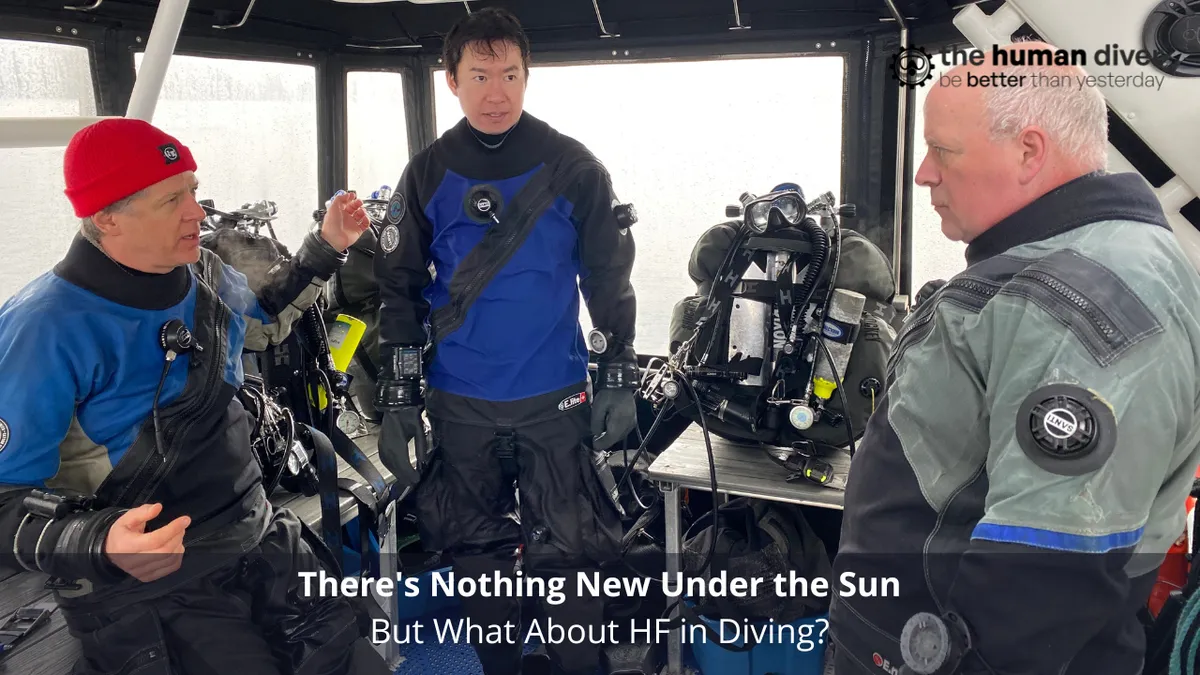
There's Nothing New Under the Sun: But What About HF in Diving?
Pretty much ever since I first started talking to divers about human factors in 2009, I've had two sorts of critical reply. The first was a polite shrug and the words "isn't that just common sense?" The second went the other way. Human factors belonged in cockpits and operating theatres, and diving was different. And yet people are people. As one of my roles I am a MSc student mentor/coach at Lund University, Sweden, where I did my MSc, and that means I get to learn from lots of different perspectives as I review the students' submissions. This blog is on the back of a recent submission which made reference to a book chapter, combined with a recent podcast from two people in the safety science space, one of whom I really look up to.
What counts as new? Is HF in Diving really new?
The chapter is by Davide Bavato, and it is called "Nothing New Under the Sun". Bavato looked at how researchers define and measure novelty, and found it is far less simple than it seems.
He opens with Monet's painting Impression, Sunrise, and asks whether it is new. One person will say it is over 150 years old, so clearly not. A newcomer to art will say it looks like any other landscape of its time. An art historian will tell you it gave its name to the whole Impressionist movement. A keen art lover will add that a group of Italian painters got there first. Each answer uses a different yardstick.
Bavato points out that most of the time when we call something new, we are actually measuring one of two things.
The first is distance, meaning how different something is from what already exists around it.
The second is frequency, meaning how rare it is, or whether it is the first of its kind. Something can be new to the world, new to an industry or new to one team, and those are very different claims.
Novelty depends on where you stand and when you are looking.
Old ideas in new water?
I am not coy about the fact that most of what we teach at The Human Diver is not new to the world - we stand on the shoulders of giants in the safety science and human factors space. Crew Resource Management (CRM) came out of aviation in the late 1970s and early 1980s. I learned it during my 2500 hours on Hercules in the RAF. The work on how organisations drift into failure, on just culture, and on psychological safety all came from aviation, healthcare, nuclear power and organisational research, and were really put together for me as part of the MSc at Lund.
So if you judge human factors in diving as being new by whether the concepts themselves are new, it fails. But if you judge it as new to the industry, it passes easily. When I started, there was no structured teaching of non-technical skills in recreational or technical diving. Most incident discussion ended with "diver error" and a reminder to follow the rules. Incident reporting and causes were focused on the proximal causes and a linear sequence of triggers/events, looking for the 'root cause'.
Learning from Emergent Outcomes (LFEO) is the same. It borrows from Safety-II, learning teams and restorative approaches to just culture, all of which have a history elsewhere. What is new is putting them into a setting that has no regulator, no shared reporting system and no one whose job it is to ask what happened and who was hurt. The claim of novelty is real, as long as we are clear about the comparison we are making.
New to whom?
I recently listened to a conversation between Ben Hutchinson and Steven Shorrock that came at the same question from another angle. Ben asked, a little provocatively, whether there is anything really new in the "new view" of safety or in Human and Organisational Performance (HOP). Steve's first answer was "new to who?" He pointed out that the HOP principles were all available by the 1980s. The "new look" on human error from Richard Cook and David Woods built on what James Reason had already described, and Jens Rasmussen's work reached a fairly small readership. Much of what is happening now, he said, is popularisation and promotion.
I find this liberating, because it describes how I see my role in the diving industries (recreational/technical/commercial/military). My aim has never been to own these ideas although we do have a bunch of IP around training delivery and tools like DEBrIEF, UNITED-C, and PETTEOT. It has been to give them a shape that divers can use. Steve also gave two warnings that I take onboard.
An idea should not be stretched beyond the setting where it fits - which is why I am keen to do academic research in these areas to show one way or another.
A theory with no method attached may change how you see the world without changing what you do. That is why LFEO is built as a process that a dive centre or club can follow, and much of HFiD is built around briefing and debriefing in a psychologically-safe environment using structured tools to explore leadership, teamwork, decision-making, and situation awareness.
Too familiar, or too strange? The real tension.
Bavato also describes a pattern from research on how new ideas get accepted.
If something looks too similar to what people already know, it gets ignored because there seems to be nothing to learn.
If it looks too different, it gets rejected because it does not seem to belong.
The ideas that take hold sit somewhere in between, and this explains the two replies I described at the start. "It's just common sense" is what people say when an idea feels too close to what they already do. "Diving is different" is what they say when it feels too far away. Both are a normal reaction to an idea that has not yet found the right distance.
One thing that stood out for me in the chapter, because of my own research at Lund, was that stories can bridge that gap by confirming what people already know without denying what is new. Steve made a similar point in the podcast about systems thinking - when the story is detached from the system, it makes it hard to connect to the idea of a system. This is why I use a mixture of diving stories and non-diving ones. When I describe a team on a boat in the Red Sea or a student in a quarry, the setting is familiar. I also use simple non-diving stories which allow people to join dots without professional or personal jeopardy. This allows them to relate to the general behaviour relating to THAT event, and then abstracting into diving allows a powerful connection to be made without defensiveness. Therefore, what is new is the way we look at what happened.
What a hit song can teach a dive briefing
From a very different field, Jakub Kasperski, a Polish musicologist, recently looked at what makes a pop song a hit. He built on Gary Burns's work on "hooks", the short phrases in a song that stand out and stay in your head. Kasperski's central point is that a hit has to resemble other hits while still sounding different from them. Songwriters lean on familiar structures so they do not lose the listener, then add small surprises to hold attention. Burns argued that constant repetition defeats itself, because listeners tire of it. What keeps people listening is repetition with variation.
This applies to how we bring human factors into diving. If we only repeat slogans such as "maintain situation awareness", people stop hearing them. If every idea arrives as something completely foreign, they switch off for a different reason. Kasperski also found that most hooks appear early in a song and then come back in slightly changed forms. A good briefing can work in a similar way. Set out the key points early, return to them as you walk through the plan, and change how you ask the question so the team has to think before they answer.
You can only see the new if you know what to expect
Bavato also points out that novelty usually only shows up for the person who knows exactly what to expect, and can therefore see that something has gone wrong. That idea sits at the heart of non-technical skills.
Think about situation awareness. We talk about DIPI (Dangerous, Interesting, Pleasurable, and Important) - you can only notice that your buddy is breathing faster, or that the current has changed, if you have a clear picture of what normal looks like. Without it, the warning signs blend into everything else. How would a dive centre notice it is drifting if it has never talked about what a good day looks like. This is why structured and critical briefings and debriefs are so important - they show how a team builds a shared picture of what to expect, so that the unexpected becomes visible early.
Another line in the chapter comes from the psychologist Daniel Berlyne, who said that something can only feel new against what came before if the earlier experiences left a lasting change, of a kind we could call learning. Bavato adds that memory fades, so things can feel new again simply because we have forgotten them. This is present in diving all the time. The same kinds of incident happen year after year. Each one is treated as a shock and often blamed on the person involved. They feel new because nothing in the system kept hold of the lessons from the last one. Without a way of keeping what we learn, diving keeps meeting its own risks for the first time.
What you can do
If you are an instructor or dive leader, notice which reply is the most comfortable when you hear about human factors. If it is "we already do that", ask yourself whether you could explain to a student exactly what you do and why - as we say about debriefing - it is the specifics that lead to learning not the generalities. If it is "diving is different", ask what is different about human performance and behaviour in diving compared to other high-risk activities. When something goes wrong, try Steve's habit of using neutral words, such as talking about "supervision" instead of "inadequate supervision", so we generate a curious opening and not a closed one around failure. The recent blog and the guide about terms for describing diving covers this is great detail.
References
Aldrich, H. E., & Fiol, C. M. (1994). Fools rush in? The institutional context of industry creation. Academy of Management Review, 19(4), 645–670. Cited in Bavato (2022).
Bavato, D. (2022). Nothing new under the sun: Novelty constructs and measures in social studies. In G. Cattani, D. Deichmann & S. Ferriani (Eds.), The Generation, Recognition and Legitimation of Novelty (Research in the Sociology of Organizations, Vol. 77). Emerald Publishing. https://doi.org/10.1108/S0733-558X20220000077006
Berlyne, D. E. (1960). Conflict, Arousal, and Curiosity. McGraw-Hill. Cited in Bavato (2022).
Hutchinson, B., & Shorrock, S. (2026). Interview with Steven Shorrock [Video]. YouTube. https://www.youtube.com/watch?v=_MMFhQkkU1o
Kasperski, J. (2025). Catchy elements (hooks) in popular music: Toward a musicological theory of hit songs. Edukacja Muzyczna, 20, 47–71. https://czasopisma.ujd.edu.pl/index.php/EM/en/article/view/2522
Kuhn, T. S. (1970). The Structure of Scientific Revolutions (2nd ed.). University of Chicago Press. Cited in Bavato (2022).


