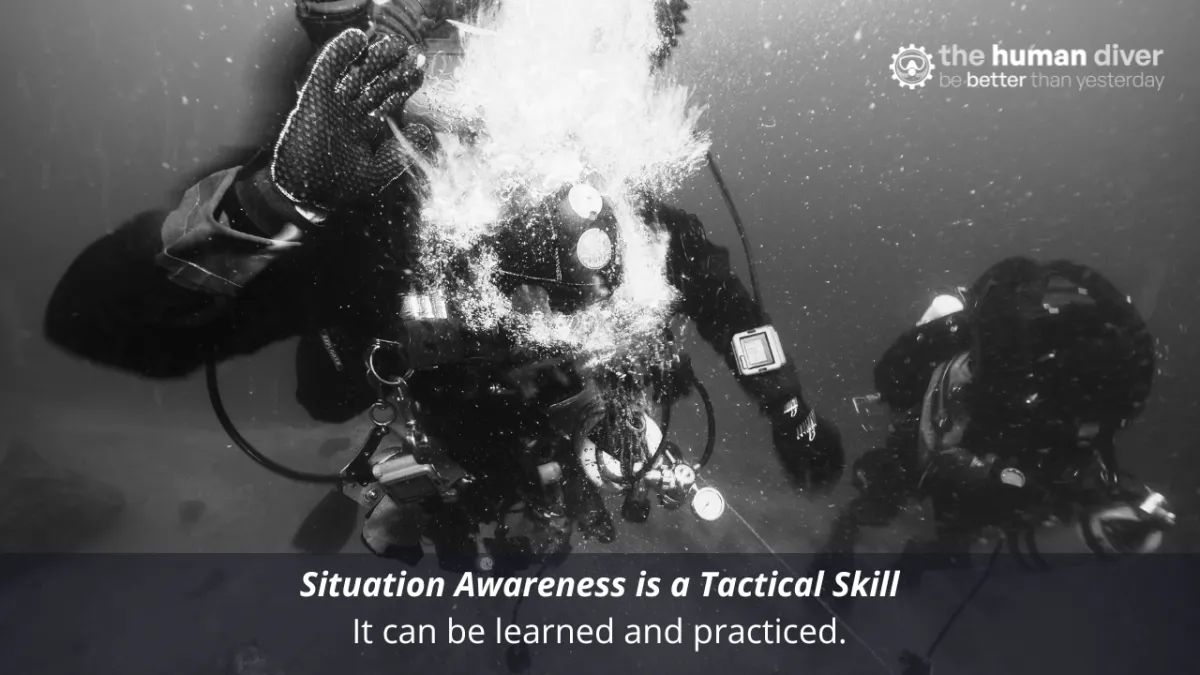
Situation Awareness is a tactical skill: It can be learned and practiced.
If you remember the first Jason Bourne movie, there's a scene where the main character, played by Matt Damon, explains that — without thinking — he automatically notices all the exits and memorizes the license plates of the cars parked outside the cafeteria.
Situation awareness isn't necessarily the same thing in the tactical world as it is in scuba diving, but the key phrase is still "without thinking." Situation awareness is what you notice around you without consciously trying to notice it, and it's what lets you anticipate — or better yet, prevent — a problem through projection based on previous experiences and mental models we've created from them.
As a technical diver, this ability to pay attention to our environment and then look into the future depends on three things and helps us to make the right choice and act accordingly:
the ability to observe what's happening around or inside us
the experience to know which elements to look at, now and later
the experience to know how to interpret those elements so we make an educated guess about what might happen in the future.
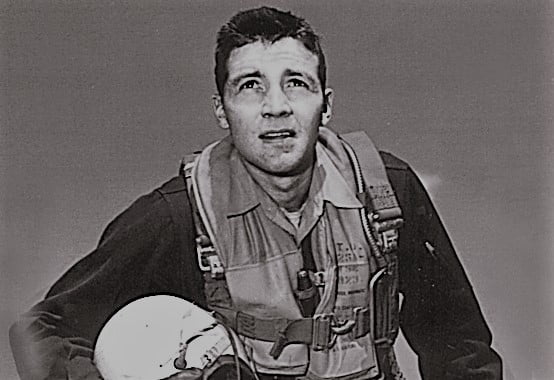
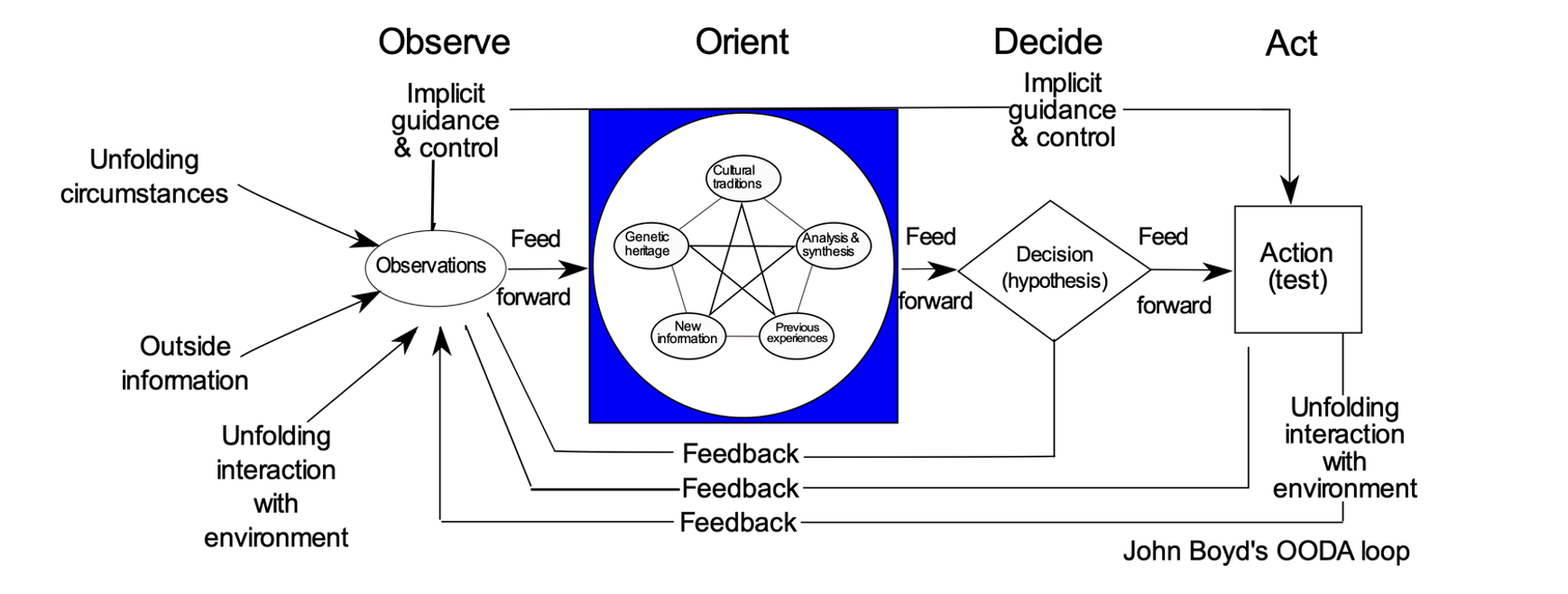
In the 1960s, Colonel John Boyd, a US Air Force fighter pilot instructor, began developing a model that has since been simplified, borrowed, and occasionally misapplied by anyone dealing with an evolving, potentially life-threatening situation. His model, the OODA loop, was designed to map the phases our brain moves through during any decision-making process. OODA stands for Observe, Orient, Decide, Act, and it applies just as well to technical diving — and to scuba diving in general.
Observation
Every second, at the surface or underwater, our senses send a massive amount of information to our brain: the direction of the waves, wind, and current; the temperature of the water; the position of our body in the water; the configuration of the cave; the position of the boat; the warmth of our breathing gas; and dozens of other things. Our conscious mind would be overwhelmed by that much input, so it's the job of the recticular activating system (RAS) to filter out what isn't immediately relevant and pass along what matters to the frontal lobes. Unfortunately, when we're focused on something else, our ability to register that information drops sharply. That's what happens when we're wrestling with an unfamiliar piece of equipment, a buoyancy problem, a photo we're trying to get, a gas switch, or a buddy who's swimming away.
This observation phase is the foundation of situation awareness. It's the "Look, Listen, and Feel" we learn in a CPR/First Aid course. In diving, that means:
We look at our environment, our instruments, our teammates.
We listen for noise from the environment (a boat engine) and from our equipment (bubbles, or the lack of them on a rebreather).
We feel what's happening in our own body (breathing pattern, fatigue, and so on).
Orientation
The more experience a diver has, the more easily they can do two things: perform routine tasks automatically, and recognize which information actually matters. That's the Orientation phase — making sense of what's happening around and inside us based on many different factors, including what was contained within the dive brief and your previous training (the implicit guidance and control).
A piece of equipment that's out of place.
A teammate who doesn't seem to understand a hand signal.
A cookie on a cave line that wasn't there thirty minutes ago.
In 2007, then-Brigadier General James Mattis launched the US Marine Corps' Combat Hunter program to help Marines detect and neutralize threats in irregular warfare. One of its core components, combat profiling, was later adapted for civilian use by Patrick Van Horne and Jason Riley in their book Left of Bang. What works in the tactical world translates well to diving: it helps us better assess what's happening during a challenging dive. With experience, we build a baseline for what normal looks and feels like, then measure any deviation or anomaly against it.
An efficient Orientation phase gets us to the Decision phase quickly, instead of leaving us stuck knowing that "something isn't right" but frozen because we can't identify what it is.
Decision
We learn from experience, and the more varied that experience, the faster our brain can work through the first three phases of the OODA loop - in some cases, especially emergency or time critical situations, we go from Observe to Act. Good, quick decisions usually come from diving in different environments, with different people, and with different equipment configurations, and most importantly, with accurate and critical feedback to inform the models at the start of the chain.
Reflecting on his years of experience with rebreathers, filmmaker Howard Hall said: "Frequent failures encourage good instrument monitoring habits and familiarity with emergency procedures. There is inherent danger in rebreathers that work flawlessly almost all the time."
The sooner we identify a problem, the more options we have. Small problems are easier to fix earlier in the dive — we have more time, more gas, less decompression obligation, and we're closer to the boat, the shotline, or the entrance of the cave. It's the lack of options, the time pressure, and the inability to move efficiently through the Observation and Orientation phases that most often pushes a diver toward panic. Panic is a complete failure of the decision-making process because the brain is now in survival mode and has moved from Observe to Act - preserve life.
Action
The last step — and almost the easiest one — is to act: to do what needs to be done, based on what we've observed, made sense of, and decided.
But the process doesn't end there. Boyd's OODA model was originally designed to help fighter pilots perform better in a dogfight, and we call it a loop because once the Action phase is done, it's time to go back to Observation and assess the effect of our action on the situation. Although the 'loop' isn't a continuous like it is often drawn, but has nested loops as we can see in the diagram above.
Did we effectively help a teammate who was struggling with their equipment?
Did we find the right way out after hitting a confusing directional marker in a cave?
Did we bring our pO2 back into a normal range in our rebreather?
The loops continue until our actions produce the outcome we're after.
Our life is a constant exercise in risk management. There's no real difference between driving a car and doing a deep wreck dive — between safely piloting an incredibly complex vehicle from point A to point B every day, and exploring a cave system on an incredibly complex rebreather. What makes one feel easier than the other is how many times we've done it, how much information we've stored in our own personal database, and how quickly we can make that experience useful when we hit a new situation. None of that is possible unless we're paying attention to the critical elements around us and inside us. The value of feedback and experience cannot be underestimated as it shapes what we look for, what we notice, and how we make sense of it. Just as texting and driving don't mix because it limits the ability to notice the external cues and clues for safe driving, divers who focus only on their computer or the task in front of them can't effective Observe and Orientate themselves based on the information that would help them make the right call. You can't make the best decision you can if you haven't got the right information.
Situation awareness gives us the ability to anticipate — or even prevent — a problem, and to act instead of merely reacting to one.
Sources
Left of Bang — Patrick Van Horne & Jason Riley
Boyd: The Fighter Pilot Who Changed the Art of War — Robert Coram
Beyond OODA — Varg Freeborn