
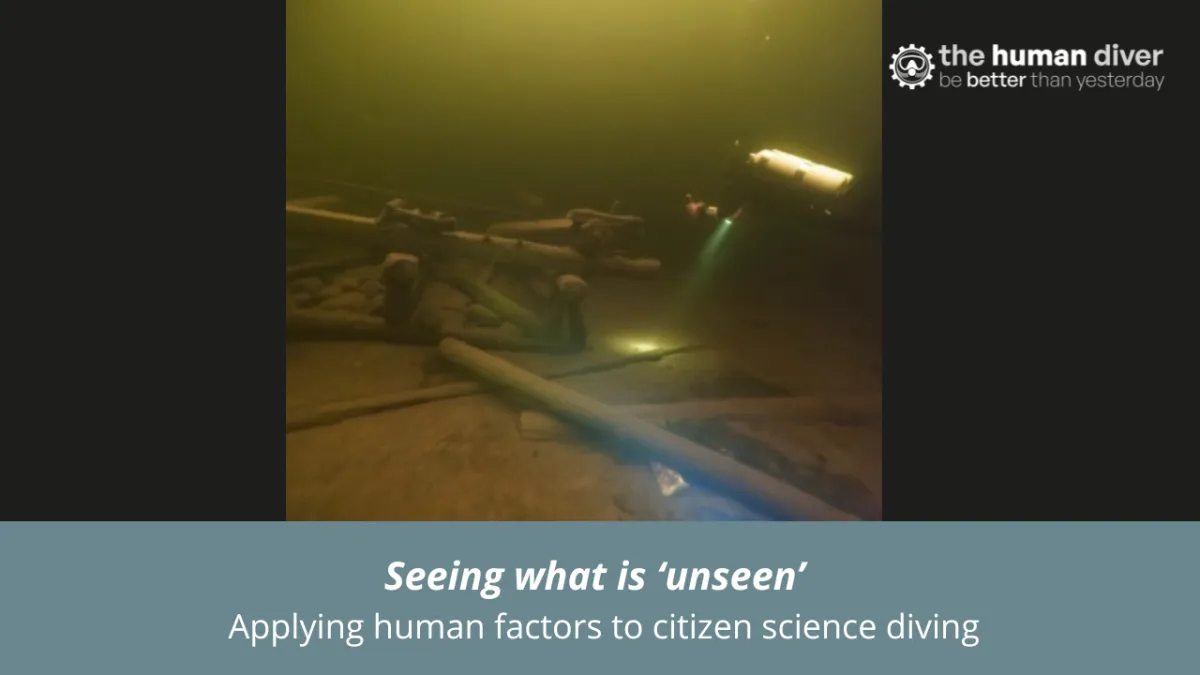
Seeing what is ‘unseen’: applying human factors to citizen science
After more than 30 years of diving at familiar river sites, observing flowing currents and striking clay walls, I realized how much we can overlook in environments we believe we already understand. I had admired these formations for decades without knowing they were varved clay — geological structures formed by glacial melt at the end of the last Ice Age.
This realization came while participating in the Finnish Heritage Agency’s Cultural Heritage of Flowing Waters project. During the project, an older and highly experienced diver showed us photographs and asked, “Have you seen formations like this?”
We had — our dive site was full of them.
Only then did it truly register: we had been unknowingly diving alongside 10,000–12,000-year-old varved clay formations all along.
These environments are not only geologically significant but biologically rich, providing habitats for crayfish and freshwater mussels. The initial reaction was disbelief, followed by a deeper understanding of the river environment as a complex, living system shaped by both natural processes and human history.
That moment changed how I approach diving. It raised a simple but powerful question: What else are we not seeing?
Waterways have long served as major transport routes for people and goods. In Finland, the industrial use of wood began in the early 16th century with water-powered sawmills, followed by log floating. Underwater traces from the 1700s and 1800s still remain today as structures and remnants hidden within rivers and lakes.
From a Human Factors and citizen science perspective, this is where divers become more than observers. By improving awareness, observation, and understanding, recreational and technical recreational divers can help identify, document, and protect underwater environments — contributing valuable knowledge to researchers and professionals alike.
Human Factors and Citizen Science as Tools for Understanding Underwater Environments
Divers are in a unique position. We access environments most people never see firsthand. The underwater world is not just a backdrop or a single dive site—it is a complex, layered reality where nature, history, and human activity intersect.
Yet much of this richness can go unnoticed if we only observe the world superficially. What if every dive was an opportunity to understand the environment more deeply, develop our awareness, and contribute valuable knowledge to science?
This article explores how the understanding and application of human factors and citizen science can help divers see more, dive more safely, and enrich both their personal experience and the scientific knowledge base.

A ship haul-out ramp at the shipyard waterfront. Kymiriver in Finland. @Tero Jokinen
Human Factors in Everyday Diving
Human Factors is a science that relates to how humans interact with their environment, the technology they us, the people they work with, and their own internal strengths and weaknesses
Applying human factors means we consider cognitive and physical limitations, how we make decisions while under pressure and deal with uncertainty, the influence that environmental and organisational factors have on our performance, and how all of the above influence our ability to learn and adapt, while dealing with tensions and conflicts surrounding goals and expected outcomes. In diving, these factors are always present, even if we don’t consciously notice them or take them into account when planning and executing our dives.
For a diver, this means better dive planning, clearer communication, more accurate observations, and smarter responses in changing conditions. Awareness of these factors changes the way we see the underwater world, as individuals an as teams.
From a Site to Its Environment
When we plan a dive, we think about sites: a lake, a river, the sea, a wreck, a mine, or a cave. But considering sense-making, another aspect of human factors invites us to expand this view.
A dive site is never just a site, it is an underwater environment with its own history, dynamics, and significance. Biological life, geological formations, and traces of human activity all interact, telling stories that might otherwise go unnoticed.
Seeing More: Diving with Awareness
Shipwrecks are often seen throudh one ”lens” as archaeological sites, and rightly so. But they are also biological and geological environments. They provide habitats for fish, plants, and microorganisms, and their locations and conditions can reflect how glacial formations, currents, and hazards impacted the site. The Vrouw Maria wreck in the Baltic Sea is a prime example.
In Finland’s lakes, glacial history is visible in Kettle ( landform rounded depressions left by melting ice blocks) Wiki: Kettle_(landform) and varved clay (layered sediments formed over different seasons) Wiki: Varve clay. These features reveal past processes and environmental changes.
Even simple-looking environments often hide complexity. Flowing rivers may feature varved clay walls and hollows where mussels thrive. Lakebeds may have iron-rich sediment layers. The environment hasn’t changed—the observer and what they are looking at, and not has.
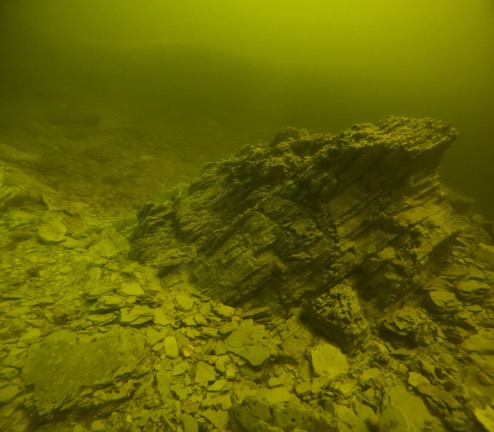
Varved clay in Kymiriver in Finland. @Tero jokinen
Divers as Citizen Scientists
Citizen science allows enthusiasts and volunteers to contribute to data collection, observation, and research. Divers are particularly suited for this role, accessing areas researchers cannot monitor regularly.
Quite often, recreational and technical divers are the first to make discoveries or observations. A new wreck, unusual structure, or undocumented formation may be noticed during a dive. Understanding on nature of the dive site helps divers respond wisely: document the finding, leave it undisturbed, and communicate it to researchers or authorities.
In Finland, the Finnish Maritime Archaeological Society is a strong example of volunteers supporting the study and preservation of underwater cultural heritage.
Simple observations, like —tracking visibility, temperature, or noting sediment layers, —can provide valuable data to topside teams. A timber-like piece of wood may be a hollowed-out boat hundreds of years old, and upright logs might indicate a long-gone bridge preserved underwater.

A stone-filled wooden crate used as ballast during log floating operations. @Juho Ollikka
Awareness Enhances Safety and Quality
Understanding the environment improves diving quality.and supports:
· Better dive planning that takes into account the plan and contingencies for when things DO go wrong or not to plan.
· Clearer communication so that maximum output can be made of the limited time underwater, instead of having to redo activities or spend time clarifying goals/tasks.
· Effective team- work, moving beyond buddies who have limited mutual accountability.
· Smarter decision-making under changing conditions leading to better data collections which minimising exposure to hazards and threats.
Safety, learning, and observation are interconnected. Awareness that improves safety also increases the ability to perceive the environment holistically and produce meaningful knowledge.
Part of a Bigger Picture
Resources for researchers and authorities are often limited. Many underwater environments remain superficially known. Divers can make a real difference by contributing observations and data.
When awareness grows in the diving community, appreciation for the environment and cultural heritage increases. Divers become active participants in sustainable practices and knowledge sharing.
When a Diver Sees More
The underwater environment is not just a backdrop. Viewed through the lens of Human Factors and citizen science, diving becomes more effective, more meaningful, and impactful, all the while improving the safety and risk management of those involved.
Every diver can be an observer, a learner, and a knowledge contributor. As awareness grows, understanding grows, —and diving gains an entirely new dimension.

Giant’s kettles, glacial potholes formed by meltwater and stones. @Tommi Nukarinen
Assisted by ChatGPT for research and information gathering in Citizen Science


