

The Insurance Illusion
About three years ago I spent a couple of hours with two senior underwriters from a company that has insured the diving industry for decades. Between them they held more than forty years of experience writing dive policies, and both came into insurance from inside diving itself. Their roles mean they got to see more than anyone when it came to the number, types, and 'causality' of the events in our industry because they read the claims, they authorised the payments, and they watched what happened long after the dive had gone wrong.
The current social media piece around insurance and litigation led me to come back to this interview.
The perspective of these two exposes something most of us would rather not look at. A lot of divers and dive professionals treat insurance as a safety net, assuming that if something goes wrong the policy will catch it and life will carry on. The picture the underwriters paint is far less reassuring. Insurance does nothing to make a dive safer, and it has no power to stop anyone from being hurt. In the market we have now, there is no guarantee it will even respond the way the holder imagines when the moment comes.
How the system actually works
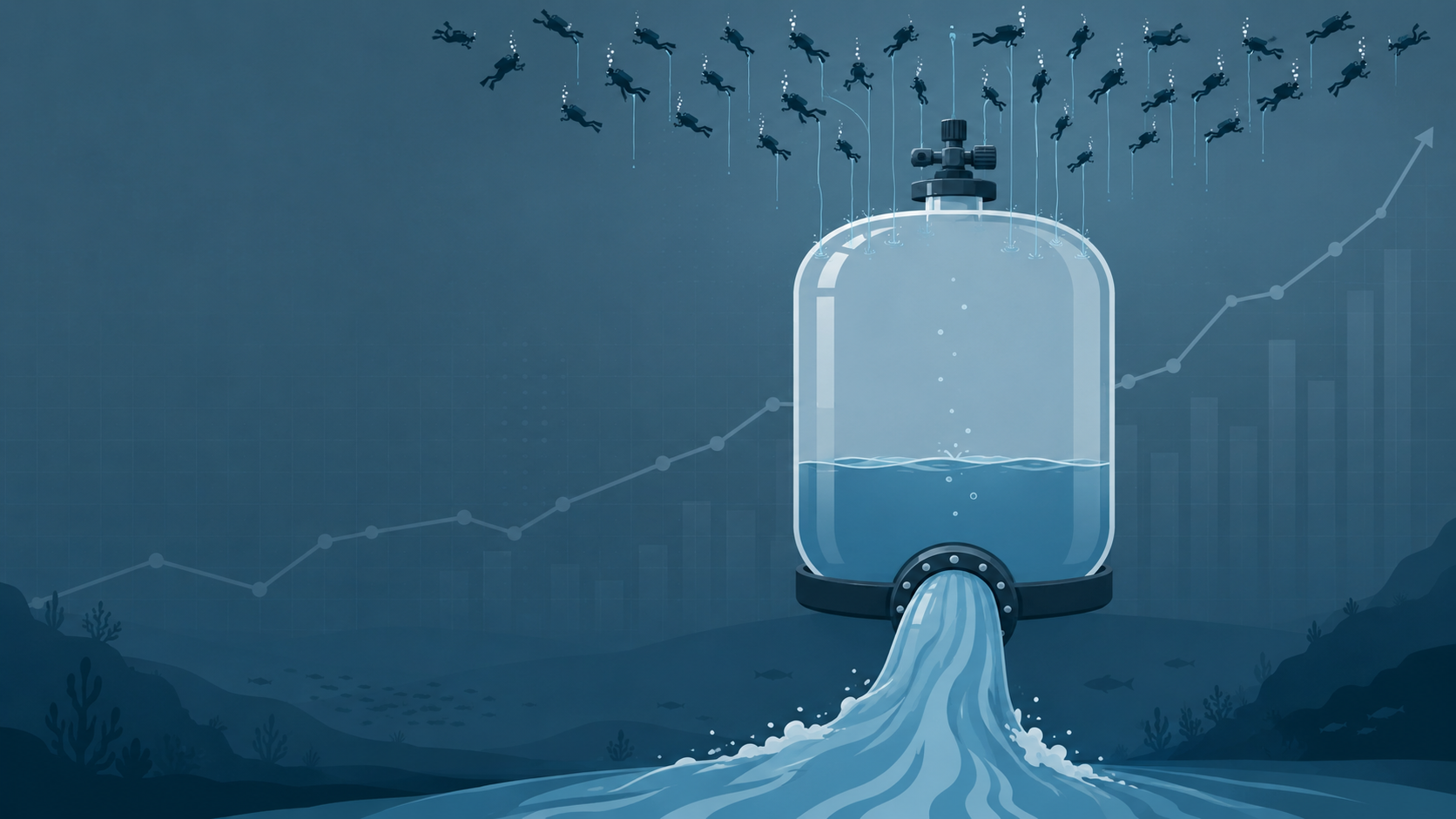
The mechanics are simpler than most people assume. An insurer gathers premium from many policyholders into a single pot, invests it somewhere secure, and pays out claims as they arrive over the following years, hoping for a modest amount left at the end. A healthy business will have a profit margin of around one percent of total premium, and in a bad year there is none at all. That is a long way from the belief, so common in our world, that insurers are quietly growing rich on the back of divers.
Diving makes for an especially hard market. The sector routinely pays out more in claims than it gathers in premium. Imagine taking in $60M in premiums over 11 years, and then paying out $200M in claims. This programme covered only a fraction of the global capacity for diving, so the real figure across the industry runs far higher than most of us would guess.
There is a second pressure that is less visible from the outside. A great deal of an insurer's return has traditionally come from investing the premium during the long wait before it is claimed. As that investment income has thinned in recent years, the model has tightened and rates have climbed into what underwriters call a hard market. An instructor policy that once cost a few hundred dollars can now run to several thousand, and a growing number of people are stepping back from teaching to dive purely for pleasure.

Why diving is a difficult risk to carry
It is tempting to line diving up against skydiving or base jumping and argue about which one kills more people. The underwriters don't make that comparison; they weigh diving against every other business that might receive their capital. Faced with a choice between insuring a company that sells car parts and one that takes inexperienced people, with potential health issues, into a foreign underwater environment, the underwriter is asking where the money is least likely to be lost, and on that measure diving struggles to compete.
A litigation event shapes the global diving insurance landscape, and one of the underwriters put it plainly: a person can collapse and die at a bowling alley from natural causes, and nobody thinks to sue the bowling alley. When someone dies on a dive, litigation almost always follows. Demands of hundreds of thousands or million dollars are not unusual, and a serious injury that leaves someone dependent for life can cost even more than a death does because of the long-duration care needed.
While no diver comes to the activity with the intention of getting bent, hurt, or to seriously harm someone else, when an event happens, because of emergent factors, the financial consequences of such a single event are unusually large. This has to be paid for somehow, and the premium has to cover it from a pot that is not very large.
The same pattern explains why several major international carriers have left the sector. Large global insurers do not abandon business that makes money for them, so when a string of them walks away, and when more than twenty syndicates have come and gone from diving across the decades, the numbers are telling a story the industry would rather not hear.

The data nobody gets to see
The next part of the conversation should raise a concern for everyone in the education and professional development space. The people with the clearest view of what actually goes wrong in diving are contractually unable to share it. The relationship between an insurer and the people it covers is privileged, so claims information cannot be passed back to the training agencies, who have no part in that arrangement. The organisations that write the standards and certify the instructors are left with very little sight of the claims being made against their own members. Combined with the ineffective reporting/learning structures identified from my MSc research, this makes it even harder to manage the risk.
The underwriters described a moment at an industry event that showed how this plays out. A representative of one agency stood up and proudly announced that they had not seen a claim in five years. The two underwriters glanced at each other, because they had been paying claims involving that agency's members throughout that very period. The agency had not set out to mislead anyone, but genuinely had no way of knowing. The system has been built in which the richest source of learning that exists sits locked away from the very people who could put it to use. Interestingly, in the UK, the Veterinary Defence Society has resolved this by having the incident data part of the both the learning and insurance processes. It's a win:win because they want to reduce harm.
Certifications that mean very little
With the data hidden, the credentials do little to fill the gap. To an underwriter, a long list of qualifications says almost nothing useful about whether a professional is competent and current, and good practice cannot be read off from the titles in a logbook. One case brought this home. A man lost his wife on a demanding wreck dive and was at first treated as a suspect, partly because his rescue diver qualification led investigators to assume he could have saved her. In truth he had only a handful of dives and had completed a rescue course with no meaningful work in the water. The title implied a capability he never possessed.
The industry has done this to itself. Courses are given names that sound impressive, because "advanced" will always sell more readily than "still learning". The underwriters also described how swiftly the industry turns on an individual once something goes wrong. An instructor who loses a student can be praised one week and expelled the next, even where they were working within the standards the agency itself had published. The system is content to lend its name to success while keeping a careful distance from failure, leaving the individual to carry the whole weight alone.
Why insurance is not the solution people think it is
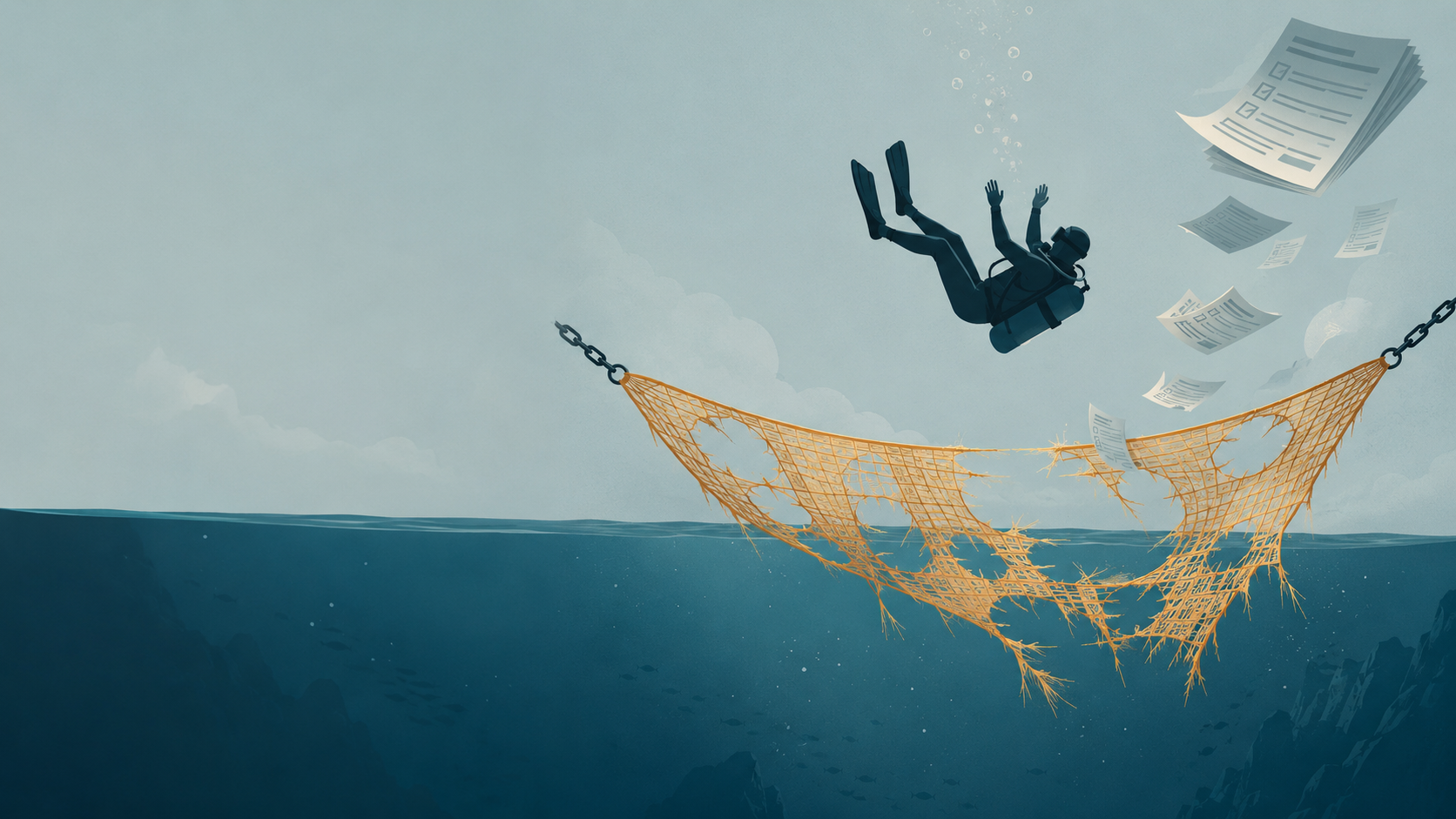
This is where the deeper problem lies. Insurance transfers financial risk away from the policyholder, yet it does nothing to manage the operational risk (harm) that produced the event in the first place. A policy releases money only after the harm has been done, and it cannot bring anyone back or undo a family's loss. When we lean on cover as though it were a safety net, we subconsciously persuade ourselves that the consequences have been taken care of, and that belief becomes a hazard in its own right.
The cover may also turn out to be far narrower than the holder believes. The underwriters described an instructor who admitted under oath that he had not followed his agency's standards, then sued his own insurer when the resulting claim was challenged. His policy, in common with many, only responded where those standards had been met. Ticking a box on an application says nothing about whether the work behind it was genuinely done, and a policy can feel like solid ground while resting on conditions the holder never met. The current DAN litigation case brings this to life.
There is something that runs beneath all of this. In a world where every professional carries insurance, it becomes easy to assume the paperwork is the job done. Very often nothing obliges them to keep learning or to have their competence reassessed, with nothing like the formalised continuing professional development (CPD) that doctors and lawyers take for granted. The cover stands in for capability and capacity, when it was never meant to be more than the last line of defence.

Where this leaves us
The difficult conclusion running through the whole conversation is that the strongest force for change in our industry may not be better training. It may be the simple fact of no longer being able to buy cover at all. Once the price climbs high enough, or the market withdraws altogether, the decision gets made on our behalf. That is a miserable way to improve a profession, because it improves nothing about the diving and merely removes the people who can no longer afford to stay.
A better road is open to us. Insurance belongs behind capability and capacity, where it can quietly support a professional who has already done the hard work of getting good. Protection from litigation was always the wrong thing to chase. What the journey ahead focuses on is to become the kind of diver and instructor who understands how decisions take shape under uncertainty and who keeps learning long after the certificate has been framed on the wall, including talking openly about the near miss that once frightened us. That is where the real risk comes down, and it remains the only thing that genuinely lowers the odds of the claim ever needing to be made.


