
When the Picture Goes Dark
You didn't lose situation awareness. You ran out of the capacity to maintain it. Part 1 of 2
James was 25 minutes into a wreck dive on the M2 off Portland, UK, and he was getting the shot he came for.
He knew the site. He'd been briefed on the limited slack window and that things would be a challenge once the current picked up. He nodded along to the brief, felt ready, and entered the water with his buddy, everything good to do. His Advanced Open Water qualification was recent but legitimate. He was the kind of diver who prepared - or so he thought.
The problem was the photograph. He was working against the current to hold position, but the shot was worth it in his mind. After numerous attempts, repositioning to get the right framing and the composition he wanted, he finally looked up, and saw that his buddy was gone.
He unclipped his SPG to check the pressure; it was much lower than he expected, past the minimums he and his buddy had agreed. He'd been working hard and hadn't checked for a while. He looked around. No buddy. He thought about ascending, but the current was strong and he wasn't sure where the boat was. He reasoned that his buddy was experienced enough, and that they'd both manage on their own. He swam in the direction he thought they’d gone. He couldn't find them. He was now fighting the current just to get back to the wreck.
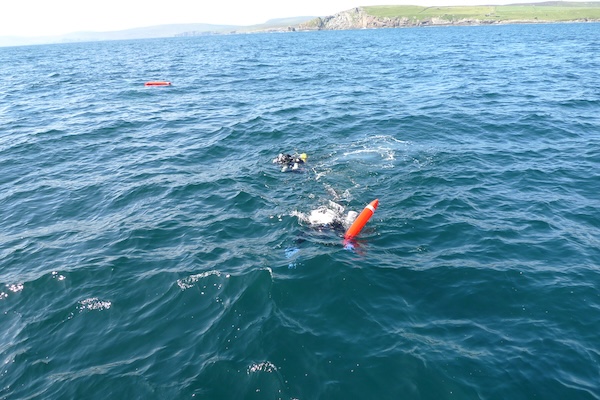
He deployed the new dSMB he'd never actually practised with. It birds-nested straight away! It took him some time to sort out the tangle of line as he was ascending, all the time trying to manage his buoyancy in a controlled manner as he knew he was on the limits for a no-deco dive and didn't want to push things. He surfaced a long way downstream, just on the edge of the skipper's visibility given the surface conditions. His buddy surfaced separately, further away still.
Back on the boat, over a mug of hot chocolate, they asked each other the honest question: "how had something that simple gone that wrong?"
It wasn't a skills failure. Not in the way you might think.
Neither diver had done anything technically wrong in any obvious sense. They knew the procedures. They'd been briefed. They had the skills. What unravelled wasn't their ability to do single actions, they'd already demonstrated that in a controlled training environment and simple dives; it was their ability to manage the execution of the dive, as a whole, when things had gone 'wrong'. There was a need to keep the bigger picture in view, while conditions were slowly and quietly consuming their capacity to do exactly that.
This is what two models from cognitive systems engineering describe with unusual precision. The Contextual Control Model (COCOM) and the Extended Control Model (ECOM), developed by Erik Hollnagel and David Woods, aren't about what people know. They're about what quality of control is available to a person in a given moment, and what determines it. And they explain James's afternoon on the M2 very well. This is the first part of a two-part series that looks at how and why we lose control and capacity, how it applies to 'fun diving' and instructional settings, and what we can do to not 'lose it' or recover it when it is needed.
COCOM: the quality of your control
COCOM starts from a deceptively important premise: control is not binary. You don't simply have it or not have it. It exists on a spectrum, and the model identifies four recognisable modes.
In strategic control, you have time and cognitive bandwidth to spare. You're holding multiple goals simultaneously, thinking several steps ahead, basing your decisions on a rich mental model of how things are likely to develop. This is where you are during a good dive brief. James, sitting on the boat running through the dive plan, considering the slack window, thinking through his gas plan and when he would end the dive; he was in strategic mode. The picture was clear and full.
Tactical control is the everyday mode of a competent diver in the water. Several goals are active. Time feels adequate. Decisions draw on plans and experience rather than calculation. For much of the first twenty minutes of that M2 dive, James was probably here. Things were working.
Opportunistic control is where the picture begins to fragment. Subjective time has compressed. The diver is no longer managing several goals in an integrated way; they are reacting to one or two competing demands. Evaluation becomes immediate and concrete: what's happening right now, not what's likely to happen next. Decisions come from habit and reflex. James, working hard against the current to hold his position for the photograph, was in opportunistic control. He was still functioning. But the goals he was tracking had quietly narrowed to just one.
Scrambled control is the breakdown state. One goal remains — usually survival or escape. Time feels wholly inadequate. Action selection becomes effectively random. This is the diver in full panic. Not a bad diver. A diver whose control architecture has been overwhelmed by the gap between what the situation demands and what they have left to give.

When we talk about ‘loss of situation awareness’ in The Human Diver programmes, we say that we can’t lose it. Instead, we highlight that our attention is just pointing at the ‘wrong’ thing or what appears to be important and/or relevant at that time. 'Wrong' is purposely in inverted commas because as you will see from this blog and part 2, 'wrong' can mean different things to different people.
What makes COCOM practically useful for divers is that the transitions between modes aren't decisions, rather they're driven by the relationship between situational demands and available resources, especially time and cognitive bandwidth. James didn't move from strategic to opportunistic because he stopped caring about his position near the wreck or how much gas he had. He moved because the current, the task, and the photography together consumed the resource he needed to maintain broader awareness. By the time he looked up and his buddy was gone, the transition was already complete. He was managing this 'second', not managing this 'dive'. In the situation awareness lessons, we talk about the difference between novice and experienced divers being the ability to predict into the future - this means moving up the layers towards the bigger picture.
ECOM: the structure beneath the modes
Alongside COCOM, ECOM describes not the quality of control but its architecture. These are the four simultaneous layers that are always running, each on a different timescale, all feeding each other. Higher levels provide 'big picture' guidance, lower levels are focused on task execution.
The easiest way to picture it is as zoom levels on a map.
The tracking layer is street view. Immediate physical reality: maintaining trim, holding depth, managing breathing, finning against a current. For a novice diver, this layer is genuinely expensive; it demands most of their available attention. For a more experienced diver, it runs closer to automatically in normal conditions, which is what frees up the layers above.
The regulating layer is the neighbourhood view. Short-term management of the task against the plan: adjusting position, reading gas periodically, keeping an eye out on the team location, tracking pO2 on the CCR, and immediate awareness of where they are on the dive site. It needs attention, but intermittently.
The monitoring layer is the city view. It watches the whole dive against expectations: is gas consumption tracking as expected? Are we likely to make the checkpoints on the dive route against the gas/time plan? Is the current stronger now than it was when we descended? Is the equipment behaving as it should? This is the layer that generates early warning — but only when it has the resource to run.
The targeting layer is the whole-country view. It sets and revises overarching goals. It was active during the briefing when James built his mental model of the dive. It would have activated again if something had changed enough to warrant rethinking the whole plan. Calling a dive early is a targeting-layer decision.
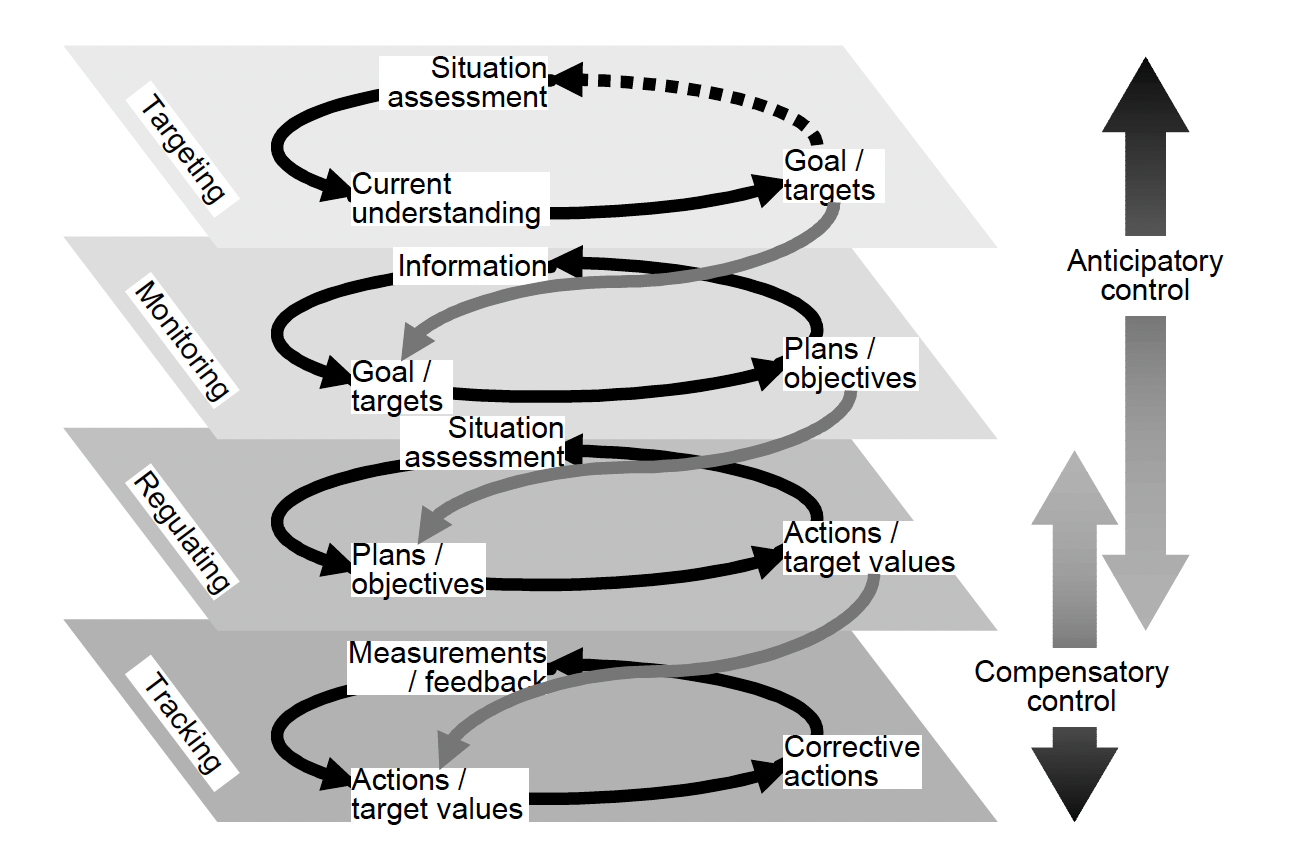
ECOM from Hollnagel & Woods (Joint Cognitive Systems, 2005, Chapter 7)
What happened to James was a textbook ECOM failure: the tracking layer became expensive as the current increased and the physical effort of holding position for the photograph climbed. The regulating layer had more to manage. The monitoring layer, the one checking on the buddy, the gas, the overall 'big picture', ran out of resource or capacity. And the targeting layer, which would have said "something has changed here, the plan needs revision", never got the signal to activate.
A 2026 study in Safety Science by Woltjer and colleagues found exactly this pattern in airline flight crews facing unexpected events in simulators. The crews who performed poorly tended to get "stuck" in the lower layers, absorbed by the immediate and the urgent, while the bigger picture deteriorated around them. The crews who performed well moved fluidly between layers: they addressed the immediate demand, then stepped back to check the wider picture, then updated their goals, then returned to execution. That attention loop, continuous, cross-layer, and unhurried, is what kept the successful crews in tactical or strategic control even in genuinely difficult scenarios.
The M2 dive didn't offer James that opportunity to use that looping perspective. He never stepped back. He stayed at tracking and regulating, and the monitoring and targeting layers went dark.
Why this changes (or should change) what goes into your dive preparation
Understanding COCOM and ECOM shifts what you focus on before a dive, not just during it. Strategic control isn't just for expert divers or deep dives. It's available to any diver who uses the surface time properly; the key is using it to pre-load decisions rather than just run through the plan. The most useful pre-dive question isn't only "what is the plan?" It's "what will change the plan, and what do I do when it does?"
James knew the current would turn. What he hadn't pre-set was the internal threshold: if I can't see my buddy for thirty to sixty seconds, I make an active decision to search. If I've been heads-down on a task and I've lost track of my gas, I stop immediately. Take an operational pause.
These aren't complicated rules.
But when you're in opportunistic control, when the upper layers have gone quiet, they're the only things that will fire, because they don't require the monitoring or targeting layers to be running. They're already there. Operating as an effective team also provides additional cognitive capacity because both divers are not stuck in the opportunistic layer; the buddy who isn’t tasked can develop strategic or tactical awareness.
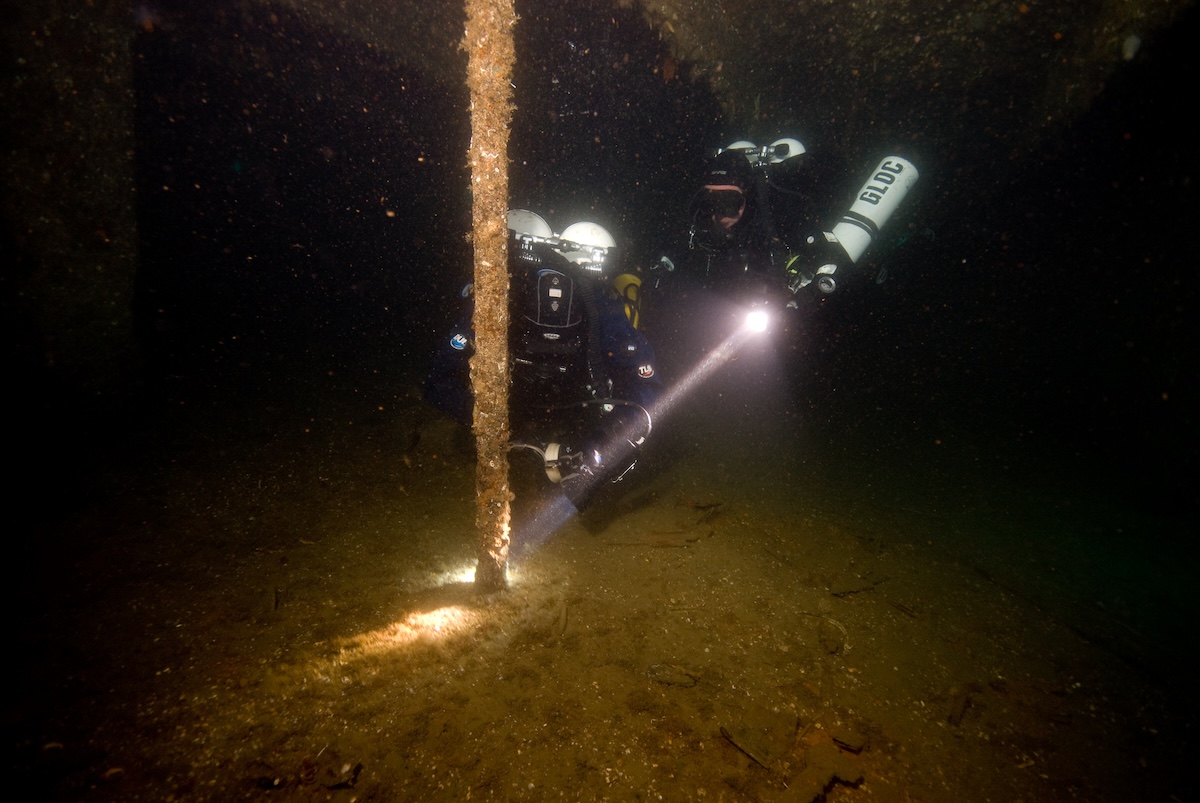
This is the practical value of a genuine dive brief: not the recitation of depth and turn pressures, but the explicit setting of criteria and thresholds that remain active even when the picture narrows. Good briefings load the targeting layer in advance, so it doesn't have to generate decisions from scratch at the worst possible moment.
When this critical discussion happened after the dive, the hot chocolate conversation wasn't just pleasantly reflective, it was the most cognitively valuable thing either diver did that day. Not because it established blame, it didn't, and it shouldn't, but because it surfaced the reasoning that led to the outcome. James made every decision he'd made for reasons that were coherent given what he could see, process, and prioritise in that moment. Understanding those reasons is how we improve our mental models. Outcomes alone don't do that. Reflection on the process does. We can't reflect in the moment, until we've reflected on the moment.
The difference between novice and expert, precisely
ECOM makes the novice-expert gap considerably more specific than the usual observation that experience matters.
For the novice diver, the tracking layer is expensive; it costs significant mental resources and we try to be as cheap/efficient as possible. Buoyancy requires conscious effort. Checking the dive computer requires the diver to deliberately shift attention away from something else. Reading the team and their actions takes active focus. Because tracking consumes most of the available attention, the upper layers receive very little. The monitoring layer is thin. The targeting layer barely functions. The plan made on the surface is followed by rote, or is quietly abandoned under the first unexpected demand, because the layer that would update the plan has no resources available to run on. How many times have you failed to 'dive the plan' despite the mantra "plan the dive, dive the plan."
This is why novice divers in novel situations make decisions that look poor but are better understood as a collapse of the upper layers when under load. They're not failing to think about the bigger picture because they're careless; they're failing because the architecture of their performance leaves nothing available for processing to happen.
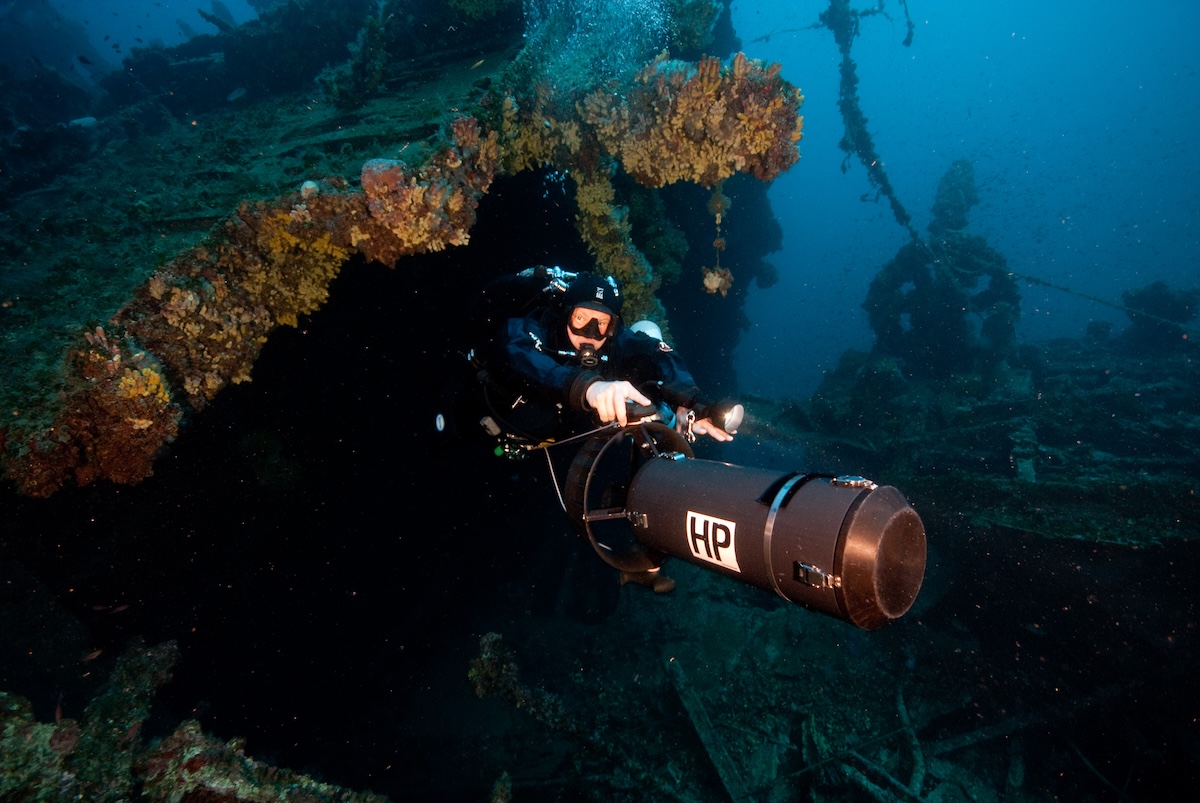
The experienced diver has driven tracking toward something close to automatic in the normal range of conditions (some might describe this as System 1). The freed capacity now flows upward, and the monitoring layer stays active. The targeting layer remains accessible enough to revise goals when the situation warrants it. The experienced diver who calls a dive twenty minutes in because something "felt off" — without being able to fully articulate what — has a targeting layer drawing on a steady stream of signals from a monitoring layer that has had the resource to run continuously throughout the dive.
The novice can't do this yet. Not because they lack awareness that calling the dive is an option, but because the layer that would put that option on the table is running dry; there are no cognitive resources left.
Developing that capacity takes deliberate practice at the lower layers, enough practice that tracking runs cheaply, alongside habits of attention that keep the upper layers resourced: checking in with the wider picture, communicating with the team, pausing when demands spike rather than pushing through. This is why taking an operational pause is important: stop, breathe, think, act....
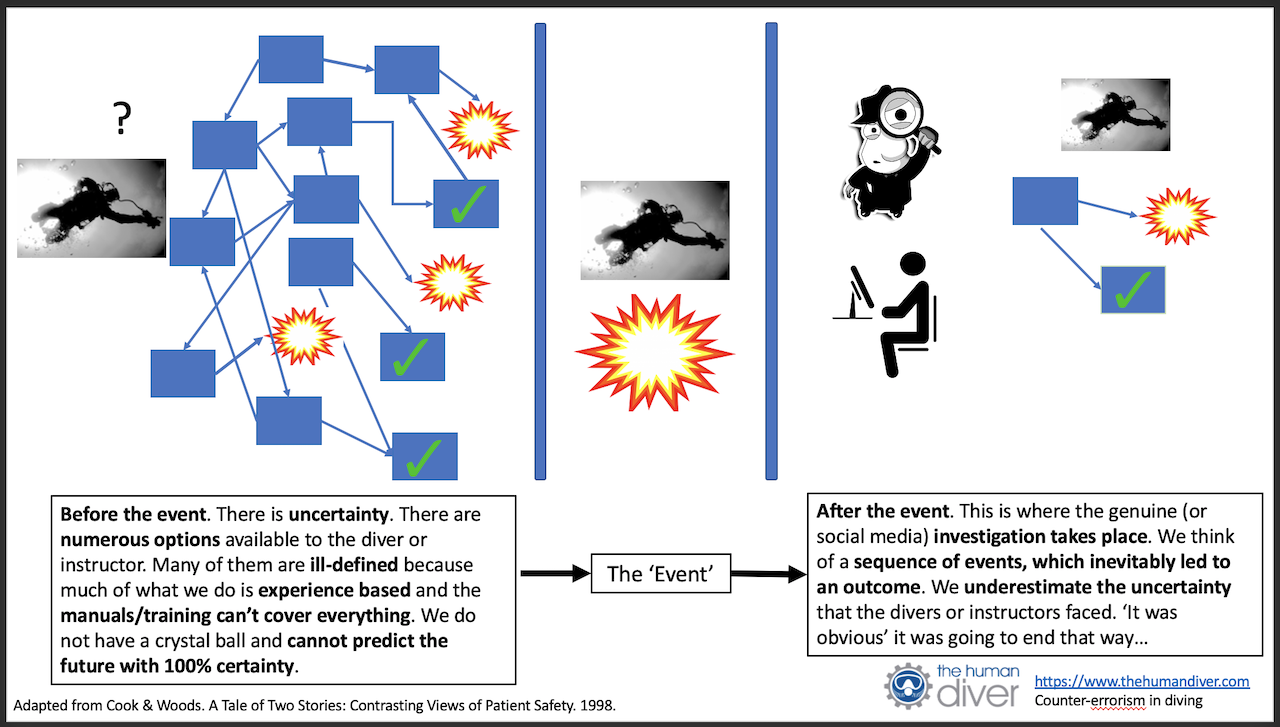
It’s easy in hindsight!
Finally, one of the reasons it is easy to make judgements about what should or shouldn’t have been done (counterfactuals) after the event is because the cognitive load to execute YOUR task is really limited. When you are in front of your computer screen or mobile device, your tracking and monitoring tasks are simple, your regulation has almost nothing to do compared to being on the dive, and your targeting layer is focusing on the ‘differencing through distancing’ bias, ensuring that you don’t think you’d be stupid enough to do something like that…
Part 2: The 'Obvious Thing' Nobody Noticed: The hazard was visible. The instructor just didn't have the capacity to see it. (Published on 5 April 2026)
In Part 2, we'll apply this same framework to the instructor and the technical diver. The same mechanisms play out, but the stakes and the complexity both increase considerably.


