

What if I am wrong? How would I know?
In 2023, Nic Emery from Fifth Point Diving wrote a guest blog for us called What are we pretending not to know? In it, she describes a trip to the Farne Islands with a boat full of fun divers. The sea was rough. Another boat was putting divers in, but the area where the team could safely dive was small, and getting back on board looked like it would be difficult. The staff talked it through and decided not to dive.
When Nic told the divers, several of them looked relieved. None of them had said anything beforehand about how they felt. When she asked them about it afterwards, the newer divers told her they would have followed the staff in, even though they were nervous. Some of the more experienced divers said they didn't want to be the ones seen to be 'chickening out'.
I was reminded of Nic's story a few weeks ago when I read an article by Catherine Sanderson, a social psychologist at Amherst College. She wrote it in response to the alleged sexual assault at Cornell University, where reports say more than 50 men in a group chat knew the assault was happening at the time. There has been no public report that any of them tried to intervene or call for help. This is a criminal case and I am not comparing it with a dive trip. However, Sanderson's question about why people who know something is wrong stay quiet applies to diving too, and her answer is useful.
Pluralistic ignorance - what does that mean, and so what?
Sanderson's explanation is something psychologists call pluralistic ignorance. Most people in a group privately feel one way, but each person believes that everyone else feels differently, and so they act in line with a norm that doesn't really exist.
The best-known study comes from Princeton in the early 1990s. Deborah Prentice and Dale Miller asked students how comfortable they were with the heavy drinking on campus, and how comfortable they thought the average student was. Across their studies, students rated themselves as less comfortable than the average student. Since the students were the average student, most of them were uneasy, and most of them thought they were in the minority.
Sanderson refers to research that takes this further. In a study of nearly 400 male students, what the students believed their peers thought about sexual aggression was a better predictor of whether they would step in than their own views were. What I think my friends think can shape what I do more than what I believe myself.
The students' most common reason for not stepping in was that they were afraid of being laughed at or looking weak in front of others. There is a second effect as well. People who behave badly tend to assume that most others agree with them, so they talk about it openly. That makes the behaviour look more common and more accepted than it is, and the people who disagree stay quiet because they think they are outnumbered.
Back to the Farnes
If we look at Nic's boat through this lens, a number of divers had doubts, and each one looked at the others getting ready and assumed they were alone. Nic identified the authority gradient between the staff and the customers as a factor, and I agree with her. I also think the divers were reading each other, and they misread what the others were thinking. If the staff had decided to dive, I suspect most of them would have got in the water.

Other places it shows up
Turn/end dive pressure is an obvious example. The team agrees to turn at a set gas pressure. Partway through the dive, one diver sees that their buddy is getting close to that number. They want to signal the turn but hesitate, because they think the others are enjoying the dive and won't mind going a little past the agreed figure. At the same time, the diver who is getting low would quite like to turn, but assumes the rest of the team wants to carry on and doesn't want to be the one who ends the dive. Both divers have the same concern, both carry on, and each thinks they are the only one who is worried.
Checks and checklists are another. On a lot of day boats, there is a sense that buddy checks are for beginners and that experienced divers just roll in. In parts of the rebreather community, using a written checklist can be seen as a sign that you don't know your unit. If you ask divers individually, many say they would be happy to do a check if they didn't think they would be judged for it. The few who visibly skip checks end up setting the standard that others follow.
Decompression has the same pattern. Talk about cutting the last stop short makes bending the plan sound normal, but the people who talk about it are usually the ones doing it. Divers who stick to their plan rarely mention it, because there isn't anything to say.
It also affects how we talk about mistakes. Many divers believe that if they share an error, they will be heavily criticised for it. That belief is usually based on a small number of people who comment loudly on social media threads. My experience is that most divers value honest accounts and learn from them, and this came through in my MSc research at Lund. However, because the critics are the most visible, people stay quiet and the learning doesn't happen.
How private views change
Prentice and Miller went back to the students a few months later. By then, many of the men had dealt with the gap between their own view and the imagined norm by changing their own view. They had moved towards a norm that hadn't existed when they started.
I think this is one route into drift. A diver privately thinks that going past turn pressure is a bad idea, but goes along with it because they believe the rest of the team is comfortable. Nothing goes wrong, and over time the discomfort fades. Their private view has shifted, and now they are one of the people the next new team member looks at when working out what is normal. Nobody decided this. It came from a misunderstanding that nobody checked.
The Princeton work also found that students who felt out of step with the norm felt more cut off from campus life, even though they weren't actually out of step. I wonder how many careful divers have drifted away from a club because they thought they were the only cautious one there.
Making the real norm visible
Sanderson argues that often the task is to help people see what the norm already is, rather than to create a new one. In diving, there are some straightforward ways to do that.
In a classroom or at a club night, run an anonymous poll with questions such as "How comfortable are you going past turn pressure?" or "Have you ever wanted to call a dive and not said so?" Then share the results. When people see that most others share their view, it becomes easier for them to act on it.
In the brief, the leader can state the norm explicitly – anyone can call the dive for any reason, and they will be thanked for doing so. A leader who shares their own uncertainty first makes it easier for others to do the same. This is how Nic started with her own staff. She talked openly about her mistakes and asked for feedback, and over time others did the same.
Agree the turn/end pressure, and what happens when someone reaches it, before you get in the water. That way, nobody has to make the case for turning during the dive, because the team has already made the decision. An agreed signal such as 'show me your gas' means you don't need to work out what to say underwater. Practising calling a dive during training means the first real call isn't the first time someone has done it.
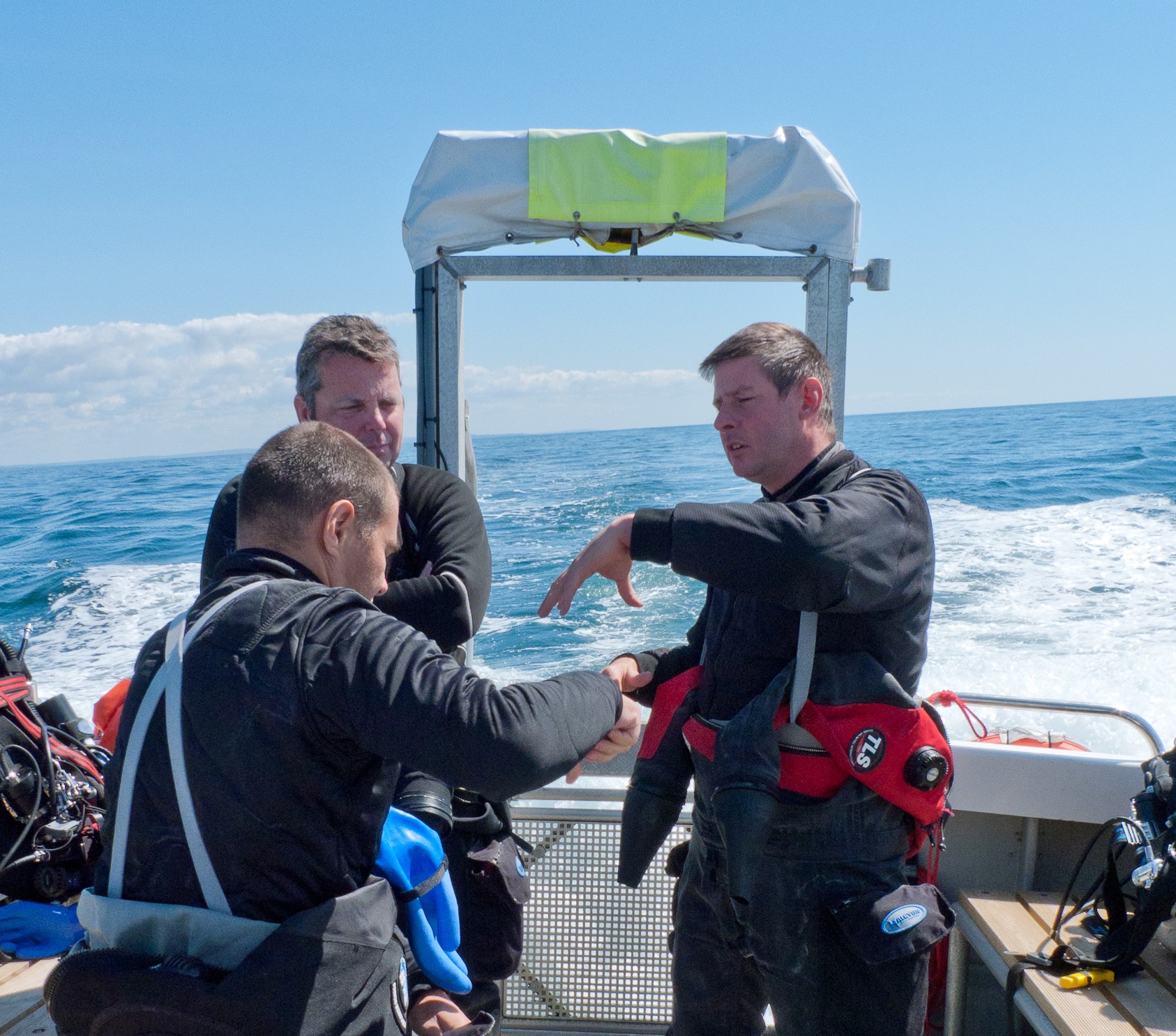
In the debrief, ask "Was there a moment when you felt uneasy and didn't say anything?" Over time, the answers show the team that their doubts are more widely shared than they thought.
None of these steps needs individual divers to be braver. They change the information people have about what others think, and that changes what they are likely to say.
Next time you're on a boat and something doesn't feel right, how many of the people kitting up around you might feel the same way, and be waiting for someone else to speak first?
References
Brown, A. L., & Messman-Moore, T. L. (2010). Personal and perceived peer attitudes supporting sexual aggression as predictors of male college students’ willingness to intervene against sexual aggression. Journal of Interpersonal Violence, 25(3), 503–517. https://doi.org/10.1177/0886260509334400
Carlson, M. (2008). I’d rather go along and be considered a man: Masculinity and bystander intervention. The Journal of Men’s Studies, 16(1), 3–17. https://doi.org/10.3149/jms.1601.3
Emery, N. (2023, July 16). What are we pretending not to know? The Human Diver. https://www.thehumandiver.com/post/what-are-we-pretending-not-to-know
Lock, G. (2024). Storytelling to learn: What happens underwater, stays underwater [MSc thesis, Lund University].
Prentice, D. A., & Miller, D. T. (1993). Pluralistic ignorance and alcohol use on campus: Some consequences of misperceiving the social norm. Journal of Personality and Social Psychology, 64(2), 243–256. https://doi.org/10.1037/0022-3514.64.2.243
Sanderson, C. A. (2026, October 4). The misperception that keeps bystanders from intervening and how to short-circuit it. PBS News (originally published in The Conversation). https://www.pbs.org/newshour/nation/the-misperception-that-keeps-bystanders-from-intervening-and-how-to-short%E2%80%91circuit-it


