

Who Can You Trust? Is the Trust Misplaced?
Many divers get on boats close to home or on the other side of the world with people they’ve never met. Sometimes they are paired with strangers and within a few hours they are following them down a line into a current.
You’ve likely been in this situation yourself, and you do it because the operator is a recognised name, the dive centre/boat holds the right certificates, the reviews were good, and the person beside you produced a card confirming they have been trained. Unfortunately, none of this gives you an idea of whether they will say something when they see you make a mistake, and converse is true, will you say something to them when it doesn't look right?
Two kinds of trust
There are two different kinds of trust working here, and importantly, they are not a substitute for one another:
- The first is structural or systems-based: the trust in this context travels with the certification card, the paperwork and the reputation of the organisations involved.
- The second is personal and has to be earned inside the relationship that has just started.
A dive team or instructional team can be rich in one and but poor in the other. Adverse events occur because failures in trust happen in different ways depending on the type of trust we’re looking at.

Trust as a calculated bet
The first kind treats trust as a decision made under risk – where something can be lost or gained. The premise is that you are placing something valuable, potentially your life, in someone else's hands and you cannot control what they do with it. You accept that exposure when the likely gain (awesome dive) is worth more than the likely loss (injury or death). This type of trust works at scale because of the organisational and social structures we are part of in diving; standards, certification cards, insurance, service intervals for equipment servicing, gas analysis records, agency quality assurance and boat licensing... These all serve to make another person's behaviour more predictable without me ever needing to actually know, in detail, what the others are supposed to be doing. They just ‘do’.
The diving industry invests heavily in this type of trust because the business model runs on it; strangers and teams, temporary operational and dive staff, and different crew on vessels, all need to work together without knowing each other. But there is something we can’t discount. What we call trust in a commercial settings is often a calculation with assumed safeguards. A signed liability waiver does not mean anyone trusts anyone, rather it means the consequences of things going wrong have been allocated in advance: the ‘risk’ has been transferred.
Trust as accepted vulnerability
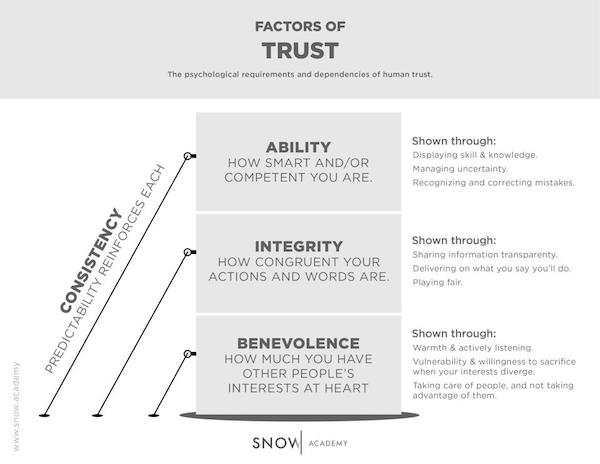
The second kind of trust is based around the psychological concept of vulnerability: the positive expectations about someone else's intentions. Research on this consistently identifies three separate judgements we make about a person.
The first is ability. Does this person know what they are doing here, in this specific setting? Ability is task and context specific rather than general. An instructor can be excellent in a quarry and out of their depth on a drift dive in current. A CCR diver can be strong on one unit and unfamiliar with another. The ‘card’ or label describes a category but it does not describe currency or competency.
The second is integrity. Does this person hold to the same principles when it costs them something? That ‘something’ might be money, time, or reputation. An instructor who passes one student because there is a personal relationship but standards haven’t been met, or not passing an ‘unknown’ student when those same standards haven’t been reached. Or allowing divers to pass because of time pressures, rather than competencies, exploiting the vague term of ‘mastery’.
The third is benevolence. Does this person care about my interests as well as their own? A guide who has never ended a dive early because one of the client’s needs will not be believed when they say the group comes first.
We can forgive a potential lapse in ability, we are less accommodating of breaches in integrity, and if we compromise benevolence, then all bets are off!
Those judgements produce a readiness to be vulnerable. Whether someone acts on that readiness depends on what is at stake for them, and in diving (like many high-consequence events) the stakes are unevenly distributed. The person raising the concern carries the cost of being wrong, being awkward, or being the diver who ruined the day. The team carries the cost of their silence, and importantly, the team usually has no idea it is carrying this risk at all. If Only… provides a number of examples of this.
The diving problem
Diving is set up in a way that few other high-consequence activities mirror. Groups (or teams) form on the day of the dive, undertake their activity in an inherently hazardous environment, and disband at the end of the day. A liveaboard is slightly different, as the group/team longevity is longer, but there is still a limited time to build trust in the conventional sense, even though safe diving depends on it immediately.
Researchers studying temporary teams called this swift trust. Groups with no shared history import trust from role expectations and category membership instead of from personal relationships. You trust a surgeon because of their category not because Pof your personal experience with them. Divers on a boat act as if trust is present: then adjust quickly based on whatever happens in front of them. Instructors and students face this problem too. The card, the logbook, the kit configuration and the way somebody assembles their gear all act as a proxy when there is no time to build the relationship.
Swift trust works more often than it should be required to do so. Unfortunately, it commonly fails in two situations:
The first is when the ‘evidence’ does not match the current capability and happens across the diving community; divers, instructors, and students. The individual ‘holds the card’ but has not done that kind of dive, on that equipment, in those conditions, for X period of time. The team has extended trust based on the category or label, discovers the gap the hard way, and the pendulum of trust swings the other way into distrusting the person entirely, causing problems which outweigh the current situation.
The second is when there is no baseline evidence. Swift trust is provisional and it is expected to be updated. If the first day of diving involves a dive briefing that invites no real questions, has a buddy check that is performed as a ritual, and no debrief takes place, then the provisional trust never solidifies. The swift trust quickly fades and divers end up diving alongside each other rather than with each other.
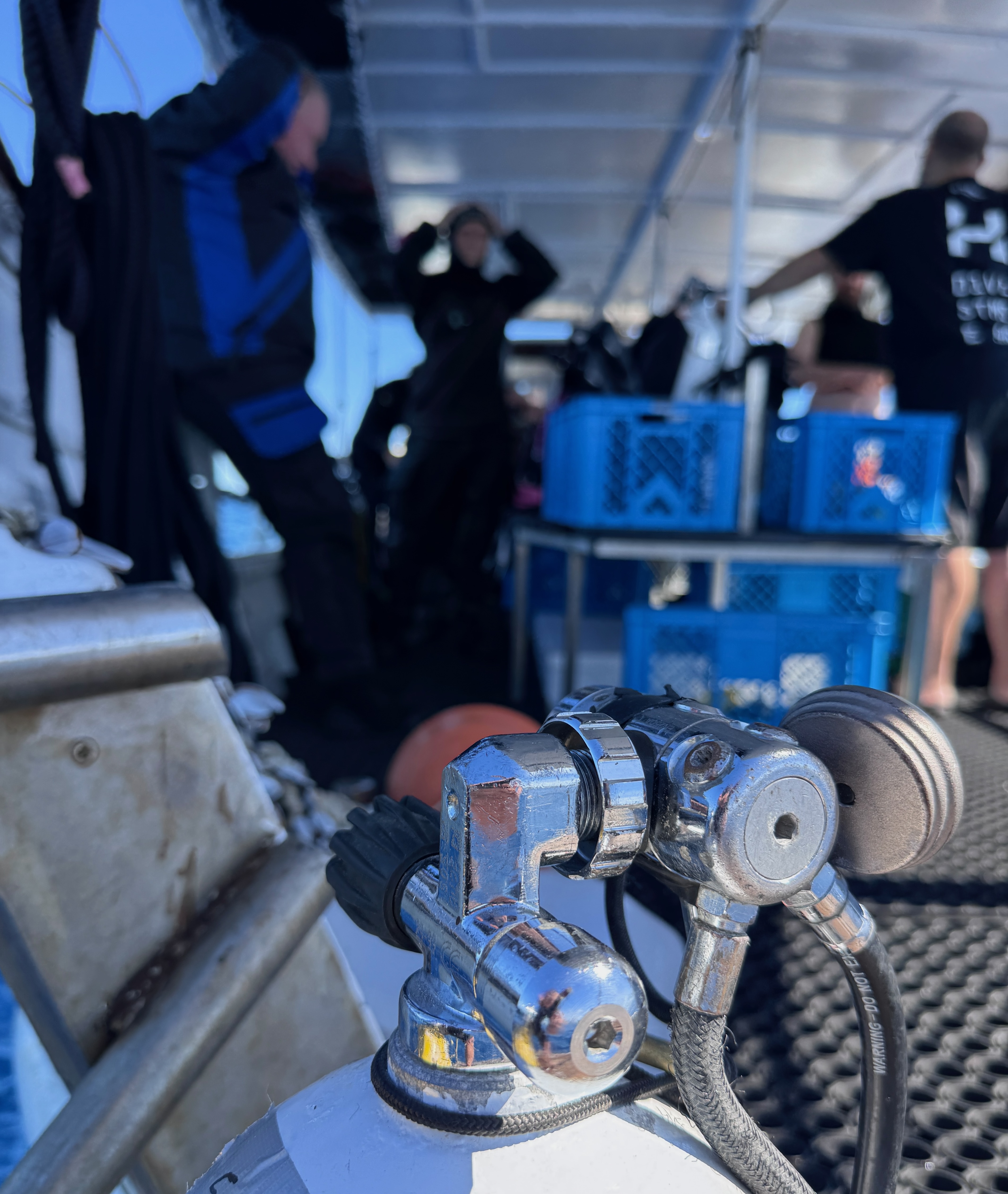
This is why the first dive of a trip has more influence than we think it does. A targeted conversation and structured brief with a new buddy before the first dive are not about being ‘nice’, they are part of the process by which the imported trust becomes real trust. Understanding their currency, competency and challenges are way more important than asking what cards they hold. The reciprocal is also true too: tell them what you are and are not current on and what you need to improve on. By being vulnerable, you have the potential to change the whole week’s diving.
Distrust is not simply low trust
Trust and distrust can be better understood as separate dimensions, than as opposite ends of a spectrum. Paradoxically, you can hold high trust and high distrust about the same person on different things.
This difference in perspective gives divers and instructors a vocabulary they can use. You can say, truthfully, that you completely trust a buddy's gas planning and do not trust their navigation at all (note, I didn’t use ‘but’). That is not a contradiction, nor is it a character judgement - it is being specific about where you need a safeguard or some oversight and where you do not. Teams that can talk about trust at this level of detail make better decisions than teams who sort people into good divers and idiots.
Control, and what it signals
There is a long-running argument about whether formal control replaces trust or supports it. Both effects appear in practice, which is why the question is hard rather than merely academic.
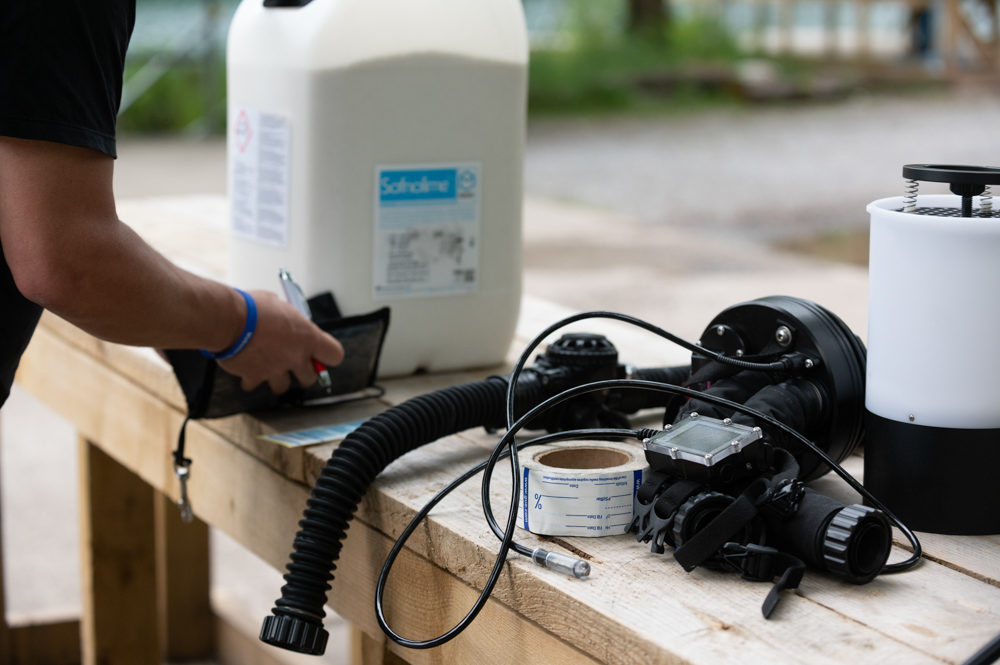
Adding checks signals suspicion if framed a certain way e.g., a team told to photograph every stage of their kit assembly, sign a further declaration and log each item on an app may reasonably conclude that they are not trusted. As a consequence, they will then do exactly what is asked and nothing beyond it, and the discretionary effort that invariably catches the unexpected problem, is the first thing to disappear. At the same time, you can’t remove structures otherwise people are left exposed and unsupported. That is the abdication of responsibility.
Checklists are among the most effective tools available in diving, but a check imposed without explanation is received as a statement about the person. However, the same check, explained as a defence against the variability of human performance (‘human error’), is received as a statement about the task. This is the same check, but has a completely different effect on the team.
Low trust is expensive and the cost rarely appears anywhere you can see it. It shows up as slower decisions, duplicated checking, defensive paperwork and information travelling sideways instead of upwards. The honest conversation about the dive happens in the car park rather than in the debrief. Nobody records that anywhere. It surfaces later as an incident that half the team saw coming.
The community effect
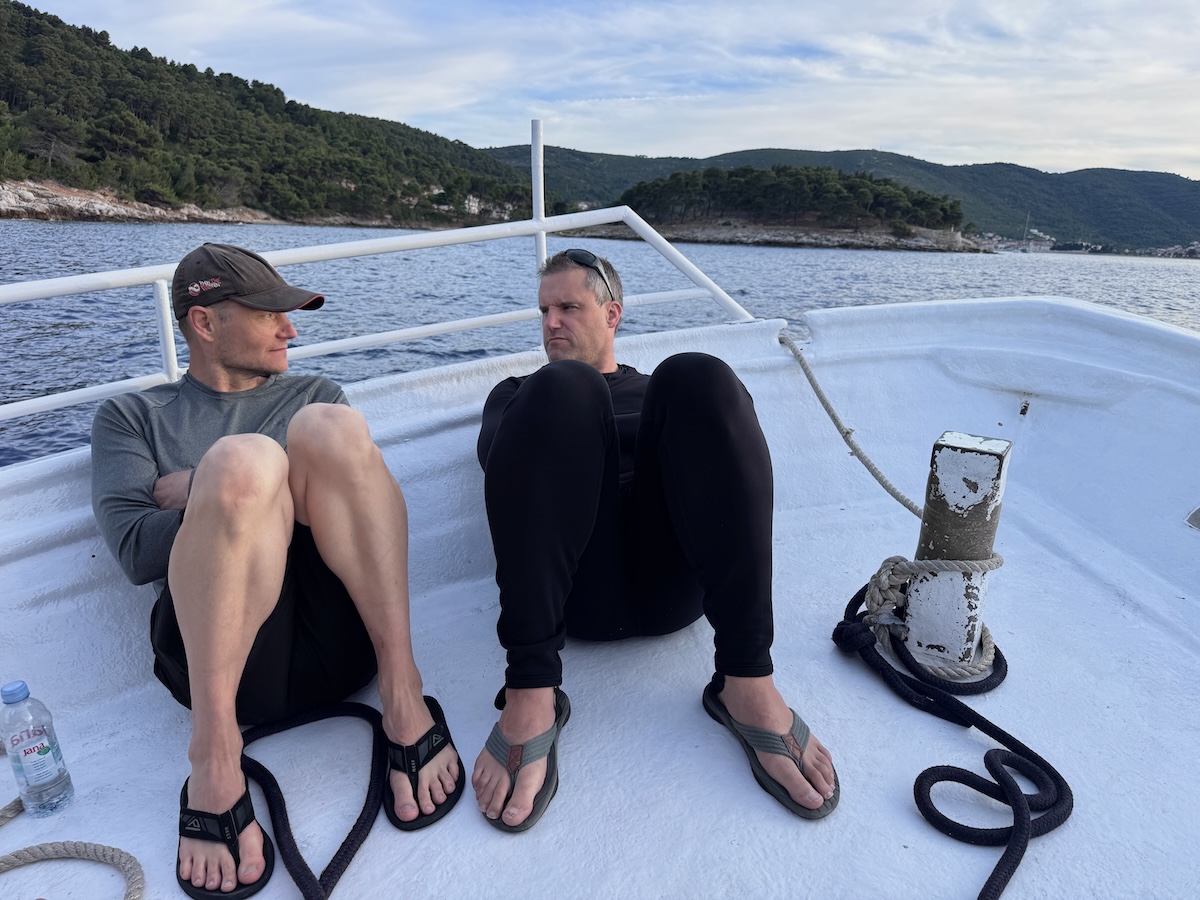
A positive reputation partly bridges the two types of trust. I trust you because I believe you have an interest in keeping our relationship intact, so your interests already take account of mine. This is both calculative and relational, and it explains why reputation has a massive impact in diving. The community is small. The same instructors, centres, skippers and divers meet again and again across different trips, different agencies and different years.
There are two edges to the reputation sword though. It makes people careful with their word, and it also makes people reluctant to say anything critical about someone they will be sharing a boat with next season. What goes around comes around.
How to make a difference
Talking about things is not enough to make a difference in the real world. That requires demonstrated action.
If you are the one in the water with the team, be explicit about the limits of your own experience and say which parts of this environment you know well and which you do not.
'Take one for the team' at least once by calling a dive for one person and handling the consequences yourself, in front of everybody, without making that person be the focus of attention.
Do what you said you would do about the small thing, because trust is built on the closed loop rather than the promise.
Explain why a check exists instead of simply imposing it.
If you run the operation:
Match supervision to the actual dive rather than to the certification level presented, and check currency/competency at the task level.
Apply the same standard on the last day of the season as on the first - your team is watching for exactly that inconsistency and they will find it.
Audit your own procedures – what is there because of tangible and defendable evidence, and what is there because of one bad afternoon several years ago. Safety clutter is everywhere – remove it.
Conclusion
Systems make it possible to start diving with strangers with an element of reduced uncertainty, and relationships make it possible for those strangers to tell you the truth so you can find those hidden secrets. Diving is generally good at building system trust, and at the same time, inconsistent at building personal trust. As such, should we be surprised when the paperwork fails to identify something that half the boat/dive operation already knew BEFORE an adverse event occured. Cards, standards and service records can make behaviour predictable, but they cannot make safety critical information move from those who have it to those who need it.
Sources
Arrow, K. (1974). The Limits of Organization. Norton.
Coleman, J. (1990). Foundations of Social Theory. Harvard University Press.
Edmondson, A. (2018). The Fearless Organization. Wiley.
Hardin, R. (2002). Trust and Trustworthiness. Russell Sage Foundation.
Lewicki, R., McAllister, D. & Bies, R. (1998). Trust and Distrust: New Relationships and Realities. Academy of Management Review, 23(3).
Luhmann, N. (1979). Trust and Power. Wiley.
Mayer, R., Davis, J. & Schoorman, F. (1995). An Integrative Model of Organizational Trust. Academy of Management Review, 20(3).
McAllister, D. (1995). Affect- and Cognition-Based Trust as Foundations for Interpersonal Cooperation in Organizations. Academy of Management Journal, 38(1).
Meyerson, D., Weick, K. & Kramer, R. (1996). Swift Trust and Temporary Groups. In Kramer, R. & Tyler, T. (eds), Trust in Organizations. Sage.
Reitz, M. & Higgins, J. (2019). Speaking Truth to Power at Work. Hult Research.
Williamson, O. (1993). Calculativeness, Trust, and Economic Organization. Journal of Law and Economics, 36(1).


