

You're Accountable. You're Responsible. You're It!
Let's Start With a Simple Question
After a diving incident, someone usually gets blamed. The diver panicked. The instructor missed a sign. The buddy wasn't paying attention.
But is that the whole story?
Almost never.
This blog is about accountability. It asks: when something goes wrong on a dive, who is really responsible? And are we asking that question in the right way?
The answer matters. If we get it wrong, we keep making the same mistakes. If we get it right, we actually start to learn.
Two Words. One Big Muddle.
Most people use the words accountability and responsibility as if they mean the same thing. They don't.
Here's the difference in plain terms:
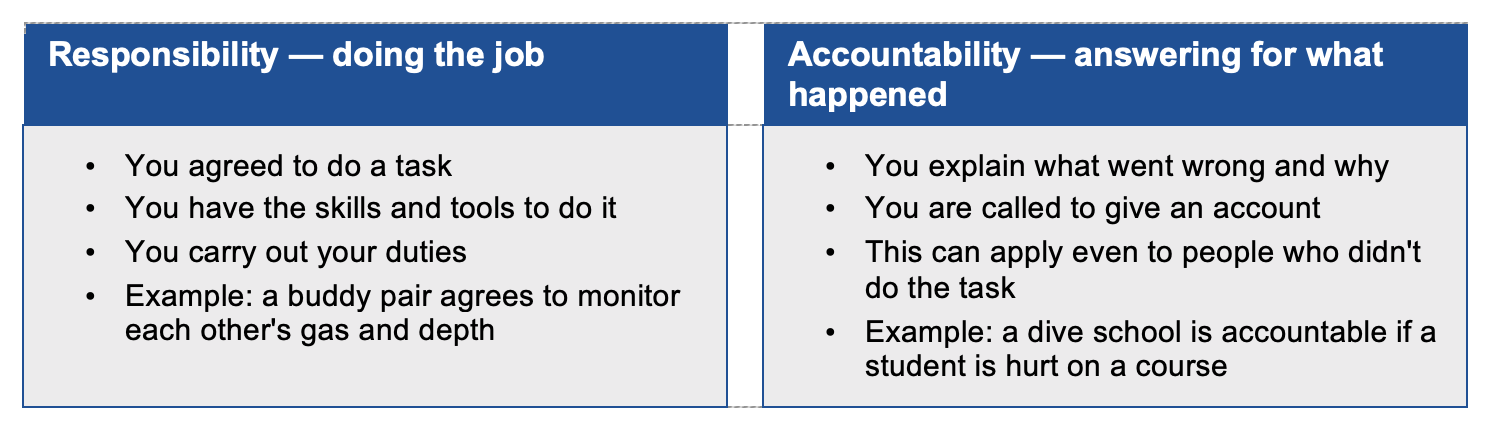
You can be responsible for something without being accountable for the outcome. And you can be accountable for an outcome you didn't directly cause.
Mix these up and you blame the wrong people. You miss the real causes. And nothing changes.
Diving example: A student panics and bolts to the surface during a training dive. We call it the student's fault. But who designed the course? Who chose the dive site? Who set the timeline? Who assessed the student's readiness? Those people had responsibility too. The student was just the last brick pulled from the tower.
The Two Ways We React When Things Go Wrong
When a diving incident happens, there are two very different questions we can ask. The question we choose shapes everything that follows.
The Blame Question (what most people ask)
Who made the mistake? Who is at fault? What did they do wrong? This feels satisfying. It gives us a clear answer fast. It reassures everyone else that they would have done better. But it almost never tells us why the incident really happened. And it stops people from talking honestly the next time something nearly goes wrong.
The Learning Question (what actually helps)
How did it make sense for that person to do what they did, at the time, with the information they had? This is harder. It requires effort. But it leads to real answers. It reveals the conditions that set the person up for failure. And it gives us something we can actually fix.
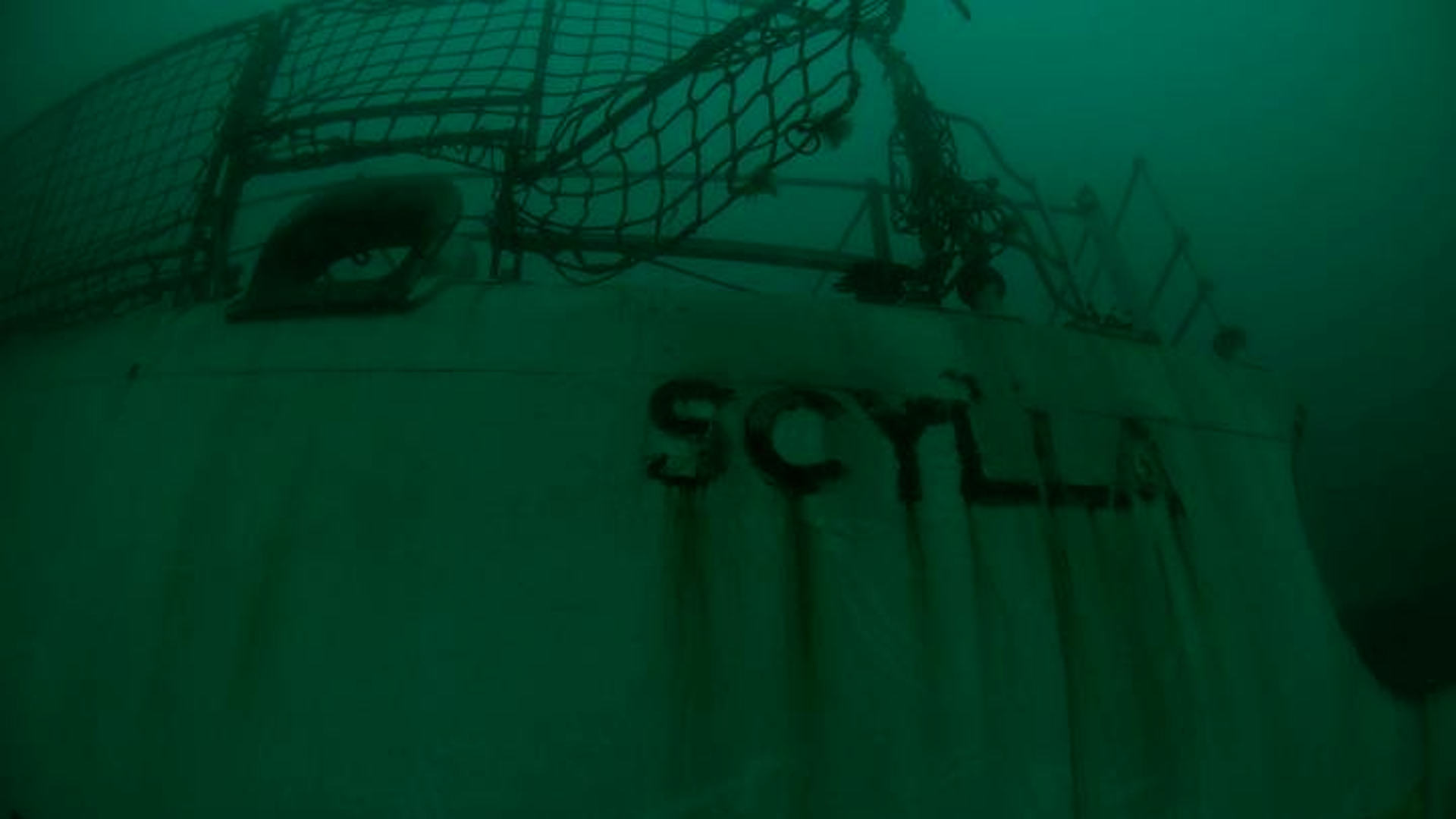
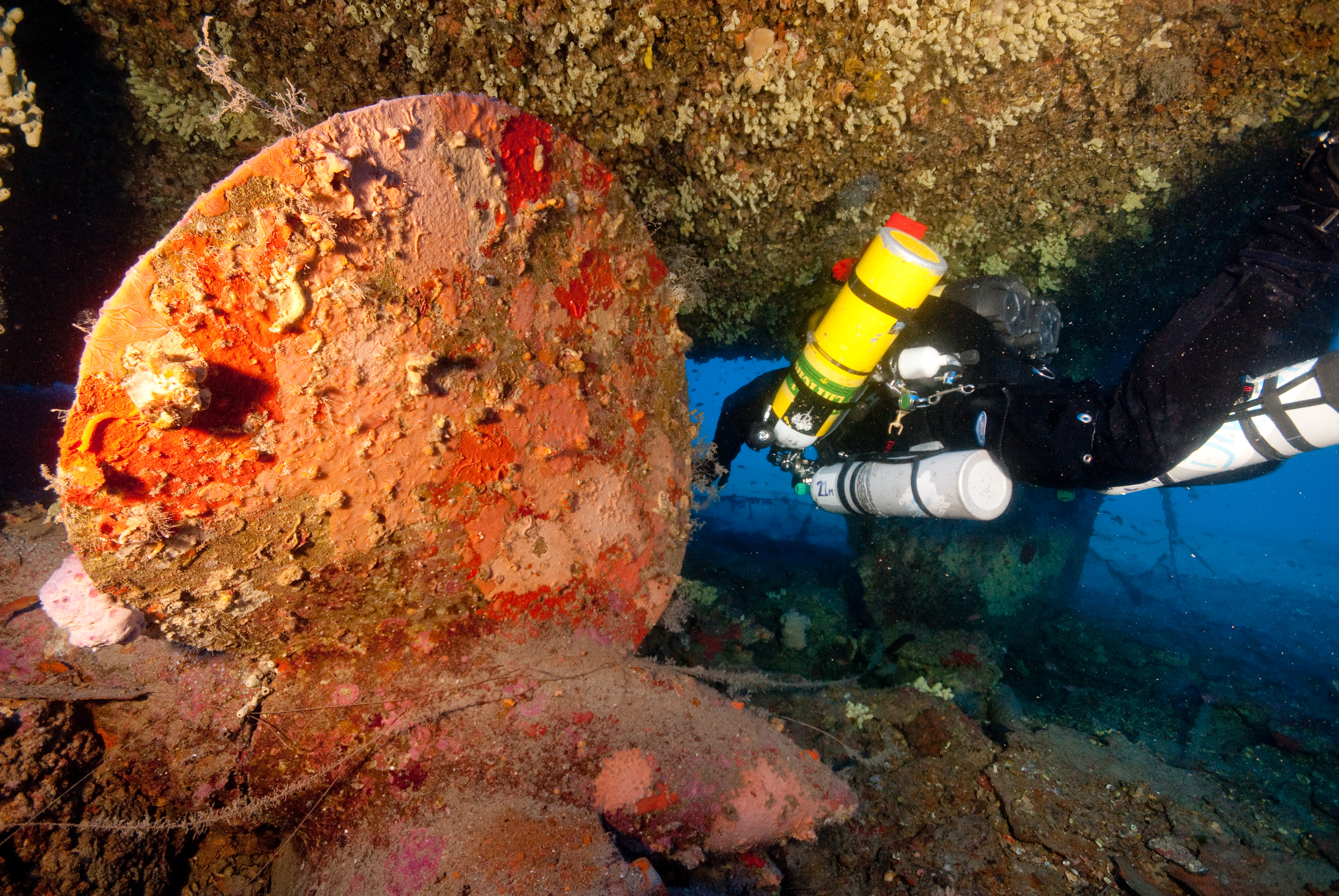
Think about the Scylla wreck in Plymouth Sound, UK. Three experienced divers — two instructors and a divemaster — all from the same dive centre. They had dived this wreck many times. They knew each other well. What started as a relaxed dive turned into a fight for survival when silt from dredging operations had dramatically reduced visibility. One diver got out through a gap so tight he shredded his wetsuit. He surfaced with twelve breaths left in his cylinder. The other two didn't make it out.
The blame question says: they should have laid a line. The learning question asks: why would experienced divers, diving a familiar wreck, with no problems on the last dozen dives, feel they needed to? What had changed in that system without them knowing it?
The learning question is the one that might save the next team.
Not All Accountability Is the Same
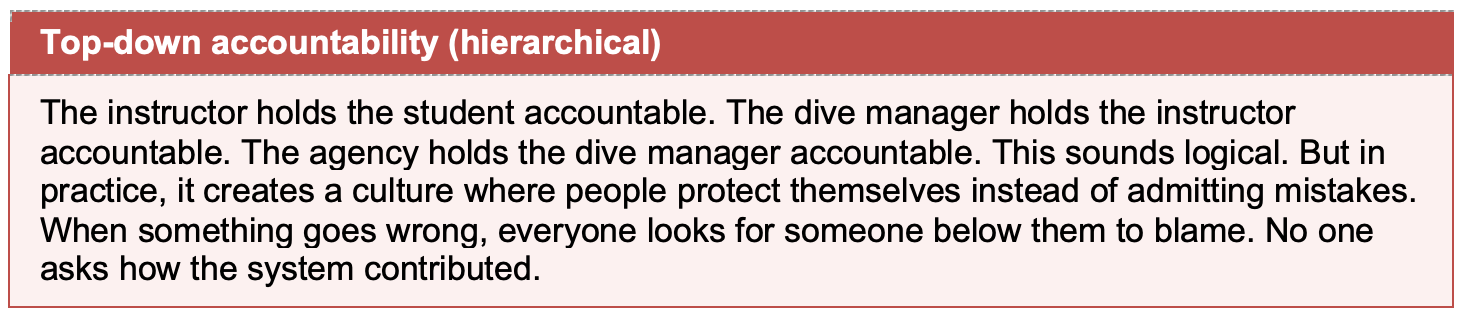
Here's something most people don't realise. There are many types of accountability. Some types help teams improve. Others damage trust and make people hide mistakes.
Most diving organisations use the types that cause the most harm.
Types That Damage Learning

Types That Support Learning
Real Diving Situations
Let's look at how these accountability types play out in situations divers actually recognise.
The Student Who Skipped the Pre-Dive Check in a Pool Session
A student arrives late to a pool session. There is pressure to keep to the lesson plan. The instructor skips the full pre-dive equipment check to save time. The student enters the water with a tank valve not fully open. Gas is restricted partway through a skill. The student surfaces in distress.
Blame-focused position: the student should have checked their own gear.
Learning-focused questions: Why did the check not happen? What was the pressure that led to skipping it? Is skipping checks when running late a known habit at this dive school? Is there a system to prevent it, or does it rely entirely on individual discipline?
The Dive That Went Well — But Shouldn't Have
A dive guide takes a group of Open Water divers to a site that is slightly beyond their certification level. The conditions are calm. Everyone has a great time. No incident. The guide does the same thing the next week, and the week after that.
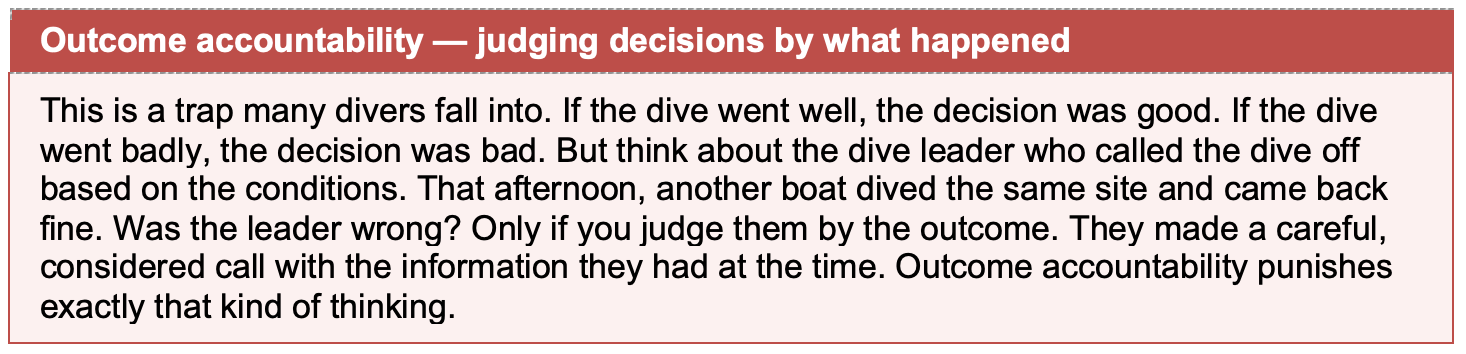
Outcome accountability says this is fine — look, no problem. But what is actually happening? The guide is slowly normalising a risky practice. Each successful dive makes the next one feel safer. This is called drift. The tower is filling with holes and nobody is pulling them out — because no one has been hurt yet.
Then the day comes when the conditions are less calm. The group is slightly less experienced. The gap that was always there becomes a problem.
I've dived this 60-70 times without laying line...
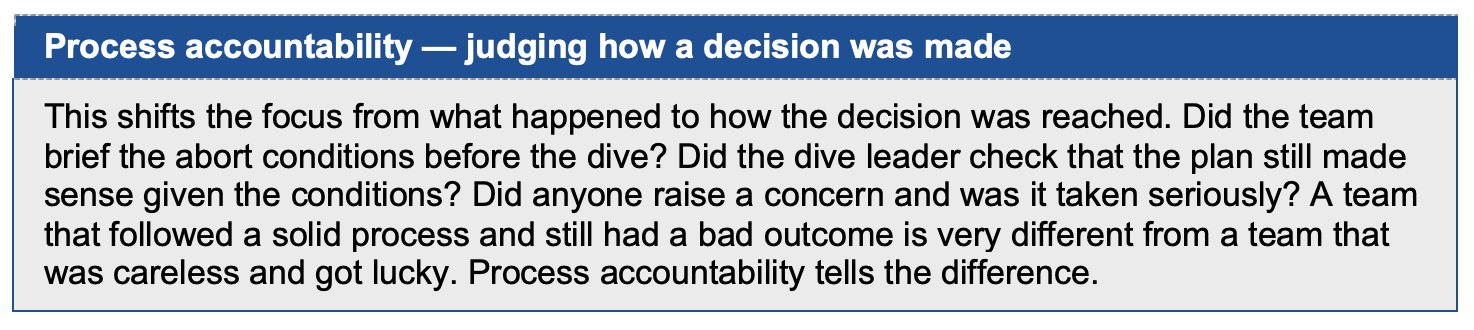
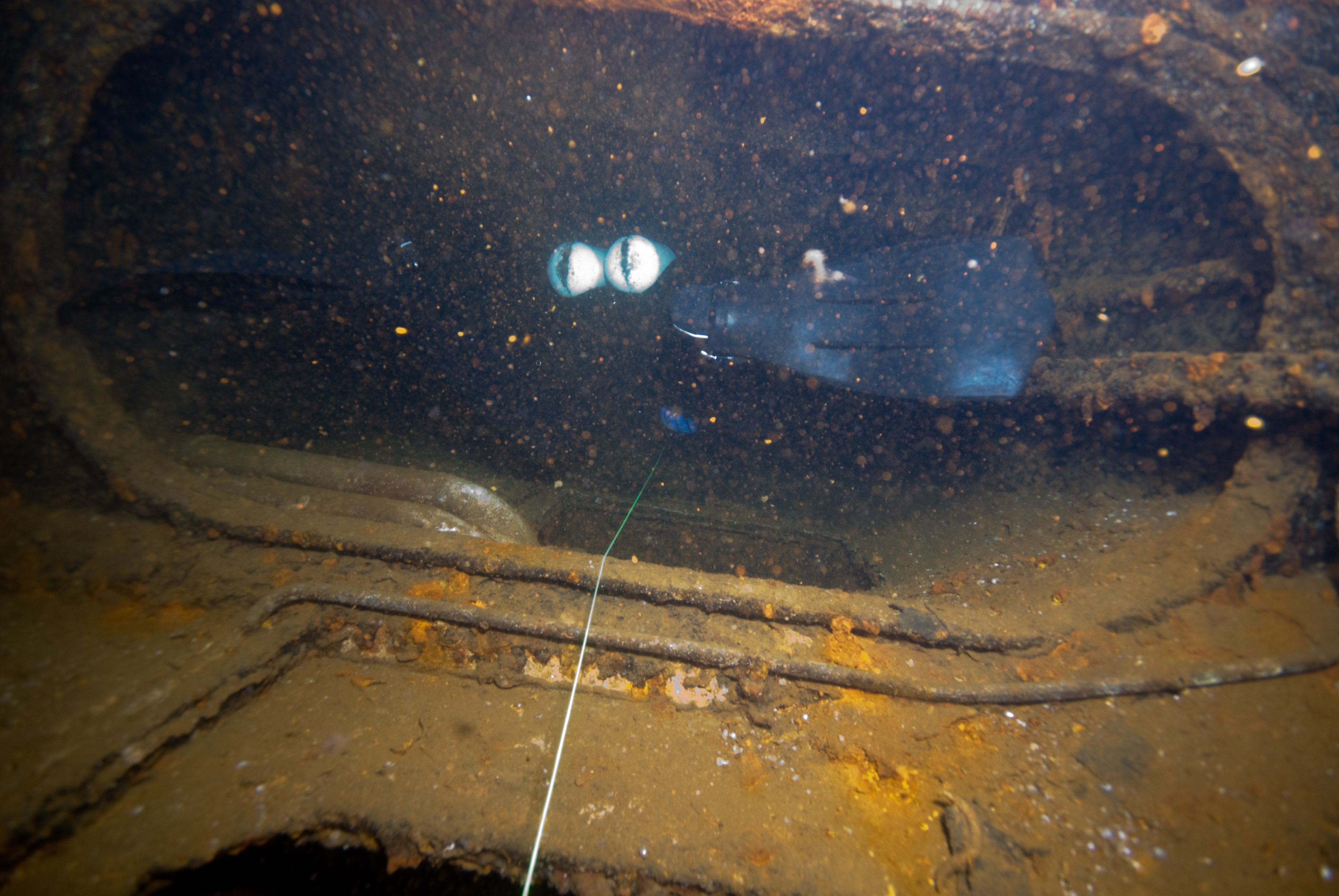
In the IJN SATA case study, four experienced divers had entered that wreck many times without laying a line. That practice felt safe — because it had always worked before. Until the wreck collapsed and blocked the exit. Their rebreathers kept them alive for five and a half hours. One of the other members of the dive team, a cave diver, had fifteen minutes to kit up and go back in to find them. Process accountability would have asked: is our practice still sound, even though we haven't had a problem?
The Instructor Who Raised a Concern
Before a boat dive, an instructor tells the dive manager that one student isn't ready for the planned depth. The dive manager says they are behind schedule and to proceed anyway.
The dive goes ahead. The student has a buoyancy problem at depth. No injury, but a genuine close call.
What often happens: The instructor gets pulled aside afterwards. 'You were responsible for that student. Why didn't you handle it better underwater?' The concern raised before the dive is forgotten. The schedule pressure that overrode it is never discussed. The dive manager's decision is never examined. The instructor learns one thing: raising concerns doesn't help.
What should happen: The investigation starts by asking: a concern was raised and overruled. Why? What does that tell us about how we balance schedule pressure and safety decisions in this operation? Who is accountable for the conditions under which that conversation happened? This gets to the real cause — and the real fix.
The Near-Miss No One Reported
A diver on a liveaboard notices their buddy's drysuit inflator is sticking. They manage the dive carefully and get back safely. They decide not to report it. They don't want to cause problems. They're not sure it counts as an incident.
Three trips later, a different diver has the same problem. This time, they are deeper and less experienced. They over-inflate, lose control, and shoot to the surface.
The first diver's silence did not cause the second accident. But the system that made silence feel like the safer option did.
People report near-misses when they trust that reporting leads to learning, not blame. They stay silent when they fear that giving an honest account will result in punishment. Your near-miss culture tells you everything about which type of accountability is actually operating in your dive operation.
The Linnea Mills Case
Linnea Mills was eighteen years old. She died during a dive that should never have happened in the conditions it did. She had forty-five pounds of lead zipped into pockets she couldn't release. She was wearing a drysuit she had never used before. The instructor was not qualified to teach the class. (Full blog taking a systems-view)
The easy response is to blame the instructor. And the instructor made serious errors. But the instructor was also operating inside a system that had normalised these practices. Another instructor who attended an early TekCamp workshop in the UK described pulling twenty kilos of lead off a student across two dives — and that was considered standard for that club.
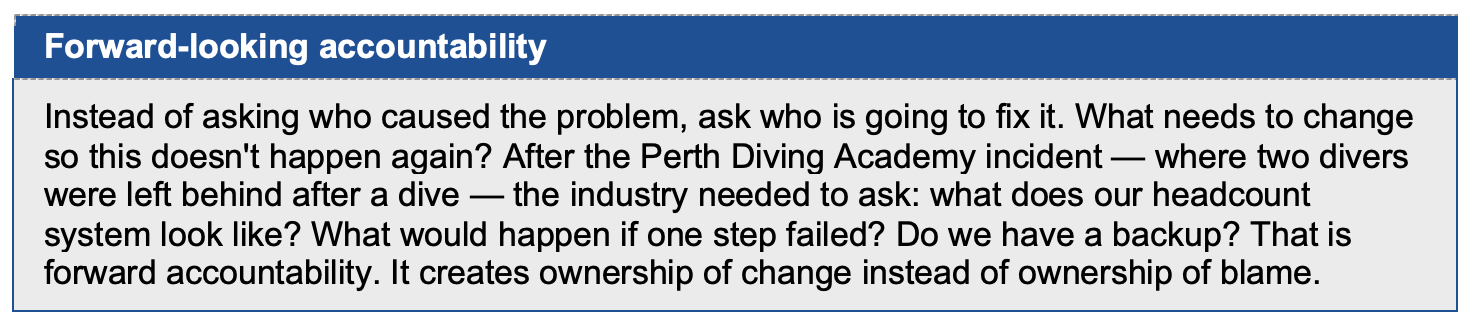
Blame accountability focuses on the instructor. Forward accountability asks: what does our industry's training system produce? Who certifies instructors to teach courses they aren't qualified for? What norms have become so embedded that no one questions them? Where did the lead-weighting practice come from, and who is accountable for passing it on? What quality management processes exist to bring people back to the standards?
The Weight You Already Carry
Here's something worth saying directly to instructors and dive leaders: you already feel accountable for the people in your care. You feel it before the dive. During the dive. After the dive. That sense of responsibility is part of what makes you good at what you do.
The problem is when that felt sense of accountability gets combined with a blame-first accountability system. When something goes wrong — even when the causes were far outside your control — you can end up carrying the full weight of an outcome that was shaped by many people and many decisions.
That is not accountability. That is scapegoating with a professional title attached.
Diving and the Maritime Sector Comparisons
A vessel captain from maritime research described being taken to court for an engine room failure he had no technical knowledge of and no ability to prevent. His words: 'I was held accountable. But I wasn't responsible.' Diving instructors know this feeling. They carry legal and moral accountability for outcomes that were shaped by training standards, dive school policies, equipment decisions, and student histories they had no part in creating.
What You Can Actually Do
You don't need to overhaul your whole dive operation overnight. Start here.
For Every Diver
After a dive, ask: how did we make our decisions, not just what happened? Talk about the process.
Resist the first story. When you hear about an incident, notice when you're reaching for blame. Ask: what was the whole situation?
Report near-misses. Even small ones. The system can only learn if it knows what nearly happened.
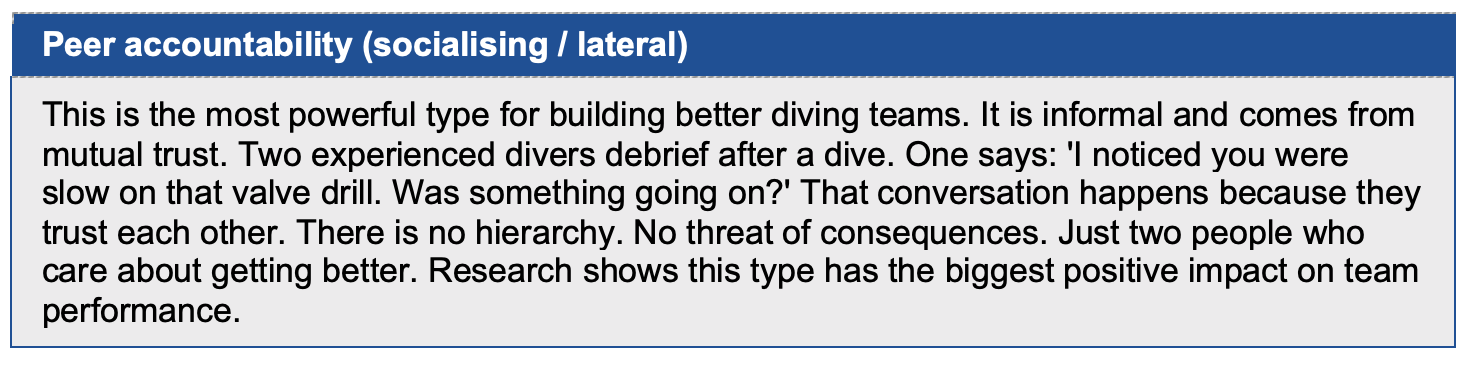
Build the kind of relationship with your dive partner where you can tell each other the truth. That peer honesty is the most powerful safety tool you have.
For Instructors and Dive Leaders
Debrief the process, not just the outcome. Ask: how did we make our decisions today? What were we thinking at each choice point?
When a student makes an error, ask: what set them up for that? What in the environment, the plan, or the conditions contributed?
Create space for concerns to be raised — and act on them. If someone raises a concern and nothing happens, they won't raise the next one.
Separate errors of carelessness from errors of complexity. An experienced diver making a poor call in genuinely difficult conditions is not the same as a reckless diver ignoring basic rules. Treat them the same way and you lose the trust of your experienced people.
For Dive Operations
Look at what happens after incidents and near-misses. Do people come forward or go quiet? The answer tells you what type of accountability is really operating.
Make sure everyone in the operation knows who is responsible for what — and who is accountable for what. These are different things and both matter.
Create a space where instructors and divemasters can talk informally about what they've seen and heard — without it becoming an official record. That informal sharing is where most real learning happens.
Ask your customers what they noticed. They see things your team doesn't. A confused briefing, a rushed headcount, a piece of kit that looked wrong. That feedback is free intelligence.
The Point of All This
Accountability is not about finding someone to blame. It is about building the conditions where honest conversations happen, where people feel safe reporting what nearly went wrong, and where the whole team gets better because of it.
The diving incidents that have taken lives — the Scylla, Linnea Mills, Dylan Harrison — were not caused by bad people making reckless choices. They were produced by systems, pressures, norms, and gaps that nobody had addressed, often because the accountability culture made addressing them feel too risky.
The question is not whether we hold each other accountable. It is whether the accountability we apply actually helps or quietly makes things worse.
Most of the time, we are applying the kind that makes things worse. We can choose differently.
If you want the PDF guide that this blog was based upon, click here
This blog was based on the research of Ruth Parris, a colleague of mine from Lund University, Sweden. Ruth works in the maritime sector in New Zealand, and you can find her thesis here.


