
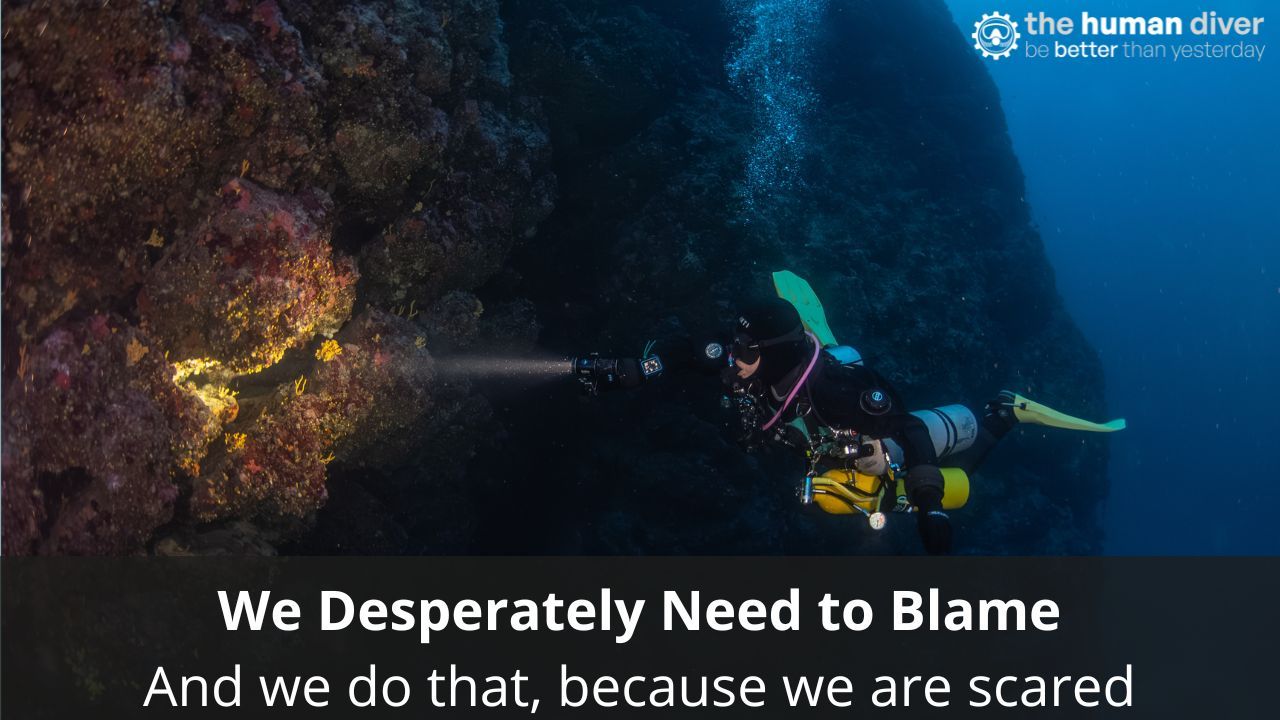
The desperate need for blame
It was a sunny November day. Despite the cool wind from the land, it was still warm. The sea was very calm. It was our third day of diving. I had dived in this spot dozens, if not hundreds, of times. Two rocks protruded above the surface of the sea, connected by an underwater ridge. The sandy bottom was at a depth of about 45 metres, but that was not our goal. We planned to dive along the vertical walls. Our goal was to find red gorgonians at a depth of about 35 metres. Our team consisted of three divers. We dived in twin-tank configurations and additionally took tanks with decompression gas containing 50% nitrox. Since one of the divers, Mike, had already had several mild cases of DCS, we planned to be extra conservative and use more restrictive decompression algorithms. The planned dive was essentially a no-decompression dive with an extended stop at 6 metres, and from 21 metres, we were to breathe nitrox. Both Mike and I had been technical divers for years, with thousands of logged dives in various conditions. The third person in our team was the least experienced. Kamila is a diver who had about 160 dives at the time and was beginning her adventure with decompression diving. This dive was her 100th dive in a sidemount configuration and her 6th dive with a stage tank.

After entering the water, we were greeted by an extremely strong current. Currents are not common in this area, and even rarer in the early morning, but despite this, its strength on the surface caused us to quickly separate. I signalled to everyone to dive down. Three metres below us was the top of a rock where we could hide from the current and calmly prepare for the rest of the dive. Kamila sank to the bottom and attached her decompression gas stage. Until then, she had been doing quite well attaching the stage and side cylinders, even though this was her first experience diving from a boat. This time, it was clear that the strong current was causing additional difficulties. We hung calmly in the water next to her, ready to help if necessary. I made a reassuring gesture to show her that we were there and could see her, and that she should calmly get her configuration in order. After about 5 minutes, she gave the OK sign. I swam up to her and visually checked that her configuration was OK. Then I asked her how much gas was left in each cylinder. She showed me. Everything was fine. We did a quick check of the regulators and began our descent. The vertical walls illuminated by the morning sun were still full of life despite the late season. We slowly descended to a depth of 16 and then 18 metres. I led the dive, with Kamila behind me and Mike bringing up the rear of our three-person team. After about 15 minutes, we had to start deepening and reach the expected depth of 35 metres. The gorgonians should be just around the corner. At 30 metres, I felt that the current was very strong. For about a minute, I tried to break through it to hide behind another break in the rock, but I saw that I was not getting very far. I had it in my head that Mike should avoid exertion at depth, and Kamila is not a very experienced diver, and despite her very good condition, swimming against such a strong current would not be pleasant for her and could lead to excessive gas consumption. I turned around and signalled that we were turning back. Oh well, the gorgonians will have to wait, the walls here are beautiful too. We returned calmly, sheltered from the current, slowly exploring and observing life. Mike was swimming much shallower at this point, probably 5 metres shallower than me. Visibility exceeded 30 metre,s and we remained in visual contact the whole time. The water was 20 degrees, but in dry suits, everyone felt thermally comfortable. I signalled to Kamila that it was time to shallow up.

I slowly ascended from a depth of 34 metres. She was constantly looking for fish and crustaceans in various recesses of the vertical walls densely covered with green algae. I was already at about 27 metres and realised that Kamila was still at depth. I went down to her and showed her again that it was time to start ascending. This time, she followed my instructions very carefully. We reached 21 metres and performed the gas change procedure. We remained at this depth for another 4 minutes and began our ascent to 6 metres. Mike joined us at around 15 metres, already breathing nitrox. At 6 metres, the computers showed 3 minutes of decompression. We swam through narrow canyons carved into the almost white dolomite rock, admiring the light reflections on the rock and the small fish chasing around us. When my computer showed that I was ready to leave, I asked Kamila what her readings were. She showed that she was ready. Mike showed that he still had 7 minutes. I expected this to be the case, even though he was swimming shallower the whole time and had left the depth earlier, as his settings are much more conservative than mine. We made an extended stop and calmly returned to the boat.

After returning to the port, about 8 minutes' sailing from the dive site, we changed into our clothes and went ashore. We had a 3-hour break before the next dive, with coffee, lunch and a walk planned. After about 90 minutes, we were already on a walk surrounded by greenery. Kamila turned to us and said that her stomach was itchy, showing us a purple-violet irregular spot. I have seen cases of skin DCS enough times to have no doubt about what I was looking at. In addition, Mike confirmed that it looked exactly like his previous cases.
After about 40 minutes and more than 2 hours after the dive, Kamila was given 85% nitrox to breathe, and the patch disappeared and the itching stopped.
Searching for meaning
The situation continued to bother me. If anyone was going to get DCS after that dive, it should have been Mike or me. If only because of our age, body type and physical condition. Kamila, who regularly practised aerobic sports, definitely had a better BMI and physical fitness than us. She took great care of her nutrition and hydration, which I cannot honestly say about myself and Mike. It is true that we all made sure to get enough sleep and went to bed around 10 p.m., so lack of sleep or fatigue was not the cause either. I called a cardiologist friend of mine who is also a dive master and an experienced diver. I sent him our profiles, and he conducted an extensive interview.
I quickly realised that he was trying hard to find a cause for the DCS. We discussed all the likely factors we knew of that increase the risk of decompression sickness and a few less likely ones, and nothing fit. I realised that we were trying very hard to find something to blame. Finally, I asked if it was so difficult for us to accept that this was ‘undeserved’ DCS.
‘You always say that there is no such thing as undeserved DCS!’ I heard.
"Yes, it was deserved for entering the water, the cause is that the dive took place.
Why is it so difficult to accept that there are factors that we have no control over and that we simply do not know about?
Why do we look for someone to blame after an accident? The psychology of blame
In high-risk environments — diving, aviation, medicine, firefighting — after every accident or incident, there is an immediate need to find someone or something to blame. This mechanism is so common that it sometimes seems instinctive. In practice, however, it is the result of several well-described psychological processes that are designed to protect our psyche rather than improve safety.
Heuristics, errors and protective mechanisms
The fundamental attribution error is a cognitive mechanism that involves overestimating personal characteristics and underestimating the situation. If everything is fine with our diving, it was not difficult, no one was cold, no one was sick, dehydrated or exhausted, it means that the problem lies with the diver. We were desperately looking for a cause. Another cognitive error that affected us was the so-called belief in a just world. In order to function in a reality full of threats, people need to believe that the world is predictable and controllable. An accident destroys this illusion. That is why the brain immediately looks for a narrative that will ‘restore’ this justice: We really want to believe in a sense of control, in the belief that the world is predictable and fair. If the dive was done correctly and both Mike and I are okay, then someone else must have made a mistake.
I knew that this way of thinking was wrong and untrue, but this perception of the situation was tempting – even for Kamila, who was ready to believe that the fact that she stayed a little longer and went a little deeper determined her fate.
As humans, we fear chaos, and that is what accidents seem: chaotic and random. Blaming something or someone allows us to restore that sense of control and distance ourselves from the people involved in the event. Thinking along the lines of ‘it won't happen to me because I don't act that way’ is known as distancing oneself by seeking differences.
Blaming gives a false sense of control. According to classic concepts of control psychology (Skinner, 1996; Rotter, 1966), people cannot stand randomness. If an accident is the result of many small factors that could happen to anyone, it means that events are to some extent random. Finding someone to blame allows us to regain our mental balance.
In addition, we need to protect our self-esteem and competence, so we blame others to feel better and safer. We are competent; we do not make such mistakes. It is 'they' who acted wrongly.
Final thoughts
When I think back on that dive today, what strikes me most is not the bruise on Kamila's skin, nor the discussions about profiles or conservatism, but how quickly everyone — experienced divers, instructors, the doctor, myself — began desperately searching for the cause. We wanted to find that one element, or set of elements, that ‘didn't work’, that one decision that ‘must have been wrong’. As if understanding the details could protect us from the uncertainty that has always been and will always be part of diving.
This need for order and control is not a weakness. It is human. It is a natural reaction in a world where risk never disappears, only changes shape. But that is precisely why it is so important that we can see when our explanations become not facts, but a defence mechanism.
DCS does not always make sense. Accidents do not always have a cause that can be pointed to. And yet, what happened underwater that day reminded me of something more important than all the procedures and calculations: that our safety is based not only on skills and planning, but also on the ability to accept uncertainty.
Risk does not disappear when we understand it. But it becomes more manageable when we honestly admit that not everything can be predicted. And that diving, like any activity in an environment foreign to humans, will always contain an element of the uncontrollable.
This awareness should not paralyse us. On the contrary. It should remind us that our strength lies not in looking for someone to blame, but in our willingness to learn, reflect and be humble about what we do not know. Planning for the unknown, weaving resilience to the improbable and unusual into the organisation of our dives.
This is true maturity in diving. And the only way to ensure that every day underwater – despite the risks, despite the uncertainties – is a conscious decision, not a naive one.
My friends' persistent search for the cause showed me how easily we fall into traps. On the one hand, as experienced divers, we are cognitively aware that we do not know all the causes of DCS and are not able to prevent it 100%, but on the other hand, it has become clear how difficult it is for us to free ourselves from cognitive errors. How much we need to latch onto some error or identifiable cause so that we don't have to face our sense of danger. We need something that gives us a sense of causality so that we can fear and guard against it and thus feel safer. Diving and how we think about diving incidents show how we actually accept the risks that diving entails, especially when we lose our sense of control.
Resources
Dekker, S., ’t Hart, P. (2010). Judgment and decision making in complex systems.
Mezulis et al. (2004). A meta-analytic review of self-serving attribution bias.
Baumeister (1999). Self-concept, self-esteem, and self-deception.
Reason, J. (1990). Human Error.
Dekker, S. (2014). The Field Guide to Understanding 'Human Error'.
Skinner, E. (1996). A guide to constructs of control.
Rotter, J. (1966). Generalized expectancies for internal versus external control of reinforcement.
Lerner, M. (1980). The Belief in a Just World: A Fundamental Delusion.
Hafer & Bègue (2005). The Belief in a Just World and Reactions to Innocent Victims.
Ross, L. (1977). The intuitive psychologist and his shortcomings.
Jones & Harris (1967). The attribution of attitudes.

Andrzej is a technical diving and closed-circuit rebreather diving instructor. He works as a safety and performance consultant in the diving industry. With a background in psychology specialising in social psychology and safety psychology, his main interests in these fields are related to human performance in extreme environments and building high-performance teams. Andrzej completed postgraduate studies in underwater archaeology and gained experience as a diving safety officer (DSO) responsible for diving safety in scientific projects. Since 2023, he has been an instructor in Human Factors and leads the Polish branch of The Human Factors. You can find more about him at www.podcisnieniem.com.pl.
If you're curious and want to get the weekly newsletter, you can sign up here and select 'Newsletter' from the options


