
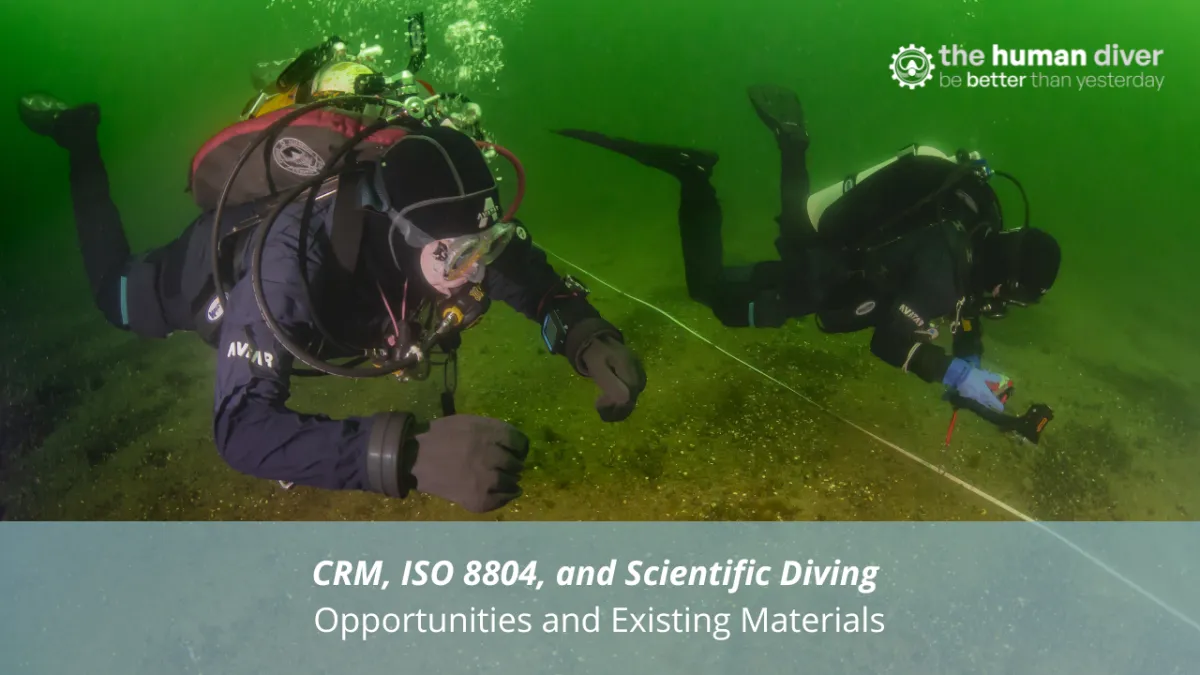
CRM, ISO 8804, and Scientific Diving: Opportunities and Existing Materials
A LinkedIn post appeared in my feed this week that adds more to the body evidence around a shift of thinking about human factors in diving. Raymond Arce, working with Vasio Agapitou at the University of Wolverhampton and RAA SMPC Training, has had a Master's thesis abstract accepted for the 9th Annual European Conference on Scientific Diving. The title is "Developing a Crew Resource Management Framework for ISO 8804 Scientific Diver Training", and the framework sits situation awareness, teamwork, and decision-making around a core of communication, leadership and effectiveness, mapped across the ISO 8804-1, -2 and -3 training cycles.
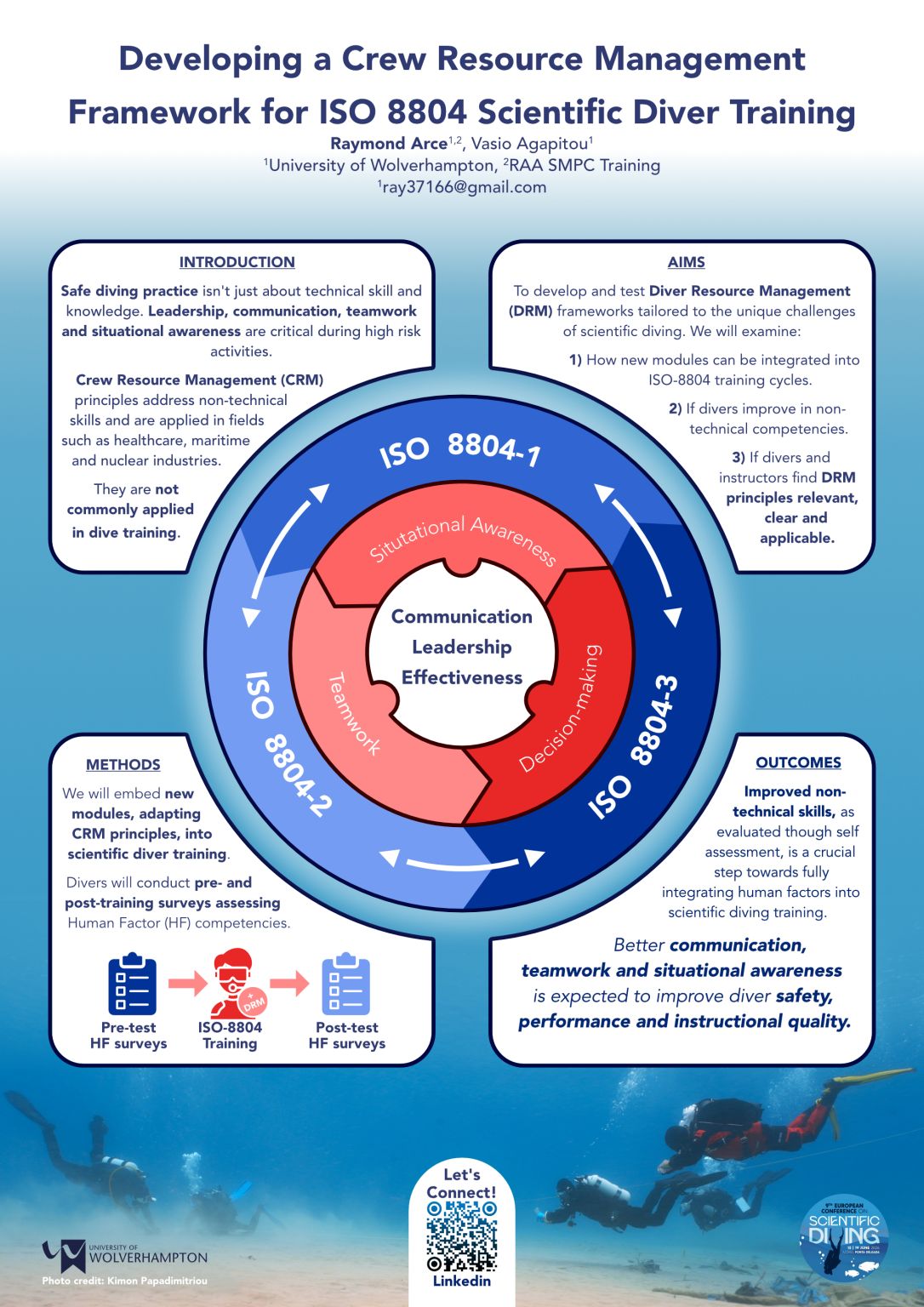
This is exactly the kind of work the scientific diving community needs more of, and I want to welcome it for two reasons. The first is that it takes seriously the fact that safe diving practice is not just about technical skill and knowledge — a point the poster itself makes clearly, and one that is overdue in this corner of the diving world. The second is that any serious attempt to bring Crew Resource Management (CRM) principles into ISO 8804 will sit on top of a body of literature and a set of operational tools that already exist, and so the process can be accelerated by lifting directly from work that has already been done.
This post is for anyone — researcher, instructor, dive officer, standards body member — thinking along similar lines, and for those of you who already follow this blog and want a quick map of where the relevant material sits.
Why CRM and scientific diving belong in the same sentence
CRM began life in commercial aviation in the late 1970s, after a series of accidents in which technically competent crews failed because of breakdowns in coordination, communication, and authority dynamics. From there it migrated, with adaptation, into healthcare (anaesthesia, surgery, emergency medicine), offshore oil and gas, the military, and nuclear operations. The shared logic is straightforward. In any domain where small numbers of people manage complex equipment in an unforgiving environment under time pressure, the technical training that gets them qualified only get them so far when it comes to success. (Resilient Performance Model and Outcomes are a function of…). What determines whether a team survives a difficult day is how they think, communicate, lead, follow, and adapt together.
Scientific diving fits that description tightly. A scientific diver is simultaneously managing life support, navigation, task load, decompression obligation, and the demands of the science itself, often inside a team configuration that spreads situational information across surface and subsurface, sometimes across a ship and a submersible, and almost always inside an institutional hierarchy that places the institution above the dive safety officer above the early-career researchers actually in the water. The conditions that produce CRM-relevant failures are not occasionally present here. They are structurally present in how the work is organised.
Three patterns are worth identifying because any CRM framework for scientific diving needs to address them head on:
Attentional load. Modern scientific diving routinely layers Structure-from-Motion photogrammetry, sensor arrays, and increasingly capable closed-circuit rebreathers onto a diver whose working memory was already busy managing the diving itself. Cognitive Load Theory is not contested: those demands are additive, and once they exceed working memory capacity, performance on the most recently loaded task degrades first. Piispanen and colleagues demonstrated in 2021 that CCR diving in Arctic conditions imposed measurable cognitive burden before any survey task was added. The science task is then loaded on top of an already taxed system.
Distributed situational awareness. The surface supervisor, the dive team, the vessel skipper, and on more complex operations, submersible pilots, or multiple teams, each see a slice of the operation and not the whole. Effective communication between these stakeholders is often reduced because of latency and is often stripped of non-verbal cues. Stanton and colleagues' 2006 work on distributed situation awareness makes it clear that mental models diverge systematically in this kind of configuration unless deliberate coordination mechanisms — structured briefings, closed-loop communication, explicit state-sharing — are employed to keep them aligned. Without those mechanisms, the team is operating from divergent pictures of the situation and discovering the divergence only when something goes wrong.
Authority gradient. The institution holds high level accountability and responsibilities, and funding support. The dive safety officer may be senior in operational terms but junior in institutional terms. The divers in the water can be early-career researchers whose continued programme participation depends on their relationship with those in the institution. Edmondson's foundational psychological safety research, combined with Reitz and Higgin’s work on speaking truth to power, is unambiguous about what this configuration produces if it is not actively managed: communication suppression, driven by perceived interpersonal risk. The diver who questions a dive plan potentially risks their place on the next research project. A CRM framework that does not take this dynamic into account or treats it as a soft cultural concern rather than the central mechanism it is, will not deliver what it claims to deliver.
What the literature already gives us
The research and presentation in the Azores describing how a CRM framework can apply to ISO 8804 likely calls on the large of body of work already present.
The core academic foundations are well established.
Flin, O'Connor and Crichton's Safety at the Sharp End (2008) is the standard reference for non-technical skills across high-risk domains.
NOTSS framework for surgeons (Yule and colleagues, 2006).
ANTS framework for anaesthetists (Flin and Maran, 2004).
IOGP 503 framework for oil and gas (2018) provide directly transferable taxonomies and behavioural marker schemes.
Endsley's situation awareness work.
Stanton and colleagues' distributed situation awareness research.
Edmondson's psychological safety literature.
Sweller's Cognitive Load Theory together give a causal account of why team performance fails.
Reader and O'Connor's 2014 analysis of the Deepwater Horizon explosion looks at a different setting but is structurally instructive about how NTS failures cascade in distributed sociotechnical systems with surface and subsurface elements.
These are not diving-specific, but they are the foundation on which any domain-specific framework gets built.

Within diving more directly:
O'Brien and Caramanna's 2017 study examined the relationship between stressors and performance in professional scientific divers and reported moderate correlations between fatigue, reduced situational awareness, and degraded teamwork — an empirical anchor for what is otherwise a literature dominated by analogy.
2011 UK Health and Safety Executive research report on rebreather diving recommended HF training as a curriculum component; that recommendation has sat largely unactioned for fifteen years.
CSA 275.2 (2026) is the first occupational diving standard to explicitly require HF and NTS competencies and provides a working template for any other standards body looking at how to phrase such requirements.
Rebreather Forum 4 presentation on Human Factors in rebreather diving.
A guide to Diving Crew Resource Management (DCRM) for occupational diving is available to download for free from here.
Caramanna's 2023 book Risk Management for Diving Operations: How to enhance the safety and proficiency of diving teams and my own 2019 book Under Pressure: Diving Deeper with Human Factors are the two domain-focused books currently in print. Between them they cover the conceptual ground a CRM framework needs: what HF actually means, how NTS competencies translate into diving operations, what the common failure modes look like, and how to talk about all of this in language that practitioners recognise. Both are referenced in the diving literature that is now starting to accumulate.
What is missing — and what work like Raymond's may contribute to filling — is a validated, scientific-diving-specific NTS taxonomy with behavioural markers, and prospective evaluation of training interventions using validated outcome measures. If it covers those markers, researchers need to be cognisant that assessment of behavioural markers is subjective, and the training needed to be consistent is not insignificant.
The cross-domain literature gives us very strong reasons to expect benefit. It does not yet give us scientific-diving-specific evidence of effect size, optimal dose, or the conditions under which transfer is most reliable. Those are the empirical questions the next decade of research in this space needs to answer.
What The Human Diver already provides
I want to be transparent about my own position before saying this. I run The Human Diver. I have a commercial and mission-orientated interest in HF and NTS training reaching the diving community. That said, the work that has been done over the last several years exists, and if it is useful to someone building a CRM framework for ISO 8804, it is more useful for me to say what is there than to pretend it isn't.
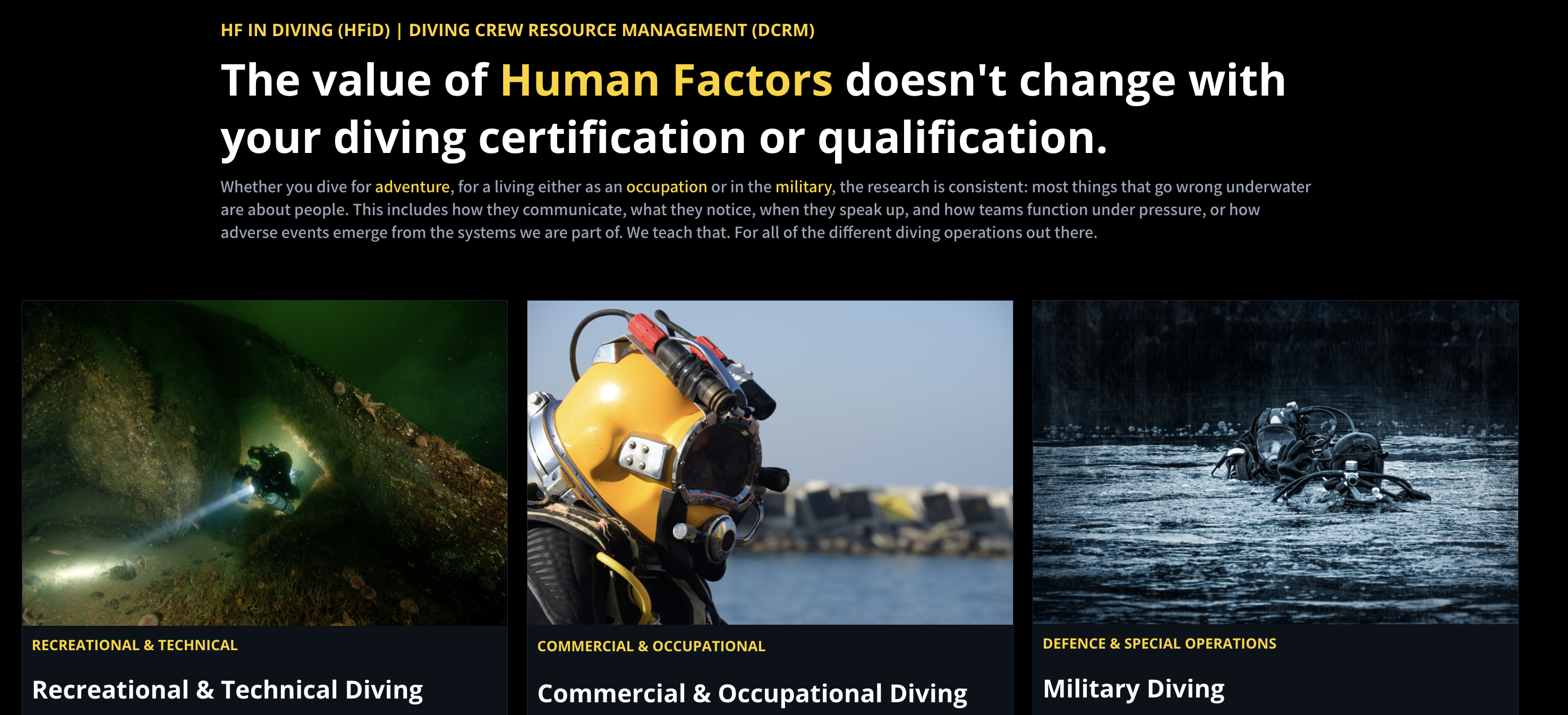
HFiD: Essentials is a five-hour online self-paced programme that introduces an NTS framework adapted for diving operations. It includes two structured operational tools: UNITED-C as a pre-dive briefing structure, and DEBrIEF as a post-dive reflective analysis structure that moves the team from "what happened?" to "how did it make sense at the time, and what does that tell us about the conditions of the work?" Both tools were developed specifically for diving and have been adopted across recreational, technical, occupational, and now scientific diving contexts.
HFiD: Applied Skills is a two-day experiential programme using the Interpersonal Skills LAB simulation. The simulation isolates team dynamics under distributed knowledge, time pressure, and ambiguity — the same conditions that produce NTS-relevant failures in real diving operations — without the cost and logistical complexity of replicating an underwater environment. This is the same approach the Bavarian Firefighting School uses for leadership and decision-making training, and the cross-domain evidence for low-fidelity simulation of cognitive and interpersonal skills is robust.
Several scientific diving programmes have already drawn on these materials in their own contexts: the Finnish Scientific Diving Academy at the University of Helsinki, King Abdullah University of Science and Technology, Georgia Aquarium, the California Academy of Sciences, and the University of Tasmania among them. Each has adapted the content to their specific operational reality, which is exactly how this kind of programme should be used. The frameworks and tools are not the intervention. The intervention is what an organisation does with them.
Alongside the courses, the book Under Pressure is available as a starting reference, the Human Diver blog has eight years of accumulated case analysis and commentary, lots of free resources to download, and a growing community of trained instructors and facilitators is now active across several countries. None of this replaces the academic work that needs to be done to build a validated, ISO-aligned CRM framework. What it does provide is a set of working materials, tested in the field, that a framework like the one Raymond is developing can plug into rather than build from scratch.
A genuine offer, and a wider point
If anyone working on CRM frameworks for ISO 8804 or for any other scientific diving standard would find it useful to discuss what is already in place, what the materials cover, and where the genuine gaps in the literature still are, I am happy to have that conversation. The point of this work is for scientific diving to end up safer and more effective, not for any particular provider to own the space. There is more than enough work in front of us for collaboration to make more sense than competition.
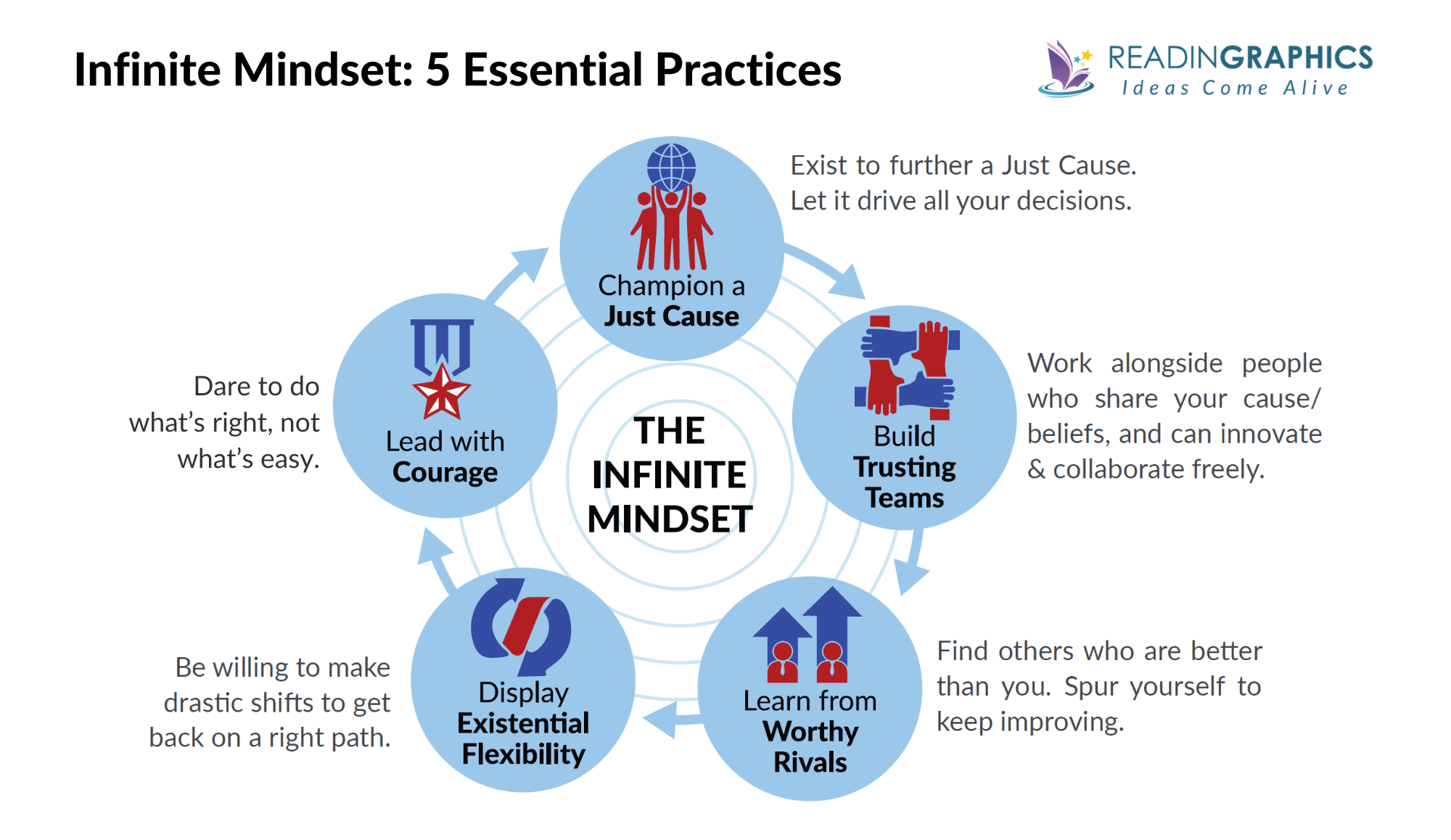
Simon Sinek's distinction between finite and infinite games is useful here. A finite game has known players, fixed rules, and a defined end point at which somebody wins. An infinite game has known and unknown players, changing rules, and no end point — the objective is to keep playing, and to keep playing well. Most of how the community has talked diving safety has been finite in flavour: pass the course, sign the logbook, get certified, close the incident report, file the corrective action. That framing makes sense for the things it covers, and incomplete for everything else. Scientific diving safety, and the HF and NTS work that underpins it, is unambiguously an infinite game.
There is no point at which a team has "completed" psychological safety.
There is no certificate that marks the end of learning to brief and debrief well.
There is no version of an ISO standard that, once written, removes the need to keep examining how the work is actually being done in the field.
Organisations that approach this as a finite game — train the staff, tick the audit box, move on — are the ones whose programmes of change will fade within eighteen months. The ones that treat it as infinite game, building the conditions for sustained learning rather than chasing the appearance of completion, are the ones that change and create wider change.
The wider point around which this blog opened is critical. The community is beginning to take seriously that technical proficiency, medical fitness, and equipment certification are important but not enough for safe and effective (scientific) diving operations. The 9th European Conference on Scientific Diving will hear at least one paper that says so directly. The literature has been saying it for a long time. The materials to act on it exist and are improving. There are leaders who are moving beyond the position that compliance means safety. The remaining questions are about validation, governance, and implementation discipline — about how organisations actually make this work, sustain it past the initial training events, and embed it in leadership behaviours rather than letting it settle as a slide deck nobody opens again. That will not be easy, especially as we don’t measure safety, we measure unsafeties, and so the evidence around how a programme is working has to be based on proxies and not directly around safe or unsafe outcomes.
Be better than yesterday. Most of what makes a scientific diving operation safe and effective is in the conditions you set, the team you build, and the way you respond when somebody raises a concern, not in the heroics that get demanded when those conditions fail.
References
Caramanna, G., & Strickland, B. (2023). Risk Management for Diving Operations: How to enhance the safety and proficiency of diving teams. Self-published. ISBN: 979-8988399612.
CSA Group (2026). CSA Z275.2: Occupational Health and Safety Code for Diving Operations. Toronto: CSA Group.
Edmondson, A. (1999). Psychological safety and learning behavior in work teams. Administrative Science Quarterly, 44(2), 350–383.
Endsley, M. R. (1995). Toward a theory of situation awareness in dynamic systems. Human Factors, 37(1), 32–64.
Flin, R., & Maran, N. (2004). Identifying and training non-technical skills for teams in acute medicine. Quality and Safety in Health Care, 13(suppl 1), i80–i84.
Flin, R., O'Connor, P., & Crichton, M. (2008). Safety at the Sharp End: A Guide to Non-Technical Skills. Farnham: Ashgate.
Health and Safety Executive (2011). Research Report RR871: Assessment of Manual Operations and Emergency Procedures for Closed Circuit Rebreathers. London: HSE Books.
International Association of Oil and Gas Producers (2018). Report 503: Introducing Behavioural Markers of Non-Technical Skills in Oil and Gas Operations. London: IOGP.
Lock, G. (2019). Under Pressure: Diving Deeper with Human Factors. Milton Keynes: Human in the System Consulting.
Lock, G. (2023). Human factors and rebreather diving. In: Pollock NW, ed. Rebreather Forum 4. Proceedings of the April 20-22, 2023 workshop. Valletta, Malta; 2024. p. 57–69.
O'Brien, E., & Caramanna, G. (2017). Human factors in scientific diving: an experimental approach. In Proceedings of the AAUS Diving for Science Symposium 2017. Thunder Bay National Marine Sanctuary: American Academy of Underwater Sciences.
Piispanen, W., Lundell, R., Tuominen, L., & Räisänen-Sokolowski, A. (2021). Assessment of alertness and cognitive performance of closed circuit rebreather divers with the Critical Flicker Fusion Frequency Test in Arctic diving conditions. Frontiers in Physiology, 12, 722915.
Reader, T. W., & O'Connor, P. (2014). The Deepwater Horizon explosion: non-technical skills, safety culture, and system complexity. Journal of Risk Research, 17(3), 405–424.
Reitz, M., Nilsson, V., Day, E. and Higgins, J. (2019). Speaking truth to power at work. Hult Research.
Sinek, S. (2019). The Infinite Game. New York: Portfolio/Penguin.
Stanton, N. A., Stewart, R., Harris, D., Houghton, R. J., Baber, C., McMaster, R., Salmon, P., Hoyle, G., Walker, G., Young, M. S., Linsell, M., Dymott, R., & Green, D. (2006). Distributed situation awareness in dynamic systems: theoretical development and application of an ergonomics methodology. Ergonomics, 49(12–13), 1288–1311.
Sweller, J. (1988). Cognitive load during problem solving: effects on learning. Cognitive Science, 12(2), 257–285.
Yule, S., Flin, R., Paterson-Brown, S., & Maran, N. (2006). Development of a rating system for surgeons' non-technical skills. Medical Education, 40(11), 1098–1104.


