

Your Body Can't Cash the Cheque Your Ego Is Writing
Near the start of the original Top Gun, Maverick's commanding officer tells him his ego is writing cheques his body can't cash. The line works because it is true, and because the film then spends two hours daring us to disagree with it. Maverick is reckless, and he is also the hero. He buzzes the tower, ignores his orders, flies too close, and comes out on top. The behaviour the warning was about is the same behaviour the story rewards. By the end, most of the audience has, without realising it, decided the rules were for the other pilots and not for Maverick.
The problem is not really the behaviour. It is what we do with it afterwards, the way we turn a survived risk into a good story. In diving, that can, and does, lead to a body count.
This real story is about a young man I will call Mark. The details are changed and the location moved, but the story below the surface is real. The point is not to identify him because it doesn’t make a different to YOUR potential learning. The point is that you have probably met someone like him and may be teaching someone like him now.
A capable young man
Mark was a commercial airline pilot, early 30s, and one of the youngest in his company to hold that position. The diving instructors who trained him described him as meticulous, and he passed his closed-circuit rebreather courses with grades that made his instructors proud. On paper, just what the industry likes to celebrate; clever, quick to learn, and keen to do more.
Like many divers, he brought more to the water than his qualifications. He came from a demanding family, with a mentor in his family having the same profession, and they pushed him hard. His professional colleagues had made him a target, rather than a star, because of his young age. He was not a thrill-seeker. He was a thoughtful, likeable man who needed other people to see what he could do. Some divers push limits to test their own competence, watching what comes back at them. Mark’s pushing was aimed at an audience: less about what he could handle than about what would make people respect him. The two look similar from the outside, but when you’re in the water, they are not.
What we reward gets repeated
Mark learned to dive in a centre where going further was the mark of competence and respect. The owner was a skilled diver who, without intending any harm, had built a culture of competition around himself. The stories that circulated were about depth, about the wrecks that were found, and about boundaries pushed. On one dive, the owner continued a deep dive despite the rebreather controller indicating a failed cell, on the basis that he knew his unit, and nothing had ever gone wrong before. Nothing went wrong that time either and the story became one more piece of evidence that the rules were softer than they looked for anyone good enough to ignore them. A competitive environment, even if well intentioned to drive development, makes it much harder to challenge the status quo. The role of any leader, including in diving, is to create a psychologically-safe environment such that challenge is easy, and when it happens, is rewarded.
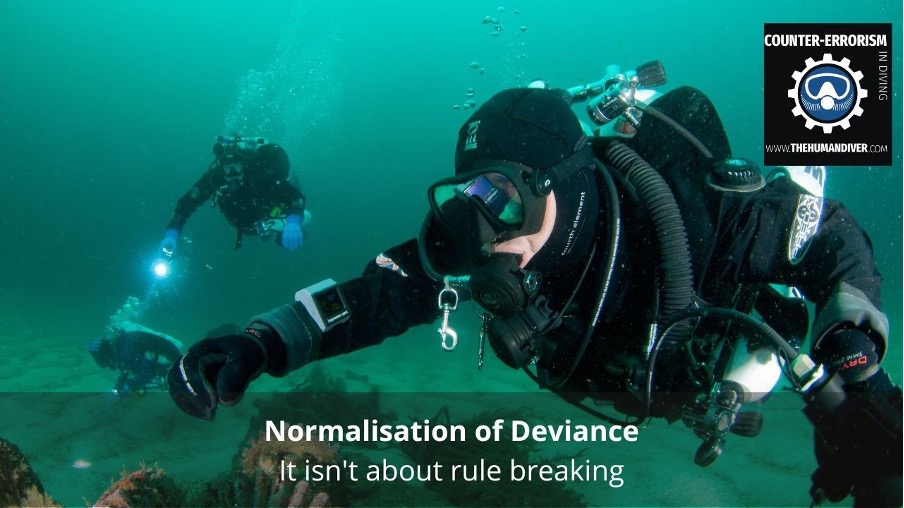
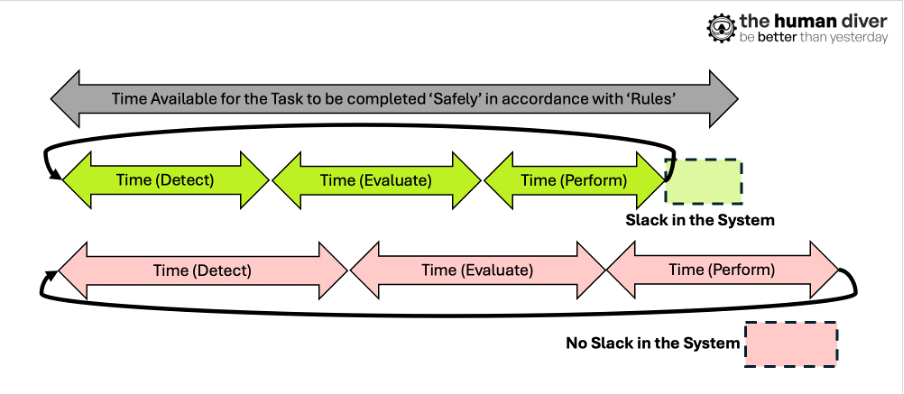
This demonstration of margin being eroded is an example of both normalisation of deviance, and practical drift. We have talked about Normalisation of Deviance in many blogs. It isn’t about breaking the rules per se, it is about the social acceptance of the erosion of margins because nothing has gone wrong. A skipped check, a sensor warning waved away, a limit nudged a little further. No one says anything – it is accepted. Practical drift takes this a little further. When there is ‘slack in the system’, a single failure isn’t an issue because it can be caught and corrected because there is time to do so. But when multiple issues happen, and time is limited, then the cascading effect can be catastrophic, like in this case. In both Normalisation of Deviance and Practical Drift, the lack of consequence gets read as the social constructed permission to carry on doing what we’ve always done. The original standard drops out of view, and the margin it protected erodes. Unfortunately, the risk stays invisible until conditions change enough for that margin to come brightly into view, and there isn’t enough time to detect, evaluate, and execute a recovery.
There is also something else running alongside this that is arguably worse, even though it is societally normal. When a diver has a near miss and survives, they rarely record it as a near miss. They record it as a success and conclude that their real limit is further out than they thought, so let’s keep going. This is shown in research by Dillon and Tinsley, highlighting that often teams and organisations reward individuals for their near-misses for two reasons; they ‘got the win’ and because they did not reflect on how much of the margin was eroded through a structured, critical debrief. The boundary moves not because they learned anything but because they got away with it. Lucky and good are different things, and a diver who confuses the two is well on the way to the dive that kills them and/or their team-mates. Mark had both pressures on him: a centre that measured diving by distance covered, and his own need to be seen going furthest.
The dive nobody could stop
Mark had been diving a rebreather for about two years, with perhaps a hundred hours on the unit. Mod 2 certified but not cave trained. His buddy that day had less experience and fewer certifications than Mark.
The site was a vertical shaft in a reef, dropping to around thirty metres, with an opening at the bottom that led into a tunnel. There was a strong current that flowed into the tunnel, strong enough to draw sand off the floor and into the gap if kicked up by fins. Due to a previous fatality in this location, a steel gate had been installed, but it had since corroded and was now half gone.
The day before, Mark and his buddy had spoken to the centre manager and said they were going to dive the shaft. The manager was an experienced explorer who knew the site and told them not to go. He talked them through the current, the hazards, and that it was not a swimmable dive. When they would not be talked out of it, the manager did the one thing still available to him and refused to support the dive, declining to fill their tanks and telling them to take their gear elsewhere. Unfortunately, they found another fill and dived it anyway.
They reached the top of the shaft after more than an hour on the reef trying to find the entrance. Both were excited to have found the location and descended the shaft. At the bottom, the buddy stayed at the gate. Mark rode his DPV through the opening, and on the recovered footage you can see him lose control and try to turn back to exit. As the camera comes round it shows his buddy holding onto the outside of the gate. Then the current takes Mark into the tunnel. There was nothing anyone could do.
The only way to recover the body was to install a steel frame rigged with a block and tackle. To return to the shaft after entering the tunnel, the recovery diver had to go with the current, secure the body, and then be pulled back with the pulley system. This gives you an indication as to how strong the current was, and why a powerful scooter could do nothing against it.
This is not new, and Mark is not alone
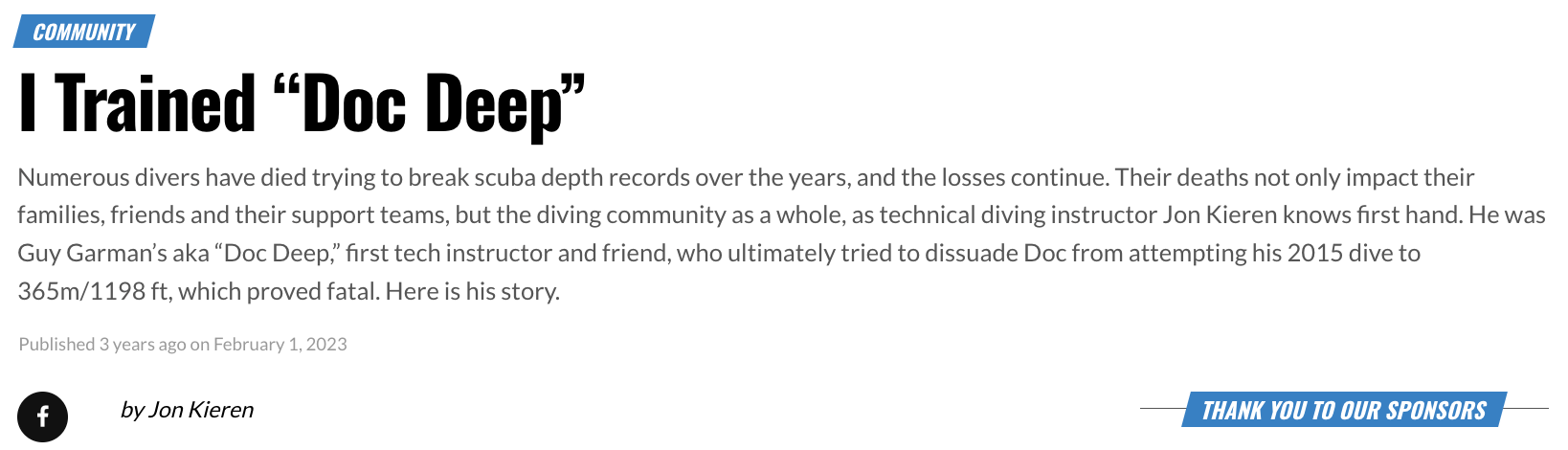
Anyone who has been in technical diving for a while has seen this pattern before, wearing other faces. A few years ago, a man the diving press called Doc Deep set out to make the deepest open-circuit scuba dive on record. His first instructor, Jon Kieren, later wrote candidly about it: how he certified a wealthy, charismatic man with very little experience and a need to be best at everything, and how those who said no, Jon among them, walked away because they could not watch. Doc Deep went past three hundred metres with his nearest support diver a hundred metres above him. Guy Garman died at the end of the line. Asked what the community learns from attempts like this, Kieren's answer was one word: nothing. Jon makes a critical point in his article – walking away is sometimes the only thing you can do, and if that means losing a friendship, then do it.
Pushing limits is not only a diving problem, and one of the clearest versions of this happened in June 1994, at Fairchild Air Force Base in Washington State, where a B-52 bomber crashed during practice for an airshow, killing all four officers on board. The pilot, Lieutenant Colonel Arthur "Bud" Holland, had a long record of flying the aircraft beyond its limits: too low, too steep, too close. He had been doing it for years, in front of his superiors, and getting away with it. On the final flight he threw the aircraft into a tight, steeply banked turn at around 250 feet. The bank passed ninety degrees, the aircraft stalled, and it hit the ground. It was filmed, and it is still shown.
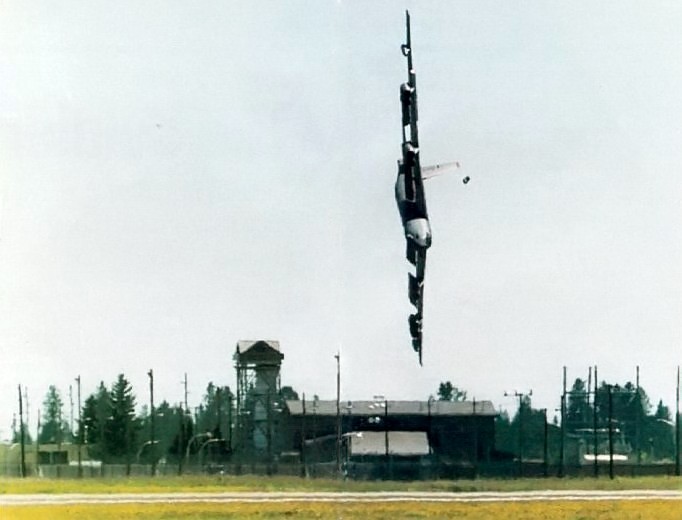
What makes Holland's case relevant to this discussion is not the manoeuvre, it is everything that allowed it. He was inside a military organisation with a chain of command, with written standards, and the formal authority to stop him. His own wing commander had ordered him, days before, not to exceed forty-five degrees of bank. Holland broke that order in the next practice session, with the commander watching, and nothing happened. Another of the pilots, Mark McGeehan, had tried for years to get him grounded and had refused to let his own squadron fly with him. McGeehan was in the co-pilot's seat when Holland killed them both. The organisation could have grounded Holland at almost any point. It had the power, and it did not use it.
The names are different each time, and so are the machines, but the context holds. A capable operator with something to prove, a circle who admire them more than they challenge them, a run of survived near misses logged as wins, and a system that finds it hard (or impossible) to say the unglamorous thing out loud. Maverick with a rebreather, or Maverick in a real cockpit with three other people aboard. The warning in Top Gun was right, even as the film spent two hours teaching us to side against it. It is worth asking how close the hero actually came, and what we would be saying about him if the cheque had bounced. Now look around you at the ‘heroes’ in diving.
What this means for the rest of us
Diving is different from Holland's world, and the unfortunately the difference does not work in our favour. His organisation had the power to ground him and failed to use it. In recreational and technical diving there is no such power to begin with. No licensing body can ground a diver. No supervisor can confiscate their gear. A diving instructor can be removed from an agency, but it is relatively easy for them to get a job elsewhere. The manager who refused to fill Mark's tanks did the one thing available to him, and it changed nothing, because Mark found another fill the same day.
Outside of the diver training environment, risk (potential loss) is managed at the level of the individual, by the individual, and once a diver has decided the limits apply to other people, there is no system above them to overrule the decision.
That can sound like an argument for leaving people to it. It isn’t, because the consequences do not stay with the person who made the decision to carry on.
The buddy at the gate watched it happen and will carry that thought for the rest of his life. He said afterwards that if he had not been looking at Mark at that moment, he would have followed him into the gap to look for him. The distance between one death and two was luck, not judgement. The family, the people who were involved in the recovery, the wider community: none of them made the decision, and all of them are harmed by it. Healthcare has a name for part of this, the second victim, the person who was trying to help and is damaged by an outcome they could not control. Diving produces second victims too. The right of an individual to manage their own risk is real, but there are times when protecting someone from themselves also protects everyone standing near them. (Note there is some discussion about the term ‘second victim’ as this removes agency from those involved.)

The really hard question
That leaves the hard question, with potentially multiple answers. How do you protect someone from themselves in an activity nobody regulates at the individual level, where the person can walk to the next shop and buy the fill you just refused them? For the diver who has fully decided, you often cannot. The manager did everything within his power, and a man still died.
The divers who are genuinely beyond reach are rare, and they are not where the effort should be focused. Far more common are the ones in the margins: divers who look up to the Marks and the Bud Hollands, who are starting to log their own near misses as achievements, and who are one persuasive mentor away from joining that group. They are reachable, and what reaches them is the kind of story we are usually too polite or too uneasy to tell.
So tell them. Not as gossip, and not as a list of the dead diver's mistakes, which teaches nothing and lets the listener decide they are different. Tell it as what it was: a series of decisions that each made sense to a capable person at the time, given the pressures on them and the audience they were performing for, and which killed them. The most useful thing you can do is help a diver see the early steps of that sequence in their own thinking, while there is still time to change course. I have had numerous people come to me and say, ‘thank you for sharing that story because it triggered a thought in THAT moment that led me to make a different, safer decision.’, and I am confident there are many, many more who’ve been in similar situations and we haven’t yet connected.
This is why the few levers diving does have are worth developing, because they are most of what we have got. The dive centre manager or instructor who carries on past a cell warning is setting an example that his students will take into water. The instructor who says, in front of those students, "I called that dive, and here is why" is setting a different one – a recent blog from SDI covers this point. A good team is one where someone will say "we are not doing this dive, and here is the reason", not as a matter of rank, but because looking after the people you dive with is the job. Mark's centre manager said as much and was ignored. More often, said early enough and by someone the diver respects, it lands. Holland's organisation had a chain of command and still let him fly. Diving has no chain of command at all, which means the thing most likely to stop the dive that kills someone is another diver willing to be unpopular for a few minutes.
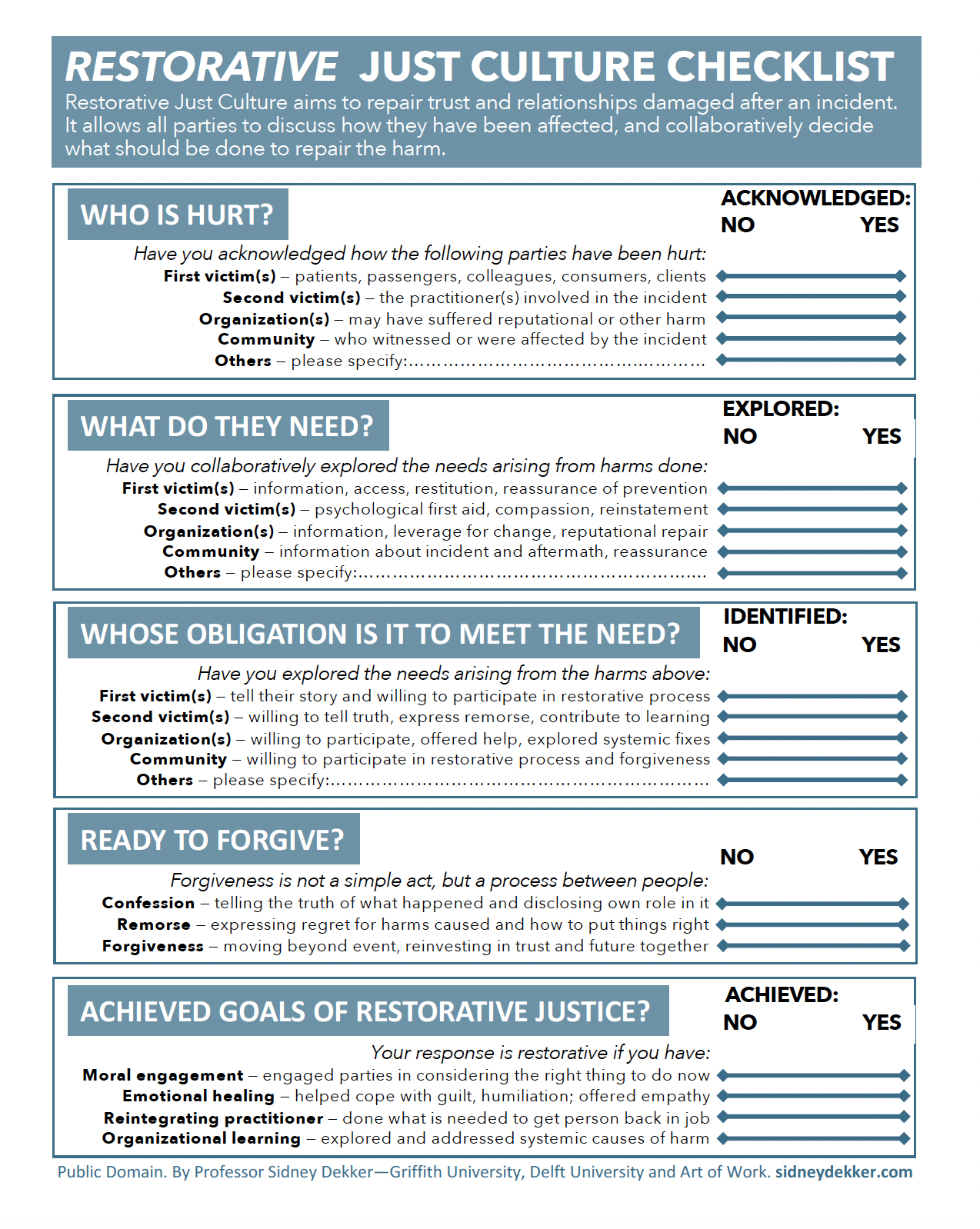
Finally, if the tragic event happens, consider who has been harmed, what do they need, and whose obligation is it to address those things. This the essence of Restorative Just Culture. This checklist, from Sidney Dekker, provides significant guidance to help support those who have been harmed.
The reflection for you. The next time you watch a diver go further than they should and surface grinning, it is worth asking yourself a question before you join the congratulations. Have they just shown you they are good, or have they shown you they were lucky, and would they themselves know which? If you’ve got the ability to debrief, you can ask the question, were we lucky or were we good. If the answer is good, you can ask what did we do that was identifiable and repeatable the next time, and how would we know the margins hadn’t been eroded.
References/Resources
Dillon and Tinsley. Near-miss events, risk messages, and decision making. & How Near-Miss Events Amplify or Attenuate Risky Decision Making


