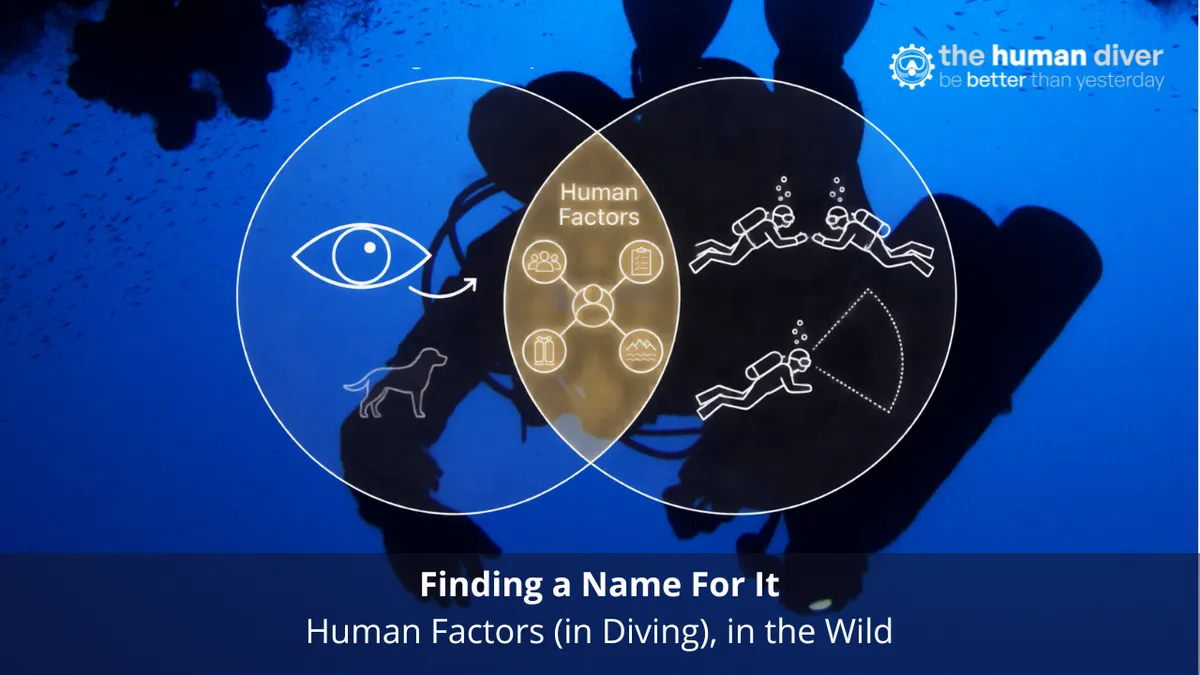
Finding the Name for It: Human Factors in the 'Wild'
Ten years ago, if someone had told me that human factors would become one of the most important subjects in my life, I probably would have laughed. Not because I had considered the field and dismissed it. I had never heard of it.
By then I had already spent decades flying, serving in the military, diving, teaching, leading teams, and watching capable people work in difficult environments. I had seen excellent performance under pressure and decisions that looked inexplicable afterward. I had lived through good training, brittle systems, strong teams, poor communication, narrow escapes, and ordinary adaptations that quietly kept things working.
I had been surrounded by human factors. I just didn’t know its name.
That may be part of why the subject remains difficult to explain. Human factors is not a component we can point to. It exists in the relationships among people, tasks, equipment, teams, organizations, and environments. It is present almost anywhere humans are trying to accomplish something inside a system—which is almost everywhere.
Two stories from the dark
My first article in this series, Looking Sideways, began at 4:30 in the morning while I waited for my German Shepherd, Echo, in a dark backyard. When I looked directly at her, she seemed to disappear. When I shifted my gaze slightly, I could see her movement. Averted vision became a way of thinking about observation: sometimes the visible behaviour in front of us is not where the explanation lives.
A diver loses buoyancy while completing a task. The movement is obvious, so we label it a buoyancy problem. But looking slightly away may reveal increasing workload, altered breathing, an unfamiliar configuration, a teammate out of position, or attention consumed by the very task the instructor assigned. The behaviour is real. It may simply be the output of a larger system.
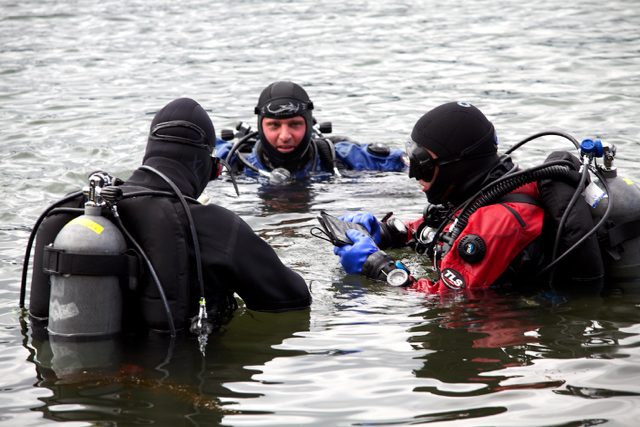
The second article, Keeping One Eye in the Dark, began with a lesson from military training. When a parachute flare was fired, we closed one eye to preserve its dark adaptation. That became a way of thinking about a three-person dive team. When one diver has a problem and another assists, the third may be more valuable remaining wide—monitoring depth, gas, movement, navigation, current, and the next consequence—than becoming a third pair of hands on the same problem.
The team has not merely distributed tasks. It has distributed attention.
Only after writing both pieces did I fully recognize what they were examples of. Looking sideways widens the frame around individual behaviour. Keeping one eye in the dark designs the team around the limits of attention. Both are human-factors moves.
A useful definition and a better doorway
The International Ergonomics Association defines human factors and ergonomics as the scientific discipline concerned with understanding interactions among humans and other elements of a system, and applying that knowledge through design to improve human well-being and system performance (International Ergonomics Association, n.d.). It is accurate. It also makes a fascinating subject sound slightly administrative.
In conversation, I often use a less complete doorway: human factors is the study of why people do what they do, especially when what they do is not what we expected. Anyone familiar with The Human Diver will also recognize the tagline of helping make it easier to do the right thing and harder to do the wrong thing.
Then comes the essential second half. The purpose is not only to explain behaviour. It is to design equipment, training, procedures, teams, and organizations so that people can succeed more reliably.
This changes the size of the question. A diver misses a signal. Why? 'They were not paying attention' describes the outcome while pretending to explain it. Human factors keeps going. Where was attention allocated? What else was demanding it? Was the signal visible and expected? What did the diver believe was happening? What did the team do immediately beforehand? What conditions made missing that signal more likely?
Those questions do not remove responsibility. They prevent us from mistaking a verdict for an explanation.
A language that lets experience travel
Before learning the formal language, many experienced practitioners already notice workload, communication, equipment, expectations, and team behaviour. A good instructor sees what disappears from a student's awareness when a task becomes demanding. A good debrief sometimes reconstructs why a poor decision made sense in the moment. But without a larger framework, each insight can remain attached to one flight, one dive, one team, or one mistake.
Human factors gives those observations neighbours.
Attentional tunnelling connects a diving problem to similar problems in aviation and medicine. Local rationality reminds us that people act according to the world as it appeared to them, not the world revealed by the investigation. Work as imagined and work as done expose the gap between a procedure and the adaptations needed to make it function in reality. Distributed cognition allows us to see a team, its tools, and its environment as parts of one cognitive system (Hutchins, 1995). Safety-II directs attention toward the adjustments that make work succeed far more often than it fails (Hollnagel, 2014).
The vocabulary does not replace operational experience. It allows experience to travel between domains. A lesson from a cockpit can illuminate a dive team. A training problem can reveal an organizational design problem. An apparently isolated error can become evidence about recurring conditions in the system.
Why this matters in diving
Diving is an unusually rich human-factors environment. Information is incomplete. Communication is constrained. Attention is finite. Equipment changes what can be perceived and done. Teams coordinate from different positions and with different workloads. Stress can alter breathing, perception, memory, and decision-making. Small deviations can accumulate while everybody is occupied with something that appears more urgent.
Our usual remedies are often too small. 'Pay attention.' 'Maintain situational awareness.' 'Communicate.' 'Follow the procedure.' Each instruction names a desirable outcome without necessarily creating the conditions that produce it.
Telling a diver to pay attention does not increase attentional capacity. Telling a team to maintain situational awareness does not decide how attention should be distributed when workload rises. Telling someone to speak up does not make it psychologically safe to challenge the most experienced person in the water. Telling people to follow a procedure does not resolve a conflict between the procedure and the conditions they actually face.
A human-factors approach asks what the system is asking people to do and whether the system helps them do it. Is critical information easy to perceive? Does the equipment make the correct action easier? Does training include the background consequences that continue while a focal problem is being solved? Are team roles clear enough to preserve a wider view? Does the debrief make room for an honest account of confusion and adaptation?
These are design questions, not demands for better character.
Humans are not the defect
Human factors is sometimes reduced to the study of human error, as though the person were the unreliable component inside an otherwise rational machine. That view misses at least half the story.
Humans are also the component that notices novelty, interprets ambiguity, improvises, repairs, compensates, and adapts to circumstances the designer did not anticipate. Systems often work because people continuously adjust them. Rasmussen (1997) described work in dynamic systems as shaped by competing pressures and movement within boundaries, not as the simple execution of a fixed script. Woods and colleagues (2010) similarly show that 'human error' is usually the starting point for investigation, not a sufficient explanation.
The goal is not to eliminate human variability. It is to understand when that variability creates resilience, when it creates vulnerability, and how the surrounding system shapes both.
This requires a balanced view. People are not defects to be controlled. Nor are they magic resources who will always compensate for poor design. They have capabilities and limitations. Human factors studies the interaction.
From blame to curiosity
The most important change human factors made in me may not be technical. It made curiosity harder to abandon.
Blame is efficient. Someone failed to pay attention. Someone lacked discipline. Someone did not follow the procedure. Once we attach the label, we can stop looking. Curiosity asks more of us. It requires reconstructing the situation before the outcome was known.
What did the person think was happening? What information was available? What goals were competing? What had worked before? What changed? What made the action reasonable—or at least unsurprising—from inside that moment?
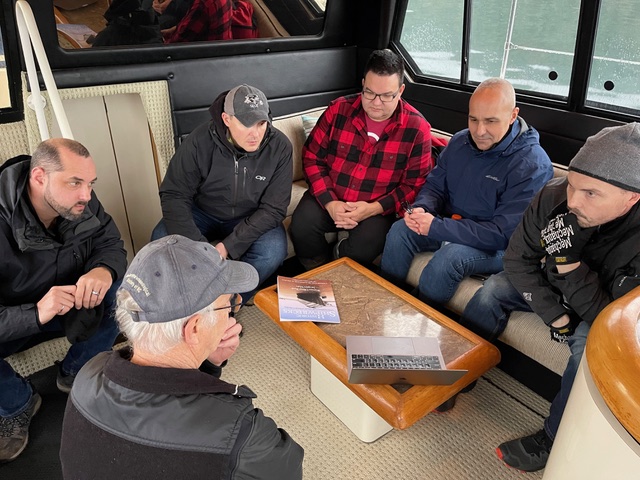
The question asked in a debrief matters. 'Why didn't you do the right thing?' already contains a verdict. 'What did you think was happening?' opens a route back into the person's world. 'Why did you lose situational awareness?' labels a failure. 'Where did your attention go, and what drew it there?' gives us something that can be examined and trained.
This is not a responsibility-free approach. Deliberate recklessness and dishonesty exist. But poor outcomes do not, by themselves, prove culpability. If we want learning rather than a tidy report, we have to resist using blame as a substitute for explanation (Dekker, 2014).
What else is this like
Human factors also rewards a question that has become central to my writing: What else is this like?
An observation about peripheral vision becomes a lesson about accident investigation. Dark adaptation becomes a model for team attention. A cockpit problem illuminates a medical emergency. The pattern recognition of an athlete helps explain expertise. A failed procedure exposes the difference between work as imagined and work as done. An apparent 'human error' is the outcome of a failed system designed to maintain safe and effective operations.
The point is not that these situations are identical. Analogies are useful only when we test whether the underlying mechanism travels. Is attention limited in both environments? Are people coordinating incomplete perspectives? Does time pressure narrow options? Does the design make one action easier or more likely?
The curious mind notices resemblance. Human factors gives us ways to examine it.
The things we cannot yet see
I remain fascinated that I lived for so long without knowing human factors existed as a discipline. The books, research, and professional communities were there. They simply sat outside the boundaries of what I knew to look for.
That leaves me with a question I can’t shake: what other extraordinarily important things are we walking past every day because we do not yet know they exist?
Looking sideways helps us search beyond the visible behaviour. Keeping one eye in the dark preserves some attention for what has not yet become obvious. Human factors connects both habits by asking us to examine the relationships around an event and design the system for the humans who must operate within it.
Ten years ago, I didn’t know the field had a name. Now I see it almost everywhere: in the diver who loses depth while succeeding at the assigned task, in the third teammate resisting the pull toward the flare, in the procedure that works only because people quietly adapt it, and in the debrief that chooses curiosity over a quick verdict.
Once I found the name for these questions, I realized I had been asking them for most of my life.
References
Dekker, S. (2014). The field guide to understanding 'human error' (3rd ed.). CRC Press.
Hollnagel, E. (2014). Safety-I and Safety-II: The past and future of safety management. Ashgate.
Hutchins, E. (1995). Cognition in the wild. MIT Press.
International Ergonomics Association. (n.d.). What is ergonomics (HFE)? https://iea.cc/about/what-is-ergonomics/
Rasmussen, J. (1997). Risk management in a dynamic society: A modelling problem. Safety Science, 27(2–3), 183–213. https://doi.org/10.1016/S0925-7535(97)00052-0
Woods, D. D., Dekker, S., Cook, R., Johannesen, L., & Sarter, N. (2010). Behind human error (2nd ed.). Ashgate.