
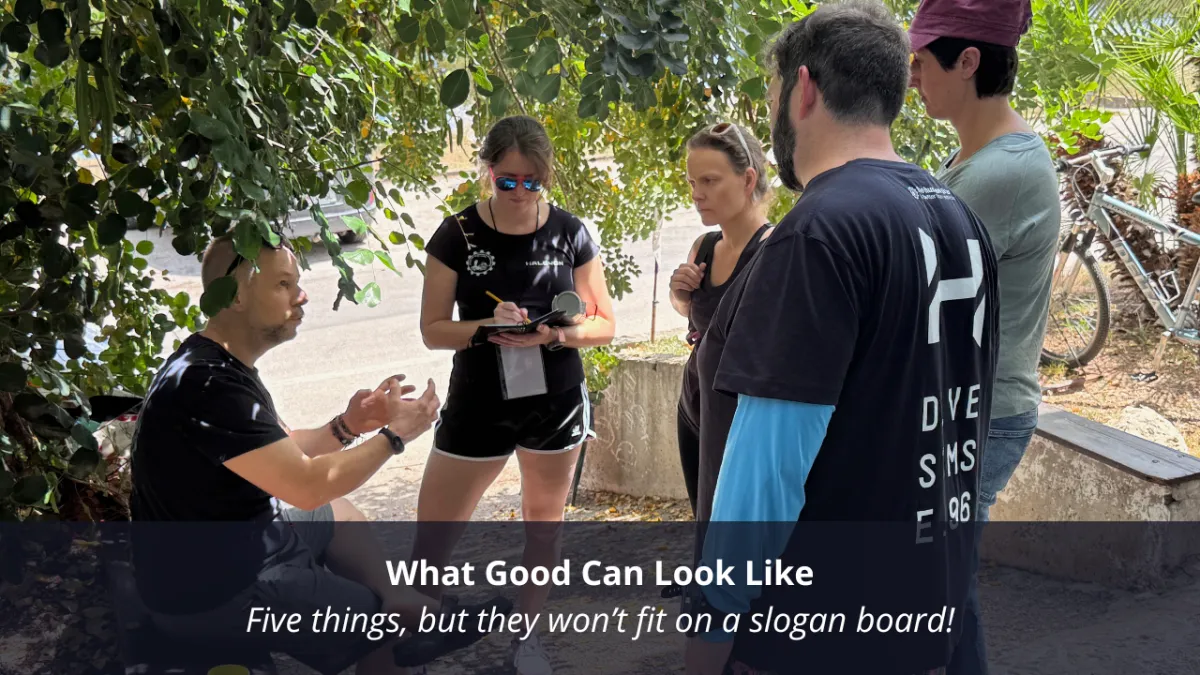
What Good Can Look Like
Yesterday I wrote about two safety messages that crossed my social media feeds recently. One was a post from a training agency setting out its commitment to diver safety. The other was a graphic headed Scuba Diver Creed, telling divers to put safety first, dive within their training, pick operators on safety rather than price, and go slow. You can read that piece here: ‘Safety First’ Slogans do not create safety, capacity or competencies do
The argument I made was that safety is not a state anyone holds. ‘Safety’ is transient, and importantly, socially constructed. It is developed and maintained on every dive by people who have been given the competence and capacity to produce it. These messages make a statement but do not provide the capacity or competence, however meaningful the statements were written.
Yesterday’s blog was the easy half because criticism is easy. However, it ended with two harder, open questions. This blog is my attempt to answer both of them as best as I can.
What do we owe people when something does go wrong?
What would I actually put on the graphic instead?
What we owe the people who were there
When something goes wrong, and eventually it will, the industry's first move is usually to work out whether the person at the centre of it was diligent enough. Were the standards followed? Was enough attention paid? Those are retributive questions, and the process looks rigorous. Sam Cromie and Franziska Bott tested this approach as part of a research project. They found the line between acceptable and culpable moves a long way, depending on who judges it and what they know at the time. Hindsight bias, outcome bias, severity bias, and the fundamental attribution bias are all at play.
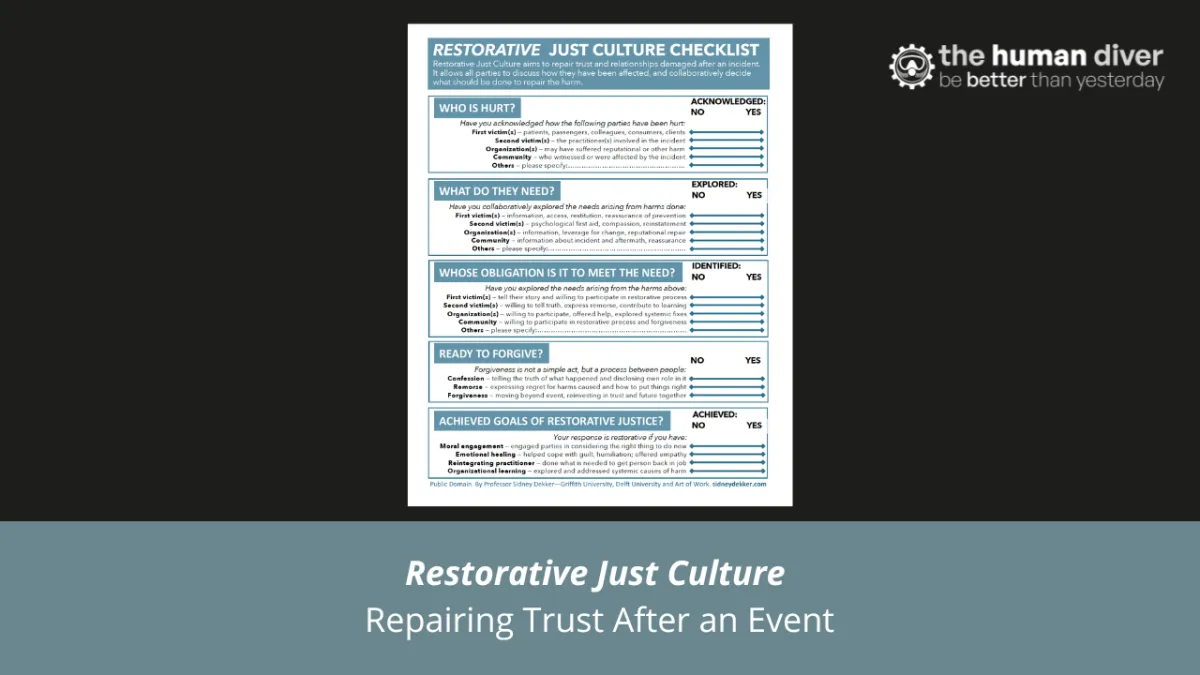
A restorative approach starts somewhere else and asks three questions in a deliberate order.
The first is ‘Who has been harmed?’
That reaches well past the diver at the centre of it. It takes in the buddy who surfaced alone, the instructor still replaying the ascent months later, the staff who checked the kit that morning, and the family who were not there. Clare Dallat and colleagues looked at this across the outdoor and adventure sector. They found long-lasting distress among people involved in serious incidents, most of it unacknowledged and very little of it supported. Diving has no reason to think it is different, and we have almost no structures through which support could be offered even where somebody wanted to offer it. The work of Dr Laura Walton, and a couple of others, is definitely breaking ground in an area that should be better resourced.The second is what those people need to recover trust, confidence and a sense of fairness.
That usually starts with information, moves to being told plainly what the review found, and ends with visible proof that something in the operation has changed. Where those needs go unmet, the response to the event can hurt people a second time, a pattern healthcare research calls compounded harm.The third is who owes those needs,
This is where the language of caring and the language of personal creeds both come under pressure. The answer is rarely the person closest to the event, who usually needs something themselves. It is the supervisor, the centre, the agency, and whoever set up the conditions the work was done in. A creed that says "I'm in charge of my own safety" quietly locates the whole duty in the diver, which means the need to take a system view of events is stuck because there is no call to look up and out, instead we focus down and in.
What good can look like
If slogans are the problem, the answer has to be capabilities and capacities (this is what I wrote last year on that following the death of 12 year old Dylan Harrison in the US). Here is what I would put on the graphic instead, and none of it fits on a graphic, which is rather the point!!
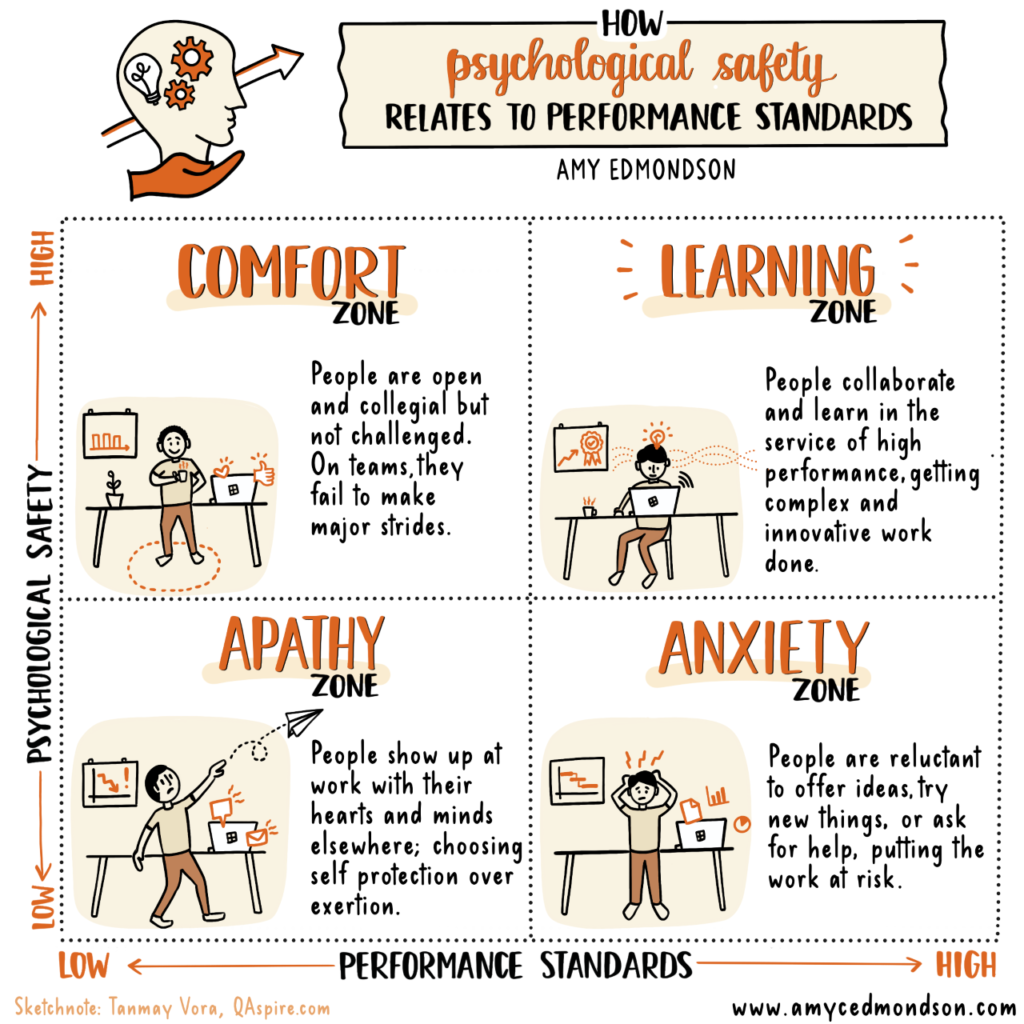
Build a learning environment where everybody learns, including dive professionals, dive operations and training agencies. That needs psychological safety and a just culture, two terms that get quoted constantly and practised rarely. Amy Edmondson's original work describes psychological safety as a shared belief that the team is safe for interpersonal risk-taking. That belief is what lets people report what actually happened rather than what they think you want to hear. It is not comfort, and it is not the absence of standards. In fact, Amy Edmondson explicitly stated that high levels of psychological safety and high-performance standards are what leads to teams excelling.
Debrief every dive, not only the ones that went wrong. Nothing going wrong does not mean there was nothing to learn. A structured debrief helps the team remember, and gives people a routine moment in which raising something is normal rather than brave. Keep it on actions and behaviours rather than individuals, and keep it specific rather than general. Erik Hollnagel, Robert Wears and Jeffrey Braithwaite set out the case for studying everyday successful work rather than only failures.[^6] A post-dive debrief is the cheapest version of that available to us.
Accept that performance improves with the quality of the feedback, and that stories carry further than numbers. Counting things is easy, but the context is where the real learning resides. My own research looked at why stories are what people actually retain and pass on in diving. It also looked at what happens when we focus on counting events, rather than exploring stories and rationality. What is clear – when we tell context-rich stories, moving beyond the last to touch it – there is more empathy and the opportunities for learning are much bigger and better.
Assume everyone is doing their best with the resources they have inside the constraints they were given. When something goes wrong, work to understand the local rationality of every stakeholder in the system (diver, buddy, instructor, skipper, dive centre manager, training agency staff…) rather than the non-compliance of whoever touched it last. Every one of those within the system made decisions that made sense to them at the time, even if they looked ‘stupid’ after the fact.
Build a vocabulary that goes past "human error" and "common sense". Both phrases end the conversation at the exact moment where we could start genuine learning. This sounds obvious, and it is far from obvious once you try to apply it on a Saturday afternoon with a full boat.
The question underneath
Every one of those five is a competence rather than a commitment. Each can be taught, practised, observed and improved, which is the test I would apply to any safety message before posting it. Does this message give somebody a capability they did not have this morning, or does it describe a state and leave them to work out the rest?
Safety first, dive within your training, choose good operators and go slowly are not wrong. They are just not instructions anyone can follow without the tools underneath them. The more difficult version of that same advice is that safety has to be produced each and every dive, by people who have been given the competencies and capacity to make it happen. In a system which is focused on human factors and system safety, the duty for supplying that capacity sits with the agencies, the centres and the professionals, not with the diver reading the graphic.
So here is the test I would apply to any safety message before posting it.
What does the person reading it know what to do and how to do it, in a way they did not know what to do or how to do it before?
References
Cromie, S. & Bott, F. (2016). Just culture's "line in the sand" is a shifting one; an empirical investigation of culpability determination. Safety Science, 86, 258-272. doi:10.1016/j.ssci.2016.03.012.
Bitar, F.K., Chadwick-Jones, D., Nazaruk, M. & Boodhai, C. (2018). From individual behaviour to system weaknesses: the re-design of the Just Culture process in an international energy company. Journal of Loss Prevention in the Process Industries, 55, 267-282, in which around 90 per cent of 353 reviewed cases resolved at the system level rather than the individual one.
Dekker, S. (2025). Restorative Just Culture: From Disciplinary Action to Meaningful Accountability (4th ed.). CRC Press. See also Dekker, S.W.A. & Breakey, H. (2016). 'Just culture': improving safety by achieving substantive, procedural and restorative justice. Safety Science, 85, 187-193.
Dallat, C., Mitten, D., Slay, S., Mitchell, V. & Ajango, D. (2025). The silence is deafening: exploring the impacts of serious incidents on practitioners across the outdoor and adventure programs work system. Human Factors and Ergonomics in Manufacturing & Service Industries, 35(4), e70017. doi:10.1002/hfm.70017
Ramsey, L. et al. (2024). Humanising processes after harm part 2: compounded harm experienced by patients and their families after safety incidents. Frontiers in Health Services, 4, 1473296. doi:10.3389/frhs.2024.1473296
Edmondson, A. (1999). Psychological safety and learning behavior in work teams. Administrative Science Quarterly, 44(2), 350-383. doi:10.2307/2666999
Hollnagel, E., Wears, R.L. & Braithwaite, J. (2015). From Safety-I to Safety-II: A White Paper. doi:10.13140/RG.2.1.4051.5282
Lock, G. (2024). Storytelling to Learn: What Happens Underwater, Stays Underwater. MSc thesis, Lund University.


