
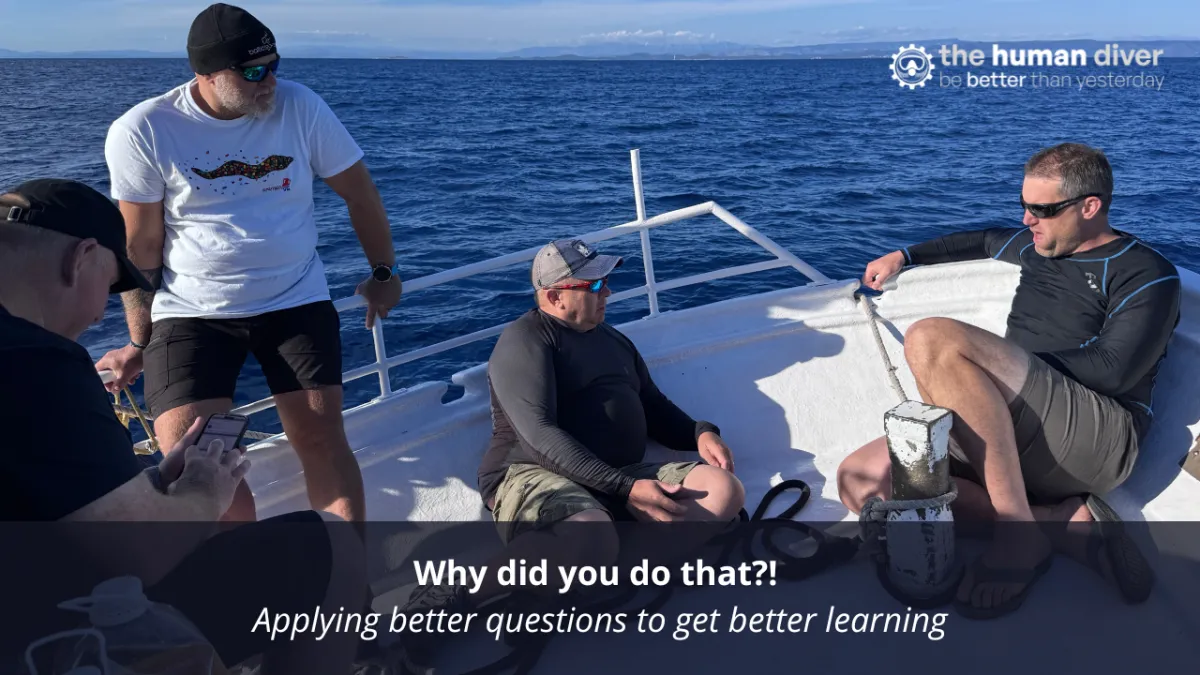
Why did you do that?! Applying better questions to get better learning
A while ago, I wrote a blog about how changing our language can change the world. One of the swaps in that piece was moving from 'Why did it happen?' to 'How did it make sense?' It's a simple change on paper. In practice, like many things, it can be difficult without practice, especially when you're stood on a boat or in a car park after a dive that didn't go to plan, the adrenaline is still flowing, and the first words out of someone's mouth are "Why did you do that?"
This week a colleague of mine shared a short paper by Louise Roe from the Maternity and Newborn Safety Investigations (MNSI) programme, published in Contemporary Ergonomics and Human Factors 2025, which gives us a practical way to make that shift. While the research comes from NHS maternity care, which is a long way from a shot line in 30 m of water or a flooded cave, the problem she was trying to solve is the same one we have in diving.
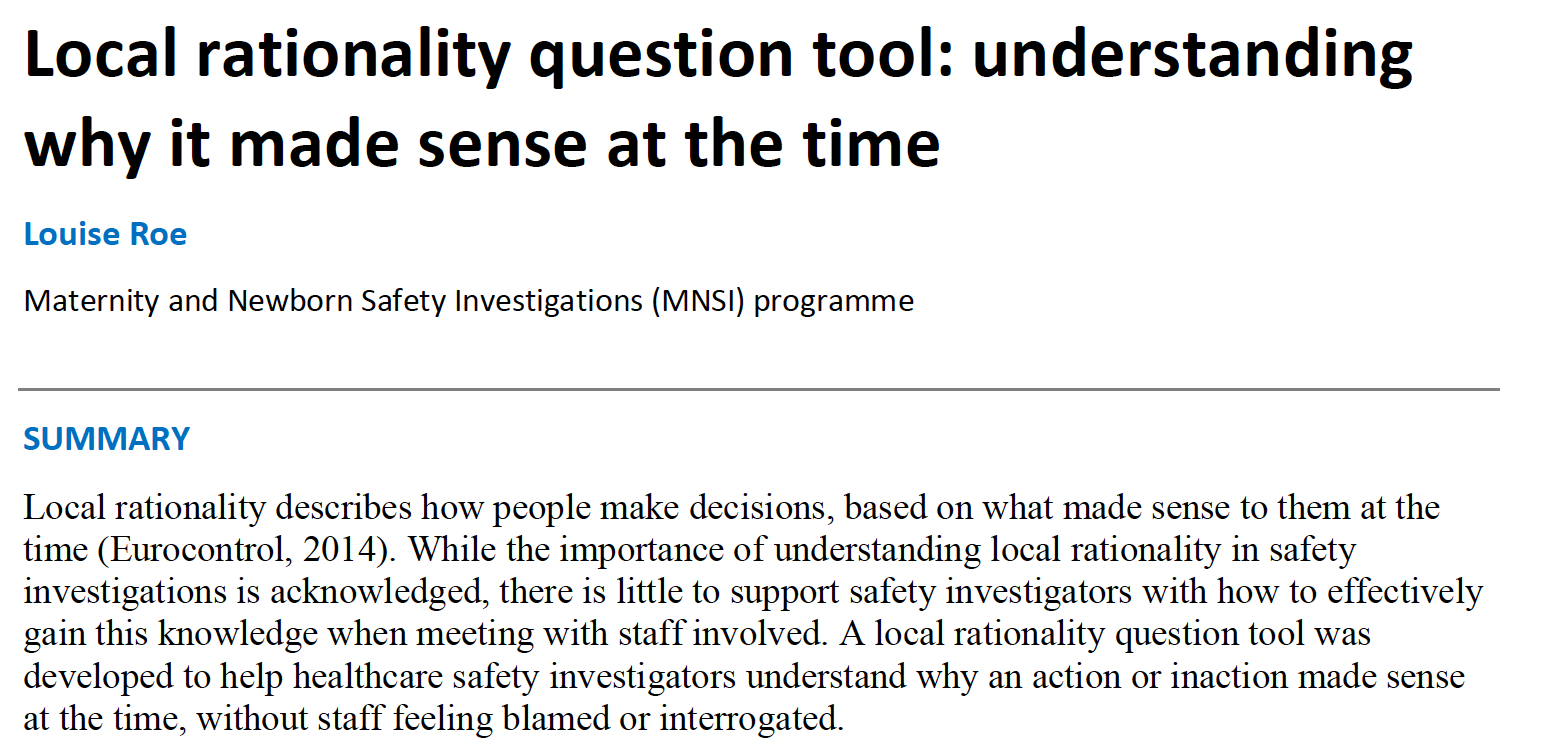
The problem: getting the story without the interrogation
Local rationality is one of the key principles of modern safety science. It can be summed up as; people are trying to do the best they can with the resources they have, the knowledge and skills they've developed, and within the constraints they're working under (time, information, kit, social pressure...), and we have to understand how it made sense for them to do what they did at the time, even if it looks 'stupid' to us afterwards. The difference is that we know how it ended, and they didn't. As I wrote after the loss of Titan, it's always obvious why it happened... in hindsight.
Most people who run learning reviews/accident investigations agree that exploring local rationality is critical. The problem Roe identified is that there wasn't much out there to help investigators actually do it when sitting across the table from a midwife or doctor who had just been involved in a serious event.
She saw a trade-off happening.
Some investigators were so worried about making staff feel interrogated that they softened their questions which led to poor information being provided and this meant the learning opportunities are compromised. Others got the information they needed, unfortunately at the cost of the psychological safety of the person with the person they were talking with. As you'd expect, neither helps anyone learn.
Her answer was a Local Rationality Question (LRQ) tool.

What's in the tool?
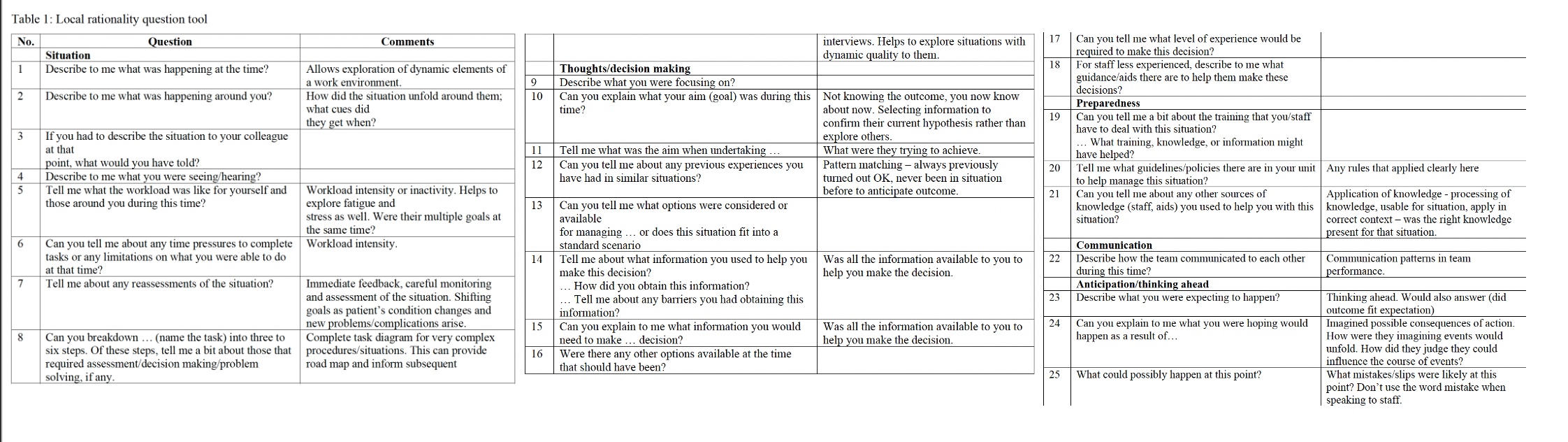
Roe looked at eight books and journal papers on decision-making, cognitive ergonomics and investigation, including work from Sidney Dekker and Gary Klein, and pulled out questions that were already being used. Where they needed it, she reworded them using a 'tell, explain, describe' (open question) approach so they invited a story rather than a yes/no answer (closed question), and removed anything that sounded like an accusation. The result is 25 questions split into five areas:
the situation;
thoughts and decision-making;
preparedness;
communication; and
anticipation/thinking ahead.
Each question has a short note explaining what it's trying to find out.
To give you a flavour, there's
"Describe to me what you were seeing/hearing?",
"Tell me what the workload was like for yourself and those around you?",
"Can you tell me about any previous experiences you have had in similar situations?" and
"Describe what you were expecting to happen?"
One thing stood out for me - I had thought about this but not embedded it in my conversations. Next to "What could possibly happen at this point?" she has added a reminder not to use the word 'mistake' when talking to staff. From experience, she knew how one word can close a conversation down when it is interpreted differently by the other parties.
Did it make a difference?
Roe used the tool in her own investigations for four years before writing it up and presenting to the national body for Human Factors in the UK at their annual conference. What she found was that conversations flowed better, the information was richer, and it pointed more clearly at system and process issues, especially when people had moved away from 'standard practice'. She also felt more comfortable herself, because she knew her questions were focused on the system and weren't 'finger pointing'.
Other MNSI investigators used it to plan conversations, as a guide during them, and when they were struggling to word a difficult question. The fundamental attribution bias (focus on the individual, not the context) is prevalent, and she found that when investigators asked about previous experience, it stopped them assuming what someone knew based on their role or seniority.
How often do we do that in diving? "She's a cave instructor, she should have known..." Applying those all too often counterfactuals.
A really positive outcome was that staff who had said they had been worried about meeting an investigator said afterwards that it had been a positive experience, and that they understood the purpose was to improve care.
Louise is honest about the limits of what she's found. The tool hasn't been formally evaluated yet. It's also meant to be used as 'pick and mix' – it's not a script, and she's clear it shouldn't be used as one. Even so, it's been well received by investigators in mining and is being shared within UK civil aviation, so it clearly travels outside healthcare. I am hoping it will get picked up in diving too!
Great, but so what's this got to do with diving?
Quite a lot. When I did my MSc research at Lund, looking at storytelling and learning in diving, the biggest theme to come out of the recreational diver focus group was 'the need for context'. Divers wanted to know what those involved were seeing, thinking and dealing with, because without that, the story doesn't give them anything to take into their own diving. They're left with 'don't be like them', which isn't very useful!
The LRQ tool is a structured way of getting that context.
Diving is also full of hindsight. Look at any social media thread after an incident and you'll see the jump from outcome to 'obvious' cause within a few comments. Mike wrote about that in his conference blog here.
"They should have run a line."
"I would have called the dive."
Finding out that someone broke a rule or deviated from the standards doesn't create learning – if that's what caused accidents, we'd have far more of them than we do. Almost every one of Roe's questions drags us back into the moment.
What were you focusing on?
What were you expecting to happen next?
What information did you have, and how did you get it?
However, there are some differences we need to think about before we pick the tool up and use it.
Roe's investigators weren't part of the event. In diving, the person asking the questions is often in the water too, e.g., the buddy, the team leader or the instructor. They have their own local rationality and their own part in how the dive unfolded. That makes it much harder to stay curious, and it means whoever runs the debrief needs to be ready to answer the same questions about themselves. Effective teamwork is about mutual accountability, and that means you are part of the learning too.
Then there's power. An instructor debriefing a student, or a 'name' in the tech community debriefing a less experienced team member, carries weight whether they want to or not. A nicely worded question can still land badly if the person asking it can fail your course or decide whether you're invited on the next trip. 'Tell, explain, describe' helps, but it doesn't remove the authority gradient. How we respond the first few times someone gives an honest answer will decide how honest the next answers are.
I'd also be careful with a couple of the questions.
"Were there any other options available at the time that should have been?"
is great if it points to missing kit, procedures or support. Asked with the wrong tone, it becomes
"Why didn't you do the obvious thing?"
Roe's advice to reflect after each conversation on how you worded things applies just as much on a dive boat as it does in a hospital.
Using it in a debrief
Most learning in diving isn't going to come from formal investigations. It's going to come from the short conversation at the end of an ordinary dive – if that conversation happens at all. The DEBrIEF model uses curious language that focuses on actions and behaviours not invididuals.
Imagine a team that turned the dive later than planned and surfaced with less gas than the plan allowed. The easy question is
"Why didn't you call it at your turn pressure?"
A local rationality version sounds more like
"Talk me through what you were focusing on in the ten minutes before the turn."
You might follow that with
"What was your workload like at that point, and what was the rest of the team doing?"
or
"What were you expecting to see when you checked your gauge?"
and then
"Have you been in a similar position on other dives? How did those turn out?"
That last one is often where the gold is. Roe links it to pattern matching – it's always been OK before, or I've never been here before so I've nothing to compare it with. This is how drift shows up in diving. A turn pressure that has been stretched on a dozen dives without anything going wrong doesn't feel like a stretch anymore. Were they lucky or good? You won't find that out by asking why they broke the plan. You find it by asking what their experience told them to expect.
You don't need all 25. Pick two or three from the situation and anticipation sections, and you'll change the tone of a ten-minute debrief. The aim is to hear the story from inside the tunnel before anyone decides what 'should' have happened.
Using it in LFEO
Some events need more than a quick debrief, like a near-miss at a dive centre or an incident in a club. That's where Learning from Emergent Outcomes (LFEO) comes in, where we map how the different parts of the system interacted using PETTEOT to identify the elements to look at: Person, Environment, Tools and Technology, Tasks, External Influences, Organisation and Time. However, any systemic analysis is only as good as the stories we get from those involved, and this is where many reviews fall down.
The LRQ tool fits into LFEO as an interview aid, and its categories map well onto PETTEOT:
Questions about workload, time pressure and what was happening around someone feed into Tasks, Time and Environment.
Questions about what information was available, and any barriers to getting it, help with Tools and Technology.
Questions about training, guidelines and other sources of knowledge inform Person and Organisation.
Roe says her tool sits well alongside SEIPS in healthcare, and will work with any model that lets you explore the 'whys'. LFEO and PETTEOT took the SEIPS v2 and extended it. It also complements the eight-question review in our Just Culture in Practice guide (you can find that in the free resources), which is there to slow down the jump to 'Why did they do that?' until we understand what the person saw, knew and was working with.
My suggestion is to use the LRQ to plan your conversations. Look at what you already know, find the gaps, pick the questions that fill them, and rewrite them in your own words. Then put the sheet down and have a conversation.
Afterwards, look at which questions opened people up and which closed them down.
Over time, you'll end up with your own version that sounds like you and fits your part of the diving world.
Summary
What I like most about Roe's work is that it treats how we ask questions as a safety tool in its own right. In diving, we spend a lot of time on what we should analyse, and very little on how we ask. The quality of any debrief or review depends on what people are willing to tell us, and that depends on whether they feel judged in the first minute. This paper is a good example of taking something that works in another high-risk domain, adapting it with care, and ending up with a richer picture of how it made sense at the time.
Next time you debrief a dive that didn't go to plan, what will your first question be?


