

Eight Questions About the Maldives Dive Accident
On 14 May 2026, five Italian nationals entered an underwater cave near the island of Alimathaa in the Maldives and never came back. The victims were Monica Montefalcone, associate professor of marine ecology at the University of Genoa; her twenty-three-year-old daughter Giorgia Sommacal; marine biologist Federico Gualtieri; research fellow Muriel Oddenino; and diving instructor Gianluca Benedetti, operations manager aboard the liveaboard yacht Duke of York.
The first instinct of public opinion, the media, and presumably the authorities is to ask: whose fault is it? The university? The boat operator? The instructor? The divers themselves, who — in some accounts — should never have gone in?
Just Culture suggests a different first question: what was it about the system that made this possible?
"Death is rarely the result of one person's one decision. It is the terminal node in a network of decisions, conditions, and silent permissions — distributed across time and space."
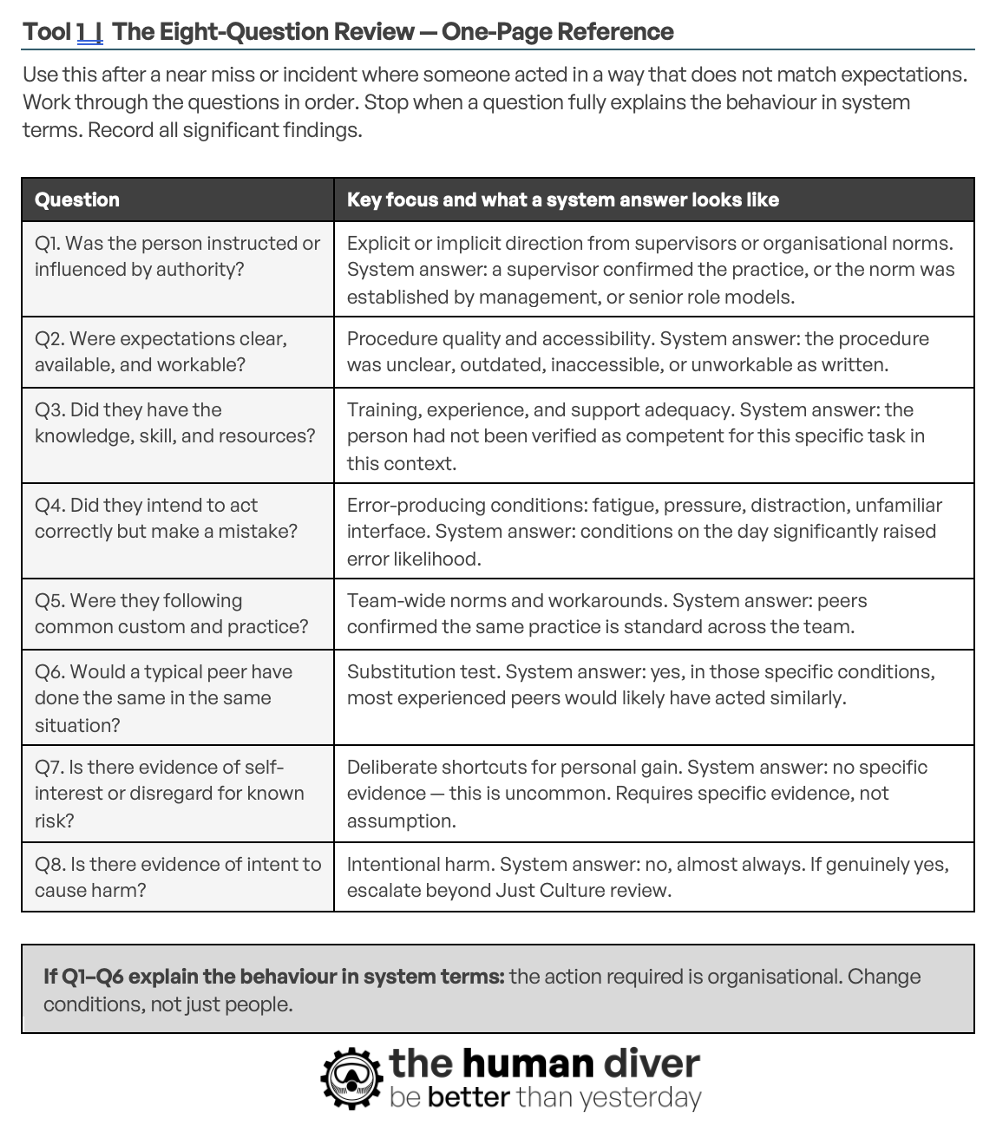
The Eight-Question Review, developed by Gareth Lock and applied across high-risk industries — from aviation to offshore — offers a way to move through that network step by step. Not to absolve anyone of responsibility. But to see where the problem actually lies — and where intervention has a real chance of changing something.
An important caveat before you read on
What you are reading is not an accident analysis. It is a demonstration of a way of thinking — an illustration of which questions are worth asking, and in what order, when things go very badly wrong. That distinction matters fundamentally.
A genuine 8QR is a tool for conversations with those who were there. It requires access to first-person perspective — to what a specific person knew, understood, and felt at the moment of a decision. What I have instead is a handful of days' worth of press reports, statements from parties with direct legal interests in particular narratives, and community accounts of uncertain reliability. The investigation is ongoing. The bodies of four victims remain inside the cave. No-one has spoken publicly with the approximately twenty other Italians aboard the Duke of York — the only eyewitnesses to the atmosphere and conversations before the dive. Not one of them has been quoted. That silence is itself striking, and may reflect legal advice from the operator.
Every answer to the questions below is therefore a working hypothesis, not a finding. Every "perhaps" is genuine. Every "the investigation should establish" means exactly that — I do not know, and I am not hedging something I do know. The aim is not a verdict in absentia on those who died or those who survived. The aim is to show which questions are worth asking — and why asking them in this sequence, from system to individual, protects against what safety culture calls scapegoating.

The Eight Questions — and why we do not yet have the answers
We apply the questions in sequence — from system to individual. At each step we pause to name what we do not know, and what the investigation must establish before anyone delivers a verdict.
Question 1 · Were the divers acting under instruction or the influence of authority?
Systemic hypothesis — requires verification
The first question in 8QR asks whether those involved were acting on someone's instruction or under the influence of authority. If the answer is yes, the weight of analysis shifts immediately towards the system rather than the individual.
In this case, the group's external structure is clearly visible, even if its internal dynamics remain unknown. Gianluca Benedetti served as operations manager aboard the Duke of York — simultaneously the group's dive guide and an employee of the operator. Monica Montefalcone was most likely Gualtieri's doctoral supervisor, Oddenino's scientific coordinator, and Giorgia's mother. The gradient of formal and expert authority in a group configured this way is theoretically steep — across several dimensions at once.
But this is where the unknown begins. We do not know how the decision to enter the cave was made — when it was made or in what form. We do not know whether anyone in the group had doubts and whether they expressed them. We do not know what the dive briefing looked like. In Just Culture we do not ask who came up with the idea — because that immediately directs thinking towards blame. We ask: what conditions made it possible for this group, in this configuration, on this day, to enter this cave?
Question 1 also extends beyond the dive group itself. The death of Sergeant Major Mahudhee during the recovery operation raises the same questions — in a different environment and a different organisational culture. Mahudhee descended below his own certified depth limit, on air, into an overhead environment. This was not a decision made in a vacuum. High-risk recovery operations conducted under time pressure, media attention, and a powerful sense of mission and hierarchical duty create conditions in which saying "we are not equipped for this" is exceptionally difficult — regardless of how clear the procedures may be on paper. The systemic question is not: who gave the order. It is: what conditions — in training, procedures, culture, and equipment — made it possible to enter that cave without an appropriate gas mix and without a recompression chamber on site, within the framework of a rescue operation?
Questions the investigation should ask: Was there a formal dive briefing, and what did it cover? Did the dive plan include penetration of a cave formation, or did this happen spontaneously? How would the approximately twenty other people aboard the Duke of York describe the communication culture — open or hierarchical? Why was the alarm raised only at 13:45 when the divers had entered the water in the morning? And separately: who commanded the MNDF recovery operation, and what authorisation process governed the decision to send divers into a technical cave environment?
Questions instead of findings. The authority structure in the group was complex and multilayered — that is a fact. Whether and how that structure influenced the decision is something we do not know. A genuine 8QR begins with conversations with people, not with an organisational chart.
Question 2 · Were expectations and procedures clear, available, and workable?
A rule honoured more in the breach — systemic tension
The Maldivian recreational diving limit is 30 metres — established under the Maldives Recreational Diving Regulation of 2003. The entrance to the Devana Kandu cave system begins at 55–58 metres. The gap between what was permitted and what the divers did is sharp and measurable. On paper.
In operational practice — less so. Diving forums and community commentary regularly note that many popular Maldivian dive sites exceed 30 metres, and that writing "30 m" on dive log sheets is commonplace. Instructor Shaff Naeem, who has dived in this very cave on multiple occasions, described it publicly not as an illegal act but as a site requiring appropriate preparation. Whether he ever obtained special authorisation to do so remains an open question.
It is also worth being precise about the Duke of York's offering. This is not a technical diving vessel in the full sense. It is a recreational liveaboard with rebreather-friendly infrastructure: nitrox 32% at no charge, 15-litre steel cylinders available on request, DIN and INT fittings, CCR compatibility. There is no mention of trimix, helium, decompression gases, or full technical diving support. The boat does, however, run dedicated themed weeks — including scientific and rebreather cruises.
Albatros Top Boat insists it did not authorise any descent below 30 metres. But their employee was aboard as operations manager. What we have, then, is a regulation honoured more in the breach than in the observance; a vessel whose offering goes beyond the recreational baseline; and an operator-employee making operational decisions in the field without oversight. This is not a gap in regulation — it is a system that actively maintains that gap.
A second dimension of the same problem: the death of Sergeant Major Mahudhee.
There is a further systemic dimension to this case that has received almost no attention outside the Maldives. Mohamed Mahudhee, a 44-year-old member of the Maldives National Defence Force, died during the recovery operation — from decompression sickness after entering the same cave. His former instructor, Shafraz Naeem, stated publicly that Mahudhee descended on compressed air — not the trimix blend standard for deep cave diving — with no portable recompression chamber on site. Brigadier General Mohamed Saleem confirmed on national television that MNDF coast guard divers are "currently certified to reach depths of only 50 metres," and that a programme to extend certification to 100 metres had just begun. Reports suggest Mahudhee descended to around 60 metres — though this figure has not been independently verified. On air. Into an overhead environment. During a recovery operation conducted without technical gases, without technical support, under time pressure and media scrutiny.
This is a separate systemic tragedy — and a precise illustration of the fact that procedural limits and operational pressure can fail at every level of a system, not only among recreational civilian divers.
Questions instead of findings. Was the 30-metre rule operationally enforced — and through what mechanisms, if any? What procedures govern MNDF operations below certified depth limits, and what conditions determined whether those procedures could be applied? What resources — equipment, training, gas — were structurally available to the recovery divers, and what determines their availability? Both tragedies — the divers and the rescuer — ask the same question: what systemic conditions made it possible to act outside safe boundaries in each of these cases?
Question 3 · Did they have the knowledge, skills, experience, and resources?
A distinction that matters
This question requires precision, because the answer differs across different dimensions of competence.
Montefalcone as a diver
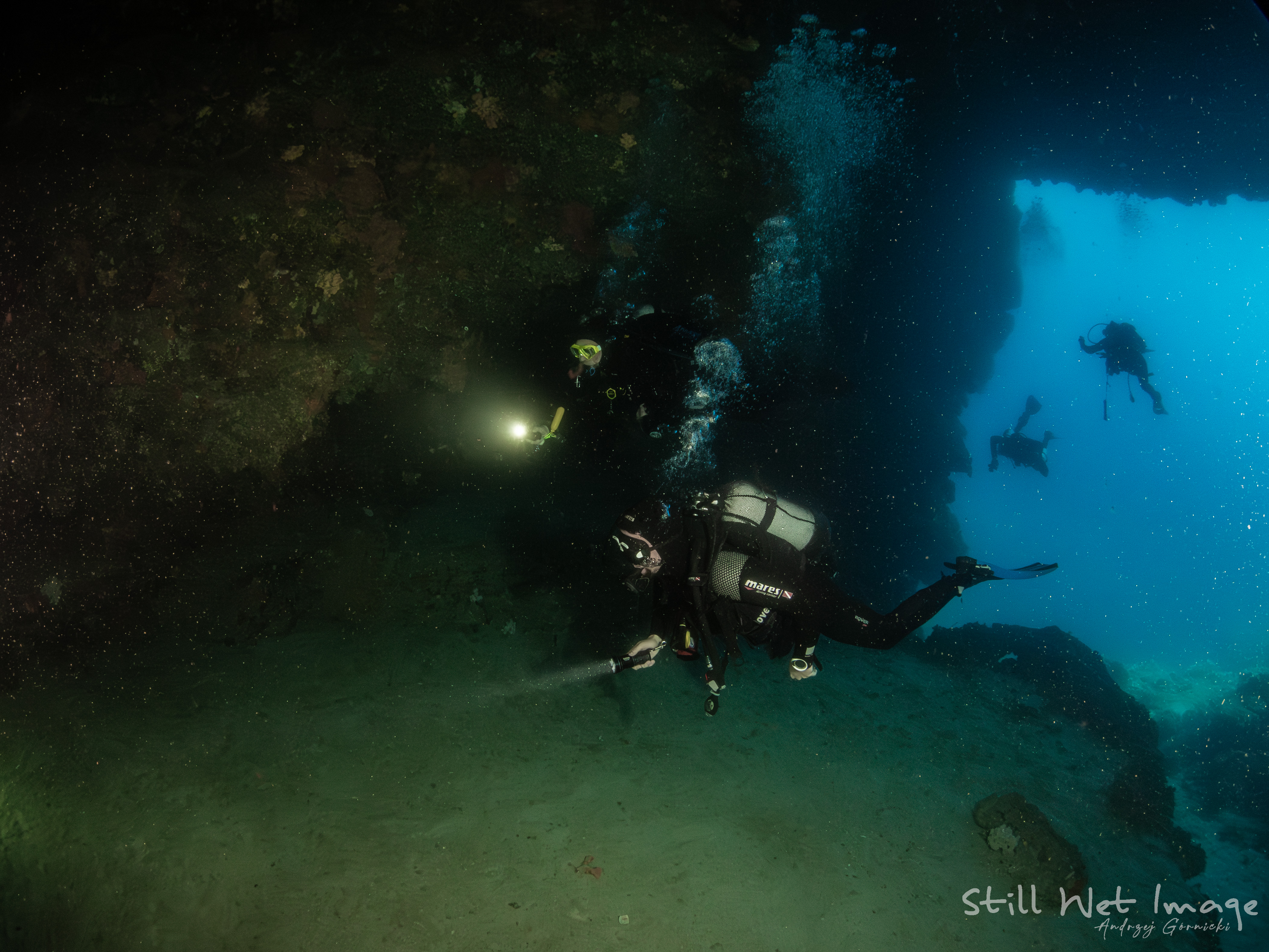
Monica Montefalcone had been diving scientifically for more than two decades. Since 2013 she had led coral reef research in the Maldives — an archipelago which Italian media described as the one she knew better than anyone else in her country. She authored over 130 scientific publications, led EU-funded marine ecosystem monitoring projects, and served as Associate Editor of Frontiers in Marine Science. Her husband Carlo Sommacal described her as a disciplined diver who carefully assessed risk before every dive and would never have made a decision that put her daughter or colleagues in danger. Together, she and her daughter had logged approximately 500 dives. As a scientific diver, Montefalcone regularly operated in demanding conditions — strong currents, limited visibility, sampling at varying depths. She was not a casual tourist.
Scientific diving versus recreational — an invisible boundary
Here lies one of the core systemic problems of this tragedy. A "Scientific Diver" certification — which Montefalcone almost certainly held — is not a technical certification in the sense used by TDI, IANTD, or NACD. In practice, scientific diving very frequently relies on recreational equipment and techniques, supplemented by sampling and documentation procedures. It does not automatically require training in decompression diving, cave diving, or technical gas management. A scientific diver with hundreds of hours underwater can therefore carry an impressive expedition history and simultaneously have no preparation whatsoever for an overhead environment — a cave from which free ascent to the surface is impossible.
Cave or cavern? A boundary that is routinely blurred
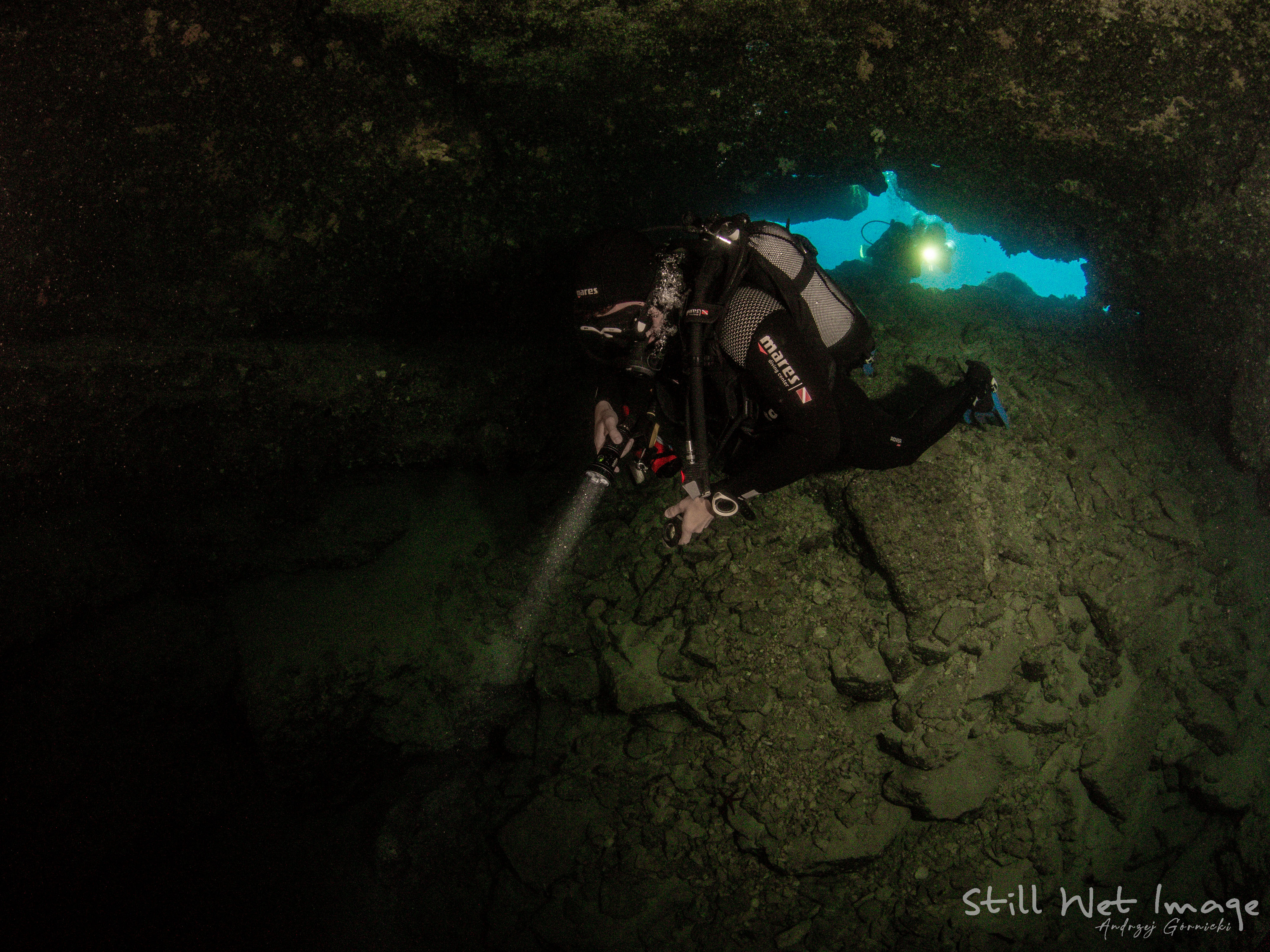
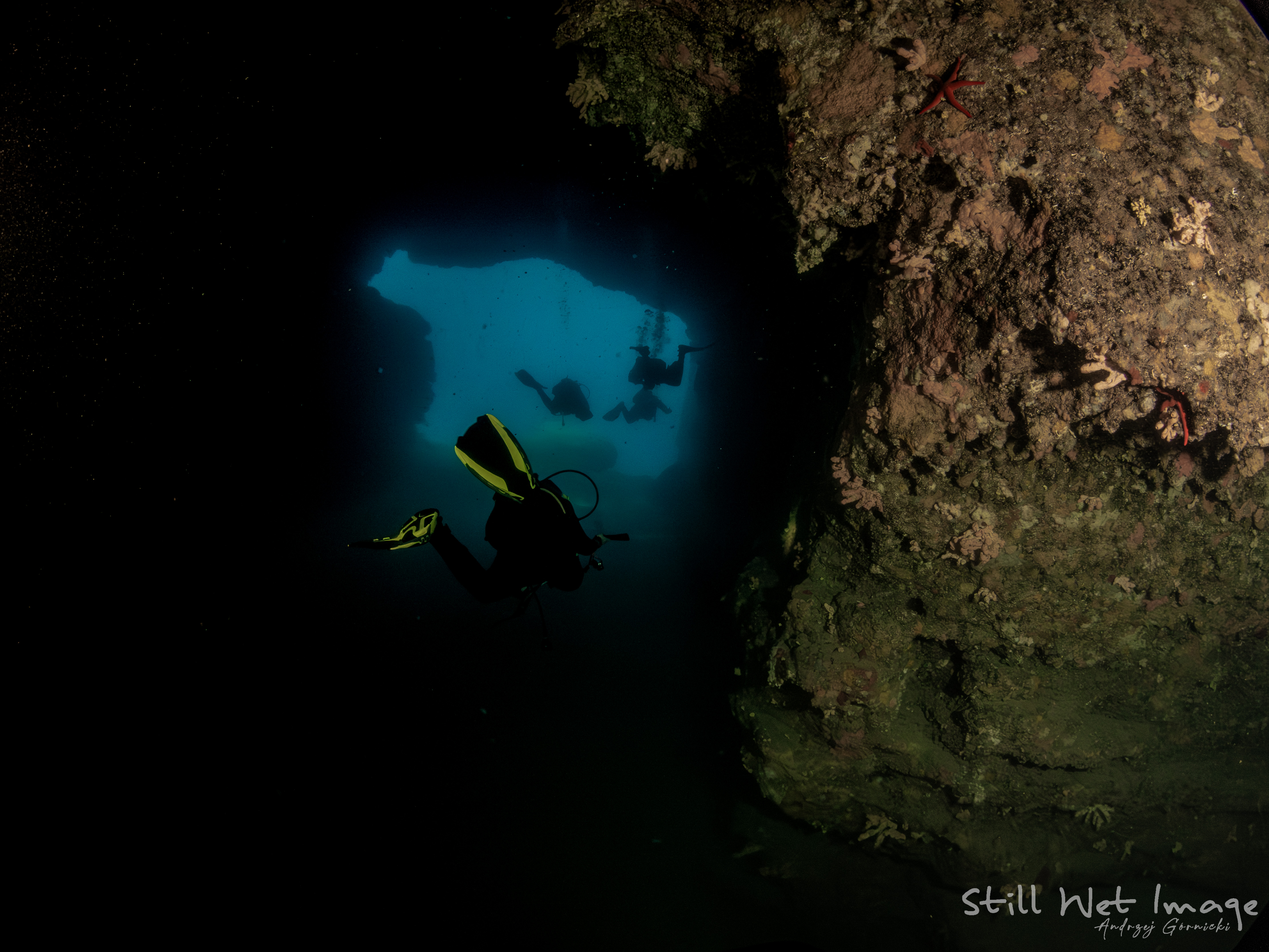
Had the Devana Kandu formation been situated at 12 metres, entry to it might have met the definition of cavern diving rather than cave diving — though even then the 40-linear-metre rule (the maximum penetration distance from the surface at which natural light must remain visible) would likely have been exceeded. The distinction matters: a cavern is a zone from which natural light is visible and direct return to the surface is possible; a cave is not. But this boundary is routinely ignored in operational practice. Guides at tropical reef sites regularly lead recreational divers on single-cylinder configurations, without guidelines, through brief passages in arching reef structures and shallow reef caves — because it is short, light, and "we always do this." Devana Kandu begins at 55–58 metres, has at least three chambers connected by narrow passages, and extends more than 100 metres into the rock. This is not a cavern. But the normalising logic — "we've been swimming into caves for years" — may have operated in exactly the same way.
Resources — including financial ones
The question asks about resources, not only skills. Trimix was not available on the Duke of York. A portable recompression chamber was not on site during the rescue. These are not oversights attributable to any individual — they reflect commercial realities in the recreational dive tourism market. Trimix requires storage infrastructure, blending equipment, and trained gas technicians. Emergency recompression chambers are expensive to operate and rarely present on recreational liveaboards. The resource gap here is structural, not personal. It is a consequence of a market in which the cost of safety infrastructure that would rarely be needed is borne by operators whose margins are thin and whose clients rarely ask for it.
Gas and depth
The lawyer representing Albatros Top Boat told CNN explicitly that the equipment the victims used was standard recreational gear — most likely single cylinders, no stage tanks, no cave configuration. At 55–60 metres on air, a diver faces severe nitrogen narcosis: impaired risk assessment, slowed reaction, inability to problem-solve rationally under stress. Some training agencies — including PSAI, whose narcosis management programme extends to 75 metres — do provide frameworks for air use at depth. But these require specific training and conditions that were most probably absent here. And in contemporary technical diving more broadly, 55 metres on air is typically treated as the point at which a diver should move towards trimix or heliox rather than an operational baseline to plan around.
Questions instead of findings. What diving certifications did each person hold — including Benedetti and Montefalcone? Did anyone in the group hold cave or technical qualifications as defined by TDI, IANTD, or NACD? What equipment did those underwater actually carry — not according to the operator's lawyer, but according to the vessel's records and the accounts of those aboard? What gas were they breathing? These are questions for investigators, not for newspapers.
Question 4 · Did they act with good intent but make an error?
Hypothesis — a critical distinction for the investigation
This question distinguishes error from violation — and has direct consequences for how the system should respond. An error is an action consistent with intent that produced an unexpected outcome. A violation is a departure from known rules — but intent is a more complex construct than it first appears. As discussed in the Learning from Everyday Operations framework, the context surrounding an intention is often more important than the intention itself. A person may deliberately cross a boundary while genuinely believing that crossing it is the right or safe thing to do — in which case the label "violation" obscures more than it reveals. The more useful question is: what did they understand about the boundary, and what made crossing it seem reasonable?
Montefalcone's husband Carlo Sommacal said publicly that his wife was a disciplined diver who carefully evaluated risk and would never have put her daughter or colleagues in danger. Benedetti is described in media accounts as meticulous — checking equipment and conditions. But these are descriptions of character, not a reconstruction of a decision.
There are at least two plausible scenarios. The first: the group entered a formation they treated as a short reef cavern — the kind of overhead passage familiar from other sites — and did not recognise in time that they had crossed into an environment from which free ascent was impossible. The second: they entered deliberately, with a plan that proved inadequate to the reality of the cave system. Both scenarios constitute an error in 8QR terms — but they require very different questions about systemic context. Only access to dive computer data, accounts from those aboard, and any footage from a GoPro will allow investigators to distinguish between them.
What we know about the sequence of events: here too we encounter a contradiction between sources. Italian press reported that Benedetti was found with an empty tank in the second chamber of the cave. The official spokesman for the Maldivian president and Italy's Foreign Ministry both stated that the body was found near the cave entrance — a finding that led rescuers to conclude the remaining four had penetrated further inside. Both versions cannot simultaneously be true. Neither has been confirmed by documentation. An empty tank — if that is a fact — would be the only hard information about the mechanism of what happened inside the cave. Everything else is speculation.
Questions instead of findings. How did the group understand the character of the formation they were entering? Was this a planned cave penetration, or did it develop spontaneously during the dive? What do the other people aboard the Duke of York say about the briefing and the plans for that morning? Where exactly and in what position was Benedetti's body found — the Italian press account and the official Maldivian account are contradictory and require resolution. Without answers to these questions, it is not possible to distinguish error from violation.
Question 5 · Were they following common custom or practice?
The crucial question — insufficient data
This may be the most important question in the entire analysis from a Just Culture perspective — and simultaneously the one for which we have the least data.
Normalisation of deviance, as Diane Vaughan described it in her analysis of the Challenger disaster, is more precise than the phrase is sometimes used. It is not simply that people started bending rules. It is that the social acceptance of a drift in standards — the collective rewriting of what counts as acceptable — meant that engineers were no longer breaking rules at all; they had restructured the rules to permit what they were doing. The problem was not non-compliance. It was that the system had redefined compliance. The diving industry does something structurally similar: commercial pressures push against conservative depth limits, operators and guides adjust their practice, and the adjusted practice becomes the new implicit standard. The regulation stays on paper; the operational norm evolves around it. In that sense, what matters here is not whether someone broke a rule, but whether the rule had any operational grip left to break.
Instructor Shaff Naeem said publicly that he had dived in this cave on many occasions — always with appropriate equipment and gas. This suggests the formation is known and visited within the community. But we do not know whether divers from the Duke of York had been there before, in what equipment, or in what configuration. We do not know whether the operator was aware of previous visits. We do not know what the approximately twenty other people aboard heard about the plans for that dive.
The cavern-versus-cave thread also deserves attention here as a distinct mechanism. In tropical recreational diving, guides routinely take divers through brief passages in reef structures — without guidelines, without cave equipment, because it is short, bright, and "we always do this." This is a different kind of normalisation from Vaughan's — it operates at the level of the whole industry, not one operator. Had the same formation been at 12 metres, probably no-one would have called it cave diving. At 55 metres, the consequences of the same error of categorisation are fatal.
Questions instead of findings. Had divers from the Duke of York or other liveaboards previously entered Devana Kandu or similar formations? Did the operator know about such dives? What did dive briefings on the Duke of York typically cover — were overhead environments discussed? These are questions for those aboard the vessel, for the crew, and for the operator's operational history. Without them, "normalisation" is merely an academic decoration.
Question 6 · The substitution test — would a reasonable peer have done the same?
Unresolvable without data from Question 5 — and without removing hindsight
The substitution test is one of the most powerful tools in 8QR — and one of the easiest to misuse. It asks: would another reasonable, competent peer, in the same conditions, with the same knowledge, and — critically — without knowledge of the outcome, have acted similarly? That last clause matters enormously. Knowing that five people died makes the decision look obviously wrong. Not knowing, from inside the conditions that existed before the dive, the picture may have looked very different.
If yes — we have a systemic signal. The behaviour is not an individual aberration but a product of the conditions in which the person was operating. If no — we are approaching the territory of an individual judgement that departed from the environmental norm.
The difficulty is that the answer to Question 6 is logically dependent on the answer to Question 5. If dives into similar formations were embedded in this operational environment, then many reasonable peers might indeed have acted similarly. Not because they were unreasonable, but because the system had mapped risk for them differently from the map that applies in technical diving training. If not — Question 6 begins to point towards an individual departure from norm, which requires a different kind of explanation.
Consider it concretely: another experienced instructor, operations manager on a Maldivian liveaboard, leading a group of scientist-divers who have dived these atolls many times. Would that person have taken them into this cave? I do not know. And the honest answer to Question 6 at this moment is exactly that: I do not know — until I know the environmental norms, and until I can genuinely set aside the knowledge of what happened next.
Questions instead of findings. The substitution test is methodologically dependent on establishing the environmental norms from Question 5, and on disciplined removal of outcome knowledge. Until we know what was "normal" in this environment — and can honestly ask the question without the shadow of the outcome — we cannot assess whether the behaviour deviated from the norm. This is not an excuse. It is the precision without which any analysis is simply reasoning backwards from the outcome.
Question 7 · Is there evidence of personal gain or conscious disregard of known risk?
Requires verification · Research pressure as a systemic factor
Only here — at Question 7 — do we approach the boundary of individual accountability as Just Culture understands it. And only here, not before.
There is, however, one thread that deserves separate discussion and that has barely featured in media coverage to date: research pressure.
Monica Montefalcone had been leading scientific projects in the Maldives for over a decade. Federico Gualtieri had just defended his doctoral thesis on corals in these same atolls under her supervision. Both had been diving at Alimathaa in the days before the accident as part of the university's official research mission. A cave at 55 metres — an ecosystem of deep coral, potentially undocumented organisms — may have represented not a site of adventure for them but a site of data.
There is a phenomenon well known in scientific communities, rarely named directly: the methodological normalisation of constraints for research purposes. When collecting specific data is difficult or impossible within the boundaries of formal permits — permits long awaited, hard to obtain, subject to bureaucratic timelines — field practice tends towards flexibility. Diving below regulatory limits for documentary or exploratory purposes is not merely anecdotal in marine research environments; it is a pattern reported across scientific diving communities, though rarely documented for obvious reasons. Especially when the data are unique, the time window is short, and previous visits to similar environments have passed without incident.
Is it possible that the decision to enter the cave was motivated — at least in part — by the desire to collect research material or visual documentation otherwise inaccessible? Montefalcone's husband asked rescuers to look for his wife's GoPro camera, which he says she used to document her dives. Whether that camera was with her in the cave, and what it recorded, remains unknown.
Just Culture does not treat research motivation as a justification. It treats it as context. If pressure to produce results, the uniqueness of the data, and the location's availability within the limited window of a week-long cruise were factors in the decision — those are systemic factors, not individual ones. They belong to the environment of research funding, publication pressure, the absence of mechanisms that would make proper authorisation accessible, and the absence of clear boundaries between "scientific diving" and "recreational diving for scientific purposes."
Is there evidence of conscious disregard of identified risk? That word is critical. Disregard implies knowledge of a specific danger and its deliberate rejection. If the competence boundary between recreational and cave diving was invisible or obscured for this group by years of experience without incident — it is difficult to make a substantive claim of disregard. If it was visible and rejected — that is an entirely different situation. We do not know.
Questions instead of findings. Did Montefalcone or Benedetti have previous experience with similar overhead formations, and how did they describe them? Is there any record — messages, notes, colleague accounts — that sheds light on how they understood the risk of this particular descent? Was research motivation verbalised before the dive? Without that data, the research pressure thread remains a hypothesis, not a finding.
Question 8 · Is there evidence of intent to cause harm?
No grounds
Question 8 is a boundary — it concerns sabotage, deliberate action to cause harm. In this tragedy there are no publicly known grounds to even consider that possibility. Everyone who died, died together.
Question 8 carries a different significance here beyond simply excluding intent. Its place in the sequence is a reminder that the 8QR framework reaches the question of individual culpability only after passing through seven earlier layers — systemic, organisational, procedural, competence-related. If an explanation is found in those layers, Question 8 becomes irrelevant. If it is not — it begins to be warranted.
In this case — based on what we currently know — the explanation very likely lies in those earlier layers. But that sentence is also a hypothesis, not a verdict.
Questions instead of findings. No grounds to pursue Question 8. The analysis returns to the systemic level — which is the typical and expected outcome in Just Culture for accidents in high-risk environments.
Instead of a conclusion: eight questions without answers — and why that is precisely the point
Five people died on 14 May in the Devana Kandu cave. Sergeant Major Mohamed Mahudhee died three days later searching for their bodies — on compressed air, without trimix, certified to 50 metres, having descended to approximately 60. These are two separate tragedies joined by the same question: where in the system did the conditions lie that made both of them possible?
I have worked through eight questions and have not given a single certain answer. That is not a failure of the method — it is the method's honest application in the conditions I am working under: no access to those who were there, no documentation, no dive computer data, no recording. A genuine 8QR is a tool for conversations, not for reading newspapers.
What I have tried to do instead is show which questions are worth asking and why sequence matters. We begin with the system: rules, procedures, expectations, environmental norms, organisational culture. We work through competence and the context of decision-making. We reach the individual only when the system does not explain enough.
Finding someone to blame is fast and satisfying. Finding causes is slow and uncomfortable. Just Culture insists on the second — because only the second prevents the next accident.
Cave diving is an environment that does not forgive errors. But errors do not arise in a vacuum — they arise in systems that render competence boundaries invisible, allow regulations to drift from operational reality, and make the pressure to act stronger than caution. That is the question that should be asked in the investigation, in the diving industry, and in the institutions that fund marine research. For those who want to understand how similar dynamics have played out before in cave diving incidents, the analysis of the Chac Mool accident remains one of the most rigorous accounts available — and a sobering companion to this case.
I do not know exactly what happened on 14 May in Devana Kandu. I know that before anyone delivers a verdict, they should work through these eight questions — with the data that I do not have.
This article is based on press reports from 14–18 May 2026. It is intended for educational purposes. The investigation is ongoing.
Further reading on The Human Diver:


