What Is the Purpose of an Investigation in Diving?
When a diver dies, something far bigger than a piece of equipment or a plan has failed.
Accidents don’t just damage bodies or hardware. If we choose to look deeper, we realise they shatter our assumptions; assumptions we make about safety, competence, control, and risk. They force us to confront an uncomfortable truth: the world is more fragile and less controllable than we like to believe.
And almost immediately we reach for ‘an investigation’ to find the answers. We are told that investigations are objective searches for facts. We often hear, “Just wait for the investigation.” These investigations are about finding the cause so we can stop it happening again. Unfortunately, in the diving space these ‘investigations’ are framed around litigation and not about 'real' learning.
As Sidney Dekker has argued for years, accident investigations are not just technical exercises. They are psychological puzzles, these are acts of meaning-making under intense emotional, social, and political pressures.
Which raises a more fundamental question we rarely ask in diving:
What is the investigation really for?
Four Purposes, One Impossible Task
Dekker describes four competing purposes that investigations are expected to serve simultaneously:
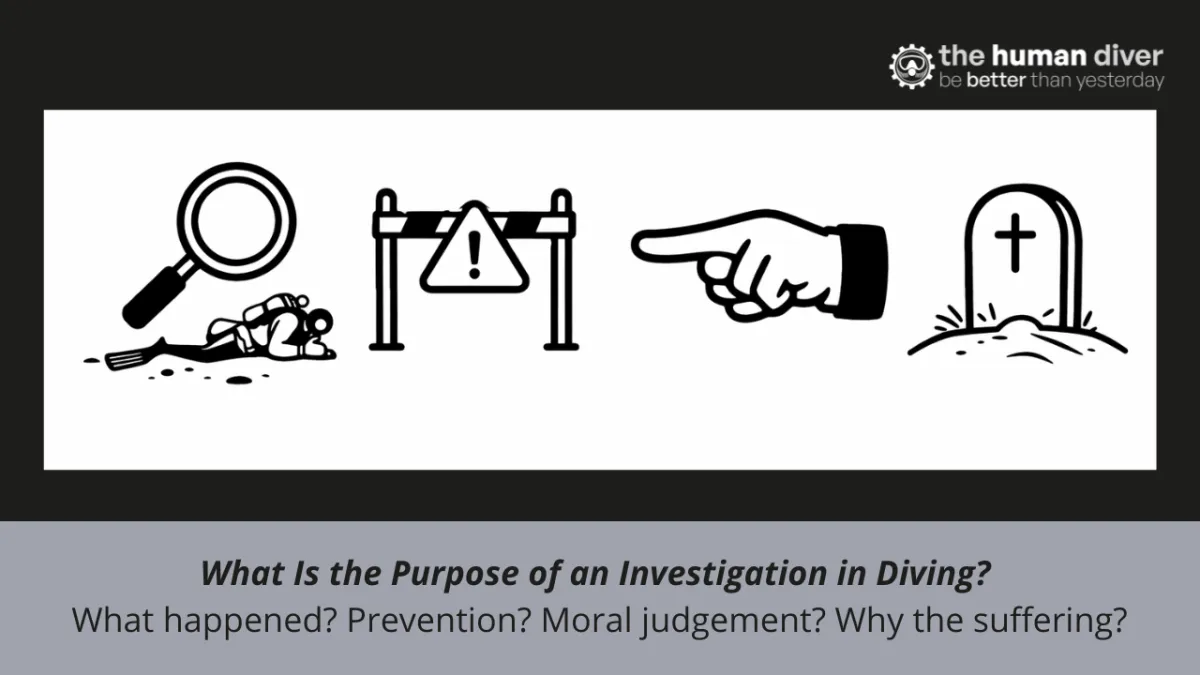
• Epistemological – an academic term that can be simplified as “What happened?”
• Preventive – How do we stop it happening again?
• Moral – Who crossed a line?
• Existential – Why did this suffering occur?
On paper, diving investigations should emphasise the first two. In practice, the last two often dominate, especially when someone has died. This happens is because once there is a fatality, the investigation is no longer just about understanding, it has morphed into something about reassurance.
We want to believe that:
• the death was not random,
• the boundary between 'safe divers' and 'unsafe divers' is clear,
• and that we are on the safe side of that boundary.
That psychological need subtly shapes the story an investigation tells.
Fatal Accidents Demand Simple Stories
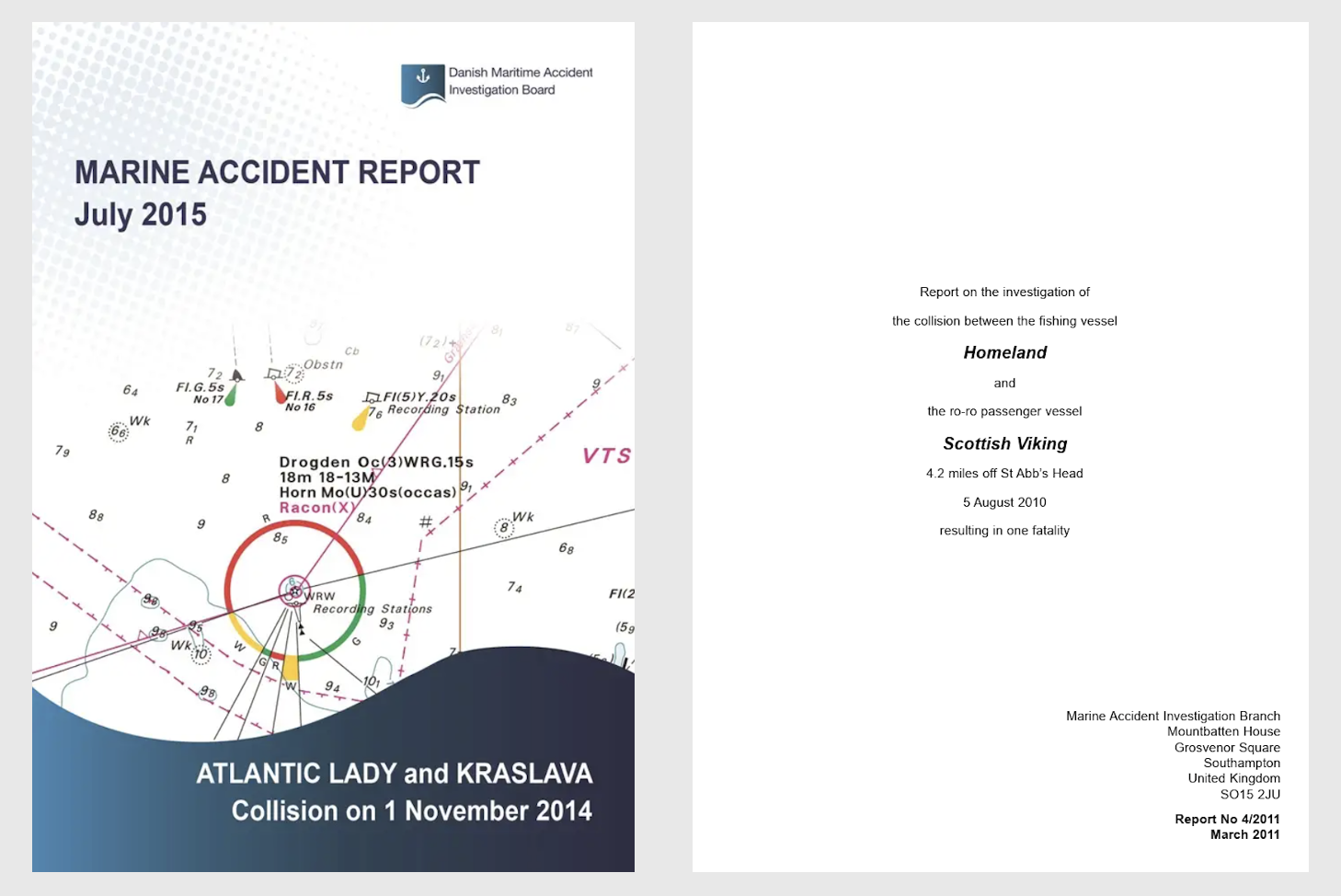
We can see this by looking at two maritime collision investigations with very different perspectives and narratives: one fatal, one non-fatal.
In the fatal case, visibility was good, but someone died. You could argue that this outcome bias lead to the investigation narrowing rapidly onto individual failures:
• failure to keep a proper lookout
• failure to follow procedures
• failure to meet qualification standards
The story was clean, it was condensed, and it is morally satisfying.
However, in the non-fatal case, conditions were awful, there was fog, current, and narrow channels to navigate, but no one died. And suddenly the investigation could afford to be generous:
• complexity was acknowledged
• system interactions were explored
• infrastructure design was questioned
The solution wasn’t “be more careful”, one option in the report stated “remove the lighthouse.”
Same profession, same risks, but very different narratives. The difference wasn’t the presence or absence of evidence, it was existential pressure ('why did the suffering happen') that was present. This pressure shapes and influences the lens by which the event is viewed, and of course, the expected outcomes.
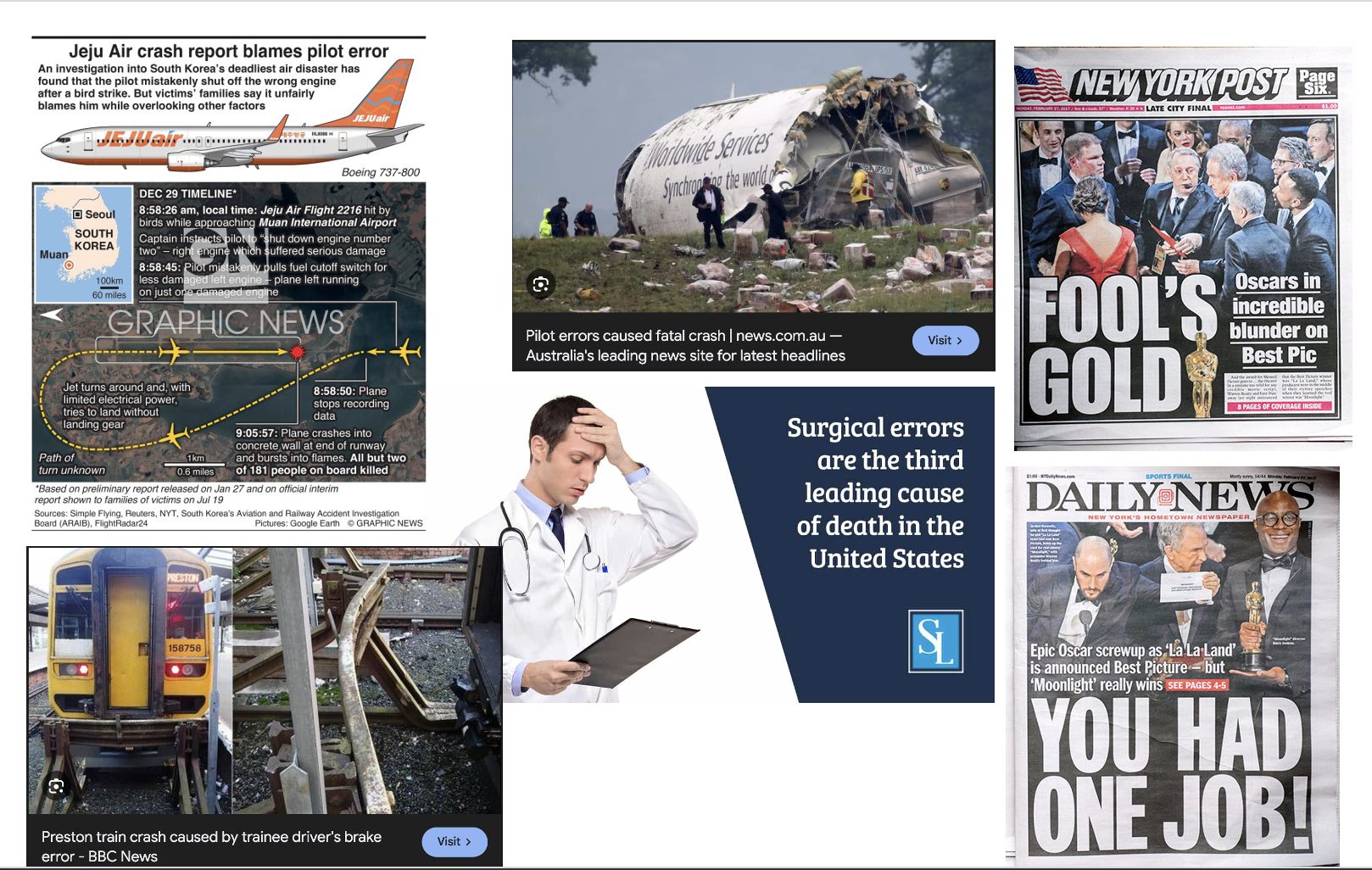
When someone dies, society demands meaning. And the simplest way to provide meaning is to locate failure in human choice. You only have to look at the media when serious adverse events occur: “Pilot error”, “Surgeon error”, “Human error” …
Diving Does the Same Thing
We see this pattern repeatedly in diving.
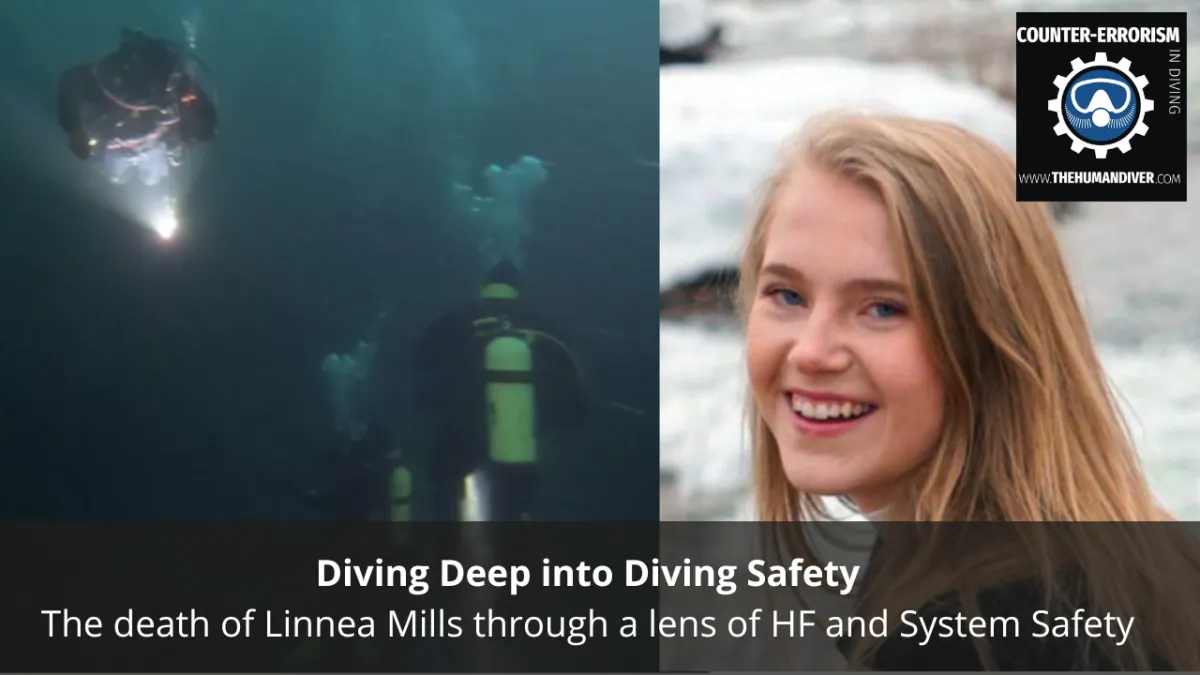
In the Linnea Mills case, it is easy, almost irresistible, to collapse the event into a single moral sentence: the instructor didn’t do her job and the student died. That framing redraws the boundary and reassures the rest of us that as long as I am not like the instructor, then my students (or I) will be safe.
But when you step back, the event only makes sense when you consider:
• training pathways and blurred thresholds of performance.
• cultural normalisation of “just going a bit further”
• the tensions between shop, instructor, and client expectations and goals
• supervision assumptions
• social signalling and silence (psychological safety and power dynamics)
• how sense-making unfolded on the shore and underwater
By taking a simple narrative, the moral story feels complete. However, the learning story is only just beginning. If you see ‘error’ as a cause, that is the starting point, not the end state.
The same is true in the Brian Bugge case. The documentary If Only… deliberately resists the temptation to end with “a missed checklist item.” Instead, it exposes authority gradients, time pressure, organisational drift, equipment feedback limitations, and a culture in which it was difficult to speak up. Barbara quote
Yet even here, the most common takeaway when exposed to a simple narrative remains individualised: always double-check your unit. That advice is not wrong. It is simply nowhere near enough. Ongoing research is highlighting a shift in perspective when exposed to HF training and a context-rich narrative, moving from blame to empathy and understanding the local rationality of those involved.
Explanation Is Not Prevention
One of the most important insights in the attachment is the distinction between explanatory variables and change variables. What explains this accident is often not what prevents the next one.
A diver forgetting a step may explain an outcome. But retraining divers rarely changes the system conditions that made forgetting likely:
• time pressure
• workload stacking
• ambiguous feedback
• social expectations
• production goals
In the maritime example, blaming crews would have been cheap and comforting. Removing a lighthouse was expensive, uncomfortable, and effective.
Diving investigations too often stop at the cheap option. In the Linnea Mills case, the deeper mechanism of self-certification and limited quality management to assess instructor performance and risk management is where the cost/quality/liability trade-off happens. Changing the QM process might also generate concerns about liability - if this has been known about, why wasn't something done before?
Moral Comfort Has a Cost
Investigations that deliver clear blame provide psychological relief. They tell us the world is ordered, that rules work, and that the tragedy has a reason behind it - an individual human. But these come with a hidden cost.
By localising failure at the sharp end, they:
• protect organisations from scrutiny
• avoid expensive systemic fixes
• silence uncomfortable questions
• increased insurance premiums
• and teach divers to hide uncertainty rather than discuss it
They also create what Dekker describes as existentially satisfying (i.e., someone is punished) but epistemologically (what happened?) thin reports.
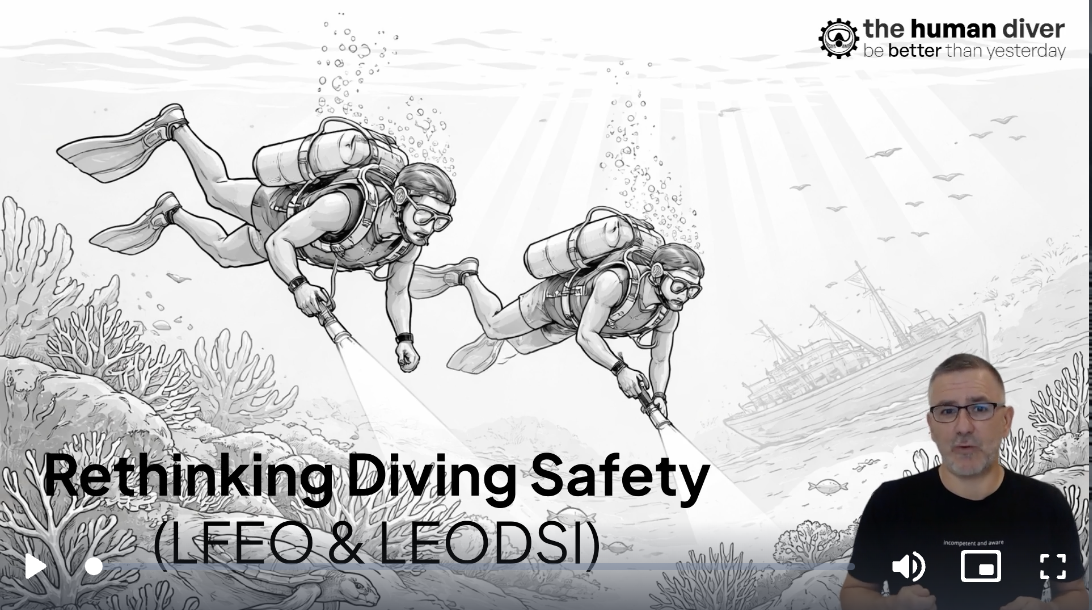
They feel ‘right’ but they change little. Addressing these issues in diving is a complex problem. We don’t have a clear definition of incident, we don’t have mechanisms for (learning-focused) investigation, and we don’t have an effective report-producing systems. To address some of these gaps, The Human Diver is developing the Learning from Emergent Outcomes (LFEO) course using a framework called Learning from Emergent Outcomes in Diving Systems and Interactions (LEODSI) which considers the people involved, the environment, the task, the tools and technology, the external influences, the organisation (paperwork and structure), and how time impacts performance. This framework helps us look up and out, and not down and in.
A Different Kind of Accountability
LEODSI was built in response to the tensions highlighted above.
It starts from a position many still find unsettling:
People did not fail. The system shaped the conditions under which failure became possible.
Despite what you might think, that approach does not remove accountability. It moves it into the forward-looking perspective, not one which looks backwards and applies numerous biases including hindsight bias.
Instead of asking who was wrong, we ask:
• what margins were eroded
• what trade-offs became normal
• what pressures went unspoken
• what adaptations usually worked >> until they didn’t
This is what forward-looking accountability looks like: locating the meaning of suffering not in punishment, but in identifying options for system redesign. You can ask who was harmed, what do they need, and whose responsibility is it to address that? Note 'who', can be the diver, the instructor, the dive centre, the training agency, the society, the families of those involved... Each has a need.

The Question That Really Matter The Most
Every fatal diving accident forces a choice. We can tell a simple story that reassures us:
This happened because someone broke the rules.
Or we can tell a harder story that helps us learn:
This happened because many ordinary things interacted in an extraordinary way.
Only one of those stories makes the system safer.
So, when the next investigation is published, the most important question is not:
• Did they find the cause?
It is:
• Did this change the conditions under which the next dive will take place?
If not, then whatever meaning we extracted, however comforting, has come at too high a price. Investigations should not help us feel safe. They should help us become safer.
References
Dekker: The psychology of accident investigation: epistemological, preventive, moral and existential meaning-making. 2015. Another link. https://research-repository.griffith.edu.au/items/d0de2c1f-08f8-43b2-9d30-2a4ff6baea09/full
DMAIB Report: https://dmaib.com/reports/2014/kraslava-and-atlantic-lady-collision-on-1-november-2014
A fellow graduate from Lund University wrote about this “Why do we ask why? Finding meaning after a violent loss.”