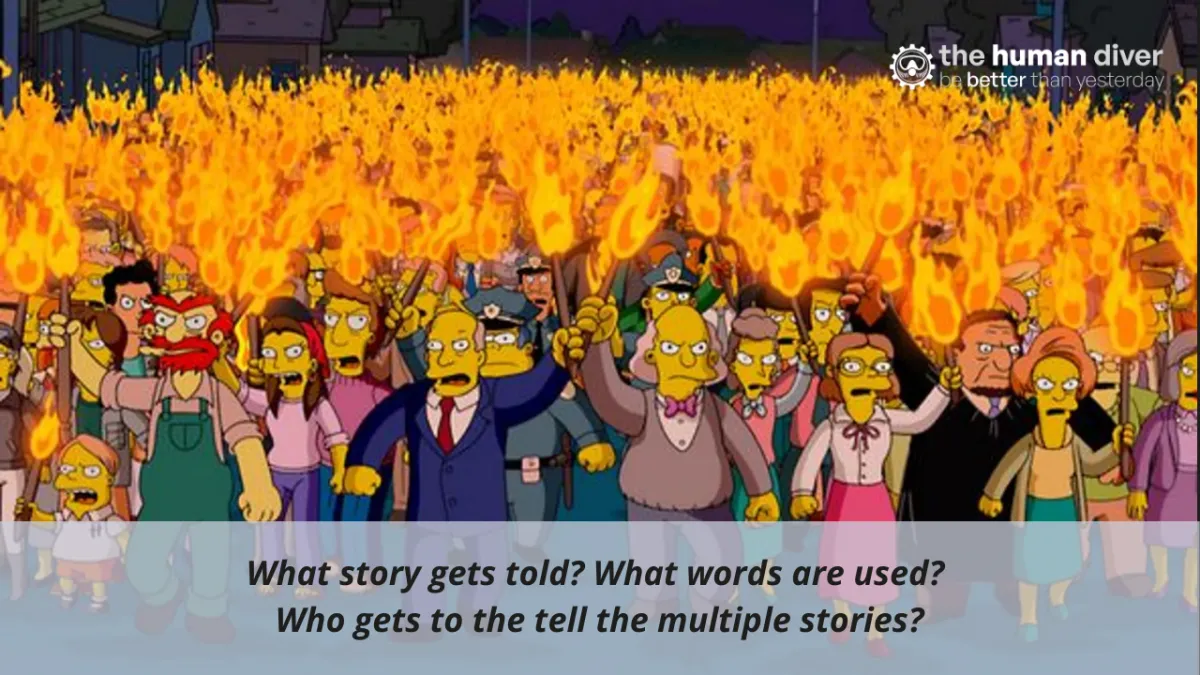
What story gets told? What words are used? Who gets to the tell the multiple stories?
The following post provides two accounts of the same event – the tragic loss of a twelve-year-old girl during a diver training programme in Texas last year. The first story is told using the sort of language used by a media outlet or seen on social media. It contains counterfactuals and seeks to find blame in the individuals present.
After you read this first narrative, think about where you would focus your efforts to prevent this event from occurring again. What elements of ‘what happened?’, ‘what learning can be had?’, ‘who is to blame?’, or ‘why the suffering?’ are you focused on?
The irony of using a burning pitchfork image is not lost on me to generate interest in a post about learning and not blaming. However, social media algorithms don't like learning, they are geared towards disharmony.
A 12-year-old wanted to be a veterinarian. The diving industry killed her.
D.H. was twelve years old, weighed 77 pounds, and dreamed of becoming a veterinarian. On August 16, 2025, she drowned during her first open water scuba dive in Texas. Court filings in the wrongful death case against the training company, the facility, and two of the world's largest diving agencies reveal a story that is far harder to stomach than a simple tragedy.
If D.H. had received the ten hours of pool training that NAUI's own standards required, she would have entered the water better prepared. She received three.
If she had been given a dive computer, a basic piece of equipment that tells a diver their depth, she might have known she was sinking to 45 feet instead of the 16-foot training platform. She was never given one. The shop's policy was not to provide them.
If the instructor had slept the night before, his judgment might not have been compromised. According to the court filings, William Armstrong had worked a full day shift as a sheriff's deputy, then an overnight security shift, then drove an hour to the dive site. He began teaching eight students, including D.H., having had little or no sleep in over 24 hours.
If anyone had noticed she was missing for more than a few minutes, a search might have found her in time. Thirty minutes passed between her last being seen alive and her recovery from the lake floor.
But none of these things happened. And the court filings reveal that none of them were accidents.
A 2017 video surfaced showing Scubatoys' owner, Joseph Johnson, bragging to staff about the number of students his company had killed. He told them their insurance broker had assured him they could "kill two a year and be fine." Standing next to him in the video was Rick Golden, NAUI's regional representative; the man allegedly responsible for supervising Scubatoys' compliance with safety standards at that time. He said nothing.
That video was passed up to NAUI's top management. According to the filings, the CEO "specifically declined to take any action" against Scubatoys or Johnson. The company continued operating. It continued certifying over 800 students a year. And D.H. continued to be the kind of child who walked into the room and made it brighter.
She deserved better. The system was designed to deliver exactly this
The second story is where the learning opportunities are greater.
This is the same incident. The same child, the same lake, the same day. But told the way the diving community needs to hear it, not to assign fault, but to understand how a system produced this outcome, and what we can change. Note, the word count is almost the same – approximately 380 words. Where would you look now when it comes to reducing the likelihood of the same event from occurring?
The system that shaped D.H.'s dive. A LEODSI learning narrative.
The training organisation had built a workflow that moved students from pool to open water in compressed timeframes. Under those conditions, it was normal to advance students after three to four hours rather than the ten that standards described. The system made that decision easy and routine. Nothing in the feedback loop flagged it as unusual.
The facility had chronic visibility conditions; two to four feet on the day in question. This was known. It was normal for that site. The organisation had no mechanism to restrict operations based on environmental conditions, so the visibility became part of the background, not a decision point. It simply was.
The instructor arrived having worked through the night in another role. Part-time instruction was common across the industry. There was no fitness-for-duty check; not because anyone chose to ignore it, but because the system had no such step in its design. The conditions he faced were shaped long before he entered the water.
The student entered the water without a dive computer. The organisation's policy was not to provide them. This meant the student had no independent depth or time awareness. Under those conditions, complete reliance on the instructor for depth monitoring was built into the task design; not a choice made on the day, but a feature of how the system was structured.
During the second descent, the group spread out in low visibility. The student became separated. The system had no real-time accountability mechanism: no continuous headcount, no proximity alarm, no structured search protocol ready to activate. When the separation was noticed, the response was improvised.
The analysis suggests several interacting conditions shaped this outcome. The task design assumed visibility and supervision capacity that the environment did not support. The equipment design removed the student's ability to self-rescue. The organisational design normalised compressed training and removed the points where conditions might have triggered a different decision.
Ask what normal looks like - at an individual element, not when the elements converge. Accidents happen as deviations from normal, not as deviations from rules...
No single element explains what happened. The outcome emerged from how these elements interacted. That is where learning lives, and where change must begin.
The second story doesn't contain the emotion from the first story, and that is intentional. The second story also doesn't contain the real details. My experience is that an effective 2nd story is at least 5 times as long as the 1st story. People don't read that long though.
Two other pieces to consider reading:
One, that looks at cognitive dissonance in the context of this story and why hurting prevents change.
Second, looking at what is the purpose of an investigation and addresses the first four questions right at the top of the post.
I this blog I can add a bit more than in the social media post.
Comments made that I've answered
"If a system can fail under normal, predictable conditions, then the lesson is not about context — it is that the system must change, and that is what I feel is missing here."
Define system "failure"? This statement focuses on outcomes. Many, many dives take place in these conditions (as individual factors or a number of them coming together), without a death taking place.
Poor visibility: normal
High student ratios: normal
Children in class: normal
People having 3 hours instead of 10 pool training: normal.
Instructors having limited experience (Linnea case, not this one): normal
Time pressures: normal
Commercial pressures driving class size: normal.
Training platform above a big drop: normal
Instructors and students churning vis: normal
Thermocline: normal
Inability to share stories due to judgement when pushing boundaries: normal (there's a whole MSc thesis on that!)
How many of these types of events have occurred together and nearly ended up as a fatality but didn't, and because of the social and cultural behaviours of the diving 'system', they don't get shared and we don't hear how often the margins are slowly being eroded and then socially accepted as 'normal'.
Absolutely the system must change, and that is what the longer blog is about. Bear in mind that the piece above was 400 words to match the 400-word judgemental piece. The other article about this case is currently 2500 words. The HF analysis of a Maltese Fatality was 4500 words...
======
"it is that the system must change, and that is what I feel is missing here."
My takeaway from the Linnea Mills case wasn't about drysuits per se, it was about the self-certification process... this allows instructors with limited experience to say they are competent to teach without being observed as being competent to teach.