

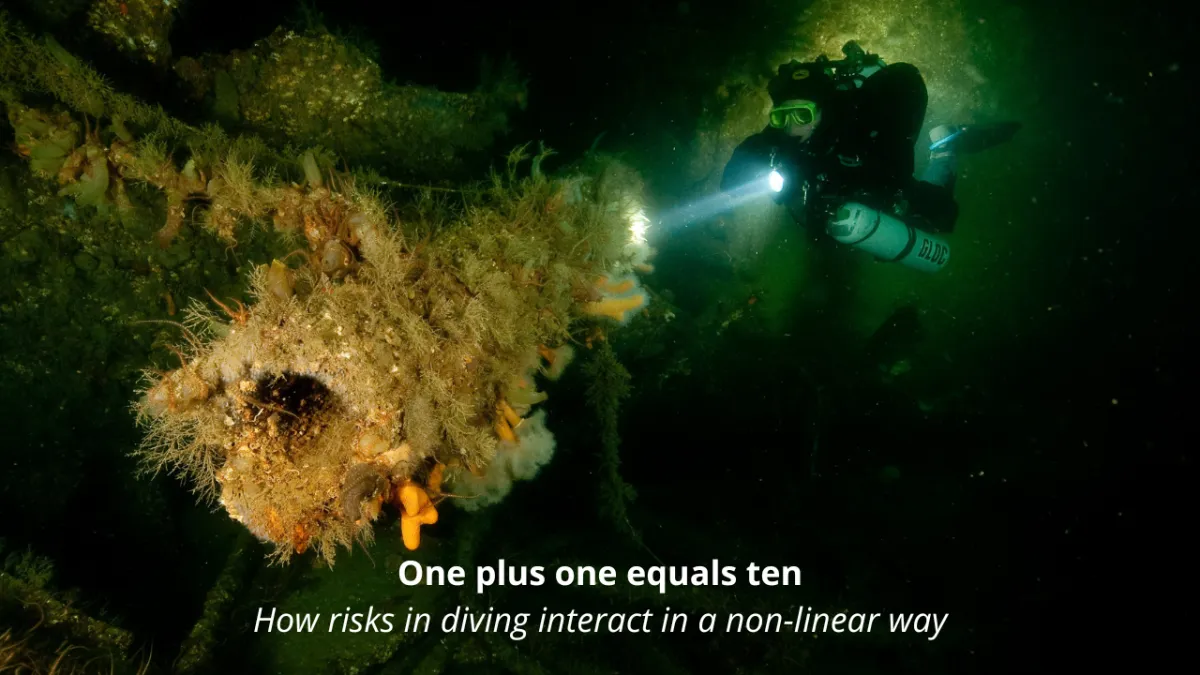
One plus one equals ten: How risks in diving interact in a non-linear way
Take two things that, on their own, most divers would treat as manageable: a blood pressure medication that has never caused a problem on land, and a dive at the colder end of what you are used to. Neither, by itself, would make many people cancel. We know about them, we have handled them before, and experience tells us they sit comfortably inside our limits. The problem is what happens when they turn up together, because immersion already shifts blood towards the core, cold narrows the peripheral vessels and adds workload, and a cardiovascular system being managed by medication has less reserve to absorb the extra demand. The combined risk is not the sum of two small risks. It can be several times larger, and the research is clear that our brains are remarkably bad at spotting this and then doing something with it.
If you read last week's incident report about a diver's 500th dive, with a first-ever DPV, a wreck at 120 ft, visibility down to five feet and a permanent line cut in the very places a teammate had warned about, you have already seen this arithmetic fail. I will be referring to that story because almost every action or decision within that event is an example of what the research outlined below predicts.
The maths our brains refuse to do
Three researchers ran a series of experiments that asked a simple question: do people believe that two hazards can combine to produce something much worse than their sum? Participants were given the individual risk of hazard A, the individual risk of hazard B, and then a statement describing the combined risk. Sometimes that statement was simply additive. Sometimes it carried a synergistic multiplier of 1.25, 2.5, 5 or 10 times. Participants were then asked one question: could the combined statement possibly be true?
People accepted the additive version quite easily, but their belief declined in a straight line as the multiplier grew. By the time the combination was ten times worse than the sum, a large share of participants rejected it as impossible rather than just unlikely. This wasn’t about maths. When they were asked to explain their reasoning, those who denied the synergy were doing basic arithmetic: one plus three equals four, so it cannot be five. However, those who accepted it weren’t doing this, they were reasoning about mechanisms, describing "a dangerous interaction" or "a toxic cocktail", and thinking about what the two hazards do to each other rather than what their numbers add up to.
The world is full of multipliers. Smoking and indoor radon each raise lung cancer risk; together they raise it around twenty-five-fold, because radioactive particles attach to smoke and are carried deep into the lung. Alcohol and tobacco combine synergistically for oesophageal cancer, because alcohol makes tissue more permeable to the carcinogens in smoke. In each case the interactive process is what makes the multiplier real, but this is invisible to anyone doing basic arithmetic.
Familiarity makes it worse
There is a second finding in this research that, as divers, we should take note of. When the hazards were anonymous, referred to simply as drug A and drug B, people were quite willing to believe in a large synergy, because mystery chemicals feel like they might react. However, when the researchers swapped in familiar names e.g., aspirin and warfarin, that willingness to believe in big interactions disappeared, even though that combination is a well-documented and life-threatening interaction between two medicines that attack blood clotting from different directions. This familiarity bred underestimation.
Now think about what experience does to a diver. Almost everything in diving becomes familiar with time: a bit of current, a new piece of equipment, a late start, a milestone dive, a buddy you have not dived with before, being a little tired, a little dehydrated, a little narc’d. Every one of these has been met individually, many times, without consequence, and that is precisely the condition under which the additive default operates without challenge or thought. Some might say complacent, but the mechanism is different.
That is what happened on the 500th dive described last week. If each of these was put into a risk assessment spreadsheet and we took each row at a time, each element would look like it could be handled.
The diver knew the DPV only in theory, but the plan was to scoot on the surface and clip off at the line.
The cut lines were known, but the teammate knew the site.
The visibility, the depth and the deco obligation were all individually familiar to someone on the team.
What nobody assessed was the combination of a first-time DPV, no line, five feet of visibility and dense gas at the most work-intensive part of the dive. Two explicit warnings, to do DPV training dives first because "it's simple, until it is not", and to take reels because the lines were cut, were each discounted on their own. Importantly, nobody asked what it would look like if these happened at the same time.
Our 'risk management' tools look one row at a time
You might hope our risk assessment methods would compensate for this bias, unfortunately, they have a tendency to amplify it. A risk register/assessment form or matrix scores hazards one row at a time, so interactions don’t show up anywhere, and the research tells us that the risk assessor is not expecting the interactions anyway. Five individually acceptable ambers/medium risk read as an acceptable 'score on the door'. Researchers showed that the matrix has deep mathematical problems even on its own terms, but the compound risk problem is worse than imprecision: the tool structurally cannot represent the thing our brains are already primed to miss.
The diving industry has not ignored risk assessment - it is core part of professional development when operating on a dive site, but does it do what we think it does? DAN ran a substantial research effort over several years, with on-site assessments at nearly ninety dive businesses across fifteen countries followed by an online self-assessment completed by hundreds of operators. It is worth noticing where that research pointed: towards the hazard identification and risk assessment (HIRA) product DAN already offered, with the organisation's own incident data supplying the supporting evidence. The HIRA tool asks diving operations to look at many individual hazards, and then asks them to convert probability, exposure and severity into a score. Unfortunately, that process still treats every hazard as if it exists individually. There is nothing that asks "which of these two are far worse together?" DAN isn’t alone in this treatment of operational risk.
When the hazards are conversations
The account of the 500th dive shows something the laboratory studies cannot: miscommunications compound in exactly the same way physical hazards do. Before the dive, "am I ready?" was heard as a request for permission by one diver and answered as an invitation to self-assess by the other, and neither checked which question was being discussed. ‘Rock bottom’ was calculated but never briefed as a shared trigger, so 800 psi at 117 ft meant "we go up now" to one diver and "we're fine" to the other. In the silt-out, "are you OK?" produced the automatic OK from a diver who was not. And underwater, one diver was in a trust-me dive while the other believed she was diving with an equal teammate. These issues were brought up in a previous blog with a diver who pressed on without realising their buddy was close to cognitive failure.
Any one of those gaps, alone, is survivable; divers leave things unsaid on every dive and get away with it. What turned them into something else is that each unresolved ambiguity subtly removed the recovery path the next one relied on.
Because the pre-dive conversation never established whose call the dive was, the warnings had no owner.
Because rock bottom was never shared, the gas reading could not trigger a shared response.
Because the ‘OK’ was automatic, the teammate who could end the dive had no data to do it with.
Four communication hazards, each rated ‘acceptable’ on its own, interacted into an ascent where one diver could not deploy her DSMB, could not switch her gas, and omitted her decompression entirely. One plus one plus one plus one was not four.
The fallout does not stop with you
Brent's recent article on diving fitness makes the same point from a different direction. He describes divers treating the medical questionnaire as a test to pass, and "I feel fine" is the additive default in miniature: the condition on land is one hazard; immersion, exertion, cold and dense gas are others; and the medical-fitness-to-dive form exists because of how they combine. His harder point is about who pays when a combination catches someone out: the buddy performing a rescue, the instructor doing CPR, the family. On the 500th dive it was the teammate who paid - she gave up her own gas switch and her own decompression rather than leave the diver struggling. The compounding effect then carried on after the dive, where her reassurance and the diver's embarrassment fed each other for five days while symptoms developed and the emergency hotline went uncalled. Underestimating a synergistic risk is not a private miscalculation; other people inherit the consequences of our additive maths.
What helps instead
The research points to three practical thing we can do, and importantly, neither requires a better ‘scoring’ system.
First, rationalise the decision via discussions and mechanisms, not numbers because these incredibly subjective and often focused on ‘passing’ not ‘understanding’. The people who correctly saw synergistic risk were the ones thinking about how hazards interact. The incident report does this well using hindsight to help learn: gas density above 6 g/l, heavy exertion and a dragging DPV do not add up to discomfort; they interact to produce CO2 retention, and CO2 is both narcotic and a very strong trigger of panic, degrading the very capacities the diver was relying on to manage everything else. If you cannot describe the interaction, you have not assessed the combination; you have assessed two ‘individual rows in the risk assessment’.
Second, speak the question about combinations out loud because it is unlikely it will be asked. Before the dive, with the whole team listening: which two of the things we have just discussed are worse together? A first-time DPV and a line that might be cut? A milestone dive and an ambiguous "am I ready?" Or something more normal, a marginal sea state and an injured diver who needs to be recovered on the boat? The way we plan dives often suppresses the question and our cognitive bias then suppresses it again. As such, these questions have to be deliberately asked, and asked socially rather than privately. The research shows that safety knowledge only survives contact with the real world when the people around us support its use. A study of safety training in construction found that technical skills transferred to the worksite but the non-technical skills of noticing and speaking up faded quickly, and what preserved them was whether peers and supervisors treated their use as normal. A buddy pair or a boat where the combination question is routine is running a control that no matrix provides. This is the same as normalising calling a dive, running an effective brief or debrief to enable learning and better decision-making.
Thirdly, tell context-rich stories like last week’s account because they provide the evidence to explain the reality of the situation. However, we have to overcome the ‘distancing through differencing’ bias – I am different to that diver, I wouldn’t make THAT mistake, and yet the evidence is that we are broadly all wired the same way and so would likely make that same mistake.
Unfortunately for us, the world multiplies effects while our brains just add them up, and the gap between these two is where a large share of diving incidents live, last week’s event among them. Other’s we’ve discussed while applying a LEODSI/Human Factors lens include the death of Linnea Mills, the death of Brian Bugge, the death of Dylan Harrison, the survival and double fatality on the HMS Scylla, and many more. No score on a matrix or normal risk assessment will close that gap.
What closes it is understanding the interactions and their mechanisms, asking the questions that will not ask themselves (and that requires psychological safety), and remembering that the people we are diving with are using simple addition when we should be looking at interactions. We should be aiming for resilient performance where we take into account the team’s technical skills and non-technical skills, and we have designed the context/environment to allow us to fail safely.
References
1. The Human Diver (12 August 2026). https://www.thehumandiver.com/post/miscommunication-and-assumptions-what-could-possibly-go-wrong
2. Dawson, I.G.J., Johnson, J.E.V. & Luke, M.A. (2012). Do people believe combined hazards can present synergistic risks? Risk Analysis, 32(5), 801-815. See also Dawson, I.G.J., Johnson, J.E.V. & Luke, M.A. (2012). Subjective judgements of synergistic risks: a cognitive reasoning perspective. British Journal of Psychology, 103(2), 203-223.
3. Cox, L.A. (2008). What's wrong with risk matrices? Risk Analysis, 28(2), 497-512.
4. Divers Alert Network. The DAN HIRA Initiative. DAN Annual Diving Report 2019 Edition. https://www.ncbi.nlm.nih.gov/books/NBK562529/
5. Brent Webb "Diving Fitness: It's Not Just Your Life You're Taking." Link
6. Nielsen, K., Ng, K., Vignoli, M., Lorente, L. & Peiró, J.M. (2023). A mixed methods study of the training transfer and outcomes of safety training for low-skilled workers in construction. Work & Stress, 37(2), 127-147.


