

HMS Scylla Wreck Penetration Tragedy: Two Perspectives on Learning
On 3rd September 2021, three experienced divers entered HMS Scylla for a recreational wreck penetration. Two never came out. This blog tells the same story but in two different ways. The first is the traditional linear approach, the sort of thing you'd read on or watch on social media. The second, takes a human factors and system safety perspective, looking at different elements and how they interacted so that failure emerged.

Part 1: The Social Media Response - A Typical Narrative
On 3rd September 2021, three experienced divers entered HMS Scylla for a recreational wreck penetration. Two never came out. Listening/watching Adam Dent's account on the Deep Wreck Diver YouTube channel, the mistakes seem obvious in hindsight.
A direct quote from a Facebook post in relation to this event.
"Well done for posting and telling the truth but f**k me what level of stupid enters a wreck without a guide line. Sorry if anyone thinks thats harsh but its shit like this that gets wreck penetration banned by tour operators boat skippers and insurance companies. If you dont have intimate knowledge of the ship layout, or if conditions allow for potential silt out, lay a f***king line. I risk it on the Stangarth and the Thistlegorm, but thats about it."
First, the plan was fundamentally flawed. "Nothing specific in terms of what we was going to do, just we was going to go look around and go inside it" is not a plan—it's an invitation to disaster. Any competent diver knows you don't just wander into overhead environments without specific objectives, exit strategies, and navigation protocols.
The equipment configuration raised red flags immediately. Why would an instructor-level diver enter a complex wreck in a wetsuit when his buddies wore drysuits? Why no redundant navigation? The lack of a continuous guideline from the very start of penetration violated basic cave and wreck diving protocols that exist for exactly this reason.
The decision-making during the dive was equally problematic. When Adam saw the head-sized hole leading to level two, that should have been the turnaround point. Instead, they pressed on. When they became disoriented after "a few corners," the rational response would have been to retrace immediately, not continue exploring. Adam's decision to separate from his team—"I can't get any more lost"—defied every principle of buddy and team diving.
The complacency is palpable throughout the narrative. Adam himself admits: "I was very much aware at level one and two. Fantastic, fantastic wreck is pretty much that you can't get lost essentially." This invincibility mindset—being young, experienced, thinking "it won't happen to me"—is the classic setup for tragedy. If they'd respected the Scylla's level three as the serious overhead environment it is, with proper planning and protocols, this wouldn't have happened.
The team separated in a silt-filled engine room with no guideline. That's not bad luck; that's a series of poor choices. Yes, Adam survived by squeezing through an impossibly tight gap, removing his equipment, and accepting he might die. But this entire situation was preventable. If they'd followed established wreck penetration protocols—run a continuous line, maintain contact, turn around at the first sign of disorientation—Mark and Andy would still be alive.
The diving community talks about learning from incidents, but the lessons here are hardly novel: plan your dive, dive your plan. Don't penetrate wrecks without proper training and equipment. Respect overhead environments. Turn the dive at the first sign of trouble. These aren't revolutionary insights; they're fundamental rules that experienced divers should already know. The tragedy is that two lives were lost relearning what the community already knew.
Does this sort of narrative sound familiar? Think about other events like the Linnea Mills case, and the tragedy in August 2025 of a 12 year old diver who died on day 1 of their open water diver training.
Let's take a more systems-based approach now...
Part 2: A LEODSI Analysis - Understanding the System
Introduction
The HMS Scylla incident of 3rd September 2021 resulted in two fatalities during a wreck penetration dive. Using the LEODSI (Learning from Emergent Outcomes in Diving Systems and Interactions) framework and PETTEOT analysis structure (Person, Environment, Tools & Technology, Tasks, External influences, Organisation, and Time), this review examines how safety capacity was eroded through system interactions rather than isolated failures.
LEODSI reviews ask not "who failed?" but rather "how did the system shape the actions, decisions, and adaptations that produced this outcome?" This analysis focuses on work as done versus work as imagined, recognising that adaptation is normal in diving and that outcomes emerge from interactions between multiple system elements. Critically, this analysis incorporates time as an active system element, examining how temporal factors shaped decisions and outcomes.
This analysis has been completed reviewing a video posted on YouTube by Deep Wreck Diver where Dom interviews Adam, the only survivor of the event. A comprehensive review of Dom and Adam's interview from Dive Talk is available here.
Context and Desired Outcomes
Three experienced divers, all instructors or divemasters from the same dive centre, planned an evening wreck penetration on HMS Scylla. Their stated objective was informal exploration: "nothing specific in terms of what we was going to do, just we was going to go look around and go inside it." This represented a recreational dive between colleagues with high mutual trust, conducted after a half-hour boat ride to a familiar site.
The desired outcome was straightforward: enjoy a penetration dive on a popular artificial reef, return safely, and likely share stories afterward about their exploration.

PETTEOT Analysis
Person(s)
Experience and Confidence: All three divers held instructor-level qualifications and had significant experience diving together. This created a high-trust environment where Adam noted: "I trusted them. I knew I could leave them to do their own thing, and it not be a problem." However, Adam was "pretty young at the time" and explicitly acknowledged: "at that age, you do think you are invincible really."
This confidence was shaped by extensive positive experiences on Scylla's levels one and two, which Adam described as environments where "you can't get lost essentially, and if you do get lost, you will always find a cutout somewhere." This mental model, built through successful repetition, did not transfer to level three.
Mental Models and Assumptions: Adam's initial response to becoming disoriented reveals powerful normalisation: "I was kind of a little bit in denial in terms of, Yeah, it's not gonna be a problem. We'll have a joke about it when we get back up on top." For the first ten minutes of being lost, he maintained this frame, believing it would resolve naturally. This is not complacency in a pejorative sense; it's a predictable human response based on prior success.
The decision to separate from teammates made local sense to Adam: "we're already lost. I can't get any more lost. Might as well have everyone like... another pair of eyes." He was actively trying to solve the problem, making an adaptation that felt rational given his goals and constraints.
Physical and Cognitive State: Adam was in a wetsuit while his teammates wore drysuits. While he noted thermal considerations later, there's no indication this affected his decision-making during the dive. However, as time progressed and stress increased, his cognitive state evolved from denial, through problem-solving mode, to eventually accepting probable death; demonstrating how stress and task-loading progressively narrowed his cognitive capacity.
Environment
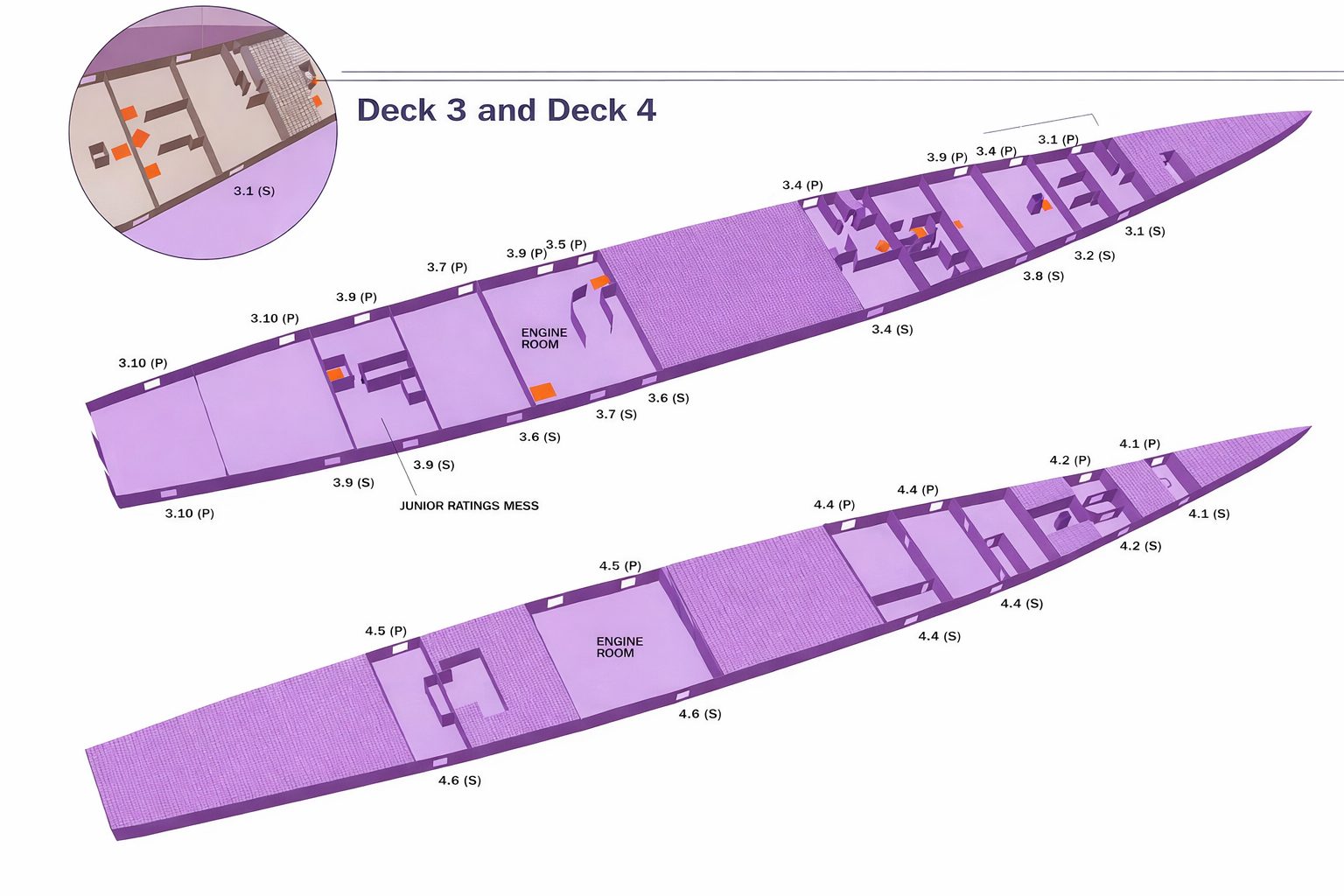
Physical Conditions: HMS Scylla's level three presented fundamentally different environmental characteristics than levels one and two. While upper levels had large cutouts specifically designed for diver access, level three's engine room had restricted spaces, numerous corners creating navigation complexity, and susceptibility to silt disturbance that eliminated visibility.
Adam encountered an exit, a head-sized hole in the ceiling leading to level two, but it was physically impossible to use. Later, the exit he escaped through was so constricted he had to remove his equipment and squeeze through, tearing his wetsuit. These spatial constraints were fixed environmental features that shaped possible actions.
Silt and Visibility: The silt disturbance transformed the environment from one of visual navigation to effectively zero visibility. Adam describes spaces as "just metal metal" where events "blend a lot" and there weren't really distinguishing features. This sensory deprivation removed normal wayfinding cues and increased cognitive workload. An interesting visual illusion presented itself later in the narrative when Adam describes entering a lower level (4th level), and then couldn't find the hole he'd come through because the bubbles has collected in the ceiling, creating a mirror-effect and this mirrored the dark environment he was in.
Environmental Mismatch: The critical environmental factor was the mismatch between expectations (based on levels one/two experience) and reality (level three's complexity). This wasn't foreseeable from the surface or entry point. The environment contained information, but that information was only discoverable through direct experience, by which point the team was already inside a complex overhead space.
Tools & Technology
Equipment Configuration: The team used mixed configurations: Adam and Mark in sidemount, Andy in backmount twin-set. This provided redundant gas supplies. Adam had a reel, which he intended to deploy if he found an exit to mark a path back to the others. However, critically, no guideline was run from the entry point.
The absence of a continuous guideline was not an oversight; it was an adaptation based on their mental model of the wreck. On levels one and two, guidelines aren't typically used because the large cutouts provide continuous visual exits. The team applied this same approach to level three.
Sidemount Advantage: Adam's sidemount configuration proved critical to his survival. He could remove cylinders and push them ahead through the constricted exit. His wetsuit (versus drysuit) allowed him to compress his profile enough to squeeze through after equipment removal. These equipment choices weren't made for this contingency, they were routine preferences, but they created survival margin when needed.
Technology Limitations: Dive lights provided illumination but couldn't penetrate silt. There's no indication of computer or depth gauge issues. The technology worked as designed; it simply couldn't overcome the environmental degradation of visibility.

Tasks
Task Evolution and Stacking: The dive began with low task-loading: descend, navigate to wreck, enter familiar structure. Tasks were sequential and manageable. However, once disoriented, the task-loading escalated dramatically:
Navigate without visual references
Monitor gas supply under increasing stress
Maintain team contact (initially)
Search for exits
Manage emotional responses
Make decisions under uncertainty and time pressure
Adam describes searching for "quite a while" and "another ten minutes" repeatedly. During these periods, he was simultaneously navigating, problem-solving, gas monitoring, and managing the psychological impact of potential death.
Task Shedding: When Adam separated from the team, he was shedding the task of "maintaining team cohesion" to focus on "find an exit." This adaptation reduced his immediate cognitive load and gave him a sense of agency: "being the head of my own rescue rather than relying on anyone else."
Priority Shifts: Goals shifted over time. Initially: explore and enjoy the dive. Then: find the way we came in. Then: find any exit. Finally: survival at any cost, including removing equipment to squeeze through impossibly tight spaces.
External Influences
Time of Day: This was an evening dive, following a work day. While not explicitly stated as a factor, timing affects fatigue levels, available daylight for surface intervals, and creates subtle pressure to "make the most" of the trip.
Social and Recreational Context: This was a recreational dive between colleagues, not a commercial or training operation. There were no external clients, no schedule pressures, no instructor-student dynamics creating authority gradients. This informal context likely supported the loose planning approach—between trusted peers, detailed briefings can feel unnecessary.
No Regulatory Oversight: Recreational diving in the UK operates with minimal regulatory oversight compared to commercial diving. Standards exist within training agencies, but recreational diver behaviour on qualified dives is essentially self-regulating. There was no external check on the dive plan, equipment configuration, or procedures.
Organisation
Dive Centre Culture: All three divers worked for the same dive centre and were senior staff. This created strong professional relationships but also meant they shared similar training backgrounds, mental models, and operational norms. There's no indication of questioning or challenge during planning—the plan was accepted by all three.
Informal Leadership: Adam notes he "could leave them to do their own thing, and it not be a problem" suggesting a distributed leadership model appropriate for experienced divers. However, this may have created ambiguity about who was leading the dive, making decisions, or holding veto authority if concerns arose.
Training and Normalisation: Their training qualified them for wreck diving and penetration. However, the specific penetration practices on Scylla (particularly level three) may not have matched formal training models. The local diving community's practices on this wreck likely evolved through repeated exposure, creating informal norms that differed from work-as-imagined in training manuals.
Post-Incident Support: The organisational response after the incident was significant. Adam describes strong community support, particularly from three named individuals who "let me talk" and "let me process it at my own speed." This demonstrates positive organisational resilience—the system's capacity to support survivors and protect psychological wellbeing.
Time
Temporal Context: This was an evening dive, meaning it began with already-reduced daylight hours and was subject to a natural temporal boundary—darkness would eventually halt surface operations regardless of dive plans. The half-hour boat ride also created temporal bookends to the operation.

Work as Imagined (WAI) - Expected Timeline: The dive plan contained no specific timeline beyond "go look around and go inside it." However, implicit temporal expectations would include:
Descent and navigation to wreck: 5-10 minutes
Exploration/penetration: 20-30 minutes (limited by gas supply and no-decompression limits)
Ascent and safety stop: 5-10 minutes
Total expected underwater time: 30-50 minutes
For wreck penetration specifically, WAI would assume:
Entry to wreck: immediate
Navigate through familiar territory: straightforward, minimal time
Find something interesting: variable
Exit when planned: no delays expected
These expectations, though unspoken, were built on previous successful experiences where "you can't get lost" and exits were always visible.
Work as Normal (WAN) - What Usually Happened: Based on Adam's description of levels one and two as places where "you can't get lost essentially," normal Scylla dives likely followed this pattern:
Descend, enter wreck: 5-10 minutes
Exploration with visual exits always present: 20-30 minutes
Natural turnaround based on gas or interest: flexible timing
Exit through visible cutouts: immediate when desired
Surface: complete dive in 40-50 minutes total
The temporal flexibility was key—divers could exit whenever they chose because exits were always visible. Time wasn't a pressure; it was a resource to be managed comfortably within gas limits.
Work as Done on the Day (WADD) - What Actually Happened: Adam's account reveals a dramatically different temporal reality:
Initial phase (First 10 minutes): "First ten minutes pretty uneventful." This matched normal expectations—descent, entry, initial exploration felt routine.
Disorientation discovery (10-20 minutes): "After that, a few minutes looking around. Then we went inside the bulkhead." They became disoriented shortly after entering level three, but Adam was "in denial" thinking "we'll have a joke about it when we get back up." The temporal expectation was that this would resolve quickly.
Recognition of actual problem (20 minutes): "But after ten minutes, that was kind of when it dawned on me... We kind of got an actual issue now, and we need to actually like start figuring it out properly." A full ten minutes elapsed before Adam shifted from denial to problem-solving mode. This delay wasn't irrationality—it was based on his mental model that problems on Scylla resolve themselves.
Active searching phase (20-50+ minutes): Adam describes "probably run for about five more minutes" then finding the ceiling hole, then "another ten minutes of looking around," then "probably another ten minutes after that." He repeatedly uses phrases like "quite a while" and admits "it's really hard. It just kind of merges into one."
The temporal experience transformed:
Time became compressed and distorted under stress
Minutes felt like hours; sequences blurred
Gas became the ultimate temporal constraint—a countdown clock
Each passing minute reduced options and increased stakes
Critical temporal decision points:
Separating from teammates: Made after ~20-30 minutes of searching, when group searching hadn't found exits
Entering the cargo hold: A temporal gamble—investing time in an uncertain direction
Squeezing through exit: Made under extreme time pressure as gas supply became critical
Adam's estimate of "about 30 minutes" inside the wreck likely underestimates actual time given stress-induced temporal distortion. The psychological experience was likely much longer than the clock time.

Temporal Pressure Evolution: The temporal pressure followed a distinct pattern:
No pressure (0-10 mins): Routine dive, plenty of gas, familiar wreck
Emerging concern (10-20 mins): Lost but expecting quick resolution, denial protecting against pressure
Active problem-solving (20-40 mins): Searching actively, gas reserves declining but still adequate, increasing urgency
Critical pressure (40+ mins): Gas approaching minimums, options narrowing, stress escalating
Terminal pressure (final minutes): "I kind of accepted I was going to die"—when time (gas) runs out completely
Temporal Decisions Under Pressure: Several critical decisions were shaped by temporal factors:
Decision to persist rather than turn back immediately: Early in the disorientation (10-20 minute mark), the team could have attempted to retrace their exact entry route. But this felt unnecessary because the mental model said "we'll find an exit." Each additional minute spent searching reduced the gas available for that strategy.
Decision to separate: Made after significant time invested in group searching. Adam's logic—"we're already lost, can't get more lost"—was partly temporal: time already invested was sunk cost; spreading out might find an exit faster.
Decision to continue through cargo hold: A temporal gamble. Adam invested time going down into an unknown space, betting that it might lead to an external cutout. The time invested meant less time for alternatives.
Decision to attempt the impossible exit: Made when time (gas) had run out. Not really a decision but the last option when temporal constraints became absolute.
How Time Interacted with Other Elements:
Time + Person(s): Stress, cognitive tunneling, and fatigue accumulated over time. Adam's progression from denial to acceptance of death shows how temporal pressure degraded psychological state. Physical exertion (swimming, searching) accumulated fatigue, reducing strength for the final escape squeeze.
Time + Environment: The environment didn't change over time, but visibility degraded as silt remained disturbed. More critically, the team's knowledge of the environment couldn't improve over time because zero visibility prevented learning.
Time + Tasks: Task loading increased over time as gas decreased, stress accumulated, and cognitive capacity narrowed. Navigation, gas monitoring, emotional regulation, and decision-making all competed for diminishing cognitive resources.
Time + Tools/Technology: Gas supply was the ultimate temporal constraint—a visible countdown. Each breath consumed limited time. Unlike surface emergencies where time can extend indefinitely, underwater time is absolutely bounded by gas supply.
Time + External Influences: Evening timing meant surface support faced approaching darkness. Once the divers were late surfacing, surface operations became time-pressured by failing light.
Time + Organisation: The informal planning ("just look around") created no temporal structure or checkpoints. Without specific turnaround times or gas reserves, the team had no systematic temporal discipline until gas itself imposed it.
Critical Temporal Insight: The most critical temporal factor was the compounding effect of time investment. Every minute spent searching was both:
A minute of gas consumed (reducing future options)
A minute of psychological investment (creating sunk-cost pressure to persist)
A minute of stress accumulation (degrading cognitive capacity)
A minute deeper into the wreck (potentially farther from exits)
This created a temporal trap: the longer they searched, the more desperate finding an exit became, which drove continued searching, which consumed more time, which increased desperation. The system had no temporal circuit-breaker, no predetermined turnaround time or gas reserve that would force early exit while options remained.

Interaction Analysis: Where the System Failed
The tragedy emerged not from single-point failures but from interactions:
Experience + Environment: Positive experiences on levels one/two created confidence that didn't transfer to level three's fundamentally different environment. The wreck's design invited this—levels are numbered sequentially, suggesting progression rather than transformation.
Informal Planning + Trust: High trust between experienced divers enabled loose planning that felt appropriate for their skill level. But this meant no one questioned assumptions, challenged the approach, or insisted on additional safety margins.
Equipment Adequacy + Environment: Their equipment was entirely suitable for open wreck penetration with visual exits. It became inadequate once visibility was lost in a complex overhead environment. The critical missing element—a continuous guideline—was excluded based on an environmental assumption that proved incorrect.
Task Loading + Stress + Time: As time underwater extended, gas supplies depleted, stress increased, and cognitive capacity narrowed. This created a downward spiral where problem-solving became progressively harder exactly when it became most critical. Each minute of searching consumed both gas and cognitive resources.
Local Knowledge + Normalisation: Familiarity with the site reduced perceived risk. Adam explicitly states: "I was very much a well at level one and two. Fantastic, fantastic wreck is pretty much that you can't get lost." This knowledge was accurate but incomplete—it described most of Scylla but not all of it.
Time + Mental Models: Adam's past experiences created a mental model that "finding an exit takes a few minutes." This temporal expectation sustained denial ("we'll have a joke about it when we get back up") for the critical first 10 minutes when retracing their exact entry route was most feasible. Each minute spent in denial consumed gas and distance that couldn't be recovered.
Time + Decision-Making: The absence of predetermined temporal boundaries (turnaround time, gas reserves for exit) meant decisions were reactive rather than proactive. By the time gas pressure forced decisions, options had already been severely constrained.
Time + Sunk Cost: Time already invested created psychological pressure to persist. After 20-30 minutes of searching, turning back felt like "giving up" rather than "cutting losses." The temporal investment created momentum toward continued searching even as it reduced the safety margin needed for any exit strategy.
Time + Team Separation: When Adam separated from his teammates after 20-30 minutes of group searching, this decision was temporally rational—"maximise search efficiency with remaining time." But it eliminated the possibility of combined problem-solving and mutual rescue, trading temporal efficiency for systemic resilience.
Critical Temporal Cascade: The most dangerous interaction was the temporal cascade:
Environment (level three complexity) wasn't recognised until after entry
This consumed time (10+ minutes) in denial before problem recognition
Recognition triggered searching, which consumed more time and gas
Time consumption increased stress, which degraded decision-making
Degraded decisions (like separation) reduced collective capacity
Reduced capacity extended time needed to find solutions
Extended time depleted gas, creating terminal pressure
Terminal pressure forced desperate actions (impossible squeeze)
On the boat, Adam had 12 breaths left in his final cylinder
Each element fed forward, amplifying the next. Time was both cause and effect, decisions consumed time, which created pressure, which degraded future decisions.
What Made Sense at the Time: Local Rationality
From Adam's perspective:
Diving with trusted, qualified colleagues on a familiar wreck made sense
Informal planning matched their experience level and relationship
Not running a guideline matched their experience on Scylla's upper levels
Entering level three felt like a natural progression, not a fundamental change
Initially denying the severity felt protective—maintaining composure
Separating to search efficiently matched his goal of finding an exit
Squeezing through an impossibly small gap made sense when the alternative was death
None of these were irrational choices. Each made local sense given goals, knowledge, and constraints at that moment.
Outcomes and Adaptations
Successful Adaptations: Adam's decision to actively search rather than passively wait, his willingness to remove equipment, his physical perseverance through an extremely constricted space—these adaptations enabled survival.
Failed Adaptations: The team's separation, while locally rational, eliminated mutual support and combined problem-solving capacity exactly when it was most needed.

System Improvements: Learning Forward
Using LEODSI principles, improvements should target system design, not just individual behaviour:
Person:
Recognise that experience creates confidence but also creates assumptions
Train recognition of environmental transitions that invalidate previous mental models
Practice decision-making scenarios where initial plans must be abandoned
Environment:
Level three could be more clearly marked as fundamentally different from levels one/two
Additional warning signage about complexity and navigation requirements
Community could develop and share specific level-three guidance
Tools:
Consider minimum equipment standards for level three (continuous guideline, specific gas planning)
Ensure guideline/reel training is practiced, not just certified
Tasks:
Encourage explicit dive planning even among experienced divers; moving from "we'll look around" to specific objectives and turnaround criteria
Normalise continuous guideline use as default for any penetration beyond visual exit range
Practice team separation protocols before they're needed in emergency
Organisation:
Dive centres could implement peer briefing review even for senior staff
Create psychological safety for questioning plans between experienced peers
Develop DEBrIEF culture for all significant dives, not just incidents
Time:
Establish temporal boundaries before entry: Set specific turnaround times or gas reserves (e.g., "turn dive at 30 minutes or 100 bar, whichever comes first")
Create temporal circuit-breakers: Predetermined checkpoints that trigger reassessment: "If we don't have an exit identified in 10 minutes, we retrace our entry route exactly"
Recognise temporal distortion under stress: Train teams that time perception becomes unreliable under stress; use dive computers/watches as objective temporal anchors
Address sunk-cost temporal pressure: Normalise early turnarounds; create culture where "we spent 5 minutes and turned back" is celebrated, not seen as failure
Plan for temporal cascades: Recognise that delays compound; build explicit time buffers into overhead environment diving
Practice time-limited decision-making: Include temporal pressure in training scenarios to develop better decision-making under time constraints
Debrief temporal decisions: In DEBrIEFs, explicitly ask "How did time pressure influence our decisions?" to surface invisible temporal factors

Conclusion
The HMS Scylla tragedy demonstrates how normal, rational human behaviour interacts with environmental complexity, equipment adequacy, organisational culture, and temporal pressure to produce catastrophic outcomes. Adam, Mark, and Andy weren't reckless cowboys; they were experienced professionals making locally rational decisions based on their knowledge and goals.
LEODSI analysis using the PETTEOT framework reveals that simple prescriptions ("they should have run a guideline") miss the systemic factors that made not running a guideline seem reasonable: extensive positive experience, trust in teammates, familiarity with the site, and mental models built through successful repetition. The addition of time as an explicit system element reveals how temporal pressure, invisible in hindsight, shaped every critical decision.
The temporal analysis shows that the incident involved a cascade of time-related factors: denial sustained by temporal expectations based on past experience, sunk-cost pressure from time already invested, progressive degradation of cognitive capacity as stress accumulated over time, and ultimately the absolute constraint of gas supply creating a countdown to death. Understanding this temporal dimension is essential because hindsight collapses time, making decisions that were reasonable under extreme temporal pressure appear as simple failures of judgment.
Learning from this event requires examining not just what happened, but why it made sense at the time, and how the diving system, training, culture, site design, equipment norms, temporal planning, and peer interactions, can be redesigned to make safe performance easier and unsafe adaptations less likely.
Adam's courage in sharing this story creates opportunity for system-level learning. His survival demonstrates remarkable physical and mental resilience, but the system should not require such extreme adaptations. By understanding how the system shaped this outcome, including the critical role of temporal factors that are often invisible, the diving community can improve conditions for all divers, reducing reliance on individual heroism and increasing safety margins across the board.
The goal is not to eliminate risk, that's impossible in diving, but to design systems where good decisions are easier, where warning signs are clearer, where temporal boundaries protect against cascading failures, where teams can challenge assumptions, and where adaptations support safety rather than erode it. That's the goal of LEODSI with PETTEOT: learning that improves the whole system, not just individuals within it.


