

The BSAC 2025 Incident Report: reading the first stories
The 2025 BSAC Annual Diving Incident Report came out last month, and as I usually do, I skipped past the graphs and went straight to the narratives. These are the closest thing we have to the voices of the divers, instructors and rescuers who were there. Before going any further, I want to thank the people who took the time to write these reports. Some of them were describing the worst day of their diving lives, and some were describing the loss of a buddy, a friend or a student. Other contributors write to help others learn from the conditions, actions, and outcomes that were part of their dives.
This blog is a walk through what the report shows, looked at through a human factors lens. It is not a criticism of the BSAC. The safety team have produced a clear report, and in places they have been more careful about drawing conclusions from skant data than many of us would be. What I want to do is look at what the report can tell us, where it runs out of the specifics and context that could help improve safety, and what we can all do to help the next report tell us more and be better than yesterday.
The 2025 picture in brief
The BSAC captured 305 incidents for 2025, of which 220 happened in the UK and 85 overseas. The UK figure has been fairly steady since 2014, and the report links the pattern of incidents closely to how much diving is going on. Sadly, nine divers died in the UK, with an average age of 55. Three of those deaths were on dives deeper than 50 metres, and all three divers were using rebreathers. Immersion Pulmonary Oedema (IPO) was confirmed as the cause of one death, and there were three confirmed and three probable IPO cases across the year.
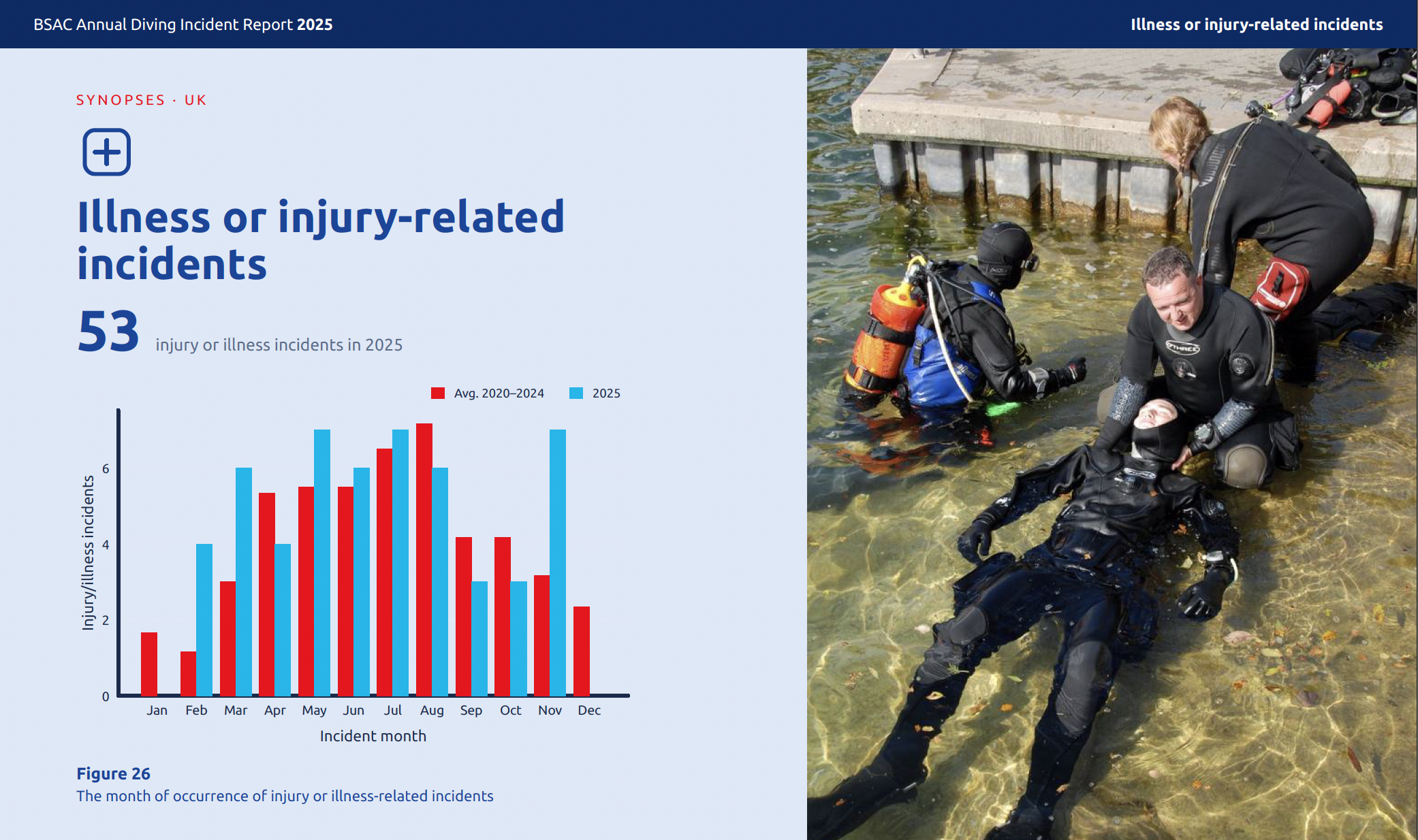
Decompression illness rose to 53 UK cases, up from 37 in 2024. The long fall in DCI rates now looks to be levelling out. Deep dives and missed stops are showing up less often in DCI cases, while repeat diving is showing up more. HM Coastguard coordinated 98 of the UK incidents, the RNLI launched 21 times and search and rescue helicopters flew 22 times, mostly between May and September.
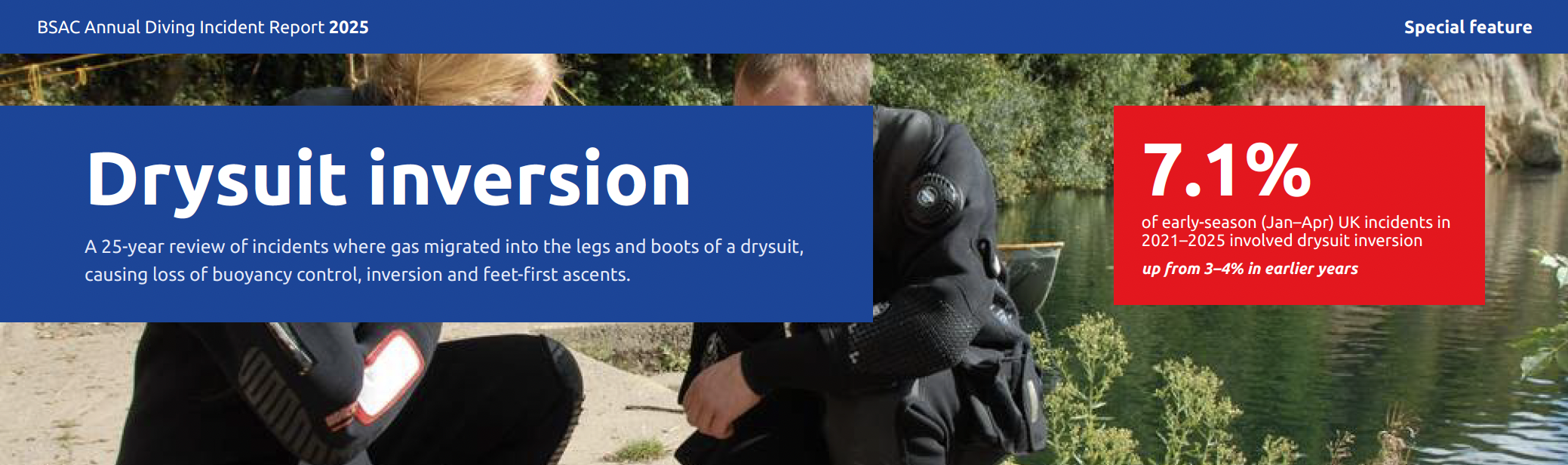
This year's special feature looks at drysuit inversion across 25 years of data. Between 2021 and 2025, inversions made up about 7% of UK incidents early in the season (January to April), roughly double the historic rate of 3–4%. Two of this year's fatalities involved a diver ending up inverted and making an uncontrolled ascent.
There is good news in the numbers too. 103 reports came directly from divers through the BSAC system, up from an average of 88. More people are choosing to share what happened, and I would argue the numbers of context-rich stories in online fora/social media is also increasing.
What stands out through a human factors lens
Inversion is a story about conditions
The drysuit feature is a useful part of the report from a human factors point of view, because the BSAC team went back through 25 years of reports and looked for patterns. Their own finding is that inversions are rarely down to a single factor. Divers were often slightly head-down while doing something else, such as sending up a DSMB, sorting out a reel, dealing with a kit problem or swimming over a slope. Suits were often borrowed, new or recently changed. Boots were too big, weighting had changed, and dump valves were blocked by undersuits or hard to find. In several cases the diver had noticed buoyancy trouble earlier in the dive.
Put those together and you get task loading, unfamiliar kit and a slow drift in trim, all arriving at the moment when attention was pointing somewhere else (we don't lose situation awareness, it is allocated to something we think is more important). The lessons the BSAC lists are sensible, and I was pleased to see one aimed at instructors checking boot fit on training dives. Even so, most of the lessons sit with the individual diver. The deeper questions are about the system around them.
Who decides which suit a trainee wears in March?
How are hire and club suits sized and checked?
What can an instructor see and reach when a student starts to tip?
What made it reasonable for a diver who noticed buoyancy trouble early on to carry on with the dive?
The team resisted an easy explanation
I want to point out something the BSAC team did well. March 2025 had 20 incidents against an average of 8.5. It would have been easy to put that down to divers being rusty after the winter. Instead, the team looked closer, found the incidents spread across every category, and said there wasn't enough evidence to support that idea. Holding back from a simple explanation is harder than providing one, and it is good practice.
Experience doesn't make you immune
The qualification data shows that trainees, Ocean Divers and Sports Divers are more likely to be the casualty than the more qualified grades. Yet experienced divers still turn up as casualties in every grade. Experience tends to change the kinds of problems we get into, rather than remove them. Deeper, longer and more complex dives bring their own traps, and the three deaths beyond 50 metres are a sobering reminder of that. At the same time, if lesser experienced divers are having more issues, does that mean the training system needs to be more robust, either in supervisory skills, technical skills and/or non-technical skills?
The data is getting thinner
For me, the most important finding sits in the analysis pages. The BSAC team notes that more reports are arriving with limited detail. The miscellaneous and injury categories keep growing because there isn't enough information to place incidents anywhere else. More incidents have an unknown depth, and some reports are too sparse to tell whether two of them describe the same event. For more than half of this year's fatalities, there was not enough information to reach sound conclusions about the cause of death. If we want to learn, we need richer stories, and people need to feel safe enough to tell them. This isn't a new declaration, and my MSc research highlighed systemic and personal reasons for this.
This isn’t only a BSAC problem. DAN’s recent Annual Diving Reports show the same pattern, only more starkly. Of the 230 diving fatalities DAN recorded worldwide in 2021, the trigger that started the chain of events was identified in just 29 cases, and a primary cause of death in only 28. For 2020, a trigger was listed in one case out of 146. DAN doesn’t investigate deaths itself. It relies on police, coroners, medical examiners and coastguards, whose focus is legal cause rather than learning, and whose reports can take months to arrive or are never released. Time is a factor too. The 2023 edition of DAN’s report covers deaths from 2021, so the lessons are at least two years old by the time they reach divers.
A first-story report, and why that's OK for now
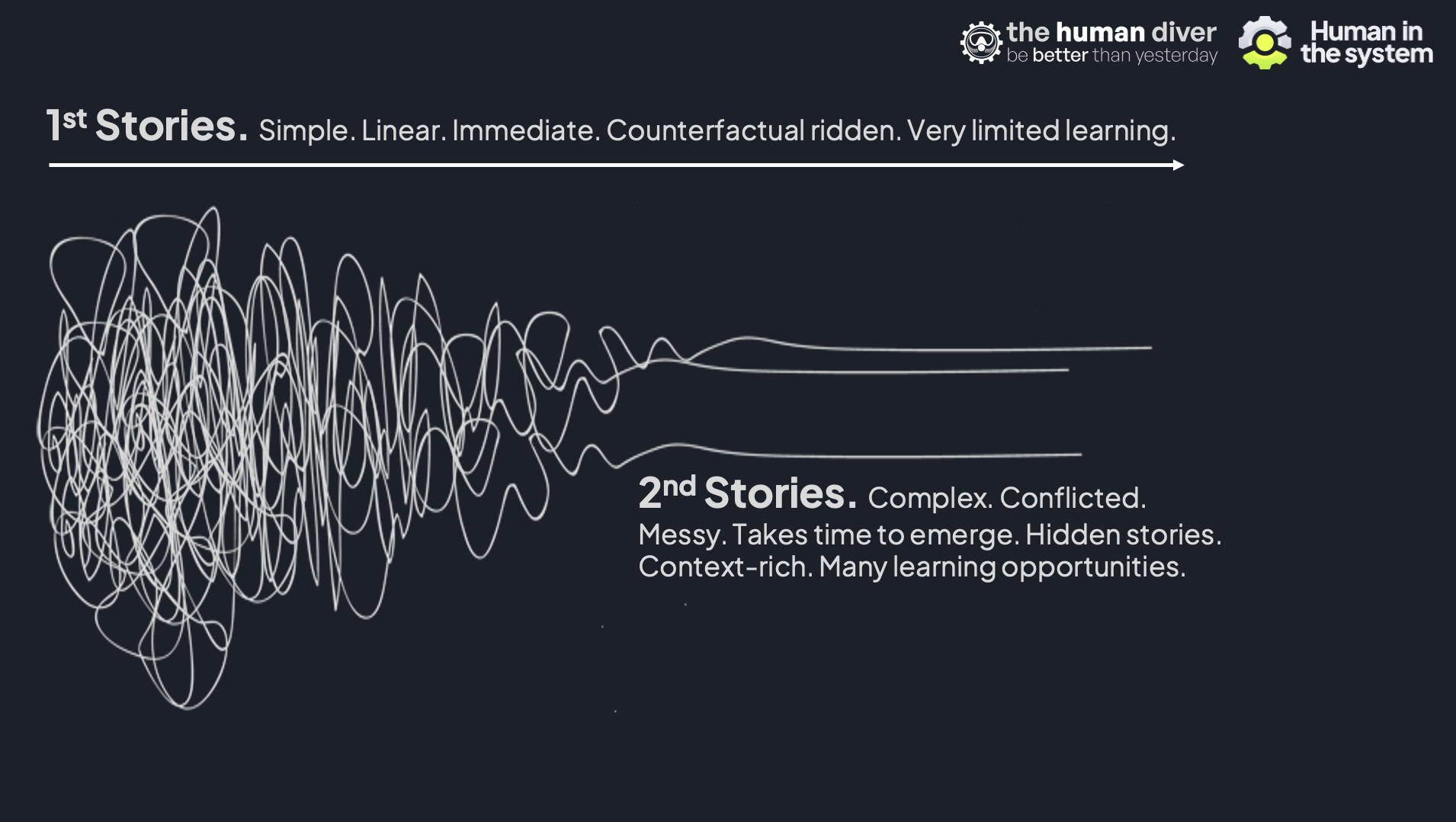
In safety science we talk about first stories and second stories. A first story describes what happened and who did what, usually written with the outcome already known. It tends to end with a list of things people should have done. A second story asks why those actions made sense to the people involved at the time, given what they knew, what they were focused on and the pressures around them.
The BSAC synopses are first stories. They are short, factual accounts written after the event, which is what they were designed to be. The conclusions follow the same pattern. One says that several incidents may have been avoided if basic safe diving practices had been followed and more thought given to the conditions. The summary closes by asking divers to stay vigilant. Both statements are true with hindsight, but neither tells us why capable divers didn't do those things on the day.
DAN’s approach shows the same thing from a different angle. Its reports trace each death back through a chain of events, from the cause of death to the disabling injury and then to the trigger. That is valuable for spotting medical and equipment patterns, and it explains why heart problems keep appearing in older divers. But a chain that stops at “equipment problem” or “loss of gas” is still a first story. It tells us what failed and leaves open why the dive made sense to the people doing it, or how the team, the operation and the training shaped it. The 2022 edition lists human factors as cardiovascular health, decision-making and adherence to safe practices, which puts the spotlight firmly on the individual diver. This framework is based on the event flow from the 2008 paper by Denoble and others: triggers, disabling agents, disabling injuries, and cause of death.
Take the training dive where a student was the first to signal low gas on each of three dives, then panicked on the surface and later died from IPO. Reading it now, after the event, the early signal is identifiable. On the day, a student using more gas than their peers is something instructors see all the time, and it rarely means anything serious. A second story would ask what the instructor and safety divers knew about IPO, what they could see, and what would have needed to be different for that signal to stand out from the 'noise' of a normal dive. This approach isn't about blame - it's about making the cues easier to spot for the next team. This is why the BSAC team have been championing IPO awareness and reporting for a number of years now. You can’t manage a risk if you can’t identify the hazard.
Another synopsis describes a beach rescue in which the dive leader couldn't get the oxygen to flow. The instructor took over the oxygen while the dive leader carried on with CPR, an AED delivered four shocks, and the team kept working until the paramedics arrived. That is a team adapting under huge pressure. It is also a clue about the gap between how we imagine emergency kit will work and how it works when hands are shaking. Those details are gold for learning, and they only appear because someone took the time to write them down. Team training and understanding what makes teams successful can make a huge difference to outcomes and reducing post-event trauma.
So, I don't see the first-story nature of the report as a criticism. It reflects where the sport is right now. Most divers have never been shown how to write a report that captures context, and most clubs and centres don't have anyone trained to help them make sense of one. That is a gap we can help close.
What we can do to help
None of what follows replaces the work the BSAC (or DAN or DOSA) does. BSAC's incident database is one of the most complete records of recreational diving incidents anywhere, and it exists because people have kept it going for decades. What we can offer at The Human Diver is support for the steps either side of the database: helping people tell richer stories and helping them make sense of those stories once they are told.
Help divers tell the story from inside the dive
A report form that asks ‘what happened?’ will get a first story. A form that also asks what you were trying to do, what you noticed, what made sense at the time and what helped will get something much closer to a second story. We have built these kinds of prompts into our Learning from Emergent Outcomes (LFEO) work and into the Better Questions for Learning cards, which group questions under the PETTEOT headings. We would be very happy to share them with BSAC and the other agencies, so they can sit alongside the existing forms.
Train people to make sense of reports
Collecting stories is only half the job. Someone then has to look at them in a way that reaches beyond the diver to the kit, the training, the site, the team and the pressures of the day. LFEO: Applied Skills and LFEO: Essentials gives club diving officers, instructors and dive centre managers a structured way to do this, and the book is now available for pre-order following its launch at DEMA. The aim isn't to turn everyone into an investigator. It's to give the people closest to the event the tools to ask better questions.
Make the debrief the start of the report
Much of the detail that goes missing from incident reports was there in the car park after the dive. If teams debrief well, using something like our DEBrIEF model (also in Wetnotes), the story is captured while it is fresh and before hindsight starts to reshape it. Regular debriefs on ordinary dives also build the trust people need before they will share a mistake with a national database.
Respond well when someone speaks up
How a club or centre reacts to the first report shapes whether there is a second one. A Just Culture is about responding with curiosity and fairness, so that people see sharing leads to learning rather than punishment. We teach this to club and centre leaders, and it costs very little to put into practice. A free guide on building a Just Culture is available in the ‘Curious’ Resources community from The Human Diver
Learn from the saves as well as the losses
The BSAC report notes that many potentially serious incidents were stopped from escalating by prompt rescue skills and a quick response from the emergency services. Those are stories of people adapting well under pressure, and we rarely study them. I would love to see future reports include a short section on what helped teams recover, because that is where we find the things worth teaching on purpose.
Show what a second story looks like
Over the coming months, we plan to take a small number of published synopses and, with care and respect for those involved, explore the questions a second story would ask. The aim is to show divers and instructors what richer reporting looks like, so they can start doing it themselves.
Over to you
If you were involved in an incident in 2025 and haven't reported it, it isn't too late, and the BSAC online form is a good place to start. If you’re not in the UK, you can visit the DAN Incident Reporting System. When you write it, try telling the story from inside the dive. What were you trying to do, what had your attention, and what made sense to you at the time?
And if you lead a club, a centre or a team, here is a question to reflect upon. What happens the next time someone tells you about a dive that didn't go to plan? Your answer will shape what ends up in the 2026 report.


