
Change around Safety Culture is Really Hard
After almost every serious diving incident the same story plays out. The diver didn't follow the rules, they should have tried harder, and/or they should have paid more attention. This leads to the consistent position: pin it on the diver and move on. Even when major events occur, like the death of Linnea Mills, the deeper issues have remained untouched.
Structurally, this approach is exactly what the system is set up to produce. Pin it on the last person to touch it, and you miss everything else that shaped what happened — the training system, the quality management system, the reporting system, and the culture within the different communities of practice. These are the conditions that a competent diver would be operating inside, every day a dive takes place.
In 2022, I started the MSc in Human Factors and System Safety at Lund University. In 2024 I graduated, and I now work as one of the tutors/mentors on the same MSc. What I bring to the diving safety party is a very different perspective, because I sit with a foot in three camps: twenty-five years in the Royal Air Force as aircrew, flight instructor, and systems engineer, 20 years in the diving world including a spell inside a training agency as the Director for Risk Management, and the academic world through Lund and Cranfield. These slides are part of the presentation I gave at the 20th Anniversary of the Lund MSc in HF and System Safety.
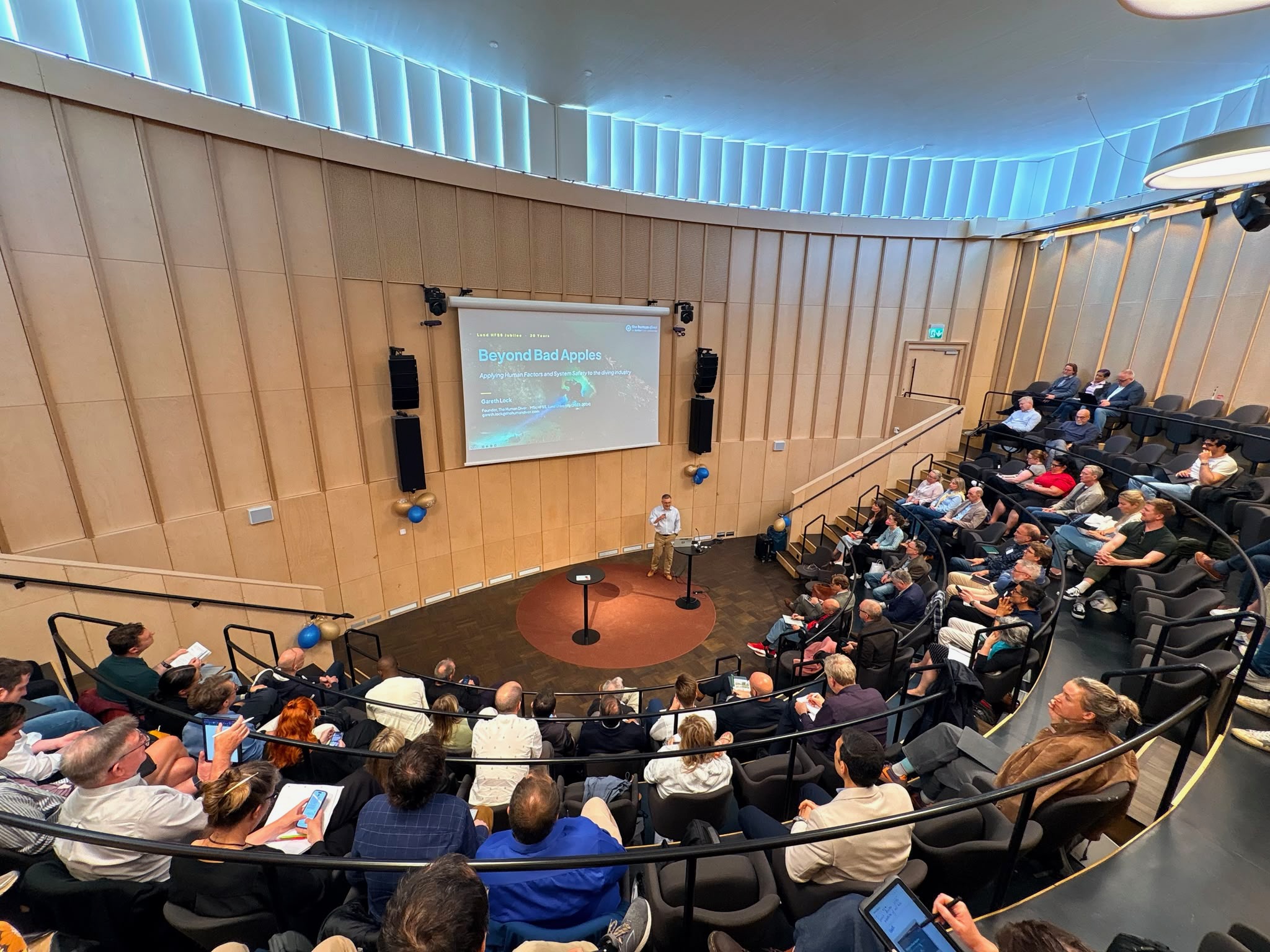
Change can happen, but it is bloody hard work, and to keep the momentum going, you need to deeply believe that the goal for improving the system is both technically possible, and there are the resources to make it happen. I believe in both, and that is what keeps me going when the system pushes back.
A Different Set of Questions
Before Lund, I already knew a great deal about this world of Human Factors and System Safety – The Human Diver was formed ten years ago in 2016. What the MSc gave me was a reset — an enhanced toolset regarding the use of language, and a way to look further up and out. It allowed me to better understand why the people involved made sense of things, rather than stopping at their mistake. It also helped me promote a position where safety is not the absence of accidents, but rather it is a condition with as few unexpected and unwanted outcomes as possible, and we get closer to this by developing competencies and capacities for resilient performance.
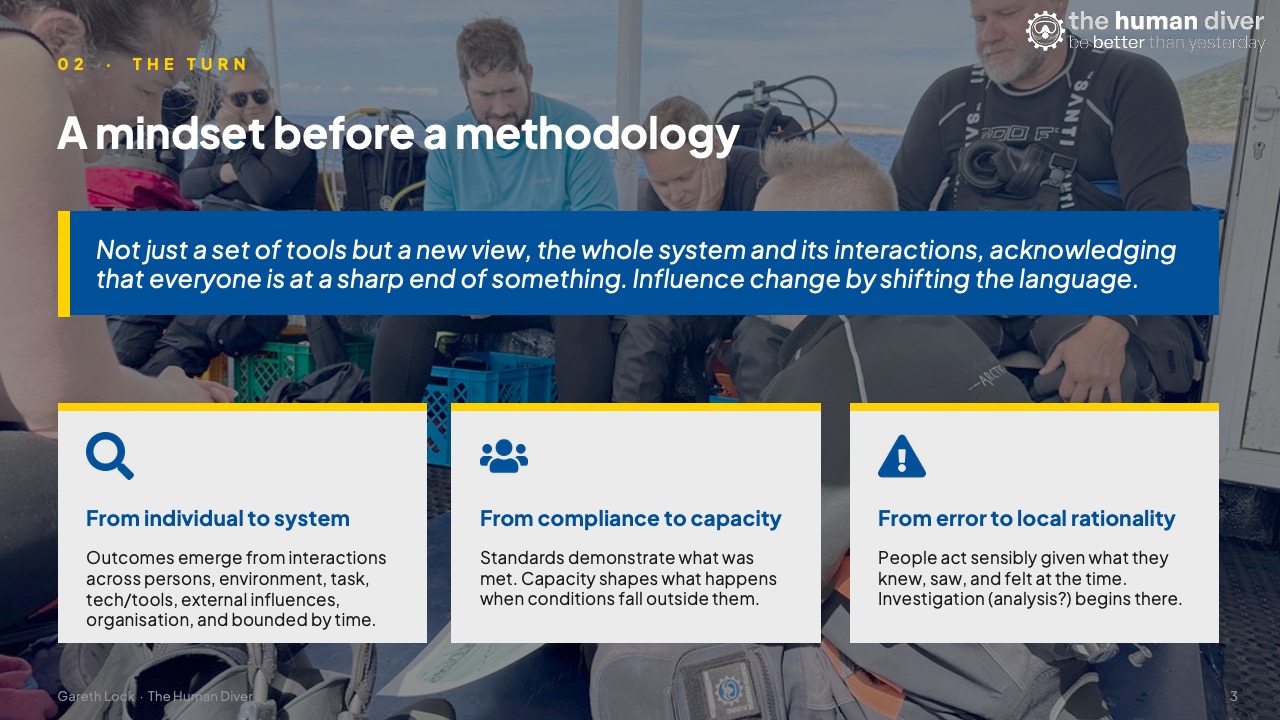
That shift runs through everything I do now. It moves the focus from the individual to the system, and to how the parts work together. It moves the goal from compliance to capacity. And it moves the question from error to local rationality: how did it make sense, in the moment, for that person to do what they did?
Four years ago, at Diving Talks in Portugal, I argued that compliance provides an illusion of safety in diving. Some of those in the industry were not happy. Their line is simple: follow the standards and the rules, and you will be safe. Unfortunately, the reality does not work that way, there always gaps between ‘Work as Imagined’ and ‘Work as Done’. At that same event, another speaker suggested that we should expect instructors to go above and beyond the standard. My answer: why would they? In a competitive, commercially squeezed environment, the standard is the floor, not the aspiration.
Context Is the Signal, Not the Noise
My thesis asked a specific question: what stops divers learning from adverse events, even when the stories are widely shared? To answer it, I ran an online survey with 676 divers, five focus groups, and interviews with lawyers. I covered recreational, technical, and rebreather divers, along with instructors. I also asked the agencies to take part in a focus group. One agency member came forward. I asked again. No-one came forward this time. That silence said a lot.
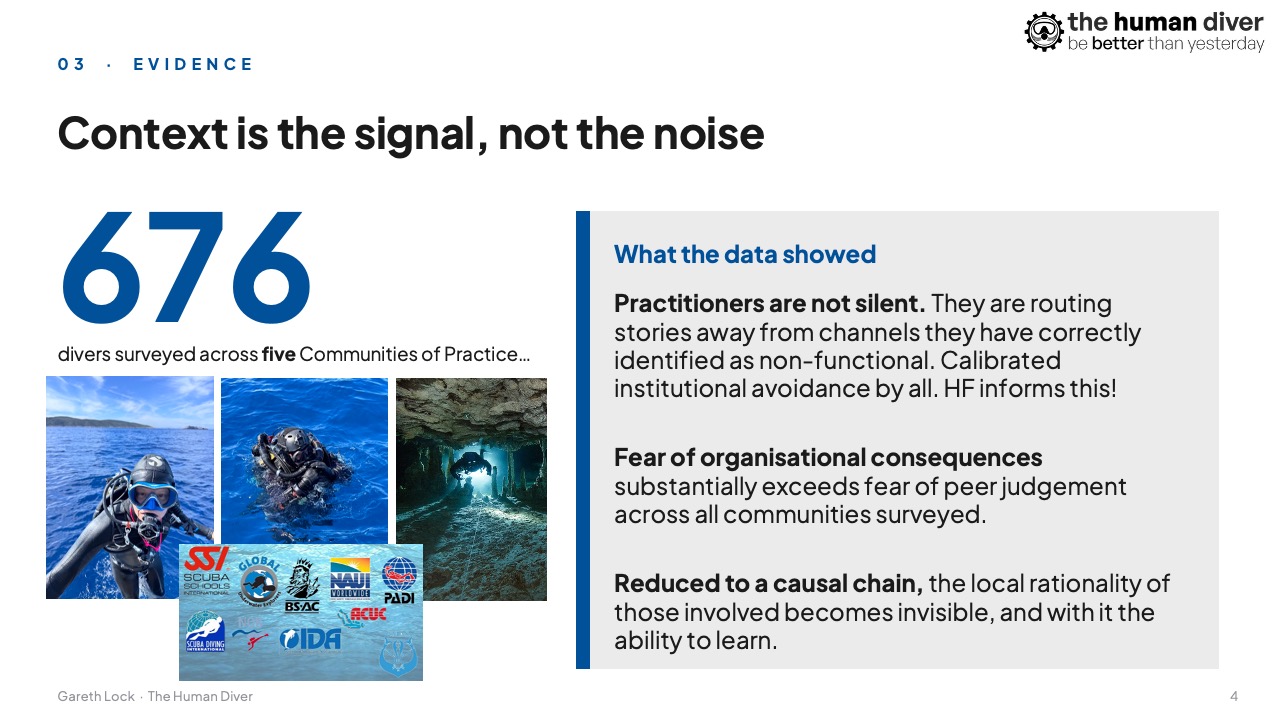
The data showed something clear. People know what happened and they share the stories — but they deliberately keep them out of the agency reporting systems. When asked where they would report, divers placed the training agency near the bottom of the list. They share with their buddies, their dive centre, and online long before they go anywhere near the agency. Most of the time, the reason is fear of what the agency might do with it.
One detail surprised me. Divers who had done some human factors training were even more reluctant to share with the agencies, because they had a clearer picture of how broken the system was. More awareness produced less trust, not more. I call this calibrated institutional avoidance, and it should concern anyone who assumes that better-informed divers will fix this problem on their own.
When the story never gets told, all we are left with is a first story — the simple one — and people fill the gaps with their own assumptions about what the diver did wrong.
Why the Structure Doesn't Learn
To see why this holds, you have to look at how the industry is built.
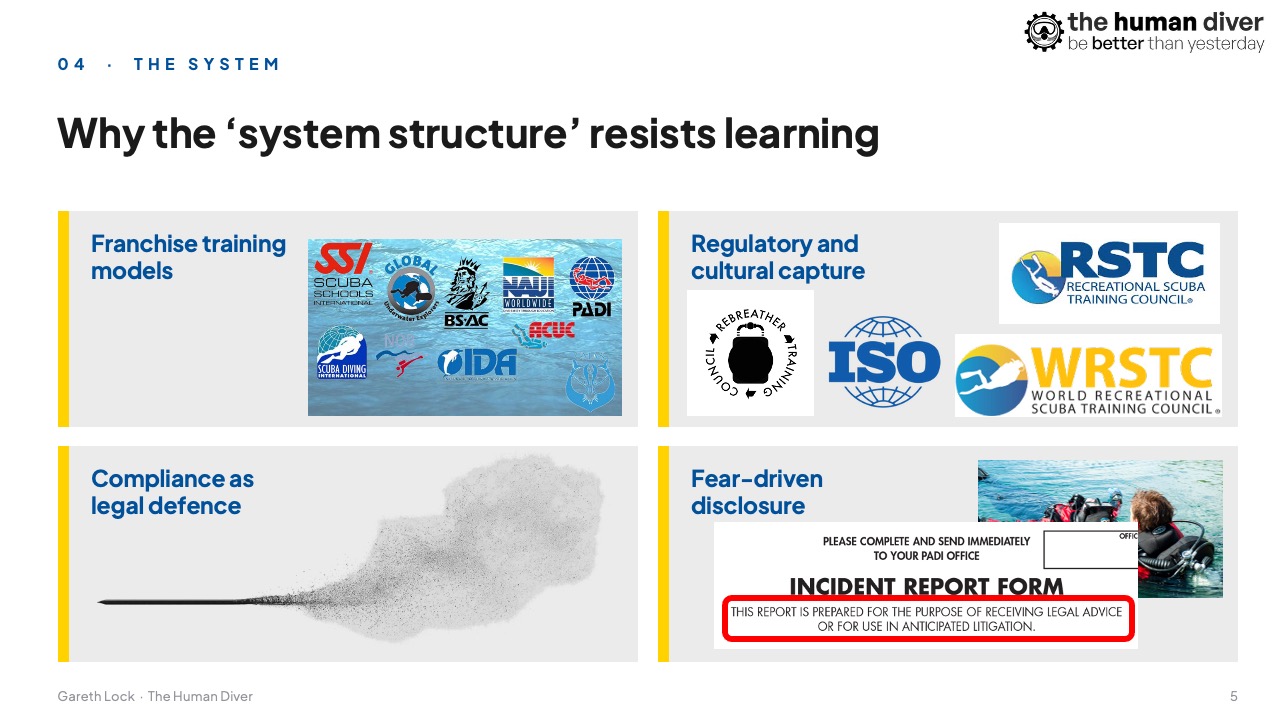
The training agencies run a business model somewhere between a franchise model and multi-level marketing. They sit at the top as publishing houses, training instructors who then deliver through dive centres or on their own. There is an intentional air gap between the agency and what happens on the day. There are good reasons around liability management to run it this way. The argument I hear is that the agency has no control ‘out there’, so it carries no responsibility for it. I would argue that meaning-making and sense-making (culture) starts when the divers work their way through the diver development and instructor development programmes. They are already ‘programmed’ as to what to expect when they graduate from the instructor exam.
Those same agencies sit on the panels that write the standards they then follow. That is regulatory capture — and specifically, cultural capture. It is a niche field, so you genuinely do need the experts. But there are almost no independent voices in the room. I sit on a couple of panels, and have tried to join some of the others, but the answer comes back that I do not meet the criteria.
Commercial drivers shape what goes into safety and performance standards e.g., we know that team diving has greater margins around safety than solo diving, and so team diving should be happening in training programmes. However, some instructors struggle to get more than one student and so it would be unfair to mandate such a standard. The same goes for HF training – it would be commercially disadvantageous to mandate an HF programme as a single agency.
The agencies write their own standards, and when something goes wrong they point out that they were compliant. That the standard itself might be weak is not treated as their problem. Compliance becomes a way of spreading accountability so thin that nobody holds it.
Then there is the language on the reporting forms. One states plainly that the report is being prepared in anticipation of legal action. Who writes the honest truth into a form like that? This means the industry has no evidence that human factors makes a difference — because it never collected the right stories. It wants to count numbers, not tell stories. It is why The Human Diver writes context-rich narratives to show the impact of the system on individual and dive centre performance and safety.
What a Real Learning System Looks Like
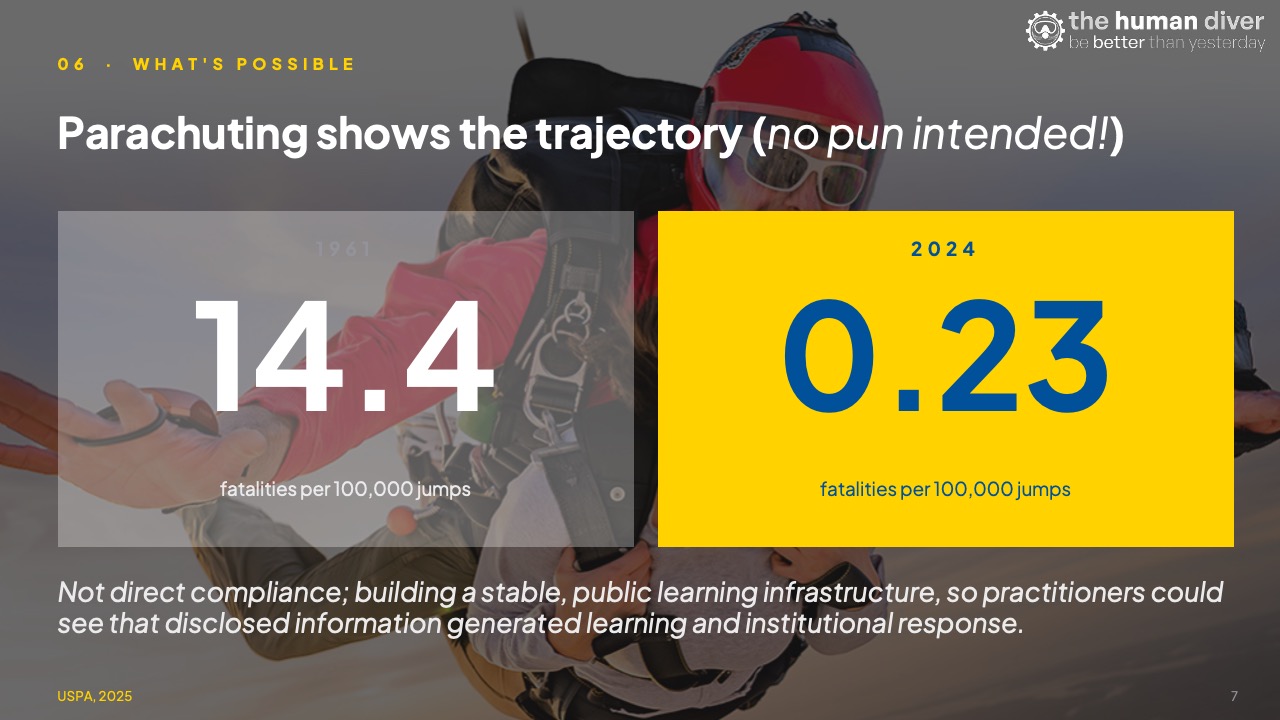
The US Parachute Association went from 14.4 fatalities per 100,000 jumps to 0.23 over 4 four decades. They achieved it not through more rules, but by collecting the data, telling the stories, and feeding back to the people who reported: thank you, we heard you, and here is what we changed as a result.
That last part is the whole point. When a report leads to a visible response, people come to trust the channel and route their stories toward it rather than away from it. Diving has not built that loop. Until it does, asking individuals to report more will keep hitting the same wall, because the channel has to earn trust before people will use it.
Real change started with a leadership position that said this is unacceptable and we need to do something about it. They did. British Airways did the same.
Working Across the Levels
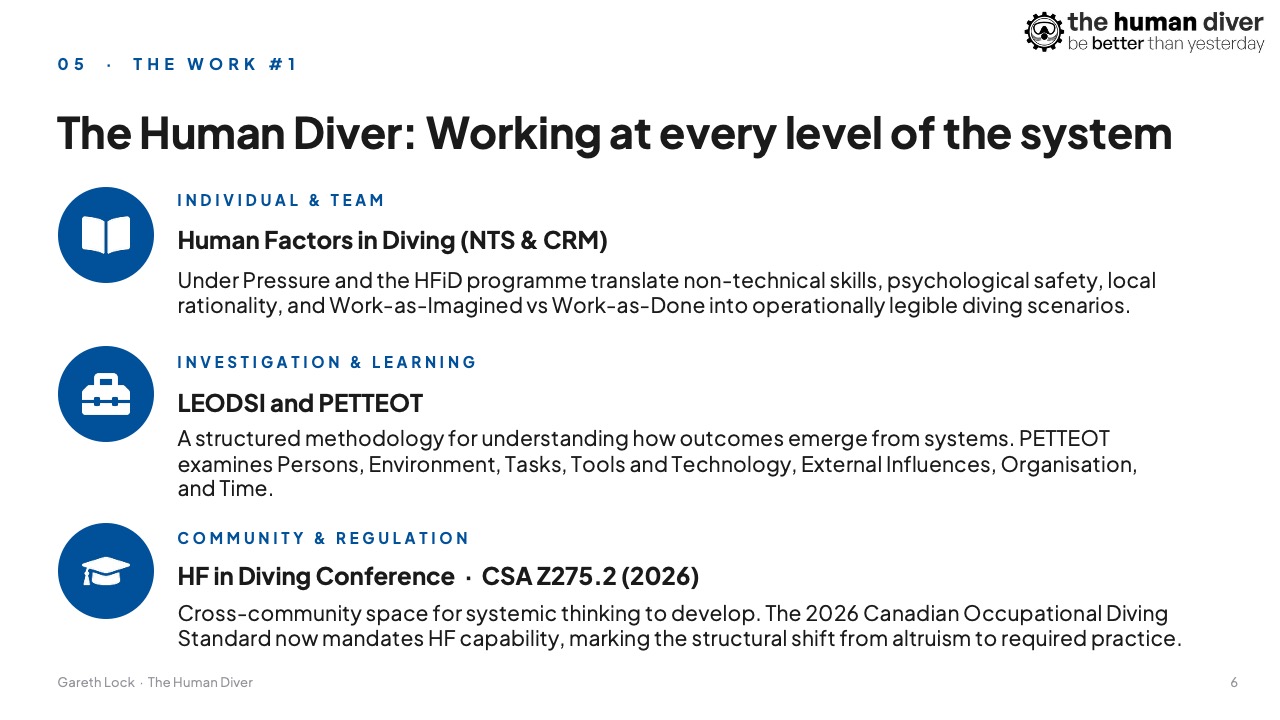
I founded The Human Diver in 2016. I am the only full-time person, with eight instructors delivering what is in effect crew resource management and non-technical skills for divers. This work gives people a language for the human side of diving — psychological safety, just culture, the different ‘flavours’ of human factors, and the gap between work-as-imagined and work-as-done.
For investigation, I built LEODSI — Learning from Emergent Outcomes in Diving Systems and Interactions. It is framed on the UK National Health Service SEIPS model, with extra elements added for diving. It examines Persons, Environment, Tasks, Tools and Technology, External Influences, Organisation, and Time. That final element came directly from a Lund learning lab on joint cognitive systems: did the divers have enough time to do what they needed to, and what did the day actually look like against what was imagined? You can see the effect of this near the bottom of this blog.
Then there is community. Last week we ran our first face-to-face Human Factors in Diving conference, in Vis, Croatia. The best feedback I received was that it did not feel like a conference — it felt like a gathering of like-minded people. That is the feeling I want to build in this space. (And just how I felt at the Learning Lab in Lund this week).
Regulation can help too, as a kind of Trojan horse. After three years of work with the Canadian Standards Association Technical Committee for Occupational Diving, the new occupational diving standard (CS275.2) now includes a human factors and diving crew resource management requirement, which is a global first. No other agency or system has one. This sets a precedence regarding the art of the possible. Again, this took leadership and I thank those involved for their work.
The Harder Truth
At Rebreather Forum 4, I said that there are not enough dead divers to make a difference. People told me I could not say that. I can, because it is true. We lose divers in ones and twos, so it never builds the pressure that forces change. In the US, there 350-400 General Aviation fatalities each year – they also happen in ones and twos. However, if three regional jets crashed each year, there would be an outcry. Last year there were approximately 300 reported diving fatalities – and almost zero had any form of structured analysis.
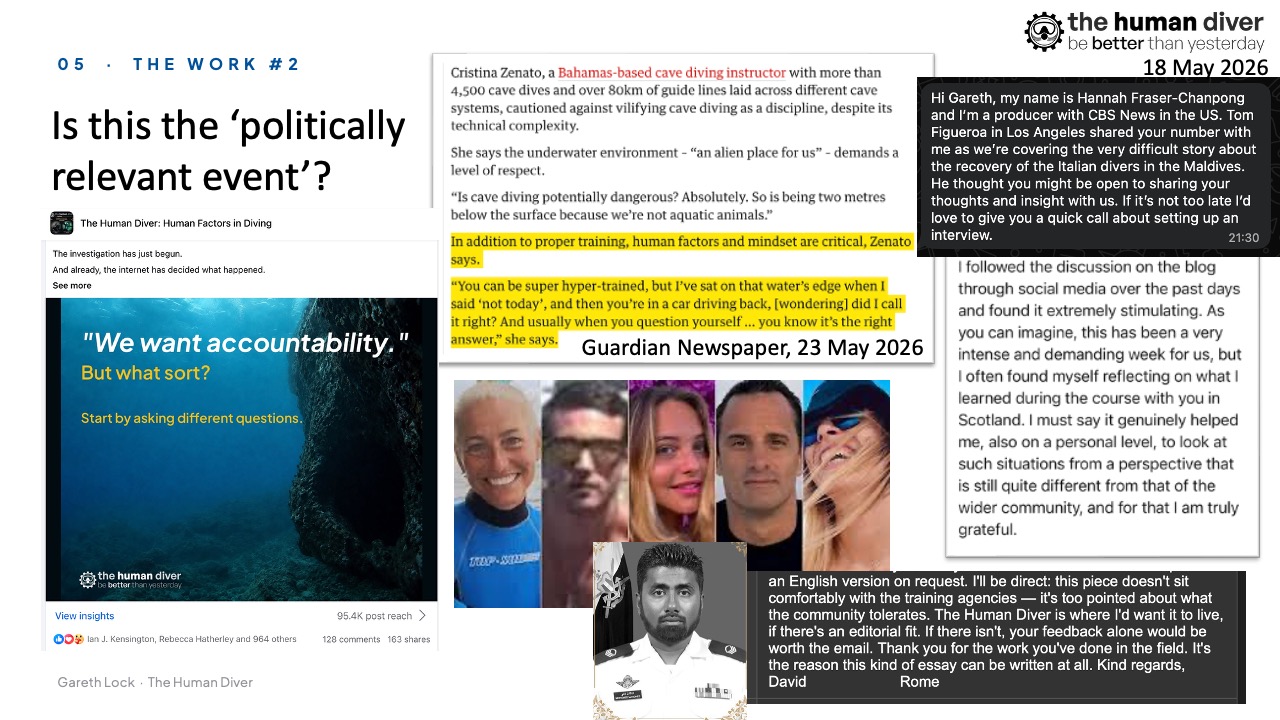
Three weeks ago, five divers died in the Maldives, and a rescue diver died very shortly afterwards. We don’t know the exact details around any of those deaths, but the structure of that tragedy was not unusual. Only the scale was. Events like it happen all the time without ending in death. We get away with a great deal.
This is also why individual training, on its own, is not enough. Investigation methods find what they are designed to find. Most diving reviews put human error at the centre, which leaves the standard that authorised the practice, the body that wrote it, and the commercial logic beneath both outside the frame. Each incident confirms the existing story rather than testing it. That will not change until the model changes — and the model will not change until the industry is willing to look at what it has been built to avoid.
The Work Continues
Not all is doom and gloom - I can see the evidence that it is moving. More divers are searching for this content. The Canadian standard exists. The community around human factors in diving keeps growing. Someone involved in coordinating that Maldives rescue told me that the training they did with me five years earlier helped them make sense of the situation as it unfolded.
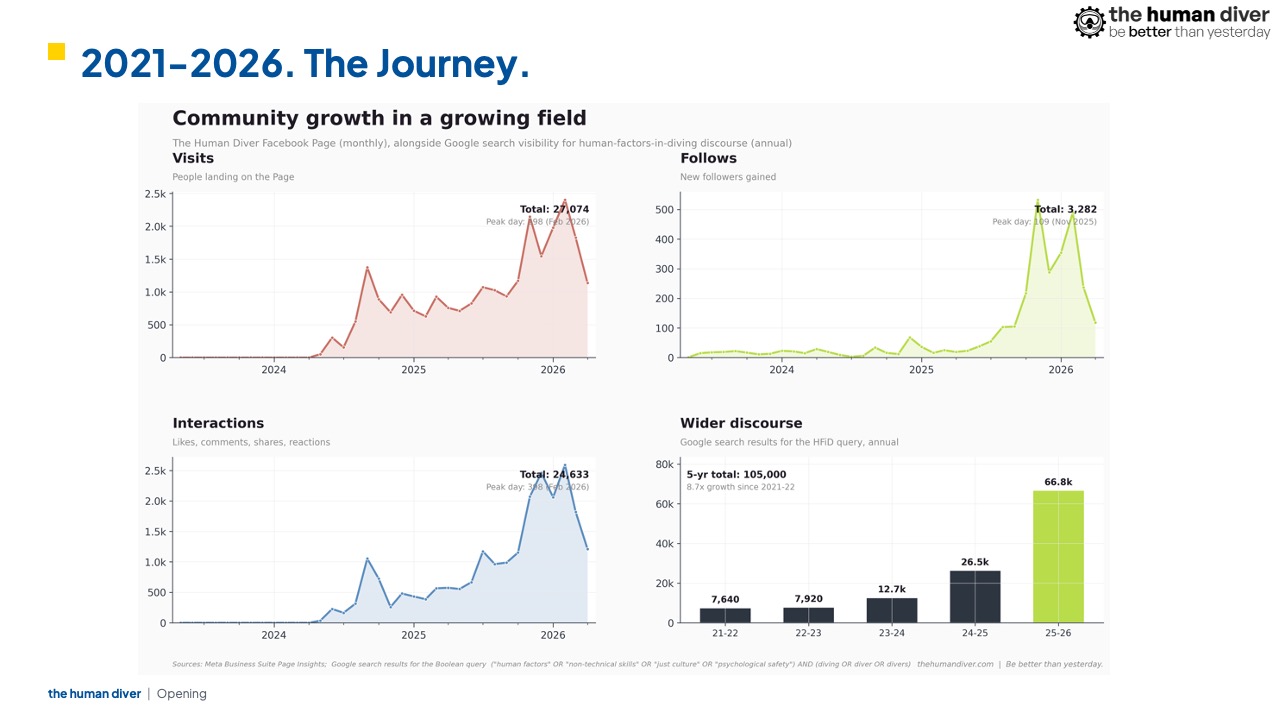
The agencies are starting to use the language too. They sometimes get the meaning wrong, and that frustrates me after ten years of writing blogs and articles and producing training materials, but one of my instructors put it well: they are writing the words. Five years ago, they would never have written these words. Now our job is the education that fills those words with the correct meaning.
Years ago, Guy Shockey said to me that every storm starts with a single raindrop. I shifted that to say that every blizzard starts with a single snowflake. Snowflakes have a negative connotation in modern society, but a blizzard is made of thousands of them, and change happens when the trajectory of a system shifts. If you’ve got to the end of this article, you are part of that community. A community that has different levels of engagement and commitment.
Context is everything. It is the foundation for learning and the basis for honest investigation. Getting it into diving, and building the conditions that make it stick, is the work.


