

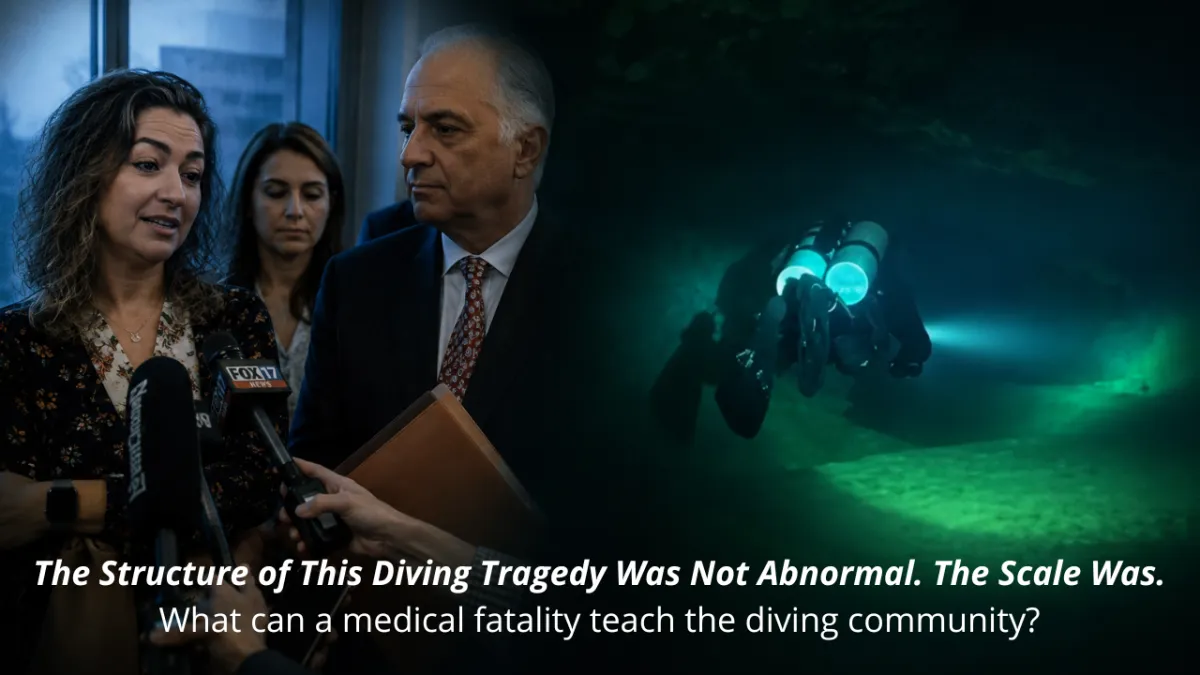
The Structure of This Diving Tragedy Was Not Abnormal. The Scale Was.
In 2017, a nurse called RaDonda Vaught gave a patient the wrong drug. The patient, a 75-year-old woman, died. Five years later, Vaught was convicted of criminally negligent homicide. Martin Anderson's careful write-up at Human Factors 101 is one of the most thorough accounts of the case in the public domain. It is worth reading in full. But the part most relevant to diving right now is not the drug, or the trial. It is the structure of the event itself.
RaDonda Vaught was sent to give a patient a mild sedative. She could not find the drug in the cabinet, so she overrode the safety system. She typed two letters and selected the first thing on the list, without reading what it was. She skipped the barcode scan that would have flagged the error. She missed the warning label on the vial. She missed the red cap that distinguishes a paralysing agent from a sedative. She failed to notice that the drug was a powder, when the one she had been asked for was a liquid. She injected the patient and walked away. She did not check back. By the time anyone realised what had happened, the patient was brain-dead. The court counted ten warning signs RaDonda had passed straight through. The verdict, in this telling, writes itself: she was negligent, and the patient paid for it.
This is the story that satisfies the judgements we have hard-wired into us. It has a clear actor, a clear failure, and a clear moral.

The second story, the structural version of the story, is different.
Vaught was a "help-all" nurse, asked to give a sedative to a patient she did not normally care for. The drug cabinet had been set up so that overrides, the workaround that lets a nurse pull a drug the system does not yet recognise, were happening dozens of times a day for routine reasons. Searching by brand name returned nothing, because the system used generic names. A scanner that should have caught the wrong drug was not present in that part of the hospital. The patient was not monitored afterwards, because nobody had written down whether monitoring was required. Vaught was training another nurse and was distracted. The drug came out of the cabinet as a powder, where the right drug would have been a liquid. She did not pause.
Each one of those things was happening in that hospital, every day, to other nurses. Nothing about Vaught's situation was unusual. The investigation by federal regulators, when it finally arrived, found exactly that: the system was placing all patients at risk of serious injury or death. The same medication error had occurred in other hospitals. The Institute for Safe Medication Practices said so explicitly.
And yet, when the prosecution made its case, the chair of the nursing board said something that should make every safety professional look up and realise how hard change is: "The only thing we are charged with is the mistake that was made by the respondent in front of us today." The prosecutor added that the board was "not here to look at the system."
This is the moment the structure disappears, and only the individual remains.
The shape of the Maldives story so far
On 14 May 2026, five Italian divers entered a cave system at around 55 metres in Vaavu Atoll and did not come back. A sixth person, Sergeant Major Mohamed Mahudhee of the Maldivian military, died during the recovery process. Earlier this week, Finnish recovery divers working through DAN Europe and the Maldivian government completed the operation and recovered the four remaining divers from the cave system. Their working theory is that the group passed easily over a sandbank into the second chamber, but on the return the same sandbank presented as a wall, and they could not find their way out. It is a theory, not a finding. The investigation continues.
The diving internet, meanwhile, did what diving internets do. It found the verdict before the facts. They shouldn't have gone in. They were only recreational divers. The instructor should have known. The operator is to blame. Andrzej Gornicki worked through this carefully in his eight-question review, and my piece on “We want accountability” said the same. Hold the judgement. Ask the right questions. Wait for the narratives.
There is a wider question we need to ask, a question that sits underneath the others. Why is the diving community reacting to this event the way it is reacting?
Outcome severity is doing most of the work
In the Vaught case, the federal investigators were explicit. The medication error itself was happening in other hospitals, with the same drug cabinet, the same overrides, the same gap in monitoring. What made it different was that the patient died, that a quiet settlement followed, and that an anonymous complaint forced the system to look. Once it looked, it needed an answer. The structural answer was uncomfortable and slow. The individual answer was fast and satisfying.
Diving has the same reflex. A diver returning from a 50-metre site logged as 30 metres barely makes a conversation, because nothing happened. A diver entering a short overhead passage on a single cylinder is a daily occurrence on tropical reefs, because it usually ends fine. A scientific diver crossing into an environment they have no technical training for is, judging by reports across the marine research community, not that rare. Each is the same structural act. None of them produce outrage, because they end with everyone on the boat. The dive was ‘successful’.
Five people in one cave is different. Six counting the rescuer. The numbers force a response. But the response is reacting to scale, not to structure; and the structure is what produced the conditions in which a sandbank could become a wall.
This is what we have been talking about for some time. The behaviours that contributed to this accident — depth limits honoured on paper but not in practice, scientific dives in technical environments without technical training, single-cylinder kit in overhead spaces, the unspoken assumption that "we've been here before and it was fine" — are not anomalies. They are the worn paths the system quietly depends on. The 30-metre rule sits in regulation. The operational norm sits somewhere else entirely, and everyone in the industry knows it. Consensus isn’t because everyone agrees, it is because no-one wants to disagree, and this happens at all levels in the industry.
What the hindsight lens does to all of us
In the Vaught case, the prosecution argued that she had missed ten warning signs. How can you miss ten warnings?! Reading the case backwards through that lens makes her look unfit to hold a licence. Reading it forwards, from inside a busy ward, ten warning signs is also a fair description of a system that fires alarms at every nurse, all the time, for routine reasons. The same alerts that look damning after the fact are alert fatigue before it.
The Maldives accident will follow that same backwards read. We will count the markers — the depth, the kit, the certification, the cave, the gas — and the answer will look obvious. It is obvious now. The question is what those same markers looked like on the morning of 14 May, on a boat with twenty other guests, after prior dives that had ended fine, at a site the group had visited before, with a senior researcher who had spent a decade in the area. From that side of the outcome, the picture was not "we are about to die." It was, in all likelihood, "we have done this kind of thing before."
That is not a defence of the decision. It is a description of how the decision was reached. This distinction between the outcome and the process to get there is critical, because the conditions that produced it are still in place, on other boats, in other atolls, on other dives planned for next week. “We can’t change the human condition, but we can change the conditions in which humans work” – Professor James Reason
The fundamental attribution error, and why diving falls for it every time
There is a name for what happens next. When something goes wrong for someone else, we explain it by who they are — careless, arrogant, under-trained, reckless. When it goes wrong for us, we explain it by the situation — busy, distracted, let down by the system, unlucky. Social psychology calls this the fundamental attribution error, and the diving community demonstrates it with painful reliability after every fatality or serious event.
The instructor who ran the dive becomes the kind of person who would run ‘that sort of dive’. The scientist involved in that task becomes the kind of scientist who would push the limits. The operator becomes the kind of operator who would look the other way. And the structural conditions drop out of the analysis entirely.
The depth-limit regulation the industry routes around.
The absence of technical infrastructure on recreational liveaboards.
The research-pressure environment that pushes scientific divers into spaces they don’t have the experience for.
None of these get the airtime, because all of them are uncomfortable. They implicate too many people who are still working. Blaming the people who died is the only response that does not require anyone else to change; useful illegality in action.
What we owe these six
The structure of this event was not abnormal. The scale of it was. Six families have lost someone. The diving community has a choice. But choices are not easy because they sit in a tension between ‘unacceptable performance/outcomes’ (safety), ‘financial viability’ (money), and ‘resources’ (people) for the diving operations.
We can find the individuals, name the failures, close the file, and feel that justice has been done. The Tennessee Board of Nursing did exactly that, and the medication errors continue.
Or we can do the slower, harder, less satisfying work.
-We can look at how recreational depth limits drift into operational practice.
-At how scientific and technical diving sit either side of a boundary that exists in the literature but not necessarily in the water.
-At how rescue services are sent into overhead environments without the kit they need.
None of those are individual failures. All of them produced the conditions in which a sandbank could become a wall.
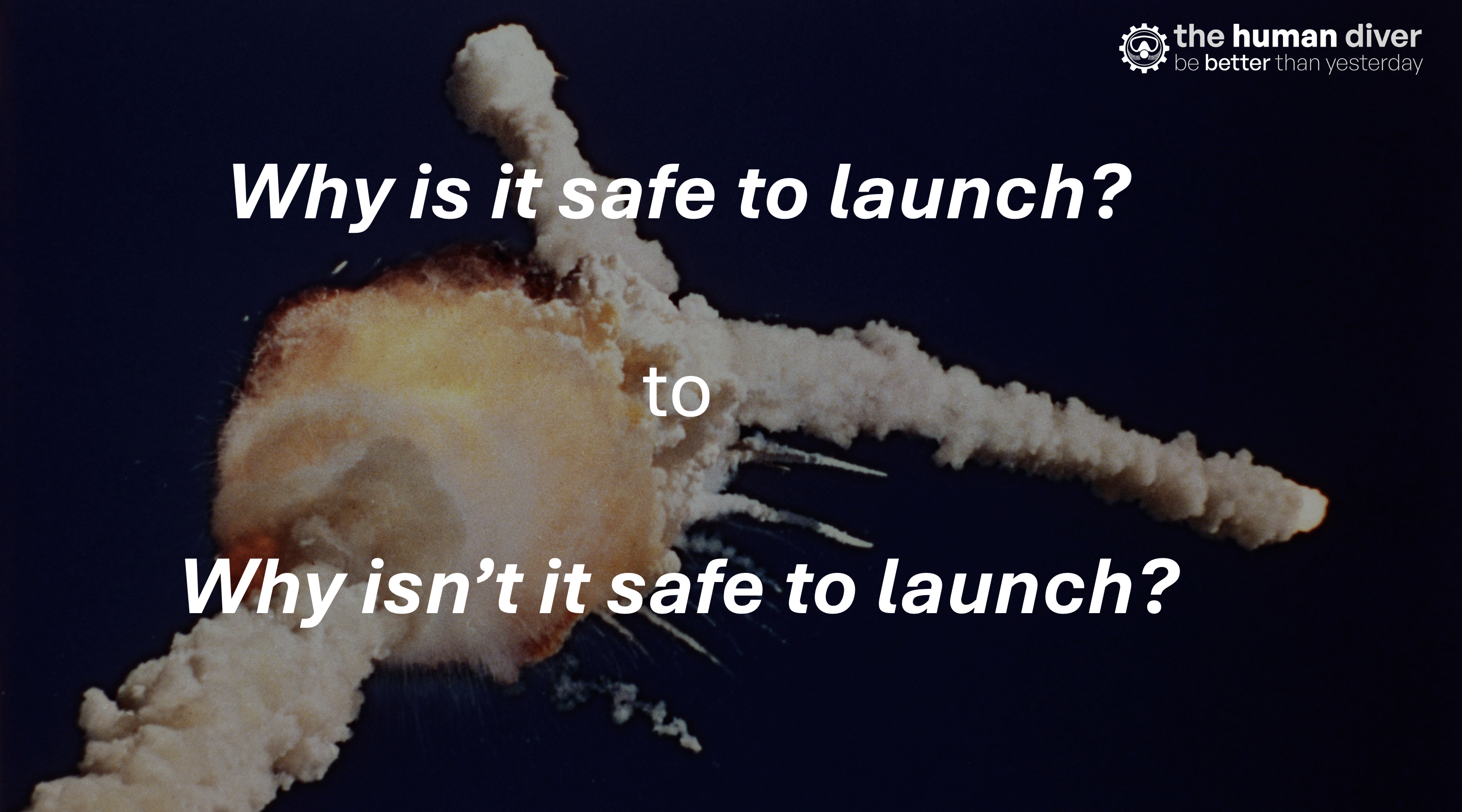
We can also look at how we rationalise ‘risky’ decisions. A relevant parallel here is how NASA managed safety and risk during the space shuttle programmes, ultimately leading to the loss of Challenger and then Colombia. When the programme started, the basic premise was that evidence needed to be provided that showed it was safe to launch, otherwise the platform would stay on the launch pad. However, due to commercial, political, and resource pressures, the question moved from ‘why is it safe to launch?’ to ‘why isn’t it safe to launch?’ The burden and type of proof is significantly different for the second question. That is where the diving industry is at the moment.
This conversation is important. Not because it absolves anyone, but because it is the only one with any real chance of preventing the next adverse event. Absence of evidence is not evidence of absence of a problem, you’re just not asking the right questions, and sometimes you don’t want to ask them.
Reflection
Take the next dive you are planning. Which of its conditions — depth, gas, environment, kit, group, schedule — sit comfortably inside the formal standards, and which sit on a worn path that the industry quietly tolerates? If the dive ended badly, which of those would the outcome make look obvious? And if it ended fine, who would have noticed any of it at all?
Be better than yesterday.


