

Why Investigations Stop Where They Stop
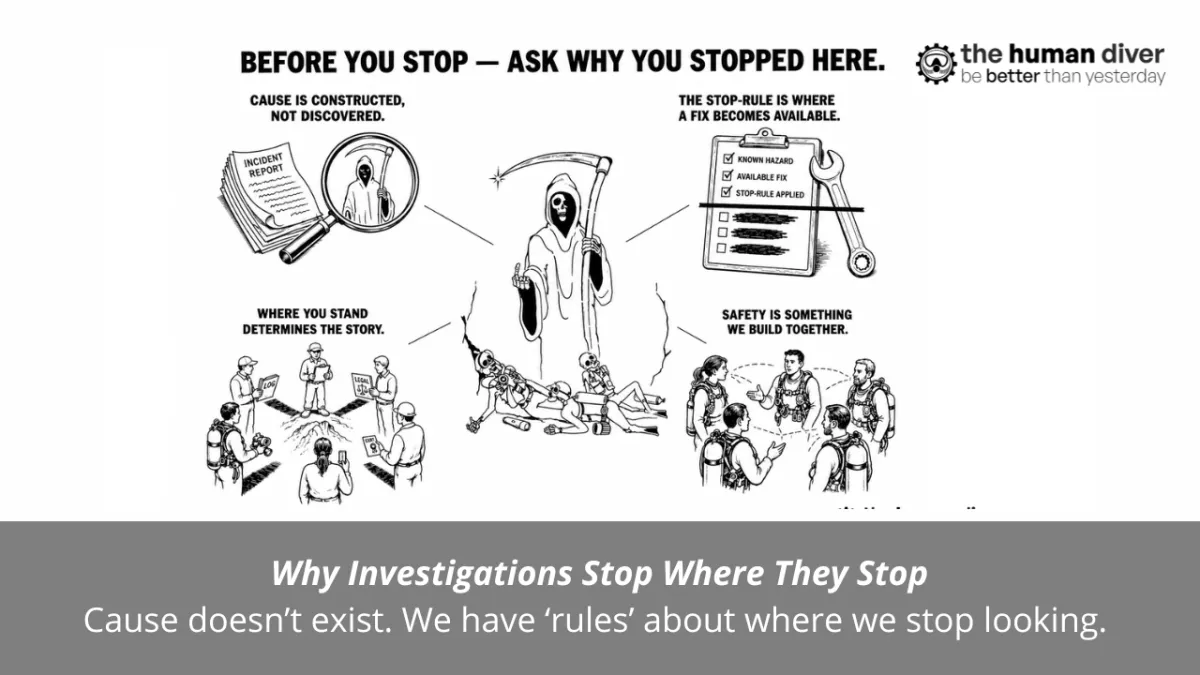
Whenever we read an incident review, an accident report, or a "lessons learned" review, we should ask a simple question about the process. The question is rarely asked, but when it is, the answer is usually treated as obvious: when we investigate something that went wrong, how do we know when to stop looking?
At first glance, that might appear to be straightforward. You stop when you have found the cause. But the research on how investigations actually work, across industries from nuclear power and aviation to gas distribution and road traffic, tells a very different story. Where an investigation stops is not determined by the structure of the event itself. It is determined by a set of pragmatic, social, and political constraints that are rarely visible to the people producing the report. Furthermore, those constraints are almost never visible to the people reading the report or the review. In diving, the most complete data on diving fatalities is from 2008 and this stops at the trigger for the event. It doesn’t look beyond the ‘causes’ that are close in time and space to the diver and the event.

This blog draws on six pieces of safety science research to explore four themes can help how the diving community understands incidents and the potential learning that can come from them. Together, they make a single argument:
The "cause" of a diving incident is not a thing waiting to be uncovered. It is a thing constructed by the people doing the looking, shaped by where they are standing, what they know how to fix, and what story their community will accept.
That might get a few people hot under the collar! However, understanding this is not an attack on incident analysis, rather it is an important part of undertaking transparent and critical event learning. A previous blog, following the death of the 12-year old Dylan Harrison in the US during a diver training programme, explored the reasons for running an investigation; this blog provides more meat on the bones.
Theme 1: Cause is constructed, not discovered
Decades ago, Jens Rasmussen, one of the most famous researchers in safety science, made an observation that has been confirmed repeatedly since. When we explain an accident in causal terms, we are not reading the structure of reality, we are matching the flow of events against a set of mental models or experiences that feel familiar to us. And once the match is close enough to be accepted by our organisation or wider audience, we stop digging.
His example is a classic: "the short-circuit caused the fire in the house." This statement is immediately accepted in a region where open wiring and wooden houses are common. In a region where brick houses are the norm, the same statement triggers further questions: short-circuits normally blow fuses, so what else was going on? The point is not that one explanation is right and the other wrong. The point is that the explanation is accepted or rejected based on the intuitive background of the listener, not on any property of the event itself.
In the diving world, the same applies. When a report concludes that a fatality was caused by "task loading" or "narcosis" or "poor gas planning," the explanation is accepted because it matches the mental models the diving community already holds as being ‘true’. Other explanations — about how the diver came to be in a position where task loading became overwhelming, about the conditions that made narcosis predictable, about the social pressures that shaped the dive plan — sit outside the normal mental models and are rarely explored.
The cause is not discovered - it is identified within a finite library of culturally available and acceptable stories. This is why The Human Diver is trying to expand the vocabulary and mental models with recent blogs and also the new LFEO programme launching at the HF in Diving Conference at the start of June 2026.

This is not an intentional criticism of incident analysis; it is how human beings make sense of complex events. However, it does mean that what we call "the cause" of an event is, at best, a negotiated agreement between the person doing the analysis and the community about how we explain the event using a specific narrative or story.
Theme 2: The stop-rule is wherever a fix becomes available
A 2010 study of twenty-two accident investigators across rail, maritime, road, nuclear, occupational, and patient safety domains produced a challenging set of findings for those in the safety investigation world. When asked what determined where their investigations stopped, what the actual ‘stop-rule’ was, the most common answer was a variation of this:
The analysis stops when we reach a level where we can formulate a remedial action
- that statement is important for us to acknowledge.
The investigation does not stop when the network of influential, causal and interacting factors has been mapped, it stops at the level where the investigator can write a recommendation that someone in that organisation has the authority and resources to implement. In diving, who would that be? If the event happens outside a training system/course, now what?
Causes that sit above that level, in regulatory structure, in commercial pressure, or in cultural norms across the industry, are not formally treated as causes. They are treated as context and quietly excluded from a report.
It isn’t just diving. I recently delivered some safety leadership training to a construction company. Their client would often put pressure on them to deliver, leading to errors being made, and adverse events occurring. I asked if the client ever appeared in the incident reports… you guessed right, they didn’t.
The researchers gave this scenario a name: "what you find is not always what you fix." A companion paper published the year before named the underlying mechanism the What You Look For Is What You Find principle, or WYLFIWYF, with its follow-on What You Find Is What You Fix, or WYFIWYF. The investigation method determines what counts as a finding. The available remedies determine what counts as a cause worth finding. The two are circular, and the loop closes around whatever the investigating organisation already knows how to do.
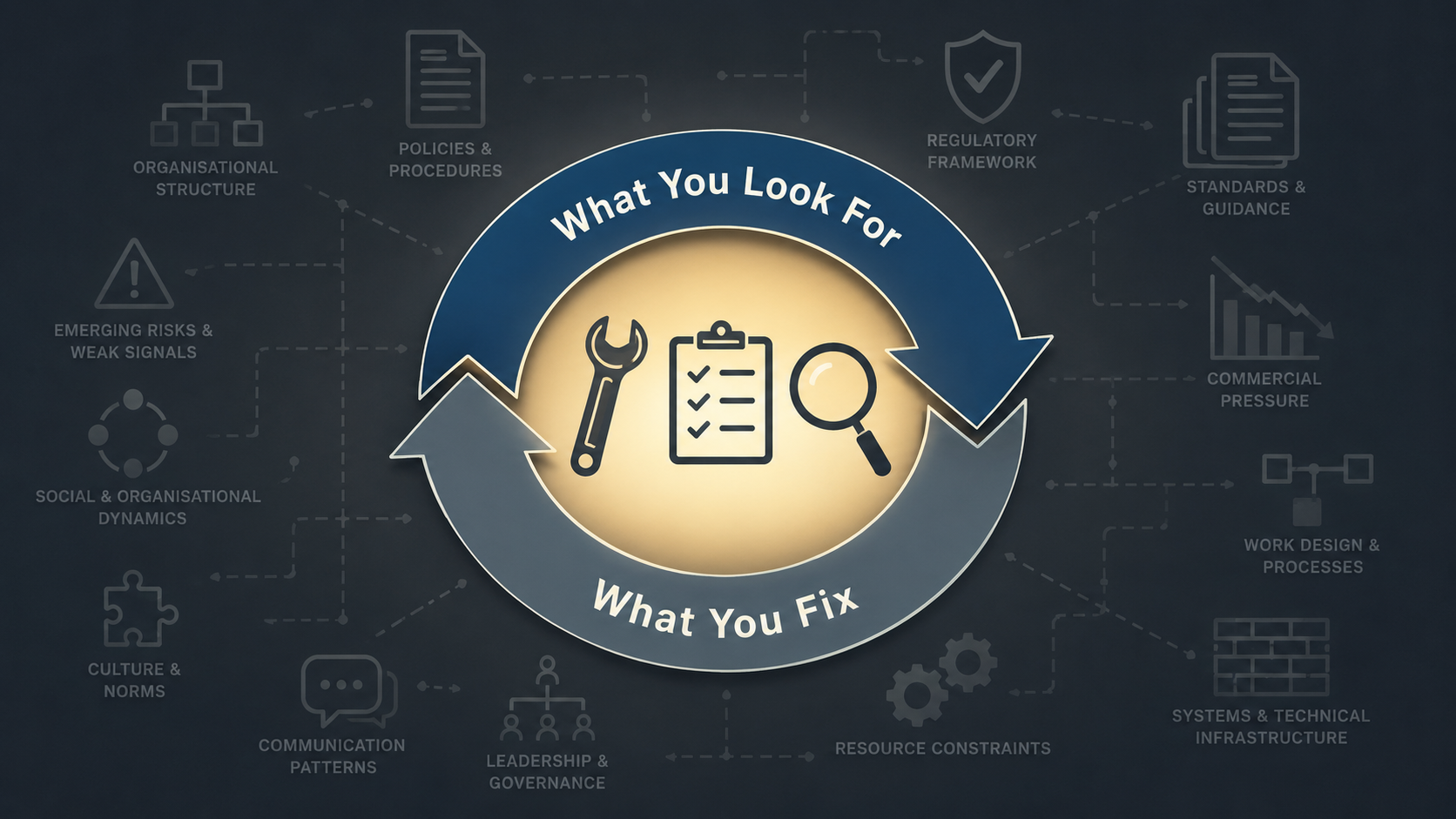
In diving, this shows up in a recognisable pattern. Most fatality reports terminate at the level of the individual diver's decisions, the instructor’s behaviour (normally on the back of a lawsuit), the buddy's response, the configuration of equipment, or the medical explanation e.g., AGE, DCS or IPO/E. These are the things that diving organisations and instructors can fix.
Explanations that would require restructuring how courses are sold, how instructors are paid, how certifying agencies compete with one another, or how the industry handles commercial pressure are rarely named. This is not because they are absent, but because nobody reading the report has the authority to act on them. The stop-rule is built into who is doing the looking. This concept aligns with the recent blog about agency/organisation standards and how developed standards don't always focus on the deeper issues at hand. And so the circle continues. As highlighted in this standards article, systems can change, but it takes courageous leadership to make it happen.
Theme 3: Where you stand determines the story you tell
A 2014 study of a French gas distribution company found something remarkable. Three groups of employees — field workers, frontline supervisors, and network supervisors — all worked at the same site, under the same safety policies, and shared a similar root perception that the policy was distant from real work. However, from that shared root, three completely different constructions of safety emerged.
Field workers described "umbrella safety" — the company's safety policy as a legal cover, designed to protect the organisation rather than the people. Their relationship with the policy was one of denunciation, and they saw the rules as obstacles to good work.
Frontline supervisors described "utopia safety" — well-intentioned but unachievable, with accidents ultimately seen as unavoidable. Their relationship was one of responsibility denial.
Network supervisors described "project safety" — pragmatic, actively constructed, blending field experience with rules into something workable. Their relationship was one of re-appropriation.
Three different realities, three different sets of causes, three different sets of remedies. But all grounded in the same events. Each person is operating inside their own 'tunnel', unaware of the others' perceptions.
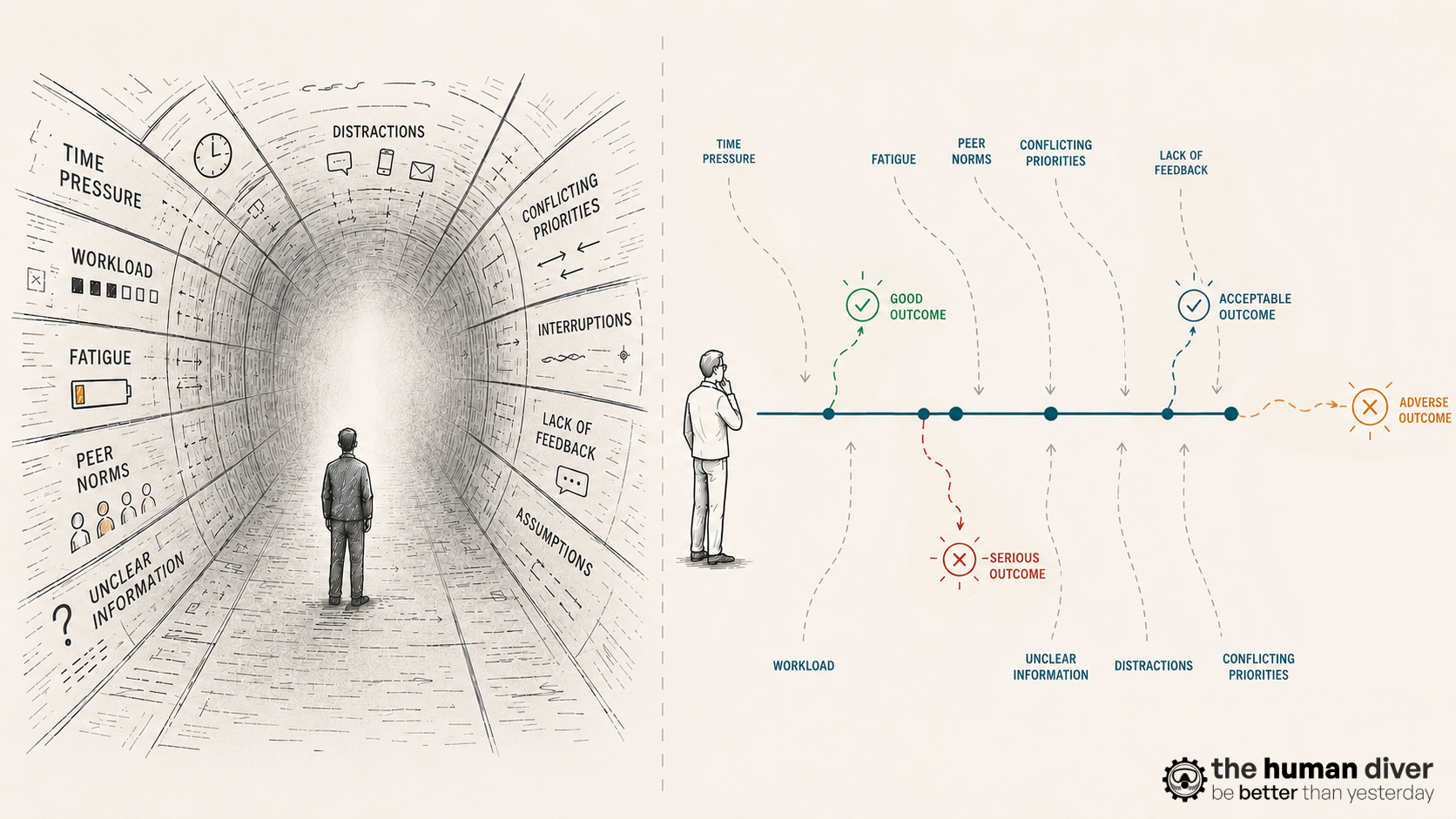
The diving community contains comparable levels. A technical instructor, an agency manager, an active diver, a coroner, a manufacturer, a fellow member of a tight-knit team, and a member of the public or owner of a social media channel will each construct a different account of the same incident — not because some are right and others wrong, but because the events look different from each position, and each position carries its own legitimate set of concerns. When a single account is treated as the account of what happened, it then becomes elevated above the others. The other positions, with their other causes and other potential remedies, have been quietly silenced and omitted from the record. As we have seen recently, social media has the potential (reality) to shape, strengthen, or weaken these perspectives too, both positively and negatively.
This connects directly to earlier work on Speaking Truth to Power. If the version of an incident that gets formalised is the version produced by the most senior or most visible actors, then the versions held by junior divers, students, and crew remain hidden. The "cause" recorded in the report is the cause that the speakers at the top of the hierarchy could write in the report.
Theme 4: Safety is something we build together, not something we measure
This one gets a bit deeper into the thinking!
Safety is not the absence of error, nor the management of risk. In the high-reliability organisations subject to research in the 1990s — aircraft carriers, air traffic control, nuclear power — safety was something operators actively constructed together, through continuous communication, ritualised practice, shared narrative, and a collective belief in the possibility of safe operation. Safety was described as being more easily judged than defined.
Why I mention this for stop-rules is because it changes what an investigation is for:
If safety is a ‘property’ that an organisation possesses, then an investigation is an audit to find where that ‘property’ has degraded.
If safety is something a community actively constructs through shared practice and shared sense-making, then an investigation is itself a part of the construction. The act of producing an account of what went wrong shapes the community's future understanding of what is safe.
The stop-rules embedded in either account become the stop-rules embedded in the community's collective mind. Culture is the collective behaviours of a group, based on deep assumptions and values, not just what we see.
The diving community has tended to treat investigations as audits; dig into the details and the paperwork and find where the ‘properties’ were degraded. The shift that we should consider is that every published account of a diving fatality or serious injury — every coroner's report, every internal review, every social media post-mortem — contributes to constructing what the next generation of divers will believe safe diving to be about. If those accounts consistently terminate at the level of individual diver or instructor decisions, then individual diver decisions are what the community will learn to scrutinise. The structural conditions that produced those decisions will remain socially invisible, not because nobody knows about them, but because the community does not have the words or imagination to talk about them in a meaningful way. The old adage, if all you have is a hammer (investigation based around ‘human error’ and non-compliance), the world looks like nails (causes), holds true.
What this means for diving
As you’d expect from the work of The Human Diver; there are not a tidy set of recommendations. Rather, at the end of this blog, your reflections and discussions should lead us to a different relationship with the incident reports we produce and read.
When an investigation report names a cause, the right question is not "is that the cause?" but "what stop-rule produced that cause as the answer?"
Was the analysis terminated because there wasn’t an ability to go back beyond the ‘trigger’ (e.g., OOG, entanglement…)?
Did the analyst reach a level where a familiar fix became available?
Was a single account accepted, or were the other stakeholders or participants in the system allowed to construct their own account?
Were the structural conditions that shaped the event treated as context to be acknowledged and excluded, or as causes to be explicitly called out?
The biggest impact is that the diving community's library of "lessons learned" is not a neutral record of what has been discovered about diving safety. It is a record of which causes happened to fall within the reach of the people doing the investigating, at the time they were investigating. Reports like the 2008 ‘Common causes of recreational diving fatalities’, and ‘Violations of safe diving practices among 122 diver fatalities’ are examples of this.
When ‘causes’ sit above this, in commercial structures, in how training agencies compete, in how risk is framed by manufacturers and media, and in how the community itself handles incidents, they become absent or hidden. This is not because they are unimportant, but instead, they are missing because the stop-rule excluded them.
If you can only remember a few things from this blog, this is one of them: the account that gets told is the account that the social conditions of telling will permit. Social media can help this, but it might not reach the right people.
Recognising this limitation should not lead us to put our heads in our hands and say, ‘we can’t do anything about it’. Instead, we can treat it is the starting point for open and transparent learning. The stop-rule will always exist, because investigations always operate under real social, financial, and commercial constraints. But the stop-rule does not have to be invisible. Reports can name where they stopped and why. Communities can ask which positions were represented in the account and which were not. Readers can develop the habit of asking what was excluded as much as what was included.
The investigation is not the end of the learning. It is one moment in an ongoing construction. What we learn from an incident depends, in the end, less on what happened than on how the community chooses to talk about it afterwards. A colleague of mine, Ron Butcher, provided this quote in another social media post yesterday “The Investigation Does Not Occur in the Same World as the Incident”. Hold that thought.
A question for reflection:
The next time you read a diving incident report, try this experiment. After you have read the named causes, ask: what would this report have said if the investigator had different resources, sat in a different position, or worked for a different organisation? The gap between the report you are reading and the reports you can imagine is a measure of how much of the cause was constructed rather than discovered.
Be better than yesterday.
References
Blazsin, H. & Guldenmund, F. (2015). The social construction of safety: Comparing three realities. Safety Science, 71, 16–27.
Lundberg, J., Rollenhagen, C. & Hollnagel, E. (2009). What-You-Look-For-Is-What-You-Find — The consequences of underlying accident models in eight accident investigation manuals. Safety Science, 47(10), 1297–1311.
Lundberg, J., Rollenhagen, C. & Hollnagel, E. (2010). What you find is not always what you fix — How other aspects than causes of accidents decide recommendations for remedial actions. Accident Analysis and Prevention, 42, 2132–2139.
Rasmussen, J. (1990). Human error and the problem of causality in analysis of accidents. Philosophical Transactions of the Royal Society of London B, 327, 449–462.
Rochlin, G. I. (1999). Safe operation as a social construct. Ergonomics, 42(11), 1549–1560.
Shreeves, K., Buzzacott, P., Hornsby, A., & Caney, M. (2018). Violations of safe diving practices among 122 diver fatalities. Int. Marit. Health, 69(2), 94–98. https://doi.org/10.5603/imh.2018.0014
van der Schaaf, T. W., Lucas, D. A. & Hale, A. R. (1991). Near miss reporting as a safety tool. Butterworth-Heinemann.


