

Cause Reason. Excuse. Three Words Doing Three Very Different Things.
A discussion this weekend generated some thinking on my part. What is the difference between an excuse, a reason, and a cause? These three words get used interchangeably, even by people who are engaged in the discussions. The misuse/mismatch of these words is doing a lot of damage when it comes to discussing events, and so it covering them off, in a similar to the accountability blog last week "We want accountability".

Cause
This is the most neutral of the three. A cause is a thing that, had it been different, would have changed the outcome. It is a factual claim about how something came to happen. If, as described in the press releases, the sandbank was a cause of the divers being unable to find the exit. The drug cabinet override was a cause of RaDonda Vaught dispensing the wrong drug. Causes are normally plural. Incidents in complex systems don’t have a cause; they have a network of them. Some are close in time and space to the event, others sit further back in the training pathway, the commercial structure, the agency standards, the norms the community quietly tolerates. Calling one of them the cause is almost always a decision about where to stop looking. That was the point of the previous blog on stop-rules. Where the investigation ends is not where the causes end. It is where the investigator’s authority to do something about it ends.
Reason
This is different. A reason is a cause seen from the inside. It is what made the action make sense to the person doing it at the time. Vaught’s reason for overriding the drug cabinet was that the cabinet was not finding the drug under its brand name, and overrides were happening dozens of times a day for routine reasons. Everyone in that hospital was doing it.
The Maldives divers’ reason for entering the cave, if one theory holds true, the entry passage likely looked benign and they had been into similar formations before without incident. They had been there. It had ended fine. Reasons live in the local rationality of the person inside the situation, with the information they had at the time, under the pressures they were under. This is not the same as how we make sense of the situation, after the event, with knowledge of the outcome, and applying judgment based on severity.
A reason is not a justification of the outcome. It is a description of the decision as it was being made, not as it looks from the other side. Richard Cook's diagram is gold here - a full blog on this topic is available here
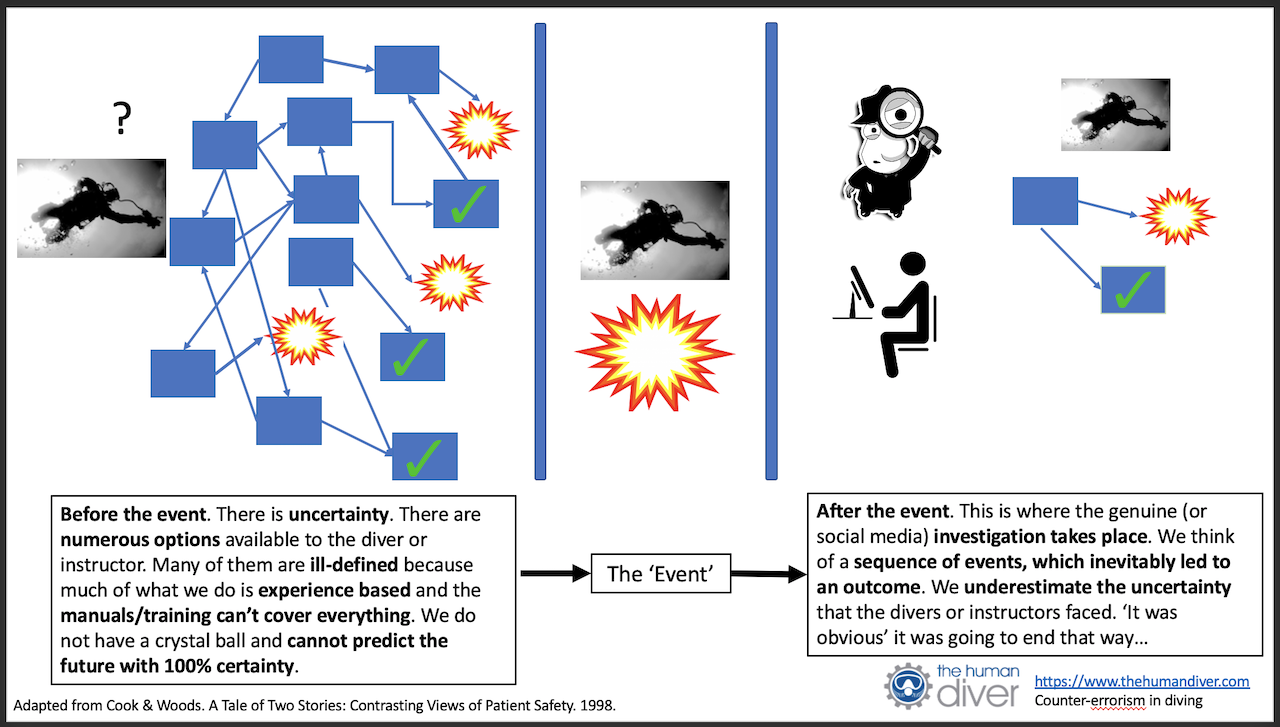
This is also the distinction Sidney Dekker draws repeatedly when describing the 'tunnel'. You cannot understand an action until you can describe the reason that made it make sense at the time. If the reason still looks unreasonable once you have done that analysis and reflection, you have learned something about the person or persons involved. If it suddenly looks reasonable, you have learned something else, usually about the system.

Excuse
This is the word that is causing the problems in the comments sections in social meda. An excuse is a reason being used to dissolve accountability. The shift is rhetorical, not factual.

Take the same statement: the drug cabinet was overriding dozens of times a day. That same sentence can do three different jobs.
As a cause, it describes what was happening. The cabinet was overriding dozens of times a day. Neutral.
As a reason, it explains why the override felt normal to Vaught. The cabinet was overriding dozens of times a day, so reaching for the override didn’t register as a decision. Explanatory.
As an excuse, it is being offered to clear her. The cabinet was overriding dozens of times a day, therefore she is not responsible. Exculpatory - we've let her off the hook.
The words that you are reading on the screen are the same. What changes is what the writer is asking the words to do for the reader.
I get there is a fair chunk of pushback against systems thinking because human factors analysis is just dressing up excuses as causes. Sometimes that accusation is valid. There are practitioners who, having identified the systemic conditions, treat the individual’s actions as if they no longer count. Punishment is not the same as blame, and in some cases is absolutely needed, but it shouldn't be the first tool to come out of the box. A reason is not an excuse unless someone uses it as one.
A practical test for you
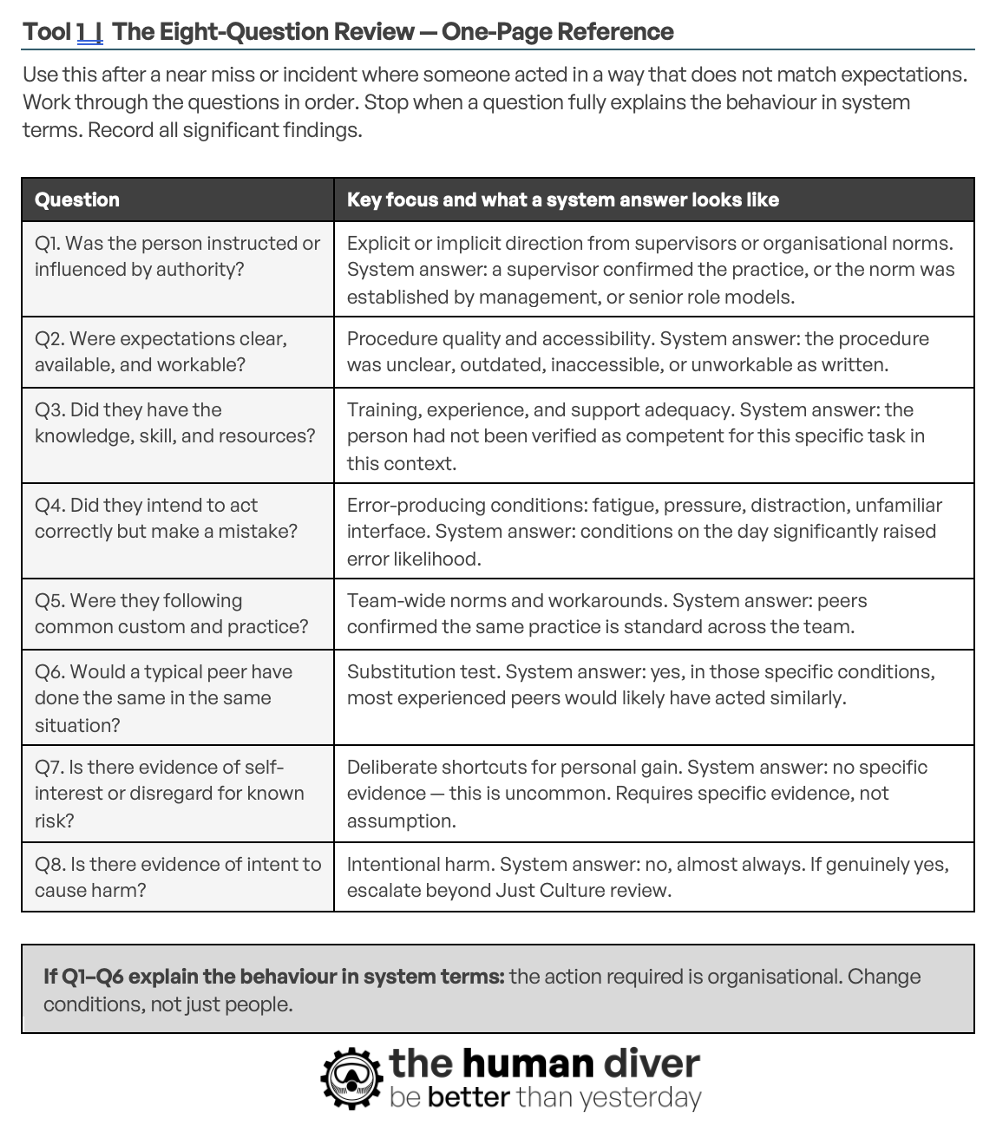
If a statement answers how did this happen? it is a cause. If it answers what was she thinking? it is a reason. If it is doing the work of therefore she is not responsible it is being used as an excuse. The same factual content can sit in any of the three slots. Which slot it ends up in depends on the framing, the tone, and what the speaker wants the listener to do with the words next. The eight question review, described in Andrzej's blog, asks us to consider what causes and reasons might be present, it doesn't point to excuses.
This is why a Just Culture insists that understanding is kept separate from a punitive approach to accountability. They are different operations. Understanding asks what the causes and the reasons were. Most forms of accountability asks what consequences should follow. You can hold both at the same time. I understand why she did it, and she is still accountable for the patient’s death. Most mature safety frameworks insist you must hold both; those same mature organisations recognise that accountability has to be clearly understood by all parties and not just another term for 'blame'. The mistake the comments sections in social media keeps making, in both directions, is collapsing the two.
The system was at fault, so she is not accountable. That treats a reason as an excuse.
She is accountable, so the system was not at fault. That treats accountability as displacing the causal analysis.
Neither add value to learning and the change that is needed.
The divers in Vaavu Atoll 'chose' to enter the cave. The system produced the conditions in which that choice looked reasonable to them. Both sentences are true. The first is about accountability that has limited learning opportunities. The second is about causes and reasons. Neither one cancels the other, and we can only progress with creating an environment for learning when we stop merging the two.
The drunk, speeding motorcycle rider scenario came up in a thread. So going back to that.
He was speeding, drunk, and uncertified for that road. Those are causes.
He had ridden that route a hundred times without crashing. That is a reason.
Therefore he isn’t responsible. That is an excuse. Systems thinking and human factors doesn't look for excuses.
The last but one blog made the same point at the structural level. The conditions that produced six deaths are present on other boats, in other atolls, and on dives planned for next week, and in other military operations. Describing those conditions is not the same as letting anyone off. It is what makes the next dive different. Without such distinction, we keep ‘learning’ the same lessons that don’t actually change anything.

If you can only take a few things away from this, take this
A cause is what happened (evidenced).
A reason is what made it make sense at the time (especially local rationality).
An excuse is a reason being used to clear someone.
The three are not the same. And the next time you read an incident discussion, ask which lens the event is being viewed through.
If a cause is being heard as an excuse, that is a problem with the receiver.
If a reason is being offered as an excuse, that is a problem with the transmitter.
And if the discussion has stopped distinguishing between the three, that is a problem with the community.
A question for reflection:
Look back at the last incident discussion you took part in, online or in a debrief.
Where did a cause get heard as an excuse?
Where did a reason get used as one?
What might have changed if the three had been kept clean?
We have the power to change our perspective of the world by changing the words we use, or the words we listen out for.
Be better than yesterday.


