A Review of 2025. Looking Forward to 2026.
Dec 30, 2025Today is the last day of 2025, and a lot has happened in the world of Human Factors in Diving. This blog is a summary of what The Human Diver team has achieved, and what we are looking to achieve next year.
Before we start with the details, I’m going to share a favourite short passage which brings the challenges of creating change in a dynamic, competitive, emotive, and sometimes dysfunctional system to life.
“It is not the critic who counts: not the man who points out how the strong man stumbles or where the doer of deeds could have done better. The credit belongs to the man who is actually in the arena, whose face is marred by dust and sweat and blood, who strives valiantly, who errs and comes up short again and again, because there is no effort without error or shortcoming, but who knows the great enthusiasms, the great devotions, who spends himself in a worthy cause; who, at the best, knows, in the end, the triumph of high achievement, and who, at the worst, if he fails, at least he fails while daring greatly, so that his place shall never be with those cold and timid souls who knew neither victory nor defeat.”
—Theodore Roosevelt
Speech at the Sorbonne, Paris, April 23, 1910

Creating the conditions for change is never easy. Divers love the shiny stuff, the technology that they believe will help them achieve more than they can do now. And in some way, this is correct. However, the piece of ‘technology’ that people take on every dive, their brains, is much harder to improve because of numerous biases and heuristics that limit our want and perceived priority to learn.
Often, we hear
“I don’t have time to take that course.”
but this could be reframed as
“This personal and professional development is not a high-enough priority. Nothing has gone wrong, why do I need to do this?”
Life is full of tensions and conflicts.
Life is full of tensions and conflicts. We have limited resources, including time. Often, we don’t have many choices over how we spend our time. At the same time, in 2025 many divers, instructors and diving supervisors (and non-divers) did go through some form of personal/professional development with The Human Diver.

The Human Diver team ran 24 HFiD: Applied Skills classes around the globe, from Vancouver through to Brisbane, with more than 130 people graduating from the two-day class.
190 people signed up directly for HFiD: Essentials, with hundreds more taking the class through the Ambassador programme where instructors/dive centres/dive operations mandate the programme as part of pre-learning/professional development.
23 people completed the 10-week Masterclass series, which involves 20 hours of live online sessions with homework and consolidation between.
Three new Human Diver instructors graduated, but due to work pressures and changing professional priorities, we lost two. To become an instructor is a significant investment – at least 150 hours of work over a minimum of six months. We develop dynamic and adaptive facilitators, not ‘slide readers’.
Our goal is to make learning accessible
Our goal is to make learning accessible for all. Some paid options, but the majority are free.
- We published a new version of HFiD: Essentials in June, which was completely rewritten and reproduced using novel technology to allow multiple language translations.
- We developed and published a short 30-min online programme (Dive Smarter in 30 mins) to get people into the topic for a small fee.
- We published 104 podcasts.
- We wrote 74 English blogs, and Andrzej wrote/translated 28 Polish blogs!
- We published three free eBooks providing Top Tips for Beginner Divers, Diving Instructors, and Technical/Cave Divers. More than 1000 copies of these were downloaded from the mailing list, each containing more than 50 pages of stories, guidance, and practice advice.
- We uploaded 22 presentations into YouTube along with three online interviews/webinar sessions.
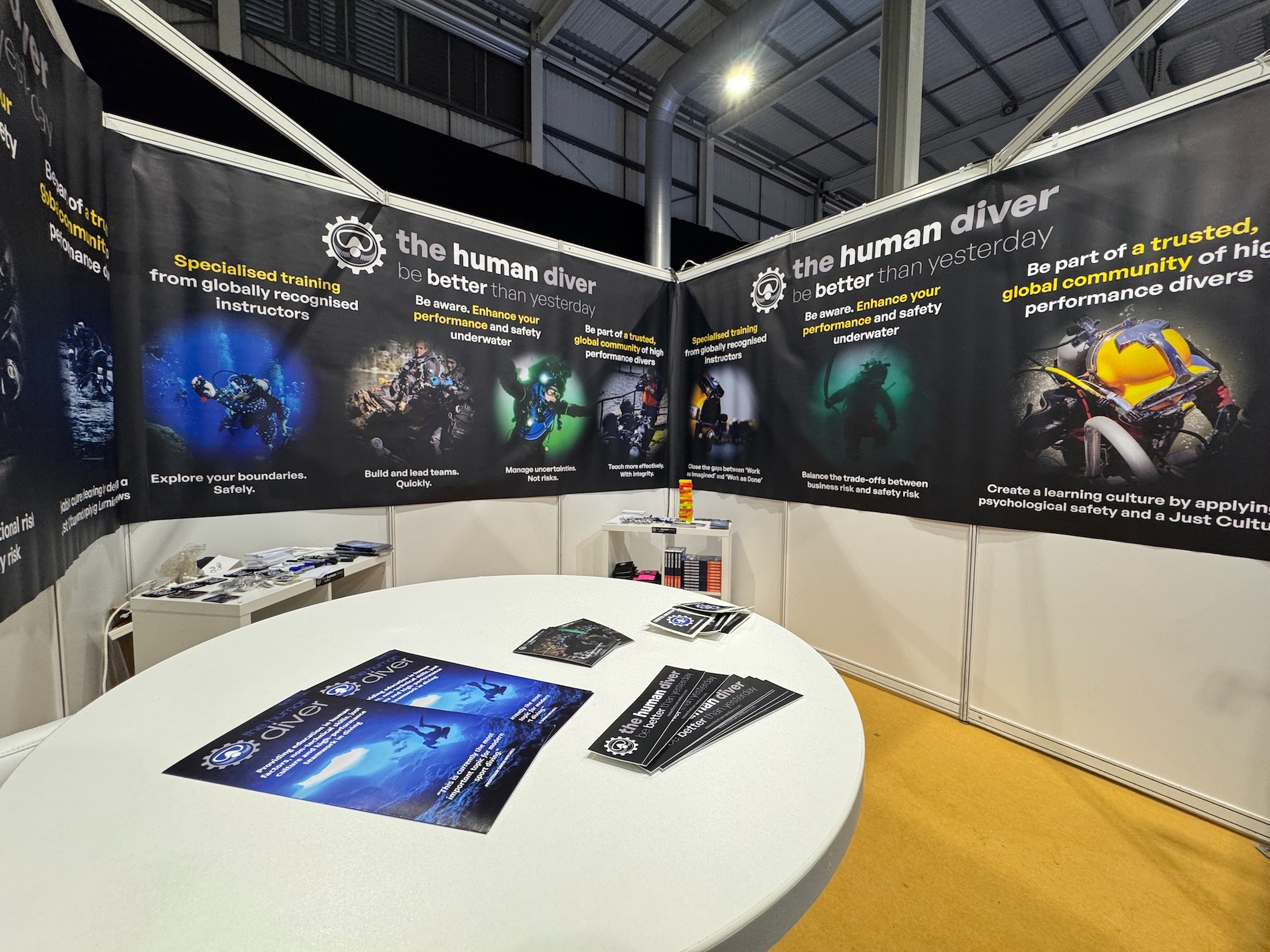
We undertook a rebranding exercise leading to the new tagline ‘Be Better Than Yesterday’ highlighting the focus on reflection and improvement.
We’ve recently looked at developing a couple of simple visuals that describe resilient and adaptive performance, and these will be more visible in the start of 2026.
The website has had than 1M unique page views
The website has had than 1M unique page views since 1 January 2025, and 500k of them went to the blogs! We are getting between 1500-2000 people visiting the site each day. The HFiD Facebook group has more than 14k people in it now, and we are pleased to see so many different conversations being made across materials and social media about the importance of human factors in diving and understanding the location rationality of those involved. We know that SDI has included a short section in their new Open Water instructor manual about human factors – there are some errors in there (feedback has been provided) but it is a start, and SSI XR has started to include specific elements of human factors in their materials.
What does 2026 bring to the diving community from The Human Diver?
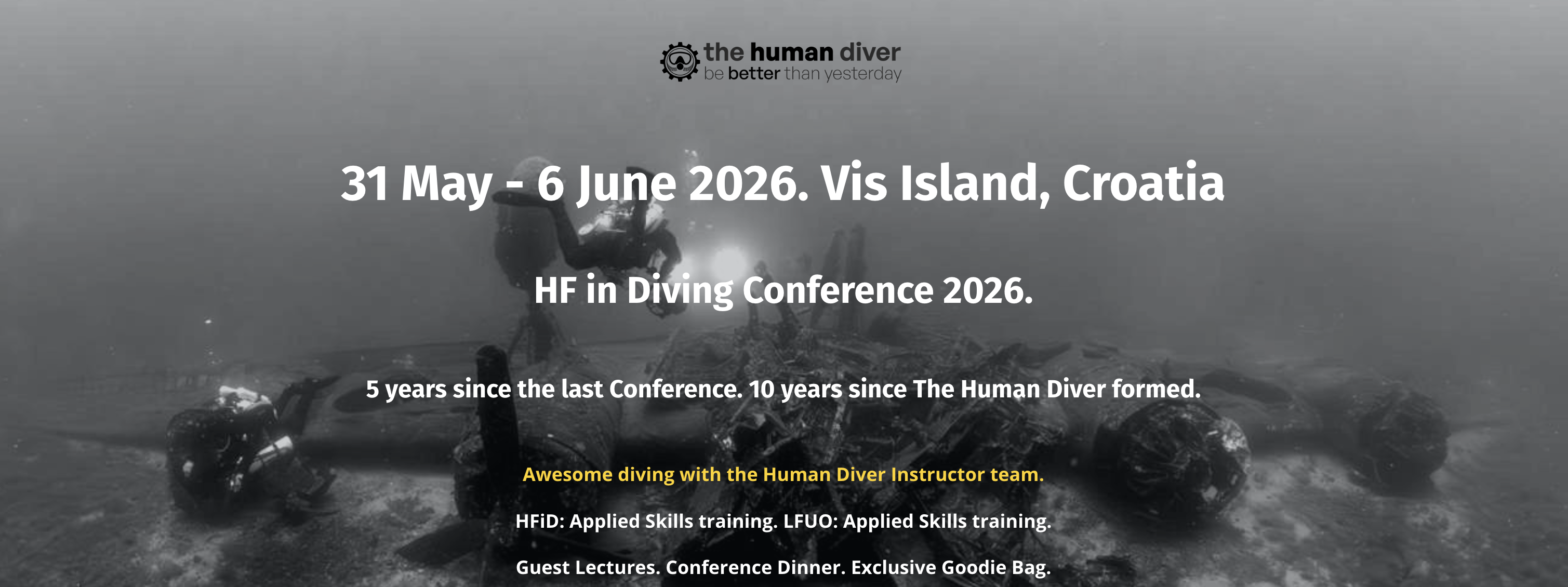
The big thing for The Human Diver team in 2026 is the HF in Diving Conference. This will run from 31 May to 5 June in Vis, Croatia, and will be another unique offering to the diving community.
- Sunday 31 May: Presentations from world-class speakers on applying human factors to diving in practical terms, and looking at what happens when things go wrong.
- Monday 1 June – Thursday 4 June: In the morning of each day, we’ll be running either an HFiD: Applied Skills class, or a LFUO: Applied Skills class (more on LFUO below). In the afternoon, we’ll be diving on the wrecks and reefs around Vis, bringing the classroom theory and practice to life in the water. In the evening, there will be a number of presentations.
- Friday 5 June: Free day with the end-of-conference dinner with another world class speaker providing the after-dinner presentation.
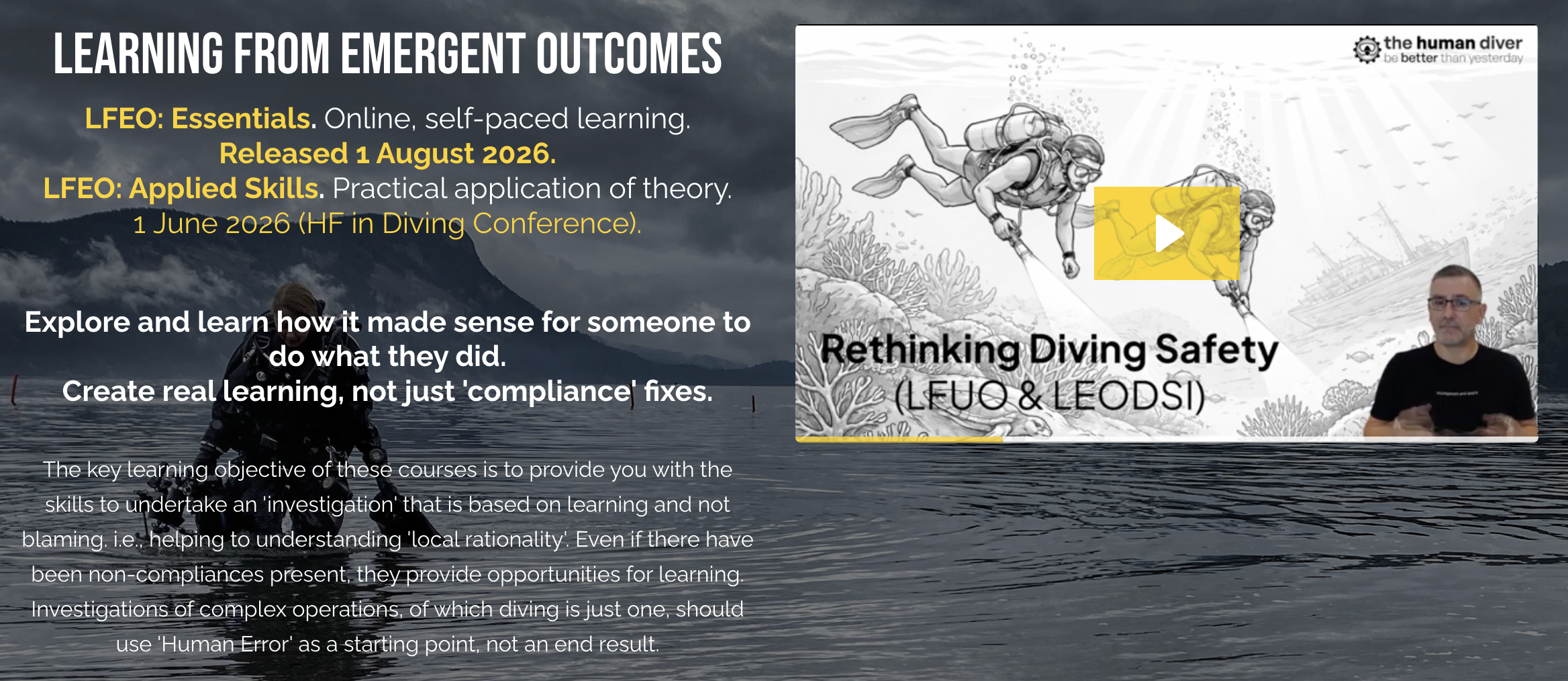
The next ‘big thing’ is the launch of the Learning from Emergent Outcomes (LFEO) course – this used to be known as Learning from Unintended Outcomes (LFUO). The ability to view an event using a structured way of looking at diving events so that learning, not blame, has been missing from the diving industry and this course and associated materials will fill that gap. Using experience and knowledge from other domains, this two-day course gives divers, instructors, dive operators, supervisors, and agencies a framework they can use to generate learning from unwanted, unexpected, or unintended outcomes. This course will be accompanied by a book and an online course similar to the HFiD: Essentials course. The LFEO programme will also generate numerous case studies and facilitation guides that divers, instructors and supervisors can use to increase learning and practice.
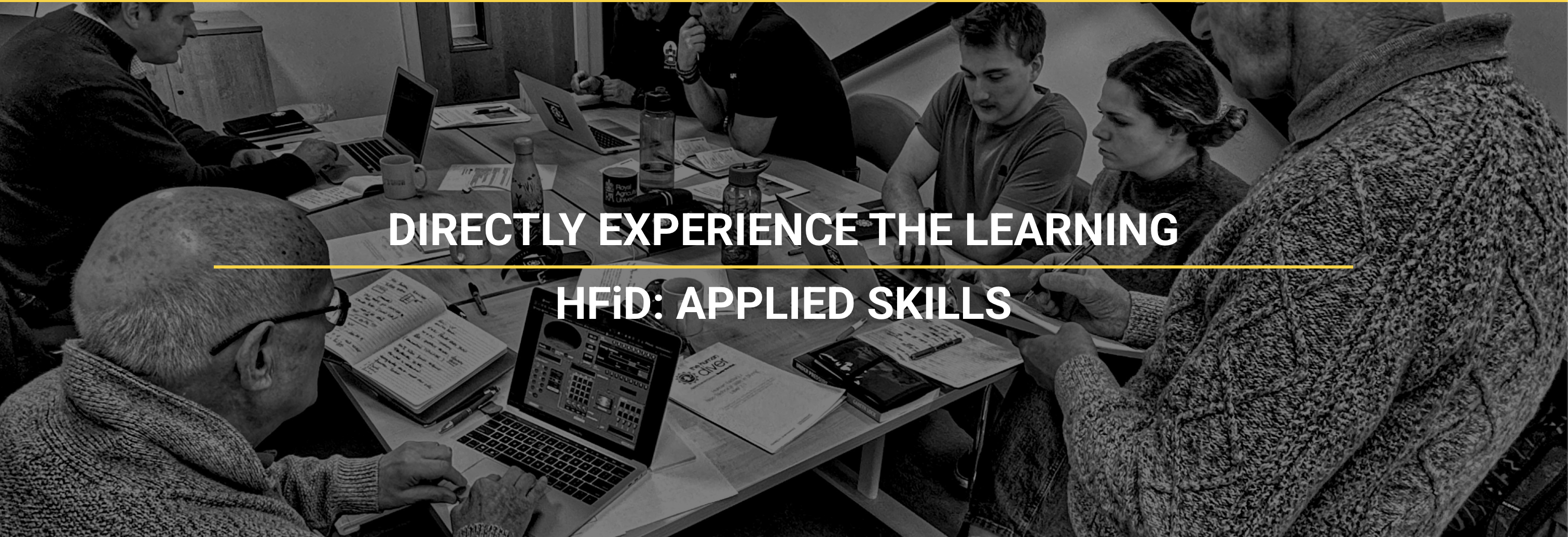
We intend to run as many HFiD: Applied Skills classes as possible. We start the year with a programme working with the Canadian Military – a five-day combined Non-Technical Skills and Learning Teams event in Toronto. We are also running courses in California, Texas, Bali, as well as a two-day event at the commercial diving conference (CUCE 2026) in Toronto in March. We will also be at the Divescapes conference in Edmonton in the October. Lanny, one of the THD instructors and owner of Underworld Tulum, is hosting the NSS-CDS Winter Workshop and HFiD: Applied Skills will be part of the programme there too.
We are looking to grow the Ambassador network. The key reason is that instructors have reach and influence that The Human Diver doesn’t. Agencies are reticent to mandate HF training as it may lead to a commercial disadvantage in the market, but instructors can add value and knowledge to their students directly. The only real requirement is that you have to have completed HFiD: Essentials if you are going to mandate it on your students or staff. If you want to know more, visit this page.
In addition to growing the Ambassador network, we are looking forward to publishing more guest blogs on the site, and interviewing people for the YouTube channel.
What are your goals for 2026?
Goals can take many forms. Aspirational goals where we are looking much further into the future and want to achieve something major or complete a ‘bucket trip’, and journey goals which are the steps that help you progress towards that major goal. These aspirational and journey goals can involve personal and/or professional development.
The goals for The Human Diver in 2026 are to:
- Have a successful HF in Diving Conference – learning transferred by attendees having specific tasks/tools/concepts they can use immediately.
- Release the LFEO courses and start to change the language of learning in diving.
- Publish the LFEO book.
- Increase the Ambassador network to increase the reach of Human Factors in Diving.
- Increase the number of Human Diver instructors to make the learning more sticky through more HFiD: Applied Skills programmes.
- Submit a proposal to numerous training agencies offering a ‘Powered by The Human Diver’ white label or hosted product for Essentials and Dive Smarter in 30.
Something to consider when setting your goals:
Goal – What do you want to achieve and why?
Reality – What is getting in the way of you achieving that right now?
Options – What can I do to break barriers down, or put things in place to make it easier to achieve those goals?
Will – What concrete thing will I do now to start the journey?
If you want to dig deeper into the topic, look up James Clear’s Atomic Habits, or listen to this short podcast about his book. Clear argues that minimising friction for good habits and increasing it for bad ones is more effective than relying on willpower alone. Ultimately, the book serves as a manual for mastering the tiny rituals that compound into long-term success and personal transformation.

What do you need from The Human Diver?
“Knowledge is not enough, we must apply. Willing is not enough, we must do.” JW Goethe
There is loads of information in the blogs, podcasts, and accessible courses about how to change your diving, your mindset, and your practices. What else do you need to be successful? Please get in touch with your ideas and stories.
Here’s to an awesome 2026.
If you are part of an organisation (centre or agency) that wants to make a difference to diving safety by developing and deploying a HF/NTS programme to your team, get in touch.
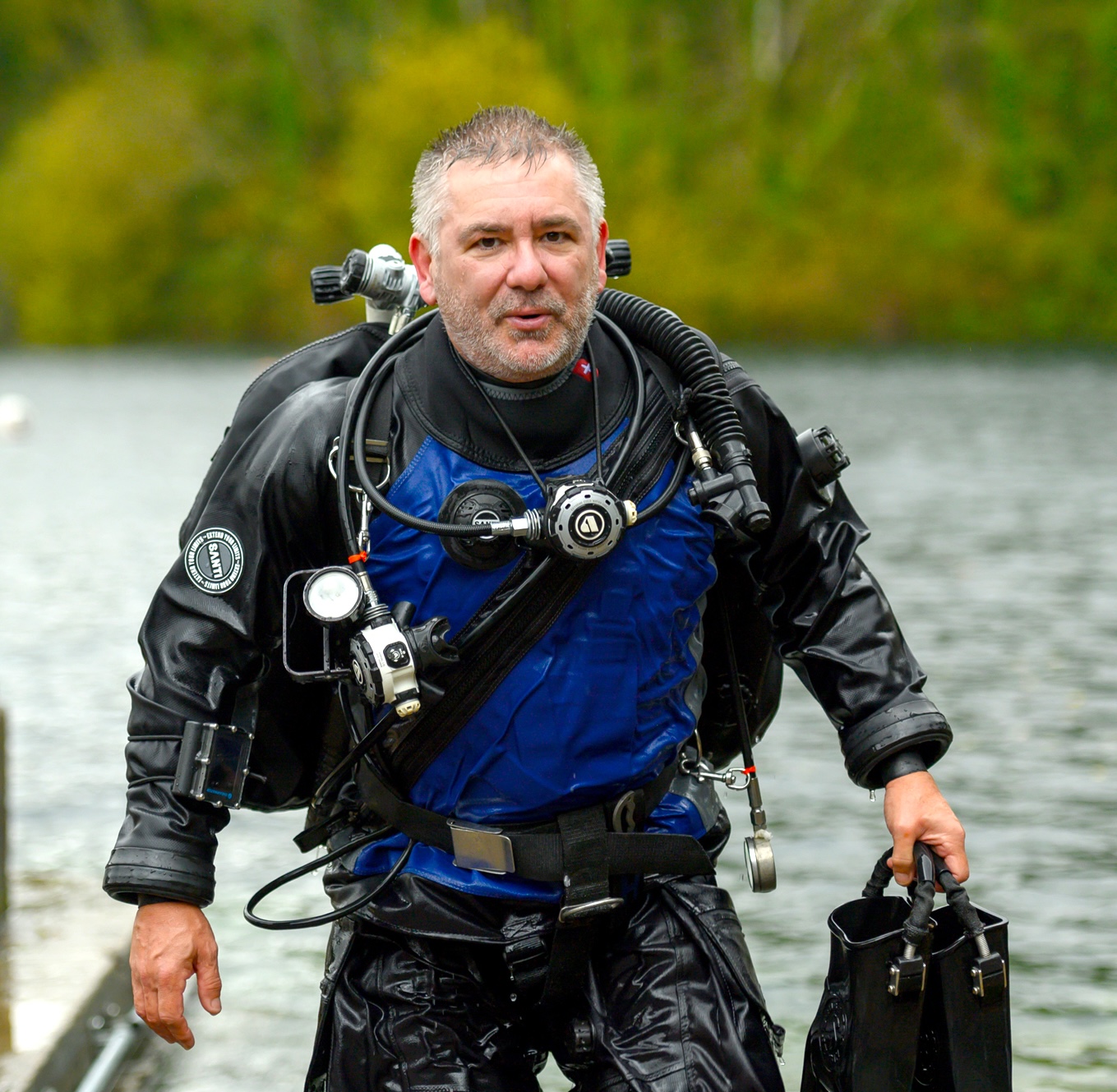
Gareth Lock is the owner of The Human Diver. Along with 12 other instructors, Gareth helps divers and teams improve safety and performance by bringing human factors and just culture into daily practice, so they can be better than yesterday. Through award-winning online and classroom-based learning programmes, we transform how people learn from mistakes, and how they lead, follow and communicate while under pressure. We’ve trained more than 600 people face-to-face and 2500+ online across the globe, and started a movement that encourages curiosity and learning, not judgment and blame.
If you'd like to deepen your diving experience, consider the first step in developing your knowledge and awareness by signing up for free for the HFiD: Essentials class and see what the topic is about. If you're curious and want to get the weekly newsletter, you can sign up here and select 'Newsletter' from the options.
Want to learn more about this article or have questions? Contact us.