

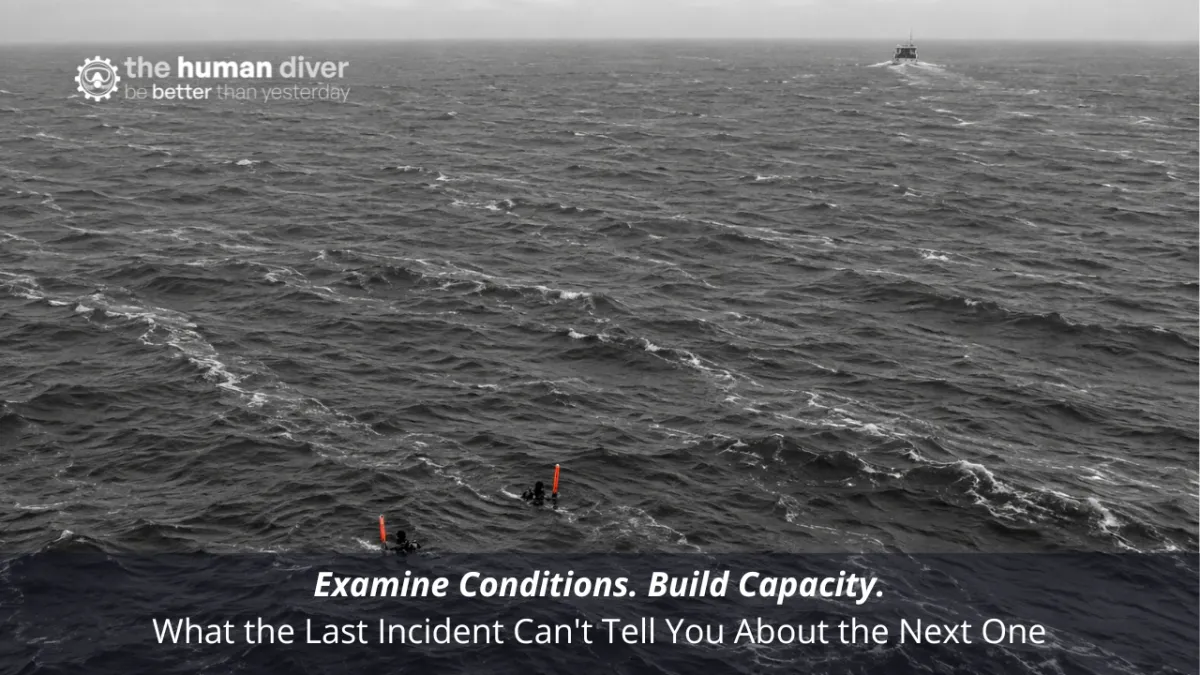
What the Last Incident Can't Tell You About the Next One: Examine Conditions. Build Capacity.
Mike Mason's learning review of the Manta Lodge missing divers along with his short videos have received a lot of attention, and I'm really pleased about that. Two divers spent almost 24 hours in the water off North Stradbroke Island (Australia), and Mike's write-up is exactly the sort of thing we need more of in diving. More recently, there was a comment that deserves a more comprehensive answer than can be given as part of an inline post - someone asked shouldn’t we identify specific preventive measures based on the event in question if we want to prevent future diving incidents/accidents?
I get why people ask that, because it's how most of us have been taught to think about accidents. You find the broken bit and you fix it - Mike's review does include such specific measures.
Carrying an electronic locator alongside your visual signalling kit
Agreeing in advance when the bags go up.
Carrying a larger DSMB with marker dye,
Adding extra controls as the weather worsens (a smaller group size or an extra person on surface cover).
The issue is the assumption that such focused interventions are enough. If Dan and Stu had carried their InReach units, they'd probably have been found within a few hours. That would have been a much better outcome, but the next team to get into trouble offshore will probably have their InReach with them. They'll get caught out by something else, and then we'll write another list.

Recurring conditions
Mark Taylor, a safety science researcher, has just had a paper accepted in Safety.Science called Signals Before the Sirens. He went through 29 major incidents between 1980 and 2025, from Bhopal and Piper Alpha to Grenfell and the Titan submersible, and looked at what the organisations were like before things went wrong. The industries and the technology changed each time, and yet the same conditions kept showing up. He grouped them into seven 'failure archetypes': drift into danger, invisible trade-offs, suppressed challenge, fragile controls, fragmented responsibility, failure to learn and poor risk imagination.
His core argument is one I've been making for years, just using different words. You can't predict the specific event, because it comes out of lots of small things interacting on a particular day – safe outcomes and adverse events emerge from the conditions and context present. However, what you can do is recognise the conditions that make an event more likely, because these turn up again and again. I recently wrote a blog about 50 words to describe successful and ‘failed’ outcomes in diving. These are all those things that influence performance, positively and negatively.
Taylor is clear about the limits of his research. He's looking back at events that have already happened, and he's relying on investigation reports, which are someone's interpretation of what happened rather than a neutral record of it. We talk about this during the LFEO course - cause is something we build after the event, and where an investigation stops usually tells you where a fix was available. Even if we can’t fix things, we can recognise the patterns and head the issue off at the pass.
Given that learning can happen when we combine two different pieces of information, I decided to go back to Mike's review again with Taylor's list next to it.
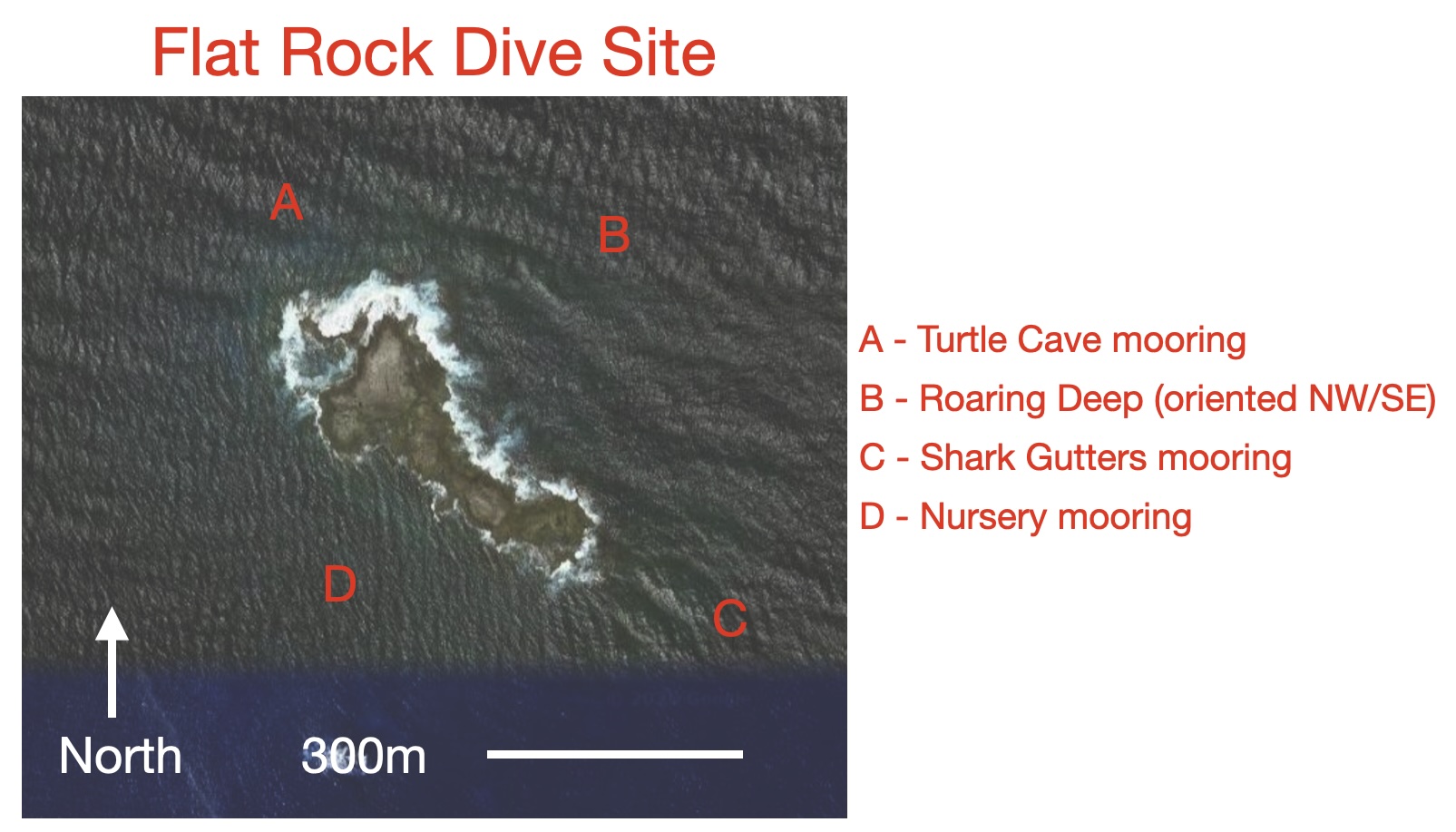
Flat Rock through Taylor's lens
Both divers owned InReach units but neither took one. Stu had a new drysuit and hadn't worked out a tidy way to mount his, and he was already taking on a lot of new kit and procedures on his XR technical diving course. Dan had seen InReach units flood when he'd tried attaching them to DSMBs. They both left them behind to keep the dive simple. That's what Taylor describes as an invisible trade-off, where something protective gets given up because it makes sense locally, and nobody can see the cost at the time. Neither of them thought they were adding risk. I am pretty sure they’d say they were reducing it.
Then look at the signalling kit. Between them they had dSMBs, torches and a mirror, and they were still incredibly hard to spot from the boats and from the aircraft flying over them. Dan's dye pack normally lives in his drysuit pocket, but the suit had just come back from its annual service, and the pack hadn't gone back in. Taylor calls this fragile controls. The safeguard is there on paper, and in our heads, but it's much weaker in the real world than we assumed. It was the most common dominant condition in his study, showing up strongly in 27 of the 29 incidents. If we looked deeply at diving incidents with a HF/systems lens, I reckon we’d have similar figures.
The DSMB timing is a really interesting one from a non-technical skills perspective. Tyler's brief was that if the divers got swept off the reef, bags should go up from the bottom so the boat could track them early. Dan, in the water and feeling the current, was worried that shooting a bag at depth could drag him up during his deco, so he waited until six metres. Both were reasonable decisions that were simply protecting against different hazards. The words "deploy immediately if you get separated" meant one thing to the person giving the brief and something else to the person acting on it, and nobody knew about that difference until the point in time when it really made a difference.
Then there's the belief that two divers with bright bags and torches would be found quickly. Almost everyone had that mental model, including the searchers early on. Taylor calls that poor risk imagination – not meant as a disparaging term. How many of us have ever thought about what we look like from a jet at a few thousand feet? It isn't something I’d really considered before reading Mike's review.
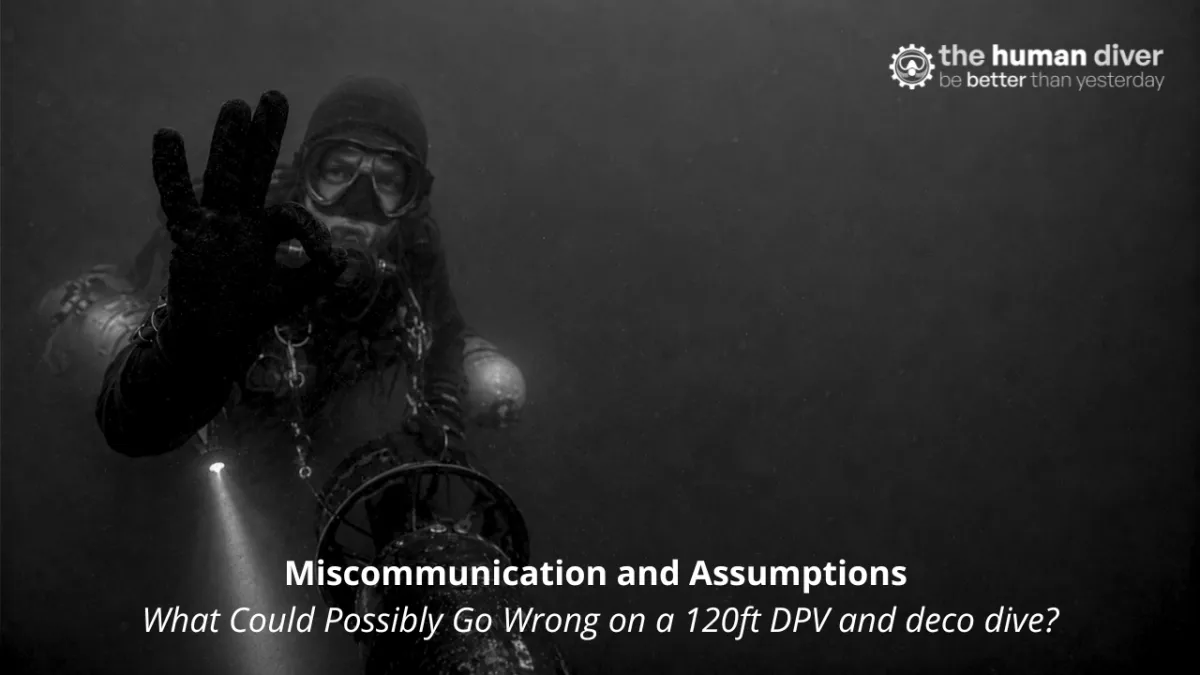
Same shape, different dive
Back in August I shared a report about a diver's 500th dive, on a wreck at 120 ft. It was their first time on a DPV, the vis was down to five feet, and the permanent line had been cut in exactly the places a teammate had warned about. While it looks nothing like Flat Rock, the socio-technical conditions underneath are very similar.
There were two clear warnings before the dive. The first was to do some DPV training dives beforehand, and the second was to take reels because the lines had been cut. Each one was heard, and each was discounted on its own. One diver asked, "am I ready?" as a request for permission, and the other heard it as an invitation to self-assess. Rock bottom/minimum gas had been worked out but never briefed as a shared trigger, so the same number on the gauge meant 'we go up now' to one diver and 'we're fine' to the other. In the silt-out, "are you OK?" got the automatic OK from someone who wasn't.
That's suppressed challenge – we might call it authority gradient or a lack of psychological safety. Taylor puts it in its own group, which he calls challenge dynamics, and it was the least common dominant condition in his study, at only seven incidents out of 29. Importantly, he's clear that this doesn't make it less serious or not something we should pay attention to, and I agree with him. There are so many stories being shared on the THD Facebook page following the recent posts on Just Culture and Psychological Safety that shows there is an issue here. Without challenge, the hidden problems remain invisible to the people who could do something about them. The warnings were given on that DPV dive, but nothing in how the team worked together made them stick.
Weak signals don't feel like warnings
Each of the following is a weak signal at Flat Rock.
People said afterwards that the current was strong but not the strongest they'd dived in.
The day sat in that grey area where being cautious felt right and cancelling felt like overkill.
On the ascent, Stu picked up a bit of urgency from Dan that wasn't stated in the plan.
They surfaced about ten minutes before the surface support team expected them to do so, with the other pair still below.
A drysuit had just come back from a service.
Every one of those is normal, and you'll have had versions of all of them on dives that finished with a brew and a laugh on the boat. The signals remain the same strength, it is the noise around them that we have to surpress.
Barry Turner called this the incubation period back in 1978. It's the stretch of time when warning signs build up but nobody sees them as warnings. Diane Vaughan found the same thing at NASA, where O-ring erosion was accepted flight after flight because each shuttle came back. In diving it's the dive that went fine. Each time a small deviation ends well, we trust it a bit more, and that important signal gets lost in the noise.
This is why I bang on about outcome bias. Mike makes the point in his review that we judge dives by how they ended rather than by the decisions made along the way. A near miss that ends well gets filed as a good dive. Whatever signals were there get lost, and the next team (or even the same team) doesn't get to learn from them because they aren’t talked about.
Back to the original question
Yes, identify the specific measures. Carry a locator without making it your only option, and agree exactly when and where the bags go up before you get in the water. Those close the gaps this particular event showed us. However, they can't close the gaps the next event will find, because we don't know where they are yet! That doesn’t mean we take a fatalistic approach, but rather develop capacity and resilience to deal with things that might go wrong.
Taylor separates the conditions that create risk from the ability of a team or organisation to spot that risk, make sense of it and respond while it's building – what I’d call resilient performance. That second part is something we can train, and it doesn't need us to know exactly what the next incident will look like.
For me it starts with debriefing normal dives, not just the training dives or the ones that went wrong. Nearly all the weak signals at Flat Rock would have come out in a structured debrief of a dive that ended well. I hold myself to this too. The Human Diver has ten instructors around the world, and I know there are silences out there. As such, I work quite hard at talking about my own mistakes, weaknesses, and issues so that some of theirs come back to me. You can’t expect your team to be vulnerable if you’re not going to role model it yourself.
It also comes down to the questions we ask.
"Are you OK to dive?" gets a yes.
"What do you think about the conditions today?" starts a conversation, and that's where the feelings around the messy grey-area finally get aired.
Ask the team what's most likely to go wrong at this site, and what's the worst thing that could credibly happen. Someone will have thought of something you haven't. After a dive where you changed the plan, ask how much you adapted and what that says about your kit or your procedures. And when something about your normal setup has changed, like a service or a new suit, build it back up deliberately and check it, rather than letting habit fill the gap. Easy to say in hindsight, but we are now using that hindsight to improve future decisions when we reflect and take action.
Telling people to be more vigilant doesn't work. What does work is a team where noticing things is normal and saying "I'm not sure about this" doesn't cost you anything socially. That's what psychological safety and good teamwork look like on a boat, and you have to build it before the day you need it.
Yes, learn the specific lessons, but don’t just stop there. If we fix the part that failed and call it done, the conditions that produced it are still sitting there for the next grey-area day. This isn’t just a dive and diver thing, it is also something for dive centres and training agencies to consider.
Reflective question for you... what have you noticed on a dive that ended well, and did you tell anyone?


